
Agricultural Wastewater Treatment: Methods and Best Practices
Introduction
Designing systems for Agricultural Wastewater Treatment: Methods and Best Practices represents one of the most formidable challenges in the environmental engineering sector. Unlike municipal sewage, which typically presents with Biochemical Oxygen Demand (BOD) in the hundreds of milligrams per liter (mg/L), agricultural effluents—from Concentrated Animal Feeding Operations (CAFOs) to meat processing plants—routinely exhibit BOD and Chemical Oxygen Demand (COD) in the tens of thousands of mg/L. Furthermore, the extreme variability in Total Suspended Solids (TSS), fats, oils, and greases (FOG), and nutrient loads (nitrogen and phosphorus) makes copy-paste municipal designs catastrophic in agricultural settings. A frequent and costly specification mistake is underestimating the buffering capacity required for high-ammonia waste streams or failing to adequately screen massive influxes of fibrous solids, leading to premature pump failures and biologically “sour” digesters.
The scope of Agricultural Wastewater Treatment: Methods and Best Practices is incredibly broad, encompassing diverse waste streams, physical-chemical unit operations, high-rate biological processes, and passive natural systems. Engineers must navigate overlapping jurisdictions, including EPA NPDES CAFO regulations and local Natural Resources Conservation Service (NRCS) guidelines. Proper understanding of this landscape is vital because over-engineering leads to insurmountable capital and operational expenditures (CAPEX/OPEX) that erode agricultural margins, while under-engineering results in severe environmental degradation, permit violations, and catastrophic lagoon overflows.
This pillar page provides a comprehensive, engineer-focused breakdown of the entire agricultural wastewater treatment landscape. It details the various waste streams, mechanical separation technologies, biological treatment methodologies, and resource recovery systems. By exploring decision frameworks, lifecycle costs, design parameters, and common troubleshooting scenarios, this guide serves as the definitive hub for public works decision-makers, plant directors, and design engineers tasked with specifying robust, code-compliant agricultural wastewater infrastructure.
Subcategory Landscape — Types, Technologies & Approaches
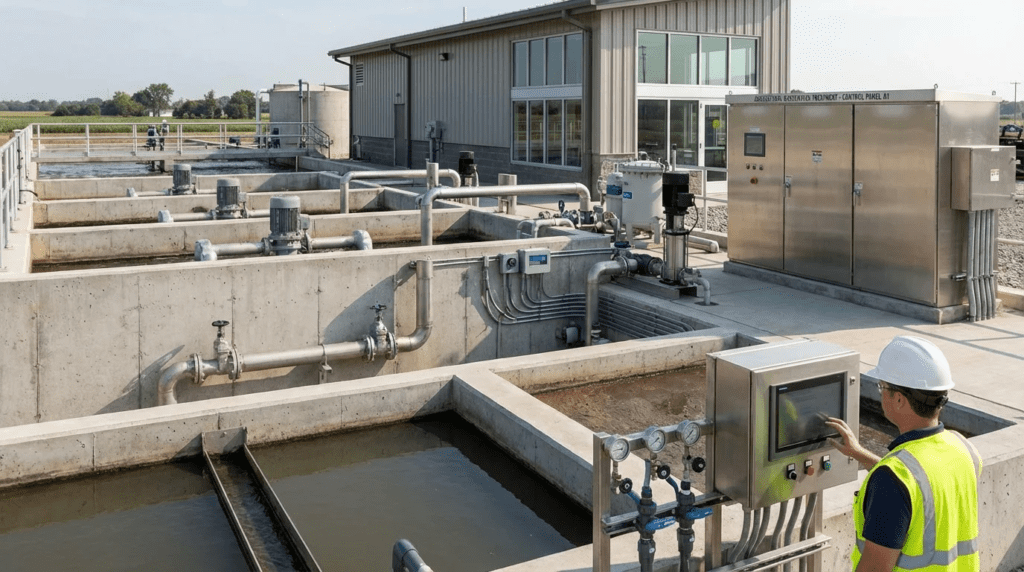
The agricultural wastewater sector cannot be treated as a monolith; it is highly segmented by the source of the waste and the specific unit operations used to treat it. Engineers must conceptualize these subcategories not as competing products, but as links in a treatment train. Typical configurations begin with source-specific waste characterization, followed by physical/mechanical primary treatment, biological secondary treatment, and ultimately, nutrient recovery or safe environmental discharge/land application. The following subsections detail the major components that make up this diverse landscape.
Waste Stream Profiles
Dairy Wastewater Treatment
This subcategory encompasses effluents generated from milking parlors, holding areas, and milk processing facilities. It is characterized by high concentrations of fibrous solids (from undigested roughage), significant milk fat content (FOG), and massive volumes of washwater containing sanitizing chemicals (chlorine, iodine, acid/alkali cleaners). Typical BOD ranges from 2,000 to 5,000 mg/L, with TSS heavily dependent on whether flush or scrape manure management is utilized. Because of the high fiber content, Dairy Wastewater Treatment heavily relies on robust primary mechanical separation (often using inclined screens or screw presses) before biological treatment. A critical selection factor is managing the pH swings caused by Clean-In-Place (CIP) chemicals, which can inhibit subsequent biological processes if not adequately equalized.
Swine Wastewater Treatment
Swine waste differs significantly from dairy waste due to a lower fiber content but vastly higher concentrations of ammonia-nitrogen and dissolved organics. Swine wastewater often presents a COD of 20,000 to 60,000 mg/L and Total Kjeldahl Nitrogen (TKN) exceeding 2,000 mg/L. Swine Wastewater Treatment is typically applied at large-scale CAFOs where odor control and nutrient management are the primary drivers. The very high ammonia levels can become toxic to anaerobic methanogens; therefore, careful dilution, advanced nitrogen removal processes (such as nitrification/denitrification in SBRs), or covered anaerobic lagoons are required. Engineers must also account for high levels of heavy metals (like copper and zinc) used as feed additives, which accumulate in the sludge.
Poultry Processing Wastewater Treatment
This subcategory covers the effluent from abattoirs, slaughterhouses, and meatpacking facilities, rather than raw litter. It is notorious for exceptionally high FOG, blood, feathers, and grit. The COD can range from 3,000 to 10,000+ mg/L, and the wastewater is highly putrescible, generating severe odors if not treated immediately. Poultry Processing Wastewater Treatment almost universally requires Dissolved Air Flotation (DAF) combined with chemical coagulation/flocculation to strip the blood and fats prior to secondary biological steps. The critical specification consideration here is screening; failure to utilize sub-millimeter wedgewire screens for feather removal will quickly foul downstream pumps and aeration diffusers.
Aquaculture Effluent Management
As Recirculating Aquaculture Systems (RAS) and high-density fish farms proliferate, managing their effluent has become a distinct discipline. Fish farm wastewater is characterized by high volumes but relatively dilute concentrations of BOD (often <100 mg/L) alongside problematic levels of un-ionized ammonia and fine suspended solids (uneaten feed and feces). Aquaculture Effluent Management heavily utilizes microscreen drum filters (typically 40-100 micron mesh) and moving bed biofilm reactors (MBBR) for rapid, compact nitrification. The primary engineering challenge is the sheer flow rate compared to the relatively low contaminant concentration, making high-headloss filtration systems economically unviable.
Physical & Mechanical Primary Treatment
Agricultural Mechanical Screening
Screening is the indispensable first line of defense in almost all agricultural treatment trains. This equipment includes rotary drum screens, static inclined (run-down) screens, and screw press separators. By mechanically separating large solids from the liquid stream, engineers can instantly remove 15-30% of the BOD and up to 50% of the TSS. Agricultural Mechanical Screening is utilized immediately post-collection, often sizing wedgewire openings between 0.5 mm and 3.0 mm depending on the waste type (e.g., larger for dairy roughage, finer for poultry). Key selection factors include the trade-off between blinding/maintenance frequency and capture rate; self-cleaning rotary screens with internal spray bars are standard best practice to prevent blinding from fats and biofilms.
Agricultural Dissolved Air Flotation (DAF)
DAF systems utilize micro-bubbles (typically 30-50 microns) generated by releasing pressurized water into an open tank, which adhere to suspended solids and FOG, floating them to the surface for mechanical skimming. Agricultural Dissolved Air Flotation (DAF) is predominantly used in poultry, meatpacking, and dairy processing where fat and protein removal is critical. When paired with proper coagulants (e.g., ferric chloride or alum) and polymer flocculants, DAF can achieve 90%+ TSS and FOG removal, drastically reducing the load on downstream biological systems. Engineers must carefully specify the Air-to-Solids (A/S) ratio and the recycle pressurization rate (typically 15-30% of forward flow), balancing energy consumption against clarification performance.
Biological Treatment Technologies
Agricultural Anaerobic Digestion
This process utilizes complex microbial consortia in the absence of oxygen to break down high-strength organic waste, converting COD into biogas (methane and carbon dioxide). Configurations range from basic ambient-temperature covered lagoons to highly engineered mesophilic (35°C) or thermophilic (55°C) completely mixed tank reactors (CSTR). Agricultural Anaerobic Digestion is ideal for high-strength swine and dairy waste where the organic loading rate (OLR) is high enough (often 2 to 6 kg COD/m³/day) to yield economically viable biogas quantities. The major advantage is the simultaneous reduction of waste strength and generation of renewable energy. However, capital costs are high, and the system requires skilled operation to prevent acidification (sour digesters) from volatile fatty acid (VFA) accumulation.
Agricultural Aerated Lagoons
Aerated lagoons are large earthen basins equipped with mechanical surface aerators or subsurface diffusers that supply oxygen to heterotrophic bacteria, which oxidize organic matter. Agricultural Aerated Lagoons are widely used due to their low capital cost, operational simplicity, and ability to handle large flow variations typical of farm washdown cycles. They typically require an HRT (Hydraulic Retention Time) of 5 to 30 days. While highly resilient, they require massive land footprints and are highly susceptible to cold weather, which drastically reduces biological kinetics. Furthermore, proper specification of aerator horsepower (typically requiring 1.2 to 2.0 lbs O2 per lb of BOD applied) is critical to prevent the lagoon from turning anaerobic and generating severe odor complaints.
Sequencing Batch Reactors (SBR) for Agriculture
An SBR is a fill-and-draw activated sludge system where equalization, aeration, settling, and decanting all occur sequentially in a single reactor tank. Sequencing Batch Reactors (SBR) for Agriculture are increasingly specified for high-strength agro-industrial effluents (like food processing or intensive swine operations) where strict discharge limits on total nitrogen and phosphorus apply. SBRs allow engineers to easily manipulate aerobic and anoxic phases via PLC timing, achieving excellent nitrification and denitrification. While they offer a much smaller footprint than lagoons and higher effluent quality, they require sophisticated instrumentation (DO and ORP sensors), automated valving, and highly trained operators.
Advanced Treatment & Passive/Recovery Systems
Agricultural Constructed Wetlands
These engineered systems utilize wetland vegetation, soils, and their associated microbial assemblages to treat wastewater via physical filtration, biological uptake, and chemical transformation. Types include Free Water Surface (FWS) and Subsurface Flow (SSF) wetlands. Agricultural Constructed Wetlands are best suited as polishing steps for lagoon effluent or for treating dilute runoff (non-point source pollution) from feedlots. Their primary advantage is near-zero energy consumption (OPEX) and high aesthetic/ecological value. However, their limitations include massive footprint requirements, vulnerability to toxic shock loads (e.g., high ammonia), and gradual plugging of SSF media over decades of use.
Agricultural Nutrient Recovery Systems
Rather than merely destroying or venting contaminants, nutrient recovery systems chemically extract valuable nitrogen and phosphorus. The most common technology is struvite (Magnesium Ammonium Phosphate) precipitation, achieved by adding magnesium salts to high-phosphorus/high-ammonia anaerobic digester effluent and elevating the pH. Agricultural Nutrient Recovery Systems are specified in large municipal-ag co-digestion facilities or massive CAFOs facing strict land-application nutrient limits. While these systems convert a nuisance scaling problem (struvite blocking pipes) into a salable fertilizer commodity, the complex chemistry control and high chemical costs currently restrict this subcategory to the largest, well-capitalized operations.
Agricultural Land Application Systems
The final disposal or reuse step for the vast majority of agricultural effluent and biosolids is application onto agricultural land at agronomic rates. This requires precise calculation of crop nutrient uptake, soil permeability, and evapotranspiration rates. Agricultural Land Application Systems utilize center-pivot irrigators, traveling guns, or deep-soil injection rigs (for liquid manure). The critical specification factor here is storage; engineers must design lagoons with enough capacity (often 180 to 200+ days) to store wastewater through the winter or wet seasons when land application is prohibited by CAFO NPDES permits due to runoff risks.
Selection & Specification Framework
Selecting the optimal combination of agricultural wastewater treatment methods requires a rigorous decision framework that balances influent characteristics, discharge limitations, and lifecycle costs. Engineers must not treat these subcategories as isolated choices; rather, they form an interdependent matrix.
Step 1: Waste Characterization and Pretreatment Sizing
The fundamental fork in the decision tree is based on suspended solids. If the waste is high in fibrous solids (dairy), Agricultural Mechanical Screening is non-negotiable. Bypassing this step will doom any subsequent biological system. If the waste stream is high in FOG, blood, or colloidal proteins (poultry processing), engineers must select Agricultural Dissolved Air Flotation (DAF). Mechanical screens alone cannot capture emulsified fats.
Step 2: Selecting the Primary Biological Engine
Once solids are managed, the choice between aerobic and anaerobic processes depends on the BOD/COD concentration and land availability:
- COD > 10,000 mg/L: Agricultural Anaerobic Digestion is highly recommended. The OPEX of aerating waste this strong is financially ruinous. Anaerobic systems turn this high strength into an asset (biogas).
- High Volume / Ample Land: Agricultural Aerated Lagoons represent the lowest CAPEX and easiest O&M, assuming environmental regulations allow open basins and sufficient acreage exists.
- Strict Discharge Limits / Tight Space: If the facility must discharge to a municipal sewer (POTW) or sensitive surface water, Sequencing Batch Reactors (SBR) for Agriculture are required to meet strict nitrogen and BOD limits reliably.
Step 3: Polishing and Disposal
The final decision hinges on the nutrient balance and local regulations. If land application is constrained by phosphorus indexing (a common CAFO issue), engineers must integrate Agricultural Nutrient Recovery Systems. If land is plentiful and local regulations permit, Agricultural Land Application Systems coupled with winter storage remains the most economical terminus.
Lifecycle Cost Trade-offs (CAPEX vs OPEX):
Engineers frequently fall into the specification pitfall of minimizing CAPEX at the cost of catastrophic OPEX. For instance, using high-rate aeration (SBRs) on concentrated swine waste will result in electrical bills that bankrupt the farm. Conversely, passive systems like Agricultural Constructed Wetlands and lagoons have minimal OPEX but require vast tracts of land (high CAPEX if land must be purchased) and extensive permitting.
Comparison Tables
The following tables provide an engineer-level quick reference for navigating the agricultural wastewater landscape. Table 1 directly compares the core technologies across functionality and cost, while Table 2 maps these subcategories to specific real-world farm and industrial applications.
Table 1: Subcategory Technology Comparison
| Type/Technology | Key Features & Mechanism | Best-Fit Applications | Limitations | Relative Cost | Maintenance Profile |
|---|---|---|---|---|---|
| Agricultural Mechanical Screening | Physical barrier (0.5-3mm). Wedgewire or perforated drum/press. | Dairy, roughage removal, initial primary treatment. | Cannot remove dissolved organics or FOG. Blinding risk. | Low CAPEX / Low OPEX | Daily spray bar checks; bearing lubrication. |
| Agricultural Dissolved Air Flotation (DAF) | Micro-bubble attachment floating solids to surface. Uses coagulants. | Poultry, meatpacking, high-FOG streams. | Requires chemical storage/dosing; generates wet sludge. | Medium CAPEX / High OPEX | High; chemical pump calibration, skimmer chain tensioning. |
| Agricultural Anaerobic Digestion | Biological breakdown without oxygen. Produces CH4. | High-strength dairy/swine (COD > 10,000 mg/L). | Slow start-up; sensitive to pH/temp shocks; high capital. | High CAPEX / Med OPEX (Offset by biogas) | Moderate; strict monitoring of VFA/Alkalinity ratio. |
| Sequencing Batch Reactors (SBR) for Agriculture | Time-based activated sludge. Single tank for all phases. | Agro-industrial processing requiring strict municipal discharge compliance. | Complex automation; high aeration energy costs. | High CAPEX / High OPEX | High; instrumentation calibration, blower maintenance. |
| Agricultural Aerated Lagoons | Earthen basins with surface/sub-surface aeration. | Dilute washwater, large farms with ample land. | Large footprint; cold weather impacts kinetics; sludge build-up. | Low CAPEX / Med OPEX | Low; seasonal aerator maintenance, decadal dredging. |
| Agricultural Constructed Wetlands | Phyto-remediation and passive biological filtration. | Dilute runoff, post-lagoon polishing. | Massive land requirement; vulnerable to high ammonia. | Med CAPEX / Ultra-Low OPEX | Low; vegetation harvesting, inlet/outlet clearing. |
Table 2: Application Fit Matrix
| Application Scenario | Primary Subcategory Fit | Key Engineering Constraints | Operator Skill Required |
|---|---|---|---|
| Large Swine CAFO (5,000+ head) | Agricultural Anaerobic Digestion + Agricultural Land Application Systems | High ammonia toxicity; strict nutrient management plans for land application. | Moderate to High (for Digester) |
| Poultry Processing / Abattoir | Agricultural Mechanical Screening + Agricultural Dissolved Air Flotation (DAF) | Rapid treatment needed for putrescible waste; sub-millimeter screening for feathers. | High (Chemical dosing and DAF tuning) |
| Mid-Size Dairy (Flush System) | Agricultural Mechanical Screening + Agricultural Aerated Lagoons | Handling massive sand/grit accumulation; separating large fiber before lagoons. | Low |
| High-Density RAS Aquaculture | Drum Screening + MBBR + Agricultural Constructed Wetlands (Polishing) | Extremely high flow rates with dilute contaminants; zero tolerance for un-ionized ammonia. | Moderate |
Engineer & Operator Field Notes
Theoretical knowledge of biological kinetics must be paired with practical field execution. The following field notes bridge the gap between process design and real-world plant operation, highlighting critical nuances across subcategories.
Commissioning Considerations
Commissioning an agricultural wastewater plant differs wildly depending on the biology. For Agricultural Anaerobic Digestion, start-up is notoriously precarious. Digesters must be “seeded” with active sludge from an existing mesophilic digester (typically at 10-20% of the reactor volume). Engineers must limit the initial Organic Loading Rate (OLR) to roughly 0.5 kg COD/m³/day, slowly ramping up over 60-90 days to prevent methanogen washout. Conversely, commissioning Agricultural Dissolved Air Flotation (DAF) systems is a mechanical and chemical exercise. The immediate focus is optimizing the whitewater (micro-bubble) saturation pressure (typically 60-80 psi) and conducting jar testing to find the exact polymer dose curve—which will change dynamically with production shifts in meatpacking plants.
Never size Sequencing Batch Reactors (SBR) for Agriculture or Agricultural DAF units based on a 24-hour average flow. Agricultural and food-processing facilities generate massive hydraulic and chemical spikes during the 3rd-shift CIP (Clean-in-Place) washdown. Always design a robust equalization (EQ) tank capable of holding at least 30-40% of the daily flow to buffer these surges.
Common Specification Mistakes
A frequent error is misjudging the physical debris in the waste stream. For example, specifying a standard non-clog centrifugal pump prior to Agricultural Mechanical Screening in a dairy application guarantees failure; long fibrous roughage will “rope” around impellers. Chopper pumps or progressing cavity pumps must be used for unscreened manure. Another classic mistake is ignoring grit. If a dairy uses sand bedding, standard Agricultural Aerated Lagoons will quickly lose volumetric capacity as the heavy sand settles out, bypassing biological treatment entirely. In these cases, dedicated hydro-cyclone sand separators are required prior to biological treatment.
Operations & Maintenance Comparison
The O&M burden shifts dramatically depending on technology. Passive systems like Agricultural Constructed Wetlands require primarily horticultural maintenance—harvesting biomass to permanently remove stored phosphorus and managing vector (mosquito) control. In contrast, mechanical systems demand daily attention. Agricultural Dissolved Air Flotation (DAF) operators must constantly monitor sludge blanket thickness and adjust skimmer speeds. If the sludge is skimmed too fast, it contains excess water, multiplying disposal costs; if skimmed too slow, the sludge can turn septic and sink, ruining effluent quality.
The most common failure in Agricultural Anaerobic Digestion is allowing the Volatile Fatty Acid (VFA) to Alkalinity ratio to exceed 0.3. When high-carbohydrate waste is fed too quickly, acid-forming bacteria outpace the methane-formers. The pH plummets, biological activity ceases, and the digester “sours.” Remediation requires halting all feeding and bulk-dosing sodium bicarbonate—a highly expensive operational failure.
Troubleshooting Matrix
- Lagoon Turnover/Odor: If Agricultural Aerated Lagoons suddenly release overwhelming hydrogen sulfide odors, it often indicates spring “turnover” (thermal inversion) or failed surface aerators. Root cause: Insufficient DO mixing depth. Fix: Introduce supplemental hydrogen peroxide for immediate odor control and repair aerator draft tubes.
- DAF “Pin Floc” Carryover: When tiny solids escape the Agricultural Dissolved Air Flotation (DAF) weir. Root cause: Over-shearing in the flocculation tube or incorrect polymer charge. Fix: Reduce mixer RPM or switch from a high-charge to a medium-charge cationic polymer.
- Struvite Scaling: Hard, rock-like buildup in pipes exiting anaerobic digesters. Root cause: Unintended crystallization of magnesium, ammonia, and phosphate. Fix: Install controlled Agricultural Nutrient Recovery Systems to precipitate the struvite intentionally inside a reactor rather than inside the piping network.
Design Details & Standards
Robust agricultural wastewater engineering relies on strict adherence to established design parameters and regulatory codes. Engineers must navigate the intersection of EPA effluent limits and NRCS practice standards.
Sizing Methodology Overview
Volumetric sizing across biological subcategories is dictated by organic loading rates (OLR) and retention times.
For Agricultural Aerated Lagoons, the typical BOD volumetric loading rate is restricted to 1.0 to 2.5 lb BOD/1,000 ft³/day to prevent anaerobic conditions from prevailing.
In contrast, high-rate Sequencing Batch Reactors (SBR) for Agriculture can handle F/M (Food to Microorganism) ratios of 0.1 to 0.3 lb BOD / lb MLVSS / day.
For Agricultural Constructed Wetlands, sizing is based on hydraulic loading rates (HLR), often 1 to 5 cm/day, combined with first-order kinetic decay models (k-rates) specific to the target contaminant (BOD, Nitrogen, or TSS).
Key Design Parameters by Subcategory
- Agricultural Anaerobic Digestion: Design HRT is typically 20-30 days for mesophilic complete-mix reactors processing dairy manure. The expected biogas yield is approximately 0.25 to 0.35 cubic meters of methane (CH4) per kilogram of COD destroyed.
- Agricultural Dissolved Air Flotation (DAF): The critical design parameter is the hydraulic surface loading rate, typically engineered between 2.0 and 4.0 gpm/ft². The recycle ratio should be capable of providing 8-10 grams of air per kilogram of incoming solids.
- Agricultural Land Application Systems: Sizing the winter storage lagoon is dictated by local climate data. For northern CAFOs, engineers must design for up to 210 days of storage to accommodate frozen ground conditions, adhering strictly to the farm’s Comprehensive Nutrient Management Plan (CNMP).
Applicable Standards & Compliance
Unlike municipal plants driven entirely by EPA/NPDES and Ten States Standards, agricultural systems fall heavily under the purview of the USDA Natural Resources Conservation Service (NRCS). Key engineering standards include:
NRCS Practice Standard 313 (Waste Storage Facility): Dictates the structural design, soil permeability (liner requirements, often 1×10⁻⁷ cm/sec), and freeboard requirements for lagoons to prevent 25-year/24-hour storm overflows.
NRCS Practice Standard 366 (Anaerobic Digester): Provides foundational guidelines for the structural, thermal, and hydraulic design of farm-scale biogas systems.
EPA CAFO Rule: Defines which facilities qualify as Concentrated Animal Feeding Operations and requires zero-discharge of manure or process wastewater to surface waters (except during extreme precipitation events).
Specification Checklist
When drafting bid documents for agricultural wastewater projects, engineers should include:
- Waste Characterization Profile: Min/Max/Avg values for Flow, BOD, COD, TSS, TKN, TP, pH, and Temperature.
- Screening Tolerance: Strict definition of acceptable bypass solids size for Agricultural Mechanical Screening.
- Corrosion Resistance: Mandatory use of 316SS or duplex stainless steel for any equipment exposed to high-H2S environments (e.g., inside anaerobic digesters or lift stations).
- Winterization: Traced/insulated piping and enclosed housings for chemical dosing systems attached to DAFs or SBRs.
FAQ Section
What are the different types of agricultural wastewater treatment?
The field is divided by waste source (Dairy Wastewater Treatment, Swine Wastewater Treatment, Poultry Processing Wastewater Treatment, and Aquaculture Effluent Management). Treatment mechanisms include physical separation (Agricultural Mechanical Screening, Agricultural Dissolved Air Flotation (DAF)), biological processes (Agricultural Anaerobic Digestion, Agricultural Aerated Lagoons, Sequencing Batch Reactors (SBR) for Agriculture, Agricultural Constructed Wetlands), and final disposition (Agricultural Nutrient Recovery Systems, Agricultural Land Application Systems).
How do you choose between an Aerated Lagoon and an SBR?
The choice between Agricultural Aerated Lagoons and Sequencing Batch Reactors (SBR) for Agriculture comes down to space, effluent requirements, and budget. Lagoons are ideal when land is cheap, the climate is temperate, and effluent is used for irrigation. SBRs are required when land is severely restricted, or the facility must meet strict municipal/POTW discharge limits for nitrogen and high BOD reduction in a tiny footprint.
What is the most cost-effective treatment for small to mid-sized dairy farms?
For moderate operations, the most cost-effective and reliable approach is pairing robust Agricultural Mechanical Screening (like an inclined static screen) to capture roughage, followed by Agricultural Aerated Lagoons for liquid storage and BOD reduction, culminating in Agricultural Land Application Systems to utilize the nutrient value on surrounding cropland.
Why do anaerobic digesters fail in agricultural settings?
The primary cause of failure in Agricultural Anaerobic Digestion is biological souring due to organic overloading, which causes rapid VFA accumulation and pH drop. Secondary causes include severe grit/sand accumulation reducing active reactor volume, and ammonia toxicity commonly seen when improperly diluting high-strength swine waste.
How do you optimize a DAF system for meatpacking wastewater?
Optimizing Agricultural Dissolved Air Flotation (DAF) involves continuous jar testing to adjust coagulant (ferric/alum) and polymer dosing as the washdown chemistry changes. Mechanically, operators must verify the recycle pump is maintaining 60-80 psi for optimal micro-bubble formation and adjust the surface skimmer speed to maximize sludge dryness (typically 15-25% dry solids) without losing floc down the weir.
Can wetlands handle raw agricultural wastewater?
No. Agricultural Constructed Wetlands should never be used for raw, high-strength agricultural effluent. They function effectively only as a secondary or tertiary polishing step. Raw effluent will rapidly blind the gravel media in subsurface flow wetlands and create highly toxic, anoxic zones that kill the wetland flora.
Conclusion
KEY TAKEAWAYS: Specification & Implementation
- Characterize Accurately: Agricultural wastewater has COD and TSS levels routinely 10x-50x higher than municipal sewage; never use municipal sizing parameters without scaling for high-strength organic loads.
- Screen Early and Often: Implement robust Agricultural Mechanical Screening as the first step for dairy/swine, and Agricultural Dissolved Air Flotation (DAF) for high-FOG poultry/abattoir streams.
- Anaerobic for High Strength: Use Agricultural Anaerobic Digestion when COD > 10,000 mg/L to minimize aeration OPEX and capture biogas.
- Understand Land Constraints: Specify Agricultural Aerated Lagoons and Agricultural Constructed Wetlands only when expansive footprint and long HRT are feasible.
- Buffer Surges: Always design 30-40% volume Equalization (EQ) tanks to protect Sequencing Batch Reactors (SBR) for Agriculture from washdown chemical and hydraulic shock loads.
- Nutrient Endgame: Design with the final discharge in mind—whether utilizing Agricultural Nutrient Recovery Systems to export struvite, or sizing winter storage for Agricultural Land Application Systems.
Mastering Agricultural Wastewater Treatment: Methods and Best Practices requires abandoning the “one-size-fits-all” mentality. The physical, biological, and chemical diversity of agricultural waste demands a modular approach to system design. Engineers must meticulously evaluate the specific industrial source—be it fibrous dairy manure, high-ammonia swine slurry, or high-FOG meatpacking effluent—and build a treatment train from the ground up. By starting with aggressive physical separation, intelligently routing organic loads to either high-rate aerobic or energy-recovering anaerobic systems, and carefully navigating NRCS and EPA regulatory frameworks, designers can implement solutions that protect the watershed while maintaining the agricultural facility’s economic viability. Successfully balancing the CAPEX of advanced mechanical systems against the long-term OPEX of biological aeration and sludge disposal remains the hallmark of expert agricultural wastewater engineering.