
Automation
1. Introduction
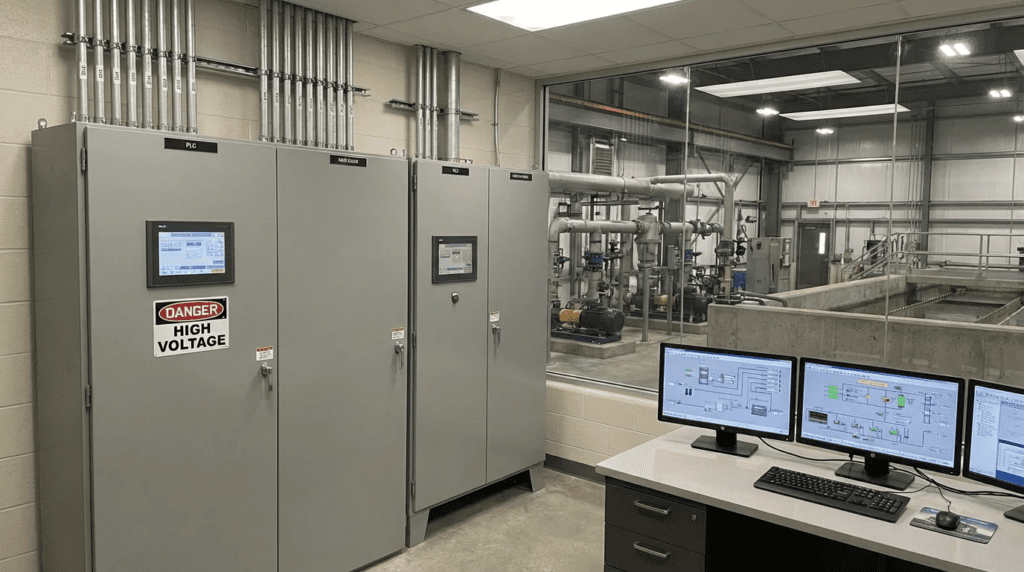
Automation in the municipal water and wastewater sector serves as the central nervous system of critical infrastructure. Unlike discrete manufacturing, where systems function in controlled environments with predictable cycles, water and wastewater automation must contend with geographically dispersed assets, variable biological loading, hydraulic non-linearities, and harsh operating conditions. For consulting engineers, plant managers, and utility superintendents, the specification of control systems is not merely a matter of selecting hardware; it is a strategic decision regarding the long-term operability, data integrity, and regulatory compliance of the utility.
The scope of automation in this sector encompasses three distinct but interconnected layers: the field device layer (instrumentation and actuation), the control layer (Programmable Logic Controllers or PLCs), and the supervisory layer (SCADA and HMI). Furthermore, the successful deployment of these technologies relies heavily on the capabilities of the System Integrator (SI)—the entity responsible for programming, panel fabrication, networking, and commissioning. In an era of increasing cybersecurity threats and tightening environmental regulations, the reliability of these systems is paramount. A failure in a PLC or a breach in the SCADA network does not result in lost production time; it can result in untreated discharge, permit violations, and immediate threats to public health.
Regulatory bodies, including the EPA and state-level environmental agencies, require rigorous data logging and reporting. Modern automation systems must ensure data gaps are nonexistent and that historical data is immutable for compliance auditing. Consequently, the selection of Original Equipment Manufacturers (OEMs) for hardware and software, alongside the selection of qualified System Integrators, determines the utility’s ability to meet these requirements efficiently. This article provides a technical analysis of the primary platforms and integrators serving the North American municipal market, focusing on engineering specifications, architecture, and lifecycle considerations.
2. How to Select This System or Technology
Selecting an automation platform and an integration partner requires a holistic engineering approach that balances initial capital cost with long-term total cost of ownership (TCO). The lifecycle of automation hardware typically spans 15 to 20 years, while software platforms may require major upgrades every 3 to 5 years. Engineers must evaluate systems based on open architecture, protocol support, redundancy, and local support availability.
Functional Role in the Plant and Network
The control system must support two distinct operational modes: local process control and wide-area telemetry. Within the plant fence line (Inside the Fence), high-speed Ethernet backbones (EtherNet/IP, PROFINET, Modbus TCP) are standard, requiring PLCs with high processing power to handle PID loops for aeration, dosing, and pumping. For distribution and collection systems (Outside the Fence), the architecture shifts to Remote Telemetry Units (RTUs) utilizing radio, cellular, or fiber backbones. The selected platform must seamlessly bridge these environments, handling store-and-forward data buffering to prevent data loss during communication outages.
Reliability and Redundancy Considerations
For mission-critical processes such as UV disinfection, membrane filtration, or raw sewage pumping, hardware redundancy is an engineering necessity, not an option. Specifications should define the level of redundancy required:
- Hot Standby PLCs: Two processors running in parallel with synchronized data tables. Upon primary failure, the secondary assumes control in less than one scan cycle (typically <50ms), ensuring bumpless transfer.
- Network Redundancy: Utilization of ring topologies (such as Device Level Ring or MRP) to protect against cable cuts or switch failures.
- SCADA Redundancy: Redundant I/O servers located in physically separate locations to ensure visibility is maintained even during a server room fire or power failure.
Integration with Existing Infrastructure
Greenfield projects allow for pure specifications, but most municipal work involves retrofitting or expanding existing systems. The ability of a new PLC or SCADA platform to communicate with legacy hardware is critical. Engineers must determine if the proposed solution supports legacy protocols (e.g., Modbus RTU, DF1, Data Highway Plus) natively or if third-party protocol converters are required. Relying heavily on protocol converters adds points of failure and latency; native support is always preferred.
Cybersecurity and Standards
Following America’s Water Infrastructure Act (AWIA) of 2018, cybersecurity has become a primary design constraint. Automation selection must align with the ISA/IEC 62443 series of standards.
- Hardware: Does the PLC have built-in security features, such as firmware digital signing, physical run/program switches, and the ability to disable unused ports?
- Software: Does the SCADA platform support integration with Active Directory for role-based access control (RBAC)? Does it support encryption for data in transit?
- Architecture: The system design must facilitate a Defense-in-Depth strategy, segmenting the OT network from the IT network via DMZs.
Common Failure Modes and Risks
Engineers should draft specifications to mitigate common risks. “Spaghetti code”—unstructured, undocumented logic—is a primary risk when selecting low-bid integrators. This makes future troubleshooting nearly impossible. Proprietary “black box” code where the utility does not own the source code or password is another significant risk. Specifications must explicitly state that the utility retains all rights to the application source code and that code must adhere to IEC 61131-3 programming standards.
3. Comparison Table
The following table compares major OEMs (Hardware/Software) and System Integrators based on their primary function within the municipal water sector. Engineers should interpret “Openness” as the ease with which third-party hardware or software can interact with the system, and “Focus” as the vendor’s historical strength in specific applications.
| Company | Category / Role | Primary Strengths | System Limitations / Considerations | Best-Fit Application |
|---|---|---|---|---|
| Rockwell Automation (Allen-Bradley) | PLC / Control Platform (OEM) | Ubiquitous North American installed base; extensive local distribution; robust “hot standby” redundancy. | Higher hardware cost; software licensing fees can be significant; steep learning curve for advanced features. | Large-scale regional plants requiring high availability and extensive support networks. |
| Siemens | PLC / Control Platform (OEM) | Global standard; integrated TIA Portal engineering environment; strong cybersecurity features; advanced process instrumentation integration. | Market penetration varies by US region; finding local integrators trained in Siemens can be harder in some rural US areas. | Complex process control; facilities prioritizing integrated safety and security. |
| Schneider Electric | PLC / Control Platform (OEM) | Strong Modbus heritage (Modicon); excellent telemetry and RTU offerings (SCADAPack); open standards focus. | Platform consolidation history can lead to confusion on product lifecycle paths. | Wide-area telemetry networks; SCADAPack applications for remote lift stations. |
| Inductive Automation (Ignition) | SCADA / HMI (OEM) | Server-centric licensing (unlimited tags); modern IT/OT integration (SQL native, Python scripting, MQTT); web-deployed clients. | Newer to the market than legacy players; requires integrators with IT/database proficiency. | Modernizations requiring data analytics, unlimited clients, or heavy database integration. |
| AVEVA (Wonderware) | SCADA / HMI (OEM) | System Platform is highly scalable; object-oriented graphics; massive installed base in large municipalities. | Complex licensing structures; significant resource requirements for development and server hardware. | Enterprise-level utilities managing millions of I/O points across multiple facilities. |
| Tesco Controls | System Integrator / OEM | Specialized in water/wastewater; massive UL panel capacity; proprietary PLC options available alongside standard integration. | Geographic focus has historically been stronger in the Western US. | Full design-build projects requiring custom panel fabrication and complex system integration. |
| Data Flow Systems | System Integrator / OEM | Proprietary “TacPack” wireless telemetry solutions; single-source accountability (hardware + software). | Proprietary hardware can create vendor lock-in compared to open PLC platforms. | Small to mid-sized utilities struggling with radio telemetry reliability or seeking sole-source simplicity. |
4. Top OEMs / System Integrators
This section details the specific capabilities of the entities allowed for specification in this automation category. The list covers three distinct groups: Hardware OEMs (PLCs), Software OEMs (SCADA), and specialized System Integrators.
Automation & Control System Integrators
System Integrators (SIs) are the bridge between raw hardware and operational reality. In the municipal sector, specialized SIs are preferred over generalist industrial integrators due to their familiarity with hydraulic modeling, pump curves, and EPA reporting requirements.
Tesco Controls
Tesco Controls is a prominent integrator and OEM in the water/wastewater industry. Unlike pure software houses, Tesco maintains significant manufacturing capabilities for custom control panels, power distribution equipment, and MCCs. They are unique in offering both vendor-neutral integration (using Rockwell, Siemens, etc.) and their own proprietary control solutions tailored for water applications. Their strength lies in “turnkey” responsibility, handling everything from the electrical service entrance to the SCADA screen.
Data Flow Systems
Data Flow Systems (DFS) focuses heavily on the telemetry aspect of water automation. They are well-regarded for solving difficult radio communication challenges in varied terrains. DFS typically promotes a single-source model, utilizing their own TCP/IP-based SCADA software and “TacPack” RTU hardware. This approach simplifies troubleshooting—there is no finger-pointing between the software vendor and the hardware vendor—but engineers must weigh this against the desire for non-proprietary, open-architecture systems.
Dorsett Technologies
Dorsett Technologies specializes in SCADA systems for municipal, military, and federal government utilities. Their offering often centers on the “InfoScan” SCADA package. They provide comprehensive services including engineering, installation, and long-term service contracts. Their systems are frequently deployed in environments requiring robust remote monitoring capabilities for dispersed assets like lift stations and wells.
Advanced Integration & Controls
Advanced Integration & Controls operates as a dedicated system integrator, focusing on modernizing aging infrastructure. They typically work with open-architecture hardware and are known for handling complex retrofits where maintaining plant operations during the upgrade is critical. Their expertise covers the programming intricacies of complex biological treatment processes and chemical feed pacing.
Primex Controls
Primex Controls delivers widespread integration services and control panel fabrication. They are particularly noted for their “Arc Armor” enclosure solutions and cloud-based monitoring platform, Prime Web. Primex often serves as a bridge for smaller to medium-sized municipalities looking to upgrade from simple dialers or alarms to full-scale SCADA monitoring without the overhead of enterprise-level IT infrastructure.
Control Assemblies
Control Assemblies brings extensive experience in industrial automation that translates to robust municipal solutions. They focus on process automation, panel building, and HMI design. Their approach is often engineering-heavy, focusing on documentation and standards compliance (UL 508A), making them a suitable partner for projects requiring strict adherence to consulting engineering specifications.
PLC & Control Platforms (OEMs Only)
These manufacturers produce the physical controllers (PLCs/PACs) and I/O modules specified in the hardware design.
Rockwell Automation (Allen-Bradley)
Rockwell Automation is the dominant player in the North American municipal market. The ControlLogix and CompactLogix platforms are the de facto standard for many large utilities.
- Engineering Note: The Studio 5000 environment integrates design and configuration. The availability of “Add-On Instructions” (AOIs) for water-specific devices simplifies programming. Support for EtherNet/IP and Device Level Ring (DLR) provides robust network resilience.
Siemens
Siemens offers the SIMATIC S7-1200 and S7-1500 series controllers.
- Engineering Note: Siemens excels in processing power and integrated diagnostics. Their PROFINET protocol is highly deterministic. The TIA (Totally Integrated Automation) Portal combines PLC, HMI, and drive configuration into one database, reducing tag duplication errors.
Schneider Electric
Schneider Electric’s Modicon line is historically significant, having invented the PLC.
- Engineering Note: The Modicon M340 and M580 ePACs are built for Ethernet transparency. Schneider also owns the SCADAPack line (formerly Control Microsystems), which is arguably the industry standard for rugged remote telemetry units (RTUs) in harsh, outdoor environments.
ABB
ABB’s AC500 PLC platform is scalable and highly modular.
- Engineering Note: ABB is particularly strong when the project involves heavy integration with ABB Variable Frequency Drives (VFDs) and power systems. Their High Availability (HA) solutions are robust for critical pump stations.
Emerson
Following acquisitions (including GE Intelligent Platforms), Emerson now offers the PACSystems RX3i.
- Engineering Note: These controllers are common in legacy plants (formerly GE Fanuc). The PROFINET-based high-availability redundancy is a key feature for mission-critical wastewater treatment processes.
SCADA & HMI Platforms (OEMs Only)
These companies provide the supervisory software layer responsible for visualization, alarming, and data historian functions.
AVEVA (Wonderware / System Platform)
Formerly Wonderware, AVEVA System Platform is an industrial object-oriented platform.
- Engineering Note: Ideally suited for large, regional utilities. The “ArchestrA” graphics engine allows for the creation of template-based assets (e.g., a “Pump” object), which can be instantiated hundreds of times, drastically reducing engineering hours for massive systems.
Inductive Automation (Ignition)
Ignition has disrupted the SCADA market with a licensing model based on the server, not the number of tags or clients.
- Engineering Note: Built on Java and SQL, it is IT-friendly and platform-independent (runs on Linux, Windows, macOS). It supports MQTT Sparkplug B, making it the preferred choice for modern IIoT (Industrial Internet of Things) architectures and efficient bandwidth utilization over cellular networks.
Siemens (WinCC)
WinCC is the native SCADA for the Siemens hardware ecosystem.
- Engineering Note: WinCC OA (Open Architecture) is capable of handling massive tag counts (millions) and is used in some of the largest water infrastructure projects globally. It offers deep integration with Siemens PLCs for unified alarming and diagnostics.
Rockwell Automation (FactoryTalk View)
FactoryTalk View SE (Site Edition) is the distributed SCADA solution from Rockwell.
- Engineering Note: Deep integration with Logix controllers allows for “Premier Integration,” where alarms and tags are shared directly without manual database duplication. It is the logical choice when the underlying hardware is exclusively Allen-Bradley.
Schneider Electric (EcoStruxure / Citect)
Schneider offers multiple SCADA solutions, including Citect SCADA (AVEVA Plant SCADA) and EcoStruxure Geo SCADA Expert (formerly ClearSCADA).
- Engineering Note: Geo SCADA Expert is specifically designed for telemetry. It has built-in DNP3 drivers and backfilling capabilities, making it excellent for managing geographically dispersed water distribution networks.
5. Application Fit Guidance
Selecting the right partner and platform depends heavily on the specific nature of the application.
Municipal Water Distribution
Primary Challenge: Geographic dispersion and communication reliability.
Best Fit: Schneider Electric (SCADAPack) and Geo SCADA Expert, or Data Flow Systems. These platforms are optimized for low-bandwidth, high-latency environments typical of water towers and booster stations. DNP3 protocol support is essential here to prevent data loss during communication interruptions.
Municipal Wastewater Treatment (Inside the Fence)
Primary Challenge: Complex process control, high availability, and biological stability.
Best Fit: Rockwell Automation (ControlLogix) or Siemens (S7-1500) paired with AVEVA or Ignition. The high-speed processing required for aeration basin control and the need for hot-standby redundancy favors these robust hardware platforms. Integrators like Tesco Controls or Advanced Integration & Controls are well-suited here due to their process engineering capabilities.
Remote Sites & Lift Stations
Primary Challenge: Environmental hardening and maintenance access.
Best Fit: Primex Controls or dedicated RTU solutions. For smaller municipalities, cloud-based solutions (hosted SCADA) can reduce the IT burden. Hardware must be rated for extended temperature ranges (-40°C to 70°C) and conformal coated to resist hydrogen sulfide (H2S) corrosion.
Retrofit Projects
Primary Challenge: Interfacing with legacy wiring and obsolete protocols.
Best Fit: Inductive Automation (Ignition) is often preferred for software retrofits because it can connect to almost any legacy PLC brand simultaneously. For hardware, integrators like Control Assemblies who specialize in custom panel fabrication can build backplates that fit into existing enclosures, minimizing downtime.
6. Engineer & Operator Considerations
Beyond the brand name, the success of an automation project relies on execution and maintainability strategies.
The “Black Box” Problem
A common friction point in municipal engineering is the delivery of locked or proprietary code. Operators must ensure that the specification (Division 25/40) explicitly states that the utility owns the final application program source code, passwords, and configuration files. Proprietary systems from some niche integrators may offer lower upfront costs but can result in expensive “service handcuffs” later in the lifecycle. Open architecture platforms (Rockwell, Siemens, Ignition) mitigate this by allowing any qualified integrator to service the system.
Spare Parts and Lifecycle Support
Hardware lifecycles are shorter than infrastructure lifecycles. A pump may last 30 years; a PLC will not. Engineers should standardize on one or two major hardware platforms across the utility to minimize spare parts inventory. Mixing Siemens, Rockwell, and Schneider in a single plant significantly increases the burden on maintenance staff who must learn three different programming environments and stock three different types of I/O cards.
Cybersecurity vs. Remote Access
Operators demand remote access via tablets or smartphones for alarm response. However, this introduces cyber risk. The engineering design must mandate secure remote access methodologies, such as VPNs with Multi-Factor Authentication (MFA) or unidirectional gateways (data diodes), rather than exposing SCADA servers directly to the internet. System Integrators must be vetted for their cybersecurity hygiene—how they store project passwords and how they manage remote support connections.
Commissioning and Simulation
For critical wastewater upgrades, “hope” is not a strategy. Engineers should specify a Factory Acceptance Test (FAT) that includes software simulation. Before the new control panel is shipped, the integrator should demonstrate the code running against a simulated process model to verify control loops and failure modes. This reduces field debugging time and prevents permit violations during the startup phase.
7. Conclusion
The automation of municipal water and wastewater systems is a discipline that sits at the intersection of civil engineering, computer science, and environmental compliance. Selecting the right combination of OEM hardware, SCADA software, and System Integration partner is critical for ensuring 24/7 reliability and data integrity.
For hardware, the industry centers around major players like Rockwell Automation, Siemens, and Schneider Electric, each offering distinct advantages regarding support networks and technical capabilities. In the software layer, the market is bifurcating between established object-oriented giants like AVEVA and modern, database-centric challengers like Inductive Automation. However, the most critical variable remains the System Integrator. Whether selecting a large-scale firm like Tesco Controls or a specialized integrator like Advanced Integration & Controls, engineers must prioritize proven water/wastewater experience, open-architecture programming standards, and robust lifecycle support over the lowest initial bid. By writing tight, performance-based specifications that enforce standardization and security, utility decision-makers can build resilient systems capable of serving their communities for decades.