
Top System Integrators for Water & Wastewater Automation
Introduction
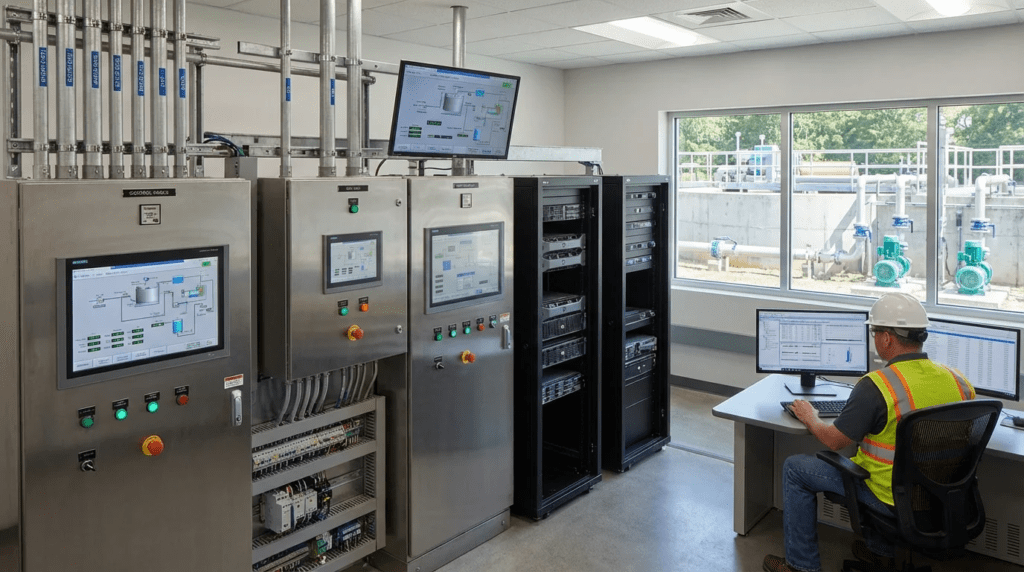
In the modern municipal water and wastewater landscape, the System Integrator occupies a role that transcends equipment supply. Unlike pump or valve suppliers providing discrete mechanical assets, the integrator is responsible for the facility’s central nervous system—the SCADA system, Programmable Logic Controllers, Human Machine Interfaces, and the telemetry networks binding geographically dispersed assets together.
For consulting engineers, public works directors, and plant superintendents, selecting a System Integrator is among the most consequential procurement decisions in a utility’s lifecycle. The automation system dictates operational efficiency, regulatory compliance, data integrity, and cybersecurity posture across the entire treatment and distribution infrastructure. An effectively integrated system gives operators real-time situational awareness, predictive maintenance capability, and automated response to process variables. A poorly executed one produces chronic alarm fatigue, vendor lock-in, unstable control loops, and vulnerability to cyber-physical attack.
The scope typically includes design and fabrication of UL-listed control panels, PLC programming against process control narratives, SCADA configuration, and commissioning of communication networks from fiber optics to licensed radio. This equipment operates in harsh environments—high humidity, corrosive gases such as hydrogen sulfide, wide temperature swings—requiring industrial-grade hardware and disciplined fabrication standards.
The industry is also shifting toward smart water technologies and the convergence of Operational Technology with Information Technology. Integrators no longer simply wire relays; they architect secure Ethernet networks, implement historians for regulatory reporting, and configure remote access so operators can monitor lift stations from mobile devices. Selecting the integrator is inseparable from selecting the SCADA system architecture itself, since the two decisions constrain one another and are frequently made in the wrong order.
The decision is further complicated by the tension between open architecture and proprietary solutions. Engineers must weigh the benefits of customized, single-source responsibility against the long-term flexibility and competitive bidding potential of non-proprietary hardware. This article provides a comprehensive technical analysis of leading System Integrators serving the water and wastewater sector, evaluating their methodologies, technical capabilities, and suitability for various municipal applications.
The Automation Supplier Landscape
The System Integrator is one supplier in a stack of decisions that specifications frequently conflate. The integrator provides engineering, programming, and project delivery. Beneath that sit distinct supplier fields for controller hardware, visualization software, physical panels, and in some models a complete automation system supplied as a package. Each has its own manufacturer landscape, and treating them as one line item is how projects end up with an excellent integrator constrained by a platform decision made elsewhere.
Automation System OEMs
Where a project procures automation as a packaged system rather than integration services, the relevant field is the automation systems OEM landscape. These suppliers deliver a bundled architecture—controllers, visualization, networking, often the panels—under single-source responsibility. The model suits utilities with limited internal engineering capacity and schedule-driven projects. The trade-off is that internal design decisions are made by the supplier rather than specified by the engineer, which matters most at interfaces to equipment packages the OEM did not supply.
PLC Control Platform OEMs
The controller platform is a twenty-year decision that outlives most integrator relationships. The field of PLC control platform OEMs should be evaluated on criteria the integrator has no bearing on: product lifecycle and declared support horizon, availability of redundant and hot-standby configurations, breadth of I/O and communication modules, local distributor stock and lead times, and the depth of the regional technician pool competent on that platform. A utility standardizing on a platform its local integrators rarely work with has narrowed its own future bidding pool.
SCADA and HMI Platform OEMs
Visualization and historian software is a separate decision again, and the SCADA and HMI platform field spans traditional licensed products, unlimited-tag licensing models, and cloud-hosted offerings. What matters is licensing structure and how cost scales as the utility grows, historian and reporting capability against regulatory requirements, alarm management conforming to recognized practice, redundancy and failover behavior, and whether the utility can make its own graphic and tag changes without returning to the integrator for every modification.
Electrical Control Panel OEMs
The physical panel is where automation meets the plant environment, and the field of electrical control panel OEMs includes both integrators with in-house shops and dedicated panel builders supplying integrators. Panel quality is assessed on UL 508A certification and the listing markings actually applied, enclosure rating and material suited to the environment, thermal design supported by a heat load calculation rather than a rule of thumb, wire management and power-to-signal segregation, and the as-built documentation package.
SCADA System Manufacturers
Finally, the broader field of SCADA systems manufacturers spans suppliers whose products cover the full control stack, including proprietary telemetry vendors whose remote units, radios, and software function as an integrated whole. These occupy a different position from the platform vendors above: they compete on system reliability and long support horizons rather than component interchangeability, and they are the correct answer for a specific class of utility. Reading these supplier landscapes together, rather than assuming the integrator will resolve them, produces a specification that can be competitively bid and maintained.
How to Select a System Integrator
Selecting a System Integrator for water and wastewater projects requires rigorous evaluation of technical competency, project management methodology, and long-term support capability. Unlike purchasing machinery where the specification is defined by physical performance curves, hiring an integrator is closer to selecting a technology partner for the lifetime of the control system. The following criteria are essential for engineering specifications and utility decision-making.
1. Open vs. Proprietary Architecture Philosophy
The most fundamental strategic decision is the integrator’s approach to hardware and software openness.
- Open Architecture: Integrators specializing in open architecture use non-proprietary hardware—standard PLCs from major manufacturers—and commercially available SCADA software, with the code owned by the utility at project completion. The utility is not tied to the original integrator for future modifications; any qualified integrator can service the system.
- Proprietary/Single-Source: Some integrators manufacture their own Remote Telemetry Units and develop their own SCADA software. The bundled approach offers seamless integration and simplified troubleshooting because one entity controls the whole stack, but creates a dependency in which the utility relies exclusively on that integrator for parts, upgrades, and support.
Engineers must explicitly require non-proprietary hardware in Division 25 or Division 40 specifications where vendor independence is a priority. The requirement is meaningless unless paired with a source code ownership clause, since open hardware running encrypted code delivers none of the intended flexibility.
2. Telemetry and Network Engineering
Water and wastewater systems are inherently distributed. A central plant must communicate with remote lift stations, water towers, and booster stations, and the integrator’s ability to design robust telemetry networks is paramount.
- Radio Telemetry: Requires expertise in propagation studies, path analysis, and FCC licensing. Integrators must understand the differences between licensed UHF and VHF bands and unlicensed spread spectrum.
- Cellular: As carriers retire older network generations, integrators must demonstrate competence in modern private APN configurations that isolate utility data from the public internet.
- Fiber and Ethernet: For plant-wide networks, the integrator must be proficient in designing redundant fiber rings, whether device level ring or rapid spanning tree, so that a single break does not sever communications.
3. Panel Design and Fabrication Standards
Panel quality directly affects reliability. Integrators should operate UL 508A certified panel shops, or UL 698A where hazardous location equipment is required.
- Thermal Management: Panels located outdoors in direct sunlight require active cooling or heat exchangers. The integrator must perform heat load calculations to size these correctly and prevent drive and controller failure.
- Corrosion Protection: In wastewater headworks or lift stations, H2S attacks copper circuitry. Specify NEMA 4X enclosures in stainless steel or fiberglass, and consider conformal coating on electronic boards.
- Wire Management: High-quality integrators distinguish themselves through meticulous wire labeling, separation of high-voltage and low-voltage signal cables to prevent noise coupling, and the use of finger-safe components.
4. Software Development and Programming Standards
The logic of the plant resides in the PLC code, and poorly written code is a long-term liability.
- Standardization: Does the integrator use standard function blocks and reusable instruction sets? Unstructured code makes troubleshooting expensive and slow, and it effectively locks the utility to whoever wrote it.
- Tag Naming Conventions: The integrator should adhere to a consistent tagging standard, often defined by the utility or the consulting engineer, that makes variables identifiable across PLC and SCADA.
- Documentation: The deliverable must include fully annotated PLC code and unlocked HMI applications. Black-box programming, where the utility lacks administrative access to its own code, should be excluded in municipal specifications.
5. Cybersecurity Competence
With ransomware attacks on municipal infrastructure now a recurring reality, the integrator is a meaningful line of defense, and the choices made during integration determine what is possible to secure afterward. Aligning the integrator’s practices with the utility’s cybersecurity practices at specification stage is far cheaper than remediating an installed system.
- Network Segmentation: Implementing a demilitarized zone separating the enterprise network from the control network, with defined and documented data flows across the boundary.
- Access Control: Configuring strong authentication, managing user privileges by role, and disabling unused physical ports on switches.
- Standards Compliance: Familiarity with the ISA/IEC 62443 series and with the risk assessment and emergency response planning requirements of America’s Water Infrastructure Act.
- Remote Access: Brokered rather than direct vendor access, with session logging and the ability to revoke credentials without reconfiguring the system.
6. Project Management and Commissioning
The integrator’s process for executing the project matters as much as their technical skill.
- Submittals: Detailed wiring diagrams, loop drawings, and bills of material for engineer review before fabrication begins.
- Factory Acceptance Testing: Staging the entire system in the shop to simulate inputs and outputs and verify logic before shipping, which minimizes downtime during onsite startup.
- Site Acceptance Testing: The formal process of verifying the installed system against the control narrative in the field.
- Cutover Planning: A critical capability for retrofit projects. The integrator must demonstrate a plan to migrate from the old system to the new with minimal interruption to plant processes.
Selection & Specification Framework
The criteria above are individually well understood. Projects go wrong when they are applied out of order—typically by selecting an integrator through a low-bid process, then discovering that the platform, licensing model, and code ownership terms that come with them were never specified.
Step 1: Decide Architecture Before Procuring Integration
Fix the controller platform, SCADA and HMI platform, network topology, and code ownership terms as owner requirements before the integrator is selected. These are twenty-year decisions; the integrator relationship typically is not. A utility letting each project’s integrator choose the platform ends up with three platforms, three sets of spares, and no ability to move work between vendors.
Step 2: Build the I/O List Before Anything Else
The input and output list is the quantitative basis for the entire automation scope and should be developed from the P&IDs before pricing is sought. Every field device, motor starter status and control, analog signal, and packaged equipment interface belongs on it, classified as discrete or analog, input or output.
Step 3: Worked I/O and Effort Example
Consider a mid-sized wastewater plant upgrade with an I/O list of roughly 900 points: 520 discrete inputs, 210 discrete outputs, 150 analog inputs, 20 analog outputs. Applying a 25 percent spare capacity requirement raises the provisioned count to about 1,125 points. At typical densities—16 points per discrete module, 8 per analog—that implies roughly 46 discrete and 27 analog modules, or six to eight I/O racks distributed across the plant, before communication and processor slots.
The effort implication is what specifications routinely underestimate. Loop checking 100 percent of points at a realistic 20 to 30 minutes each, including field coordination and documentation, is roughly 300 to 450 labor hours for 900 points—eight to eleven weeks of a two-person team. Factory acceptance testing is a further multi-day exercise. A bid that does not visibly account for this has either not read the I/O list or intends to sample, and sampling is precisely where commissioning defects survive into operation.
Step 4: Specify the Testing Regime Explicitly
State that loop checks cover 100 percent of points with signed records, define the factory acceptance test scope and the owner’s witnessing rights, define the site acceptance test against the control narrative, and define a performance test period during which the system runs without unplanned intervention. Each is a schedule and cost item for the integrator, and omitting them does not remove the work—it removes the obligation to do it.
Step 5: Settle Code Ownership and Access in the Contract
Require that all PLC programs, HMI applications, configuration files, and network device configurations are works made for hire and utility property, delivered unencrypted and unlocked at closeout with all passwords documented. This single clause determines whether the utility can competitively bid its next automation project or is captive to the incumbent.
Step 6: Budget for Post-Commissioning Support
Include a defined block of post-commissioning support hours, commonly 40 to 80, available for a set period after startup. Operators identify most needed logic and graphic refinements only after living with the system for a few months, and contracted hours avoid a change order for every adjustment.
Comparison Tables
Table 1 compares the integrators on operational model, application scale, and distinguishing characteristics. Table 2 compares the delivery models themselves, which is the more consequential decision for many utilities.
| System Integrator | Core Role | Typical Applications | Strengths | Limitations | Best-Fit Scenarios | Lifecycle Considerations |
|---|---|---|---|---|---|---|
| Tesco Controls | Design-build systems integrator and OEM | Large municipal plants, regional distribution, power and control convergence. | Large-scale capacity; combines power distribution with controls; extensive design-build experience. | May exceed what a very small single-pump application requires. | Major plant upgrades requiring both power and automation; alternative delivery projects. | Strong long-term support; works across the major controller platforms. |
| Data Flow Systems | Proprietary OEM and solution provider | Remote telemetry, wide-area SCADA networks, lift station monitoring. | Single-source responsibility; robust proprietary telemetry; long backward compatibility. | Proprietary hardware creates vendor dependency; difficult to competitively bid maintenance. | Utilities seeking a stable telemetry network with unified hardware and software support. | Long support horizon for their own products, but migrating away requires full replacement. |
| Dorsett Technologies | SCADA systems integrator | Municipal water and wastewater, federal and military facilities, smart city integration. | Proprietary SCADA platform; integrates building management and HVAC with water controls. | Geographic concentration in the Southeast and East Coast; proprietary software elements. | Municipalities needing integrated SCADA across both water utilities and building facilities. | Service-oriented model with strong regional field support. |
| Advanced Integration & Controls | Custom systems integrator | Industrial wastewater, complex process control, municipal retrofits. | Deep expertise in logic conversion, legacy migration, and complex process loops. | Focus is purely integration; does not manufacture power equipment or telemetry hardware. | Complex retrofits requiring knowledge of legacy platforms and custom coding. | Platform-agnostic; typically delivers open code for future maintenance by others. |
| Primex Controls | Panel OEM and cloud integrator | Pump stations, lift stations, standardized water applications. | Cloud-based monitoring; standardized pump control panels; efficient fabrication. | More product-focused than custom plant engineering; less oriented to large plant control systems. | Distributed lift station networks; utilities wanting cloud monitoring without IT overhead. | Subscription monitoring model; underlying hardware is widely supportable. |
| Control Assemblies | Industrial control panel manufacturer and integrator | Process automation, material handling, water treatment. | High-volume UL panel fabrication; industrial design rigor; cross-sector experience. | Roots in broader industrial automation rather than water-specific process depth. | Projects requiring high-quality custom panel fabrication and straightforward integration. | Fabrication quality reduces physical maintenance; standard components throughout. |
| Delivery Model | Who Owns the Architecture | Future Bidding Flexibility | Support Dependency | Typical Utility Profile |
|---|---|---|---|---|
| Open Architecture Integration | The utility, via specification | High; any qualified integrator can service the system | Distributed across platform vendor, distributor, and integrator | Utilities with engineering capacity and a multi-project program |
| Proprietary Telemetry System | The supplier | Low; migration means full replacement | Concentrated in one vendor, with a long support horizon | Distributed collection systems valuing stability over competition |
| Packaged Automation System | The OEM, within the package boundary | Moderate; depends on how open the internal components are | Single point of accountability for the package | Utilities with limited internal engineering, schedule-driven projects |
| Cloud-Hosted Monitoring | Shared; the utility owns the field assets, the provider the platform | Moderate; field hardware may be reusable, the platform generally not | Ongoing subscription relationship | Small utilities without IT staff or on-premise server capability |
| Owner Direct-Purchase with Integration Services | The utility, explicitly | Highest; hardware and services are separately competed | Distributed, but the utility carries coordination risk | Larger utilities with in-house engineering and procurement capability |
Top System Integrators
Tesco Controls
Tesco Controls is a substantial presence in water and wastewater automation, known for a combined power and control philosophy. Unlike integrators focused strictly on the low-voltage side, Tesco manufactures and integrates power distribution equipment including switchgear and motor control centers. This allows a consolidated solution in which power distribution and automation logic are engineered by one entity, reducing interface conflicts between the electrical contractor and the integrator.
Technically, Tesco is largely platform-agnostic regarding controllers, deploying the major platforms depending on the client’s existing installed base or the engineering specification. Their approach to SCADA is similarly flexible across the commonly specified visualization products.
Tesco suits design-build and construction-manager-at-risk delivery, collaborating early with civil and mechanical contractors to design the system rather than bidding a finished design. This makes them a common partner for large plant expansions and greenfield facilities where coordination between power feeds, backup generation, and process control is critical. Panels are built to UL standards and the firm maintains field service capability for startup and commissioning.
Data Flow Systems
Data Flow Systems occupies a distinctive niche as an OEM of telemetry hardware and software rather than an integrator of third-party components. Their philosophy centers on obsolescence. In the standard controller world, manufacturers periodically retire hardware series, forcing upgrade cycles driven by supplier roadmaps rather than utility needs. Data Flow Systems counters this by maintaining backward compatibility, allowing much older remote units to communicate on the same network as current ones.
Their technical differentiator is radio telemetry: a narrow-band protocol designed for the low-bandwidth, high-reliability requirements of water and wastewater networks, which often yields better stability in difficult terrain than generic industrial protocols carried over radio.
Specifying this route means committing to a proprietary ecosystem. The system is highly integrated and robust, with a single source for software, remote units, and radios, but it lacks the interchangeability of an open controller platform. For utilities valuing unified accountability and hardware stability over open competition for parts it is a strong contender, and their more recent product direction offers greater open-protocol compatibility while retaining the core reliability characteristics.
Dorsett Technologies
Dorsett Technologies is a prominent integrator with a strong footprint in the Southeastern United States, serving municipal, federal, and military clients. Their core strength is a holistic approach to municipal infrastructure. While rooted in water and wastewater SCADA, they frequently bridge into building management and HVAC controls, giving a unified view of municipal assets beyond the treatment plant.
Dorsett uses their own SCADA platform, designed to be approachable for operators while providing historical data analysis tools. Their engineering teams are experienced in designing control strategies for water treatment plants and water reclamation facilities.
A notable strength is distributed intelligence, pushing control logic to the edge so remote sites such as lift stations and well houses maintain autonomous operation if communication with the central host is lost. They offer lifecycle services spanning panel fabrication, software configuration, electrical installation, and maintenance contracts. For municipalities seeking a partner that understands both the IT requirements of modern SCADA and the electromechanical realities of pumps and valves, Dorsett offers a balanced, service-oriented approach.
Advanced Integration & Controls
Advanced Integration & Controls functions as a high-competency custom integrator focused on the complex logic required for sophisticated treatment processes. Rather than promoting a product line, they operate in a consulting mode, tailoring hardware and software selection to the project’s engineering requirements.
They are frequently selected for challenging retrofits where legacy systems must be migrated to modern platforms without interrupting plant operations. That work requires understanding legacy code structures and the ability to reconstruct the intent of undocumented logic—a genuinely difficult skill and one that is scarce.
Their expertise extends to industrial pretreatment and biological nutrient removal, where process variables are non-linear and loop tuning demands real process understanding. They are known for open systems, typically providing fully annotated, unencrypted source code that leaves the utility owning its own system. That transparency makes them a favored choice among consulting engineers prioritizing specification compliance and long-term flexibility.
Primex Controls
Primex Controls has established a significant position by standardizing control of water and wastewater assets, particularly lift stations and distribution pumps. While capable of custom plant integration, they are best known for cloud-based monitoring that simplifies remote oversight for small and medium utilities.
Their value proposition is reducing the IT burden. Traditional SCADA requires on-premise servers, static addressing, and firewall management; a cloud architecture lets operators monitor levels, flows, and pump status through secure web portals and mobile applications without on-site server infrastructure. Utilities should confirm data ownership, export, and continuity-of-service terms before committing, since the platform relationship is ongoing rather than transactional.
From a hardware perspective, Primex is a volume manufacturer of control panels. Standardized duplex and triplex pump station designs enable rapid, cost-effective deployment, integrating drives and soft starters into rated enclosures with consistent build quality. For utilities managing many distributed lift stations, this standardizes the operator interface and hardware platform, simplifying spare parts inventory and training.
Control Assemblies
Control Assemblies brings a broad industrial pedigree to the water and wastewater market, with decades of experience across diverse automation sectors translating into a rigorous approach to panel fabrication and system architecture.
Their strength is fabrication. They operate large UL-certified panel shops handling both high-volume production and large custom multi-bay enclosures, meaning the physical infrastructure of the control system—wiring, thermal management, layout—meets demanding industrial standards.
On the integration side they are platform-neutral, with depth across the major controller families, and particularly effective where disparate equipment packages must be unified. A large wastewater plant might have a blower package, a centrifuge, and a UV system arriving from different mechanical OEMs with different controllers; Control Assemblies works well as master integrator networking these islands of automation into a coherent plant-wide system. Their emphasis is reliability, code standardization, and documentation that facilitates maintenance by others.
Application Fit Guidance
The right integrator depends on the application. The best choice for a large reclamation plant may not suit a rural water district with ten lift stations.
Municipal Treatment Plants
Process complexity here requires deep process knowledge and the ability to handle thousands of I/O points.
- Best Fit: Tesco Controls, Control Assemblies, Advanced Integration & Controls.
- Why: These firms have the engineering depth to manage complex P&IDs, implement redundancy such as hot-standby controllers, and coordinate with multiple mechanical vendors. Tesco is particularly strong where the project involves significant switchgear work alongside controls.
Remote Telemetry and Lift Station Networks
Geographically dispersed assets where communication reliability is the primary challenge.
- Best Fit: Data Flow Systems, Primex Controls, Dorsett Technologies.
- Why: Data Flow Systems excels through robust radio telemetry. Primex suits utilities wanting cloud-based monitoring with low IT overhead. Dorsett provides a strong integrated regional SCADA solution.
Whichever supplier is selected, process context matters as much as communications technology. The control strategies a collection system needs—wet well level bands, pump alternation, run-time equalization, high-level and failure alarming, station autonomy on loss of communication—are common to every implementation of SCADA in wastewater treatment and belong in the control narrative regardless of who writes the code. Specifying them once at utility level means each new station inherits proven logic rather than a vendor’s default template.
Retrofits and Legacy Migrations
Replacing obsolete controls in an active plant, where downtime is measured in minutes rather than days.
- Best Fit: Advanced Integration & Controls, Tesco Controls.
- Why: These scenarios require custom engineering and hot cutover planning. The integrator must write code that reproduces the old system’s behavior while introducing modern capability, which demands deep software expertise and disciplined testing.
Small to Medium Municipalities
Towns and districts with limited engineering staff needing a turn-key partner covering everything from panel to screen.
- Best Fit: Dorsett Technologies, Primex Controls.
- Why: These firms offer service-heavy models that relieve the municipality of complex system administration. The trade-off is a continuing dependency, which should be entered into deliberately rather than by default.
Broader Automation Program Planning
Individual project selections should sit inside a utility-level automation plan rather than accumulating as independent decisions. A coherent approach to wastewater automation establishes the platform standard, tagging convention, alarm philosophy, and cybersecurity baseline once, so each subsequent project inherits them rather than reinventing them. Utilities that skip this accumulate incompatible systems, and the cost surfaces years later as an integration project nobody budgeted for.
Engineer & Operator Considerations
Regardless of the integrator selected, engineers and operators must prioritize specific elements during the project lifecycle to ensure long-term success.
Installation and Commissioning
The most common point of failure is the interface between field wiring and the control panel. Specify that the integrator perform loop checks—verifying the signal path from field instrument to SCADA screen—for 100 percent of I/O points with signed records. Sampling is not acceptable. The integrator should also be contractually obligated to be on site during the performance test period to address code defects and tuning issues immediately rather than through a change order.
Maintenance Access and Documentation
Operators should insist on a system administration manual distinct from the O&M manual, detailing network addressing, account structure and credential management including default manufacturer passwords that must be changed, software license keys and renewal terms, and backup and restore procedures—with backups verified as restorable rather than merely produced.
Spare Parts Strategy: The specification should require the integrator to provide a list of critical spares including controller processor, power supply, communication cards, and representative I/O modules. For proprietary systems the utility must budget for sole-source procurement. For open systems, parts can generally be sourced from local electrical distributors, which materially changes the stocking calculation.
Long-Term Support and Training
Separate operator training, covering navigation, setpoints, and alarm response, from maintenance training covering hardware troubleshooting, module replacement, and backup and restore. A block of post-commissioning support hours, commonly 40 to 80, lets the utility bring the integrator back months after startup for adjustments once operators have settled in.
Alarm Management
Alarm rationalization is the most frequently skipped step in automation projects and the one operators feel most acutely. A system generating hundreds of alarms per shift trains operators to acknowledge without reading, defeating the purpose entirely. Specify that every alarm has a defined priority, a stated operator action, and a reason to exist, and that conditions with no available operator response are recorded as events rather than raised as alarms. Set a target alarm rate for normal operation and require it demonstrated during the performance test. No integrator will undertake rationalization work that was not asked for.
The Ownership Risk
A critical consideration is ensuring the utility owns the application source code. The contract must state that all PLC programs, HMI applications, network device configurations, and license entitlements are works made for hire and utility property, delivered on digital media at closeout. This prevents the situation where the utility cannot obtain the passwords or code another vendor would need to service the system—the most expensive avoidable outcome in municipal automation procurement.
Design Details & Standards
Applicable Standards and References
Automation specifications commonly reference ISA-5.1 for instrumentation symbols and identification, ISA-101 for human-machine interface design, and ISA-18.2 for alarm management, which is the basis for any credible rationalization requirement. Industrial automation and control system security follows the ISA/IEC 62443 series, with utility risk assessment and emergency response planning governed by America’s Water Infrastructure Act. Control panels are built and listed to UL 508A, with UL 698A applicable to hazardous location equipment, and enclosure ratings to NEMA 250 or the equivalent IEC 60529 IP codes. Electrical installation follows NFPA 70, with area classification in wastewater structures per NFPA 820 and arc flash study requirements per NFPA 70E. Structured cabling follows the TIA-568 series. Programming language conformance is referenced to IEC 61131-3, and where safety-instrumented functions are involved, IEC 61508 and IEC 61511 apply.
Specification Checklist
- Architecture: Controller platform, SCADA and HMI platform, network topology, and redundancy stated as owner requirements rather than left to the integrator.
- I/O Schedule: Complete point list by type with spare capacity requirement stated as a percentage and as provisioned points.
- Control Narrative: Issued as a design document covering normal operation, alarm conditions, failure modes, and manual override for every controlled asset.
- Panels: UL listing, enclosure rating and material, heat load calculation submittal, wire labeling and segregation standard, component accessibility.
- Networks: Media, topology, redundancy protocol, managed switch requirements, addressing scheme, and time synchronization.
- Telemetry: Communication method, path study or coverage verification, licensing responsibility, and remote site behavior on loss of communication.
- Cybersecurity: Segmentation architecture, credential management, remote access method, patch and firmware path, logging requirements.
- Programming Standards: Tag naming convention, code structure and reuse requirements, documentation and annotation standard, and version control.
- Alarm Management: Priority scheme, rationalization requirement, target alarm rates, and demonstration during performance testing.
- Testing: Factory acceptance scope and witnessing rights, 100 percent loop check with signed records, site acceptance against the narrative, performance test duration and acceptance criteria.
- Deliverables: Unencrypted source code, unlocked HMI applications, documented passwords, as-built drawings, system administration manual, verified backups.
- Support: Warranty scope and duration, response time commitments, post-commissioning hours, training scope by audience.
Frequently Asked Questions
What does a system integrator actually deliver?
Engineering and delivery rather than a product. The typical scope covers panel design and fabrication, PLC programming against the control narrative, SCADA and HMI configuration, network and telemetry commissioning, factory and site acceptance testing, and training. The integrator may supply controller and software as pass-through hardware, but the value is in engineering, code quality, and testing discipline—none of which appears on a bill of materials.
Should a utility specify open architecture or accept a proprietary system?
Both are defensible; it depends what the utility is optimizing for. Open architecture preserves the ability to competitively bid future work and source parts from multiple channels, at the cost of coordinating vendors and carrying architectural responsibility internally. Proprietary systems concentrate accountability in one supplier with strong stability and long support horizons, at the cost of competitive leverage. The decision should be explicit and documented, not the incidental result of whoever won the last project.
Why is source code ownership so important?
Without it, no other vendor can service the system. A utility holding encrypted or password-protected code cannot obtain competitive pricing for modifications, cannot respond quickly if the incumbent becomes unavailable, and cannot verify what the logic does. The required contract language is straightforward—works made for hire, delivered unencrypted with documented passwords—and the cost of omitting it surfaces years later at the worst moment.
What is a control narrative and who should write it?
It describes, in plain language, how every controlled asset behaves under normal operation, under each alarm condition, on loss of signal or power, and in manual override. It should be written by the engineer or utility and issued to the integrator before programming begins. When integrators write it afterward it documents the code rather than specifying it, and the acceptance test loses its meaning.
How many spare I/O points should be specified?
A commonly specified figure is 20 to 25 percent spare capacity on installed I/O, plus spare rack and slot space beyond that. Plants add instruments continuously over their lives, and adding a point to an existing module is inexpensive while adding a rack to a full panel is not. Specify spare capacity as both installed spare points and physical expansion space, since these are different provisions.
What does 100 percent loop checking actually involve?
Verifying, for every point, that the field device produces the expected signal, that it arrives at the correct controller address, that it is scaled correctly, and that it appears accurately on the operator screen—with a signed record for each. At 20 to 30 minutes per loop this is a substantial labor item that must be visible in the integrator’s price, and it is the most effective defense against the defect that otherwise appears months later as an instrument reading plausibly but wrongly.
How should cybersecurity requirements be written into an automation specification?
As design requirements rather than aspirations. Specify the segmentation architecture and permitted data flows across each boundary, the account and privilege model, the remote access method including whether vendor access is brokered, the patch and firmware update path with responsibility assigned, logging and retention, and the requirement that default credentials are changed and documented at commissioning. Referencing ISA/IEC 62443 gives the requirements a defensible basis, but the specification still has to state which apply here.
What ongoing costs follow an automation project?
Software licensing and maintenance agreements, which on some platforms scale with tag count and grow as the utility expands. Cybersecurity patching and firmware maintenance, which is labor whether internal or contracted. Periodic hardware refresh as platforms reach end of support, typically on a ten to fifteen year horizon. Spare parts stocking. And integrator support hours for changes. Estimate these at project stage and carry them in the operating budget, because they arrive whether or not anyone planned for them.
Conclusion
Key Takeaways
- Decide architecture before procuring integration — the controller platform, SCADA platform, and code ownership terms are twenty-year decisions that should be owner requirements, not integrator choices.
- Open hardware without open code delivers nothing — non-proprietary equipment running encrypted logic leaves the utility just as captive as a proprietary system.
- Write the control narrative first — a narrative produced after programming documents the code rather than specifying it, and the acceptance test becomes a check of the system against itself.
- Specify 100 percent loop checking with signed records — it is a large and visible labor item, and a bid that does not account for it intends to sample.
- Rationalize alarms or inherit alarm fatigue — every alarm needs a priority, an operator action, and a reason to exist, and no integrator will do this work unasked.
- Cybersecurity is a design requirement — segmentation, credential management, and remote access method are far cheaper to specify than to retrofit.
- Budget the ongoing costs — licensing, patching, hardware refresh, and support hours arrive regardless of whether the capital project accounted for them.
Selecting a System Integrator is a strategic partnership that shapes a utility’s operational capability for decades. There is no single best integrator; the right choice depends on the balance between custom engineering and standardized products, and between open architecture and proprietary reliability.
Tesco Controls and Control Assemblies offer robust open-architecture solutions suited to complex heavy-civil infrastructure. Data Flow Systems provides a reliable proprietary alternative for telemetry-heavy networks. Dorsett Technologies and Primex Controls offer strengths in regional SCADA and cloud monitoring respectively, while Advanced Integration & Controls excels in process logic and legacy migration.
Engineers must craft specifications that define the required architecture, testing protocols, and documentation standards. Doing so ensures the selected integrator delivers not just a control panel, but a resilient, secure, operator-friendly system that safeguards public health and the environment.