
Badger Meter vs Siemens Clarification Equipment: Comparison & Best Fit
Badger Meter vs Siemens Clarification Equipment: Comparison & Best Fit
Introduction
The clarifier is the hydraulic control center of the secondary process, but its efficiency depends entirely on the accuracy of the feedback loops controlling it. Mechanical failure is obvious. Sensor drift or misapplication in return activated sludge lines or blanket monitoring goes unnoticed until a bulking event occurs, and by then the cost lands in permit violations and chemical correction rather than in maintenance.
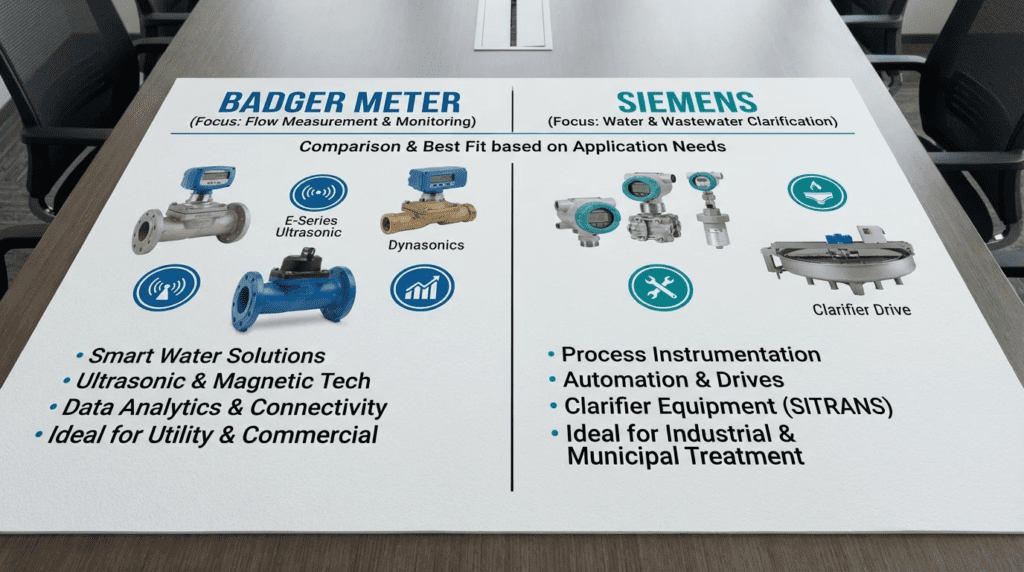
A scope correction belongs at the top of any Badger Meter vs Siemens Clarification Equipment: Comparison & Best Fit evaluation, because the market position of one of these companies is widely misremembered. Siemens does not manufacture clarifiers. Siemens Water Technologies — which held the Envirex and Wallace & Tiernan lines — was divested in 2013, became Evoqua, and is now part of Xylem. Siemens today supplies process instrumentation under the SITRANS name along with automation and drives. Badger Meter has never made clarifiers either; it supplies flow measurement and, following its acquisitions of s::can and ATi, water quality analytics.
Clarifier mechanisms come from process equipment manufacturers: WesTech, Ovivo, Xylem, Monroe Environmental, Walker Process and similar. What both companies discussed here actually supply is the process instrumentation that governs clarification — flowmeters, blanket detectors and solids analyzers that integrate with plant SCADA. That is a real specification decision with real consequences, and it is the subject of this article.
The environment is punishing. Primary and secondary clarification service brings abrasion, grease coating and low-flow velocities that wreck standard specifications. Understanding the nuances in electrode materials, liner durability and signal processing is what lets engineers specify systems that keep the biological process stable. Broader supplier positioning is covered in our overview of the top clarifier equipment manufacturers.
How to Select and Specify
Duty Conditions & Operating Envelope
The envelope is defined by solids concentration and velocity variability. Unlike potable water, clarifier lines handle fluid densities that fluctuate significantly.
- Return sludge flow measurement: The meter must handle solids concentrations in the range of several thousand to fifteen thousand milligrams per liter. Verify that the signal-to-noise ratio is sufficient to distinguish flow velocity from the noise generated by particulate impact on the electrodes.
- Velocity turndown: Clarifiers see diurnal flow patterns. Equipment must maintain accuracy at low velocities during low-flow periods while withstanding scour velocities during storm events.
- Blanket monitoring: Optical or ultrasonic sensors must penetrate the fluff layer to identify the dense bed. The duty condition here is turbidity stratification, not pressure, and the sensor must be programmable to ignore transient clouds of solids.
Materials & Compatibility
Corrosion is rarely the primary failure mode in clarifier instrumentation. Abrasion and coating are the real enemies.
- Liner selection: For magnetic flowmeters in sludge service, standard PTFE can delaminate under vacuum or wear prematurely where grit removal is poor. Polyurethane or neoprene liners are often preferred for abrasion resistance, provided they are compatible with any polymers dosed upstream.
- Electrode material: 316L stainless is the municipal baseline. Where the plant accepts industrial influent with high chloride content, Hastelloy is the appropriate upgrade to prevent pitting.
- Sensor housing: Submerged blanket detectors should be PVC, CPVC or stainless. Aluminum housings, even coated, are unacceptable given the corrosive nature of headspace gases and the liquid itself.
Hydraulics & Process Performance
- Flow disturbance: Magnetic flowmeters typically require several pipe diameters of straight run upstream and downstream. Clarifier galleries are notoriously cramped, with elbows and check valves immediately adjacent to pumps.
- Reduced-run options: Where standard straight run is impossible, evaluate equipment offering reduced or zero-diameter requirements without significant accuracy degradation. Both suppliers offer solutions here, but coil geometry on the specific model dictates performance.
- Head loss: Generally negligible for full-bore mag meters, but insertion-style meters or differential-pressure devices introduce head loss that must be accounted for in the return sludge pump hydraulic curve.
Installation Environment & Constructability
- Ingress protection: Bridge-mounted equipment needs NEMA 4X at minimum. For sensors inside the tank or in flood-prone galleries, IP68 continuous submersion is the only safe specification.
- Cable runs: Signal cables for bridge-mounted sensors route through slip rings on circular clarifiers. The specification must address signal integrity and shielding through rotating contacts.
- Separation: High-voltage power cables for the rake drive induce noise in low-voltage instrument cables. Conduit separation is non-negotiable.
Reliability & Failure Modes
- Coating detection: Grease and biological slime coat electrodes over time, insulating them and causing drift. Advanced meters include electrode cleaning circuitry or diagnostic alarms that notify SCADA when impedance rises.
- Weak link: The transmitter electronics usually fail before the flow tube. Look for modular designs where the transmitter can be replaced without removing the tube from the line — a significant maintenance advantage.
Controls & Automation
- Protocols: Analog remains standard, but modern design favors digital bus integration. Siemens instrumentation integrates naturally into Siemens controller environments, while Badger Meter devices are flexible across common industrial protocols.
- Diagnostics availability: Specify that diagnostic data — coil temperature, electrode impedance, signal strength — be available over the digital bus, not just the process variable. This is what makes predictive maintenance possible.
Lifecycle Cost Drivers
- Calibration verification: Pulling a large meter for calibration is expensive and disruptive. Specify meters supporting in-situ verification tools that validate transmitter and sensor health without removal.
- Consumables: For blanket sensors, consider whether they use wipers, which are mechanical wear parts, or air cleaning, which requires compressor maintenance.
Comparison Tables
| Manufacturer / Line | Primary Technology | Key Features | Considerations | Maintenance Profile |
|---|---|---|---|---|
| Badger Meter ModMAG series |
Electromagnetic flow | Broad liner options; battery-powered variants suited to remote vaults; hazardous location ratings available; high stated accuracy | Battery versions have lower sample rates and are less responsive to rapid flow changes | Low. Electrode cleaning needed in greasy service. Verification tool available. |
| Siemens SITRANS F M series |
Electromagnetic flow | Onboard memory module stores calibration data, allowing plug-and-play transmitter swap; composite liners available; deep integration with Siemens automation software | Dependency on the proprietary memory module; historically biased toward Siemens fieldbus protocols, though open protocols are available | Low. The memory module simplifies electronics replacement considerably. |
| Badger Meter s::can and ATi analytics |
Optical and spectral analysis for solids and blanket level | Spectral analysis for solids; self-cleaning capability; multi-parameter probes | Optical windows require consistent cleaning; sensitivity to color changes in industrial waste streams | Medium. Consumable wipers and seals; periodic validation against lab samples. |
| Siemens Ultrasonic level, Milltronics lineage |
Ultrasonic level | Echo processing filters out rake arm interference; automatic false-echo suppression | Surface foam absorbs signal; fluff layers can be misread as hard blankets without careful tuning | Low. Non-contact. Occasional cleaning of the transducer face where splashing occurs. |
| Application | Badger Meter Fit | Siemens Fit | Key Constraint | Verdict |
|---|---|---|---|---|
| Return sludge pumping | ModMAG with polyurethane liner | SITRANS F M with hard rubber liner | Abrasion resistance and vibration immunity | Tie. The decision usually follows the existing SCADA protocol standard. |
| Clarifier blanket level | s::can optical and spectral sensors | Ultrasonic transducers | Distinguishing fluff from settled sludge | Siemens for simple top-down level; Badger Meter for analytical profiling. |
| Remote or vault metering without power | Battery-powered ModMAG | Battery-powered SITRANS variants | Power availability against data transmission frequency | Badger Meter is widely favored for battery life and access. |
| Plant-wide automation upgrade | Protocol-flexible across platforms | Native integration with Siemens controllers | Integration effort | Siemens where the plant runs Siemens controllers; otherwise neutral. |
Engineer & Operator Field Notes
Commissioning & Acceptance Testing
- The zeroing challenge: To zero a mag meter properly, the pipe must be full but at genuinely zero velocity. In a sludge gallery this is difficult because isolation valves often leak slightly. Specify double block-and-bleed valves, or confirm downstream check valves are tight, before attempting to zero. Zeroing against even slight flow offsets the calibration across the entire range.
- Signal damping: During startup, return sludge flow is turbulent, and operators often raise damping to stabilize the reading. Over-damping makes the control loop sluggish. Keep damping short and address the hydraulic noise source where possible.
Common Specification Mistakes
- Grounding rings: In plastic piping found in smaller chemical feed or sampling lines, there is no earth ground for the fluid. Without grounding rings or a built-in grounding electrode, the meter reads stray electrical noise as flow. Both manufacturers offer built-in grounding electrodes — specify them and save the installation labor.
- Remote electronics cable length: Remote transmitters mounted away from the pipe are good for ergonomics, but there is a hard cable length limit depending on fluid conductivity. Exceeding it without a signal booster degrades the signal.
O&M Burden & Strategy
- Predictive maintenance: Use the manufacturer verification tools annually. These generate a pass/fail report suitable for compliance documentation without removing the meter.
- Blanket sensor cleaning: Optical sensors in the clarifier require frequent cleaning. Without an automatic air-blast system, operators must wipe lenses weekly. That is a high-labor activity, it gets neglected, and the data becomes useless. Always specify the auto-clean option.
Design Details & Calculations
Sizing Methodology
Do not match the meter size to the pipe size. Line-size specifying is frequently wrong for metering.
- Determine flow range: Identify minimum day and peak hour return sludge rates.
- Calculate velocity: Velocity equals flow divided by the cross-sectional area of the meter bore.
- Check constraints: Keep minimum velocity above roughly 2 ft/s to prevent solids deposition in the meter tube, and maximum velocity within the liner’s wear limit. Ideal operation falls in the 4 to 10 ft/s band.
- Reduce if necessary: If a 12-inch pipe yields only about 1 ft/s at average flow, reducing the meter section to 8 or 10 inches to raise velocity and accuracy is good practice, provided head loss is acceptable.
Specification Checklist
- Flange compatibility: ANSI Class 150 is standard, but check for metric standards on imported equipment
- Power supply: 24VDC is safer and standard for instrumentation, though line voltage is common in older plants. Match the spec to the panel design.
- Coating: Epoxy coating on the exterior of the flow tube to resist the damp, corrosive gallery environment
- Tagging: Stainless tag wired to the device carrying the exact SCADA tag identifier
Standards
- AWWA C700 series: Principles of metering accuracy, primarily written for cold water meters
- NSF/ANSI 61: Relevant where clarified water may be reused or enters a potable source
- NEC (NFPA 70): Hazardous location classification. Clarifier galleries may be classified depending on ventilation and connection to collection structures; verify against the plant’s NFPA 820 classification drawings.
Frequently Asked Questions
Does Siemens still make clarifiers?
No. Siemens Water Technologies, which included the Envirex clarifier line and the Wallace & Tiernan disinfection line, was divested in 2013 and became Evoqua, which Xylem acquired in 2023. Siemens today supplies process instrumentation, automation and drives to the water sector but does not manufacture clarifier mechanisms. Specifications still naming Siemens for mechanical clarification equipment are more than a decade out of date and will generate change orders at submittal.
What is the primary difference between the two for clarification instrumentation?
Core focus and integration. Siemens offers a portfolio deeply integrated with its automation and drives ecosystem, which is a strong argument for plants running Siemens control architecture. Badger Meter focuses on independent, protocol-flexible measurement and has expanded into water quality analytics through the s::can and ATi acquisitions. For pure flow measurement they are functionally comparable.
How do you select the correct liner for a sludge flow meter?
By abrasion and chemical resistance. For return and waste activated sludge, polyurethane or neoprene typically perform best, resisting grit and sand better than PTFE. PTFE is slick but relatively soft and prone to delamination under vacuum if a pipe drains. Hard rubber is a durable, cost-effective legacy standard that performs well in general wastewater.
Why do ultrasonic blanket detectors fail in secondary clarifiers?
The fluff layer problem. Secondary clarifiers often carry a low-density cloud of solids above the dense blanket. Basic ultrasonic sensors bounce the signal off this fluff and report a high blanket level when the actual bed is low. Advanced sensors let the engineer adjust sensitivity to penetrate the fluff and detect the denser interface. Optical sensors are generally more accurate for profiling but require physical contact and cleaning.
How often should mag meters in clarification service be calibrated?
True wet calibration requires removing the meter and placing it on a flow rig, which is rarely done after installation. Instead, perform electronic verification annually using the manufacturer’s tool to check coil magnetism and transmitter integrity. If verification passes, the meter is considered within tolerance for process control.
Can insertion flow meters be used for clarifier piping?
Insertion mag meters are an option on very large pipes where a full-bore meter is cost-prohibitive, but they are generally not recommended for sludge lines. Insertion probes foul readily where the sensor enters the flow stream, and they rely on a developed flow profile that is rare in clarifier galleries. Full-bore electromagnetic meters remain the standard for reliability and low maintenance.
Conclusion
Key Takeaways
- Siemens exited water treatment equipment in 2013: Envirex and Wallace & Tiernan moved to Evoqua and then Xylem. Siemens supplies instrumentation and automation, not clarifiers.
- Define scope: This comparison is about process control instrumentation, not mechanical equipment. Clarifier mechanisms come from a different bid list.
- Velocity matters: Do not line-size flow meters. Size for a velocity range that ensures accuracy and self-cleaning.
- Abrasion resistance: Specify polyurethane or neoprene liners for sludge service to extend service life.
- Integration strategy: Choose Siemens where deep integration with Siemens controllers is a priority; choose Badger Meter for protocol-agnostic and specialized analytical applications.
- Maintenance access: Ensure zero-flow conditions can be achieved for calibration, and specify auto-cleaning for any optical sensor.
There is no single winner, but there are distinct best fits based on plant architecture. For facilities invested in the Siemens automation ecosystem, the synergy between SITRANS instrumentation and Siemens controls offers a streamlined single-source lifecycle advantage.
For engineers designing open-architecture systems or retrofitting plants where instrument-level flexibility matters more, Badger Meter’s flow and analytical lines offer robust performance independent of the controller brand. The consulting engineer’s role is to look past the brand name and specify the physics — materials, hydraulics and signal processing — that survives the clarifier gallery. Related evaluations appear in our comparison of Krohne and ABB clarification instrumentation and Evoqua and ClearStream Environmental for clarification.