
Cla-Val vs Crane Hydrant Flushers Equipment: Comparison & Best Fit
Cla-Val vs Crane Hydrant Flushers Equipment: Comparison & Best Fit
Introduction
For municipal distribution engineers, the battle against water age, nitrification and biofilm formation is constant, particularly in dead-end mains and oversized networks. Automatic flushing systems have shifted from a convenience to a practical necessity for maintaining chlorine residuals and meeting drinking water compliance obligations. Yet hardware selection for these stations often relies on habit rather than hydraulic analysis.
A scope note belongs up front, because the two companies named sit in different positions in this market. Cla-Val is a hydraulic control valve manufacturer whose valves are widely used as the actuating element in automatic flushing stations, and it supplies flushing and sampling station products. Crane Co. is a valve manufacturer, but it does not supply automatic hydrant flushing stations. Dedicated automatic flusher packages come from specialists including Mueller with its Hydro-Guard line, Kupferle with its Eclipse line, and similar suppliers.
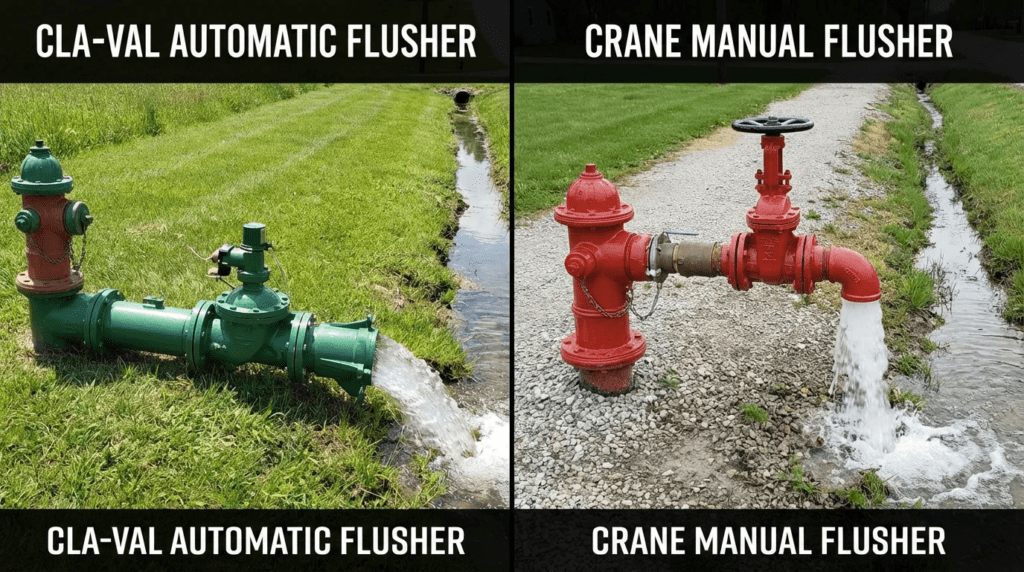
What a Cla-Val vs Crane Hydrant Flushers Equipment: Comparison & Best Fit query is really asking about is the choice between two actuation philosophies: hydraulic pilot-operated control valves, which Cla-Val exemplifies, and direct-acting mechanical or motorized valves of the kind Crane and other general valve manufacturers produce. That is a genuine engineering decision, and it is the subject of this article. Broader supplier positioning is covered in our overview of the top OEMs for hydrant flushers.
Flushers may look like commodities, but the engineering reality is more complex. A poor specification produces water hammer, cavitation, frozen assets or excessive water loss. The operational environment — from high-traffic urban corridors to remote rural standpipes — dictates whether a pilot-operated valve or a direct-acting valve is the superior choice.
How to Select and Specify
Duty Conditions & Operating Envelope
The primary driver is the pressure and flow envelope. Analyze minimum and maximum static pressure at the installation point.
- Pressure dependency: Pilot-operated systems use line pressure to actuate the diaphragm. If dynamic system pressure falls too low during a flush event, the valve may fail to close or modulate properly. Direct-acting mechanical valves are less sensitive to low pressure differential but may require higher actuation torque.
- Flow rates: Determine whether the objective is water turnover at low flow or scouring velocity, typically around 2.5 ft/s or higher. High-velocity flushing induces significant dynamic forces, so equipment must be rated for the flow coefficient required to achieve scouring without excessive head loss across the device itself.
- Intermittent against continuous: Most automatic flushers operate intermittently. Where a unit is used for continuous bleed in extreme freeze protection, valve seat design becomes critical to prevent wire drawing — erosion of the seat at low opening percentages.
Materials & Compatibility
- Internal corrosion: For aggressive water chemistry or high chloramine concentrations, 316 stainless or fusion-bonded epoxy-coated ductile iron is appropriate. Specify internal components that resist dezincification where bronze or brass internals are proposed.
- External corrosion: Below-grade units face soil corrosivity and high humidity. Stainless steel enclosures and hardware are standard practice. For above-grade units, enclosure UV resistance matters.
- Elastomers: Compatibility with disinfectants is critical. EPDM is generally preferred for chloramine service over nitrile, which can degrade and swell, leading to valve failure.
Hydraulics & Process Performance
- Opening and closing speed: This is the major differentiator. Hydraulic pilot valves offer adjustable opening and closing speeds inherent to their design, which mitigates surge and water hammer. Direct-acting solenoid or motor-operated valves need soft-close features specified, or carefully programmed ramp times, to prevent pressure transients that could rupture aging mains.
- Cavitation: In high-pressure zones discharging to atmosphere, cavitation is a real risk. Anti-cavitation trim or specific valve geometry may be required to prevent noise and rapid erosion of the valve body.
Installation Environment & Constructability
- Depth of bury: In northern climates the valve mechanism must sit below the frost line, requiring a dry-barrel design or a deep-bury approach. Accessibility of maintenance components relative to grade is a key constructability concern.
- Traffic loading: Where the unit sits in a roadway or shoulder, traffic loading ratings for the enclosure or box are mandatory and significantly affect the structural specification of the pit.
- Drainage: Below-grade flushers require a gravel bed or a storm sewer connection with an air gap to handle discharged water. Poor drainage leads to submerged equipment, which tests the ingress rating of the electronic controls.
Reliability & Failure Modes
- Fail-safe state: On power or control signal loss, does the valve fail open or closed? For flushing, fail-closed is universally preferred to prevent catastrophic water loss.
- Debris tolerance: Distribution systems carry sediment and tuberculation. Pilot-operated valves use small tubing and orifices that can clog, requiring strainers. Direct-acting globe or gate valves generally pass larger solids but can suffer seat obstruction that prevents full closure.
- Wear components: Diaphragms eventually fatigue and solenoids burn out. The design should facilitate rapid replacement of these components without extensive disassembly.
Controls & Automation
- Local control: Most units use a handheld programmer or a mobile app. The interface should be usable by field operators without specialist training.
- SCADA integration: For critical water quality points, analog or digital integration allows the flusher to be triggered by real-time chlorine analyzers rather than a simple timer. This significantly reduces water waste relative to fixed scheduling.
- Power source: Battery life is a constant maintenance concern. Hydro-turbine powered options or solar interfaces extend maintenance intervals at additional capital cost.
Maintainability, Safety & Access
- Confined space: Designs allowing all maintenance from above grade, without vault entry, are strongly preferred for safety and reduced labor burden.
- Tooling: Does the valve require proprietary tools to service the seat or pilot? Standardizing on equipment using common hand tools reduces truck inventory requirements.
- Ergonomics: For sampling and dechlorination, position the discharge to direct water away from the operator and the electrical components.
Lifecycle Cost Drivers
- Non-revenue water: A stuck-open flusher can lose an enormous volume before anyone notices. The cost of that water justifies investment in reliable closure mechanisms.
- Maintenance labor: A pilot valve requires periodic cleaning and tuning, whereas a simpler mechanical valve might be run to failure and replaced. Balance the capital cost of high-end valves against the operating cost of skilled technician time.
Comparison Tables
| Criteria | Hydraulic pilot-operated (Cla-Val type) | Direct mechanical or motorized (general valve manufacturers) |
|---|---|---|
| Supplies complete flusher packages | Yes — flushing and sampling station products, plus control valves used within others’ packages | Generally no. Crane and similar valve manufacturers supply valves, not automatic flushing stations. Package suppliers include Mueller and Kupferle. |
| Actuation principle | Hydraulic differential using line pressure via a pilot system | Direct solenoid lift, motor-driven ball or butterfly, or mechanical screw |
| Opening and closing speed | Highly adjustable with effective soft start and stop to prevent water hammer | Fixed speed. Solenoids act instantly, raising hammer risk; motorized units are slower and safer. |
| Pressure requirements | Requires minimum dynamic pressure to stroke the valve | Independent of line pressure for motorized units, working even at zero differential |
| Debris sensitivity | High. Pilot lines and orifices can clog, so strainers are required. | Low to medium. Generally passes larger particulates without failure. |
| Complexity | High. Multiple components including pilot, speed controls and tubing. | Low. Fewer moving parts and simpler operating logic. |
| Power consumption | Very low. The solenoid only triggers the pilot; hydraulics do the work. | Medium to high. A motor requires significant current to turn the valve stem. |
| Best fit | High-pressure mains, larger diameters, surge-sensitive networks | Smaller lines, low-pressure zones, rugged environments, simple operation |
| Application | Preferred Technology | Engineering Reason | Primary Risk |
|---|---|---|---|
| High pressure zone | Hydraulic pilot | Controlling closing speed is critical to prevent surge damage to aging main | Cavitation damage if trim is not properly specified |
| Remote, low maintenance site | Mechanical or motorized | A simpler mechanism is less prone to fouling and drift over long unattended periods | Battery life for motorized actuators |
| Water quality driven with SCADA | Hydraulic pilot | Easier integration with complex control logic and modulation where required | Complexity of field calibration |
| Low pressure or gravity feed | Mechanical or motorized | Hydraulic valves may fail to open fully or chatter at low differential | Flow capacity restrictions |
| Freezing climate | Deep bury, either type | Positive closure below the frost line with a self-draining riser is what matters most | Frost heave affecting stem alignment |
Engineer & Operator Field Notes
Commissioning & Acceptance Testing
- Surge verification: During the initial flush, use a high-speed pressure logger to record the transient during closure. If pressure spikes substantially exceed static pressure, closing speed controls on hydraulic units must be adjusted.
- Dechlorination effectiveness: Verify that the tablet feed or injection system reduces residuals to the regulatory limit at the discharge point, and confirm the flow rate does not exceed the chemical’s reaction kinetics.
- Drainage capacity: For below-grade units, run the flusher at full design flow for the maximum programmed duration and confirm the drain or storm connection prevents vault flooding.
Engineers often specify an air gap for sanitary protection but fail to account for the splash zone. Ensure discharge piping directs water forcefully away from the air gap to prevent back-splash contamination or localized erosion undermining the pad.
Common Specification Mistakes
- Sizing the valve to the pipe: Specifying a 2-inch valve because the pipe is 2 inches. If available flow is low, that valve barely cracks open, producing seat chatter and premature wear. Size on flow coefficient and required velocity, not pipe diameter.
- Ignoring freeze protection depth: Specifying a standard depth unit in a region with variable frost lines. Specify bury depth based on the worst-case historical frost depth plus a margin.
- Vague restoration requirements: Contractors may leave the area around the flusher settled or uneven. Specify compaction requirements and surface restoration explicitly to avoid trip hazards.
- Naming a supplier that does not make the product: Specifications naming a general valve manufacturer for a complete automatic flushing station will generate substitution requests at submittal. Name the package supplier or specify by performance.
O&M Burden & Strategy
- Hydraulic pilot units: Require semi-annual inspection of the strainer. Where source water has high mineral content, the pilot orifice may need clearing. Treat the diaphragm as a scheduled replacement item rather than a run-to-failure component.
- Mechanical and motorized units: Focus on actuator battery and seal integrity. Exercise mechanical gears manually if the unit has not flushed in months, to prevent seizing.
- Winterization: Regardless of type, inspect above-ground components before the first freeze and verify insulation integrity and heater function where equipped.
Troubleshooting
- Valve will not close. On hydraulic units, suspect a clogged pilot supply line, a ruptured diaphragm, or debris under the main valve seat. On mechanical units, suspect power failure to the motor, limit switch failure, or an obstruction in the ball or gate.
- Valve chatters. On hydraulic units, closing speed is set too fast or air is trapped in the pilot cover — bleed the air. On mechanical units, check flow direction against the body arrow and inspect for loose linkage.
Design Details and Calculations
Sizing Methodology
The goal of flushing is usually removing sediment and biofilm, which requires a scouring velocity commonly taken as 2.5 to 3.0 ft/s.
- Calculate required flow: Flow equals velocity multiplied by pipe area. For a 6-inch main with an area of approximately 0.20 square feet, a 2.5 ft/s target gives roughly 0.5 cubic feet per second, or about 225 gpm.
- Check pressure availability: Calculate head loss from the source to the flusher at that flow using Hazen-Williams, then subtract friction and elevation from static pressure to find residual pressure at the device.
- Select valve flow coefficient: Ensure the selected flusher passes the required flow with an acceptable pressure drop across the valve — generally low enough to avoid noise and cavitation. Pressure drop scales with the square of the ratio of flow to flow coefficient.
Specification Checklist
- Valve type: Explicitly state hydraulic diaphragm or motorized ball and gate to avoid substitution confusion
- Operating pressure rating: State the pressure class
- Dechlorination: Integrated tablet feeder, liquid injection port, or diffusion mesh
- Controller: Programmable features covering days, duration and multiple events; battery type; ingress rating
- Sampling: Dedicated sampling bib located upstream of the dechlorination injection point, which is essential for accurate residual testing
Standards
- AWWA C800: Underground service line valves and fittings
- NSF/ANSI 61 and 372: Drinking water system components and lead-free requirements
- Enclosure ratings: Appropriate corrosion resistance and submersion rating for the installation
Frequently Asked Questions
Does Crane make automatic hydrant flushers?
No. Crane Co. is a valve manufacturer and does not supply complete automatic flushing stations. Dedicated flusher packages come from specialists including Mueller with the Hydro-Guard line and Kupferle with the Eclipse line. Cla-Val supplies flushing and sampling station products and, more broadly, the hydraulic control valves that serve as the actuating element in many flushing station designs. Engineers writing a specification for a complete automatic flusher should be working from the package suppliers’ product lines, or specifying by performance rather than by brand.
What is the main maintenance difference between the two actuation approaches?
Complexity of the mechanism. Hydraulic pilot systems require maintenance of the pilot control loop, including cleaning strainers and small orifices that clog with sediment, though the main valve itself is extremely durable. Direct-acting mechanical systems have simpler routines focused on the actuator, but when the main mechanical valve fails it often requires a more labor-intensive replacement than swapping a diaphragm.
How do I determine flush duration for a dead-end main?
Calculate the volume of the pipe segment to be cleared — area multiplied by length — and divide by the flush flow rate. Common practice is turning over the pipe volume two to three times to ensure complete removal of aged water and biofilm. For 1,000 feet of 6-inch pipe holding roughly 1,500 gallons, a single turnover at 150 gpm takes about ten minutes, so a three-times turnover requires roughly thirty minutes.
Can automatic flushers be used in freezing climates?
Yes, but the specification must be precise. The valve mechanism must sit below the frost line. These deep-bury units use a self-draining feature similar to a dry-barrel fire hydrant, where water in the riser drains into a gravel bed after the flush completes, preventing the riser from freezing.
Why is dechlorination necessary?
Discharging chlorinated or chloraminated water into storm sewers, creeks or wetlands violates discharge permits in most jurisdictions, and aquatic life is extremely sensitive to chlorine. Flushers must be equipped with dechlorination chambers using ascorbic acid or sulfite tablets to neutralize the residual before it leaves the assembly.
What is typical battery life for an automatic flusher?
It depends heavily on flushing frequency and actuation type. Solenoid-operated hydraulic valves draw very little power and can run a season or more on a standard battery pack. Motorized ball valves draw considerably more, often requiring larger lithium packs. Most manufacturers rate battery life by a number of cycles rather than a calendar period. Proactive annual battery replacement is standard practice regardless.
How does water hammer influence equipment choice?
Water hammer is a pressure surge caused by rapid valve closure. Hydraulic pilot valves excel here because closing speed is adjustable and hydraulically dampened, naturally preventing surges. Direct-acting solenoid valves close instantly, which is dangerous in long pipelines. Where a direct-acting valve is used, select a motorized version with a slow cycle time rather than a snap-acting solenoid.
Conclusion
Key Takeaways
- Know the suppliers: Crane does not make automatic flushers. Complete packages come from Mueller, Kupferle and similar specialists; Cla-Val supplies station products and the control valves inside many designs.
- Analyze the hydraulic grade line: Use hydraulic pilots for high-pressure, surge-sensitive zones; consider mechanical valves for low-pressure areas.
- Size for velocity: Do not match pipe size. Match the flow coefficient required for scouring velocity.
- Respect the environment: Specify deep-bury units for frost zones and appropriate traffic loading for roadway installations.
- Dechlorination is mandatory: Include integrated chemical feed to meet discharge compliance.
- Maintenance trade-off: Hydraulic valves offer performance but need clean water and strainers; mechanical valves offer simplicity but depend on actuator longevity.
The engineer is ultimately choosing between two philosophies: the precision of hydraulic control against the simplicity of mechanical actuation. There is no single winner, only a correct application for each.
For complex distribution networks with high pressures, long transmission lines or significant surge potential, the hydraulic pilot-operated valve remains the reference approach for its ability to modulate and soft-close. For smaller rural systems, or locations with low static pressure where hydraulic pilots struggle, a direct-acting motorized valve offers a robust, easily understood solution. Prioritize the duty cycle, water quality objectives and the realities of the maintenance team’s capabilities, and specify by performance rather than by a brand that may not make the product.