
Commissioning Double Disc Pump: Startup Checklist and Acceptance Tests
Introduction
In the realm of municipal wastewater treatment and industrial sludge handling, the failure of a positive displacement pump during its first month of operation is rarely a manufacturing defect; it is almost invariably a failure of specification or startup protocol. Engineers often treat positive displacement (PD) pumps like centrifugal pumps, assuming a “bump and run” approach is sufficient. This assumption is costly. For heavy-duty sludge applications, the double disc pump technology offers unique advantages—specifically the ability to pass large solids and run dry without damage—but these benefits can only be realized through rigorous verification.
The process of Commissioning Double Disc Pump: Startup Checklist and Acceptance Tests is critical because, unlike centrifugal pumps, double disc pumps can generate infinite pressure against a closed valve, leading to catastrophic piping failure or drive train destruction if safety devices are not calibrated correctly. Furthermore, the reciprocating nature of the technology introduces pulsation dynamics that must be managed to prevent harmonic destruction of downstream piping supports.
These pumps are typically deployed in the most punishing applications within a treatment plant: thickened waste activated sludge (TWAS), scum transfer, lime slurry dosing, and grit removal. In these environments, downtime requires manual intervention in hazardous conditions. A poor startup leads to seal leaks, premature disc fatigue, and gearbox failures. This article serves as a definitive guide for engineers and superintendents to execute a flawless installation, focusing on technical specifications, acceptance criteria, and long-term reliability.
How to Select and Specify Double Disc Technology
Successful commissioning begins during the design phase. If the pump is misapplied or undersized in the specifications, no amount of field tuning will correct the issue. The following criteria outline the engineering framework for selecting double disc pumps appropriate for Commissioning Double Disc Pump: Startup Checklist and Acceptance Tests procedures.
Duty Conditions & Operating Envelope
The operating envelope for a double disc pump is defined by volume per revolution, not by a Best Efficiency Point (BEP) in the traditional centrifugal sense. Engineers must specify flow rates based on the pump’s displacement per stroke and the allowable speed (RPM). High RPM accelerates wear on the discs and trunnions.
- Flow Rates: Typically range from 20 GPM to over 500 GPM depending on the body size (3-inch to 6-inch connections are common).
- Speed Limitations: For abrasive sludges, specifiers should limit pump speed to 40-50 RPM to extend component life. Higher speeds (up to 100 RPM) should be reserved for intermittent, clean fluids.
- Pressure Capabilities: Standard units handle up to 60-100 PSI. If the discharge line involves long static heads or friction losses exceeding this, alternative PD pumps (like piston pumps) may be required.
Materials & Compatibility
The “double disc” mechanism relies on an elastomeric disc functioning as both the pumping element and the valve. Material compatibility is the single most critical variable for longevity.
- Disc Material: Neoprene is standard for general municipal sludge. EPDM is required for high-temperature applications or specific industrial chemistries. Viton may be necessary for harsh chemical dosing but comes at a significant cost premium and reduced flex life.
- Housing Construction: Cast iron is standard for sewage. However, for lime slurry or grit applications, hardened coatings or specific alloys may be needed to prevent internal scouring of the housing volute.
- Connecting Rods: Ensure high-tensile strength alloys are specified. The connecting rod bears the cyclic load of the reciprocating action.
Hydraulics & Process Performance
Unlike centrifugal pumps where flow varies with head, double disc pumps provide a nearly constant flow regardless of discharge pressure (up to the motor’s torque limit). However, “slip” does occur.
- Volumetric Efficiency: Specifiers should anticipate 85-95% volumetric efficiency. The “slip” is the backflow that occurs as the trunnion wipes the disc. This slip is actually beneficial in some cases as it prevents hard solids from lodging in the sealing line.
- NPSH Available (NPSHa): While double disc pumps have excellent suction lift capabilities (often up to 25 feet), the Net Positive Suction Head Available must still be calculated, specifically accounting for Acceleration Head. The pulsating nature of the intake requires a larger suction line diameter to prevent cavitation-like knocking.
Installation Environment & Constructability
When preparing the layout for Commissioning Double Disc Pump: Startup Checklist and Acceptance Tests, physical access is paramount.
- Maintenance Access: The hallmark of this technology is “maintain in place” (MIP). The design allows the housing to be split to replace discs without disturbing piping. Engineers must reserve at least 24-36 inches of clearance on the non-drive side for housing removal.
- Piping Interfaces: Flexible connectors are mandatory on both suction and discharge to isolate pump vibration from the rigid piping system. Failure to include these will result in cracked flanges.
Reliability, Redundancy & Failure Modes
Understanding how these pumps fail allows for better specification of monitoring equipment.
- Common Failure Mode: The most common failure is the fatigue of the elastomeric disc, leading to a loss of prime or flow.
- Redundancy: For critical sludge wasting (WAS) or return (RAS) lines, a triplex configuration (two duty, one standby) is recommended.
- Run-Dry Capability: Unlike progressive cavity (PC) pumps which destroy their stators within minutes of running dry, double disc pumps can run dry indefinitely. This makes them ideal for suction-lift applications where priming reliability is intermittent.
Controls & Automation Interfaces
Integration with SCADA is essential for predictive maintenance.
- Leak Detection: Specify vacuum-based or conductivity-based leak detectors inside the pump housing. If a disc fails, sludge enters the pump body; the sensor should trigger an immediate alarm and pump shutdown.
- VFD Integration: Always drive these pumps with a Variable Frequency Drive (VFD). This allows for soft starts (reducing belt slip) and precise flow pacing for process control.
Maintainability, Safety & Access
Operator safety during maintenance is a key consideration.
- Lockout/Tagout (LOTO): Ensure local disconnects are within sight of the pump.
- Relief Valves: A pressure relief valve (PRV) or rupture disk on the discharge side is non-negotiable. It must be piped back to the suction well or a drain, never to the floor.
- Guard Design: Belt guards must be OSHA compliant but designed for easy removal (e.g., tool-free or simple fasteners) to encourage regular belt tension checks.
Lifecycle Cost Drivers
While the initial CAPEX of a double disc pump is often higher than a centrifugal pump, the OPEX analysis favors it for sludge.
- Energy: Generally less efficient than centrifugal pumps at low viscosity, but significantly more efficient at handling high-viscosity sludge (>2% solids).
- Spares: The primary consumables are discs and trunnions. A lifecycle cost analysis (LCCA) should assume disc replacement every 12-18 months for continuous duty applications.
Comparison Matrices
The following tables assist engineers in evaluating where double disc technology fits within the broader pumping landscape and how to identify application suitability. Use these during the preliminary design phase.
| Technology Type | Primary Features | Best-Fit Applications | Limitations / Risks | Maintenance Profile |
|---|---|---|---|---|
| Double Disc Pump | Glandless, valveless, run-dry capable, handles large solids. | Scum, grit, lime slurry, thickened sludge, rag-heavy wastewater. | Pulsating flow requires dampeners; limited discharge pressure (typ. <100 PSI). | Low/Moderate: Discs are only wear part; maintain-in-place design; no mechanical seals to leak. |
| Progressive Cavity (PC) | Smooth non-pulsating flow, high pressure capability, precise metering. | Dewatering feed, polymer dosing, high-pressure transfer. | Cannot run dry (stator failure); large footprint; expensive stator replacement. | High: Rotor/stator wear is constant; difficult to service in place (requires substantial clearance). |
| Rotary Lobe | Compact footprint, easy access to wet end, CIP capable. | Thickened sludge, limited space retrofits. | Sensitive to grit (wear on lobes reduces efficiency rapidly); slip increases with wear. | Moderate: Lobes and wear plates require replacement; timing gear maintenance is critical. |
| Air Operated Diaphragm (AODD) | Portable, air-powered, run-dry capable. | Sump cleanout, chemical transfer, intermittent utility. | High energy cost (compressed air); check valves prone to clogging with rags. | High (in continuous duty): Diaphragms fatigue; air valves freeze/fail; check valves foul frequently. |
| Application Scenario | Solids Content | Suction Condition | Discharge Pressure | Suitability Rating |
|---|---|---|---|---|
| Primary Scum Pumping | High (Grease/Rags) | Flooded or Lift | Low (<40 PSI) | Excellent (Handles rags/dry running well) |
| Thickened Sludge (TWAS) | 4% – 8% | Flooded | Moderate (40-60 PSI) | Excellent (Viscosity handling is superior) |
| Digester Feed (Long Distance) | 2% – 5% | Flooded | High (>100 PSI) | Poor (Pressure limitations usually favor PC or Piston pumps) |
| Lime Slurry Recirculation | Abrasive | Flooded | Low | Good (Low velocity reduces abrasion, but specialized housing coating needed) |
| Raw Sewage Lift Station | < 1% | Lift | Variable | Conditional (Only for low flow/high lift; generally Centrifugal is more efficient) |
Engineer & Operator Field Notes
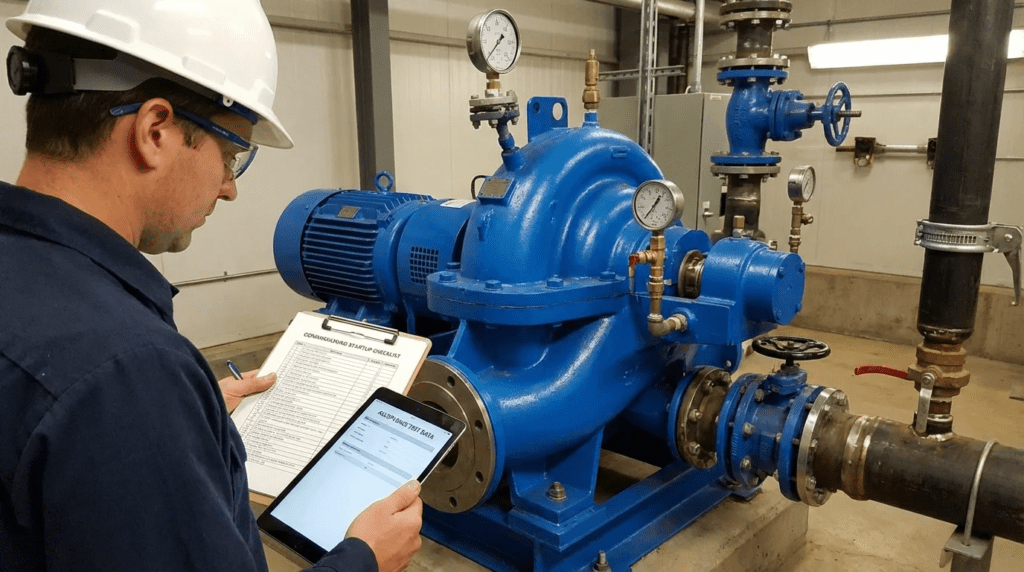
This section translates the specifications into actionable on-site procedures. The process of Commissioning Double Disc Pump: Startup Checklist and Acceptance Tests determines the baseline health of the equipment.
Commissioning & Acceptance Testing
The Site Acceptance Test (SAT) is the final hurdle before the equipment is handed over to the utility. It is not merely a “turn it on” event.
Factory Acceptance Test (FAT) Critical Checkpoints:
- Hydrostatic Test: Ensure the pump housing holds pressure at 1.5x the design pressure for at least 30 minutes with no leakage.
- Run Test: If witnessing the FAT, ensure the pump runs at 100% speed for 60 minutes to verify bearing temperatures stabilize.
- Clearance Verification: Verify the internal clearances between the disc and the trunnion are set to factory specifications to minimize slip without causing friction binding.
Site Acceptance Test (SAT) Procedures:
- Dry Run Verification: Run the pump dry for 5-10 minutes. Listen for mechanical knocking. The sound should be rhythmic and relatively quiet. Any metal-on-metal sound indicates trunnion misalignment.
- Water Test: Introduce clean water. Verify the flow rate at 50% and 100% speed using a magnetic flow meter or draw-down test.
- Process Fluid Test: Introduce the sludge/slurry. Monitor the discharge pressure gauge. It should fluctuate with the strokes but remain within the design rating.
- Pulsation Dampener Tuning: This is the most skipped step. Adjust the air charge in the pulsation dampener while the pump is running at duty pressure. The goal is to minimize the “needle bounce” on the pressure gauge. A correctly charged dampener (typically 80% of line pressure) will smooth the flow significantly.
- Thermal Check: After 2 hours of runtime, use an infrared gun on the gearbox and pillow block bearings. Temperatures exceeding 140°F (60°C) warrant investigation.
Common Specification Mistakes
Avoid these errors in RFP and bid documents to prevent change orders and operational headaches.
- Undersizing Suction Piping: Specifying the suction pipe diameter to match the pump inlet size is a mistake. PD pumps require larger suction lines to accommodate acceleration head. A 4-inch pump often requires a 6-inch suction line.
- Missing Vacuum Gauges: Engineers often spec discharge gauges but omit suction vacuum gauges. Without a suction gauge, diagnosing a clogged line vs. a pump failure is impossible.
- Ambiguous “Solids Handling”: Specifying “3-inch solids handling” is vague. Specify “compressible solids” vs. “hard sphere” passage. Double disc pumps pass rags well, but large rocks can damage the discs.
O&M Burden & Strategy
To maintain performance, operators must adhere to a strict regimen.
- Lubrication: The trunnions and connecting rods often have grease points. These should be greased monthly, but do not over-grease, as this can blow out seals.
- Gearbox Oil: Change gearbox oil after the first 100 hours (break-in period) and every 6 months thereafter.
- Disc Inspection: Inspect discs every 6 months. Look for “chunking” or deep scoring. If the pump is starting to lose flow capacity, the discs are likely worn, allowing excessive slip.
Troubleshooting Guide
- Symptom: No Flow.
Cause: Clogged suction, air lock (rare in double disc), or sheared drive key.
Action: Check vacuum gauge. High vacuum = clog. Low vacuum = air leak or mechanical failure. - Symptom: Excessive Noise/Knocking.
Cause: Cavitation, loose mounting bolts, or water hammer.
Action: Check suction pressure. If suction is starved, increase line size or reduce pump speed. Check pulsation dampener charge. - Symptom: Premature Disc Failure.
Cause: Chemical attack, over-pressure, or running too fast.
Action: Verify material compatibility. Slow the pump down via VFD.
Design Details and Calculations
Engineering the system around the pump is as important as the pump itself. Below are the methodologies for sizing and verifying the system design.
Sizing Logic & Methodology
Sizing a double disc pump differs from centrifugal sizing. You are sizing for displacement, not just head generation.
- Determine Required Flow (Q): Based on process mass balance.
- Select Pump Model: Choose a model where the required flow falls between 30-50 RPM. Avoid selecting a pump that must run at max RPM to meet duty conditions; this leaves no room for wear compensation or future capacity.
- Calculate TDH:
TDH = Static Head + Friction Head + Acceleration Head.
Unlike centrifugal pumps, friction losses are calculated using peak flow, not average flow, due to pulsation.
Understanding Acceleration Head
The most overlooked calculation in Commissioning Double Disc Pump: Startup Checklist and Acceptance Tests preparation is Acceleration Head ($h_{ac}$). Because the fluid starts and stops (or accelerates and decelerates) with every stroke, energy is required to move the mass of the liquid in the suction line.
Formula (Simplified HI Standard):
$$h_{ac} = frac{L times V times N times C}{K times g}$$
Where:
- L: Length of suction pipe (ft)
- V: Velocity in suction pipe (ft/s)
- N: Pump Speed (RPM)
- C: Pump constant (typ. 0.200 for duplex double disc)
- K: Fluid factor (1.4 for water/sewage)
- g: Gravity (32.2 ft/s²)
If $h_{ac}$ plus the static lift exceeds the atmospheric pressure available, the fluid will flash (cavitate), causing violent knocking. To mitigate this, keep suction lines short (low L) and large diameter (low V).
Specification Checklist
Ensure these items are explicitly called out in your Division 43 specifications:
- Standards: Pump must meet Hydraulic Institute (HI) Standards for Reciprocating Power Pumps.
- Testing: Non-witnessed performance test with curve generation required.
- Drive: TEFC motor, Inverter Duty rated (10:1 turndown minimum).
- Baseplate: Fabricated steel with grout holes, sufficiently rigid to resist torsional loads.
- Spares: Specification should require one complete set of discs and gaskets to be handed over at commissioning.
Frequently Asked Questions
What defines a “Double Disc” pump compared to a Diaphragm pump?
While both are positive displacement pumps, a diaphragm pump uses a flexible membrane that reciprocates to move fluid, relying on ball check valves to prevent backflow. A double disc pump uses a trunnion and disc mechanism where the disc acts as both the pumping element and the valve. This eliminates the check valves, which are the primary clogging point in diaphragm pumps, making double disc pumps superior for fluids containing rags, grit, or stringy solids.
Can double disc pumps run dry?
Yes. This is a primary advantage over Progressive Cavity (PC) pumps. The double disc design does not rely on the pumped fluid for lubrication of the pumping elements (discs and trunnions). They can operate dry indefinitely without damage, provided the pump RPM is within reasonable limits to prevent heat buildup from friction in the mechanical components. This makes them ideal for suction lift applications where priming may be lost.
How often should the discs be replaced?
In typical municipal sludge applications (RAS/WAS/Scum), disc life typically ranges from 12 to 24 months. Factors reducing life include high speeds (>60 RPM), highly abrasive grit content, and incompatible chemical exposure. Commissioning records should establish a baseline vibration and performance level; significant deviation usually indicates disc wear requiring replacement.
What is the typical suction lift capability?
Double disc pumps are self-priming and can typically achieve suction lifts of up to 25 feet (7.6 meters) of water. However, purely relying on deep suction lift requires careful calculation of NPSHa. As the lift increases, the capacity of the pump may decrease slightly due to the expansion of entrained gases in the sludge under vacuum.
Why is a pulsation dampener required?
Double disc pumps produce a pulsating flow. Without a dampener, these pressure spikes (acceleration head) travel down the discharge piping, causing pipe hammer, loosening supports, and potentially damaging instrumentation. A pulsation dampener absorbs the energy peak and releases it during the low-pressure cycle, converting the pulsating flow into a near-linear flow profile.
How do you troubleshoot low flow on a new installation?
If a newly commissioned pump has low flow, first check the suction line for air leaks (vacuum gauge reading near zero). Next, verify the rotation speed matches the design setpoint on the VFD. Finally, check the discharge pressure; if the pressure is higher than the pump’s rating, internal slip will increase, reducing flow. In rare cases, debris may be lodged preventing the disc from seating fully, though the trunnion action usually clears this.
Conclusion
Key Takeaways for Commissioning Success
- Specification is Prevention: Specify correct materials (Discs/Housing) and ensure suction piping is sized for acceleration head, not just connection size.
- Protection is Mandatory: Never commission a double disc pump without a calibrated pressure relief valve and a functioning discharge pulsation dampener.
- Process Fit: These pumps excel in scum, grit, and thick sludge. Do not use them for high-volume, clean water transfer where centrifugal pumps are more efficient.
- The Run-Dry Advantage: Leverage the run-dry capability for difficult suction lift applications where other PD pumps would fail.
- Documentation: The acceptance test must verify flow at multiple speeds and confirm vibration levels are within Hydraulic Institute standards.
Successfully Commissioning Double Disc Pump: Startup Checklist and Acceptance Tests requires a shift in mindset from “turn on and forget” to “verify and tune.” These pumps are robust, heavy-duty machines capable of handling the most difficult waste streams in a treatment plant, but they require a respectful hydraulic environment to function.
For the engineer, the priority is verifying the system curve matches the pump’s capabilities and ensuring all safety interlocks (pressure relief, torque monitoring) are active. For the operator, success lies in understanding the rhythmic heartbeat of the pump—recognizing the sound of a healthy stroke versus the knock of cavitation. By following the checklists and design principles outlined above, utilities can ensure their double disc pumps deliver decades of reliable service with minimal unplanned downtime.