
Commissioning Rotary Lobe: Startup Checklist and Acceptance Tests
Introduction
The failure of positive displacement pumps in municipal wastewater applications often occurs within the first 100 hours of operation, not due to manufacturing defects, but due to improper startup procedures and system integration oversights. Unlike centrifugal pumps, which may forgive a closed discharge valve for a short period, a rotary lobe pump operating against a closed valve or with insufficient Net Positive Suction Head (NPSH) can suffer catastrophic failure—shaft fracture, lobe delamination, or casing rupture—in seconds. For design engineers and plant superintendents, the process of Commissioning Rotary Lobe: Startup Checklist and Acceptance Tests is not merely a formality; it is the critical firewall between a reliable asset and a costly liability.
Rotary lobe pumps have become the standard for handling viscous fluids in wastewater treatment, particularly for thickened sludge, polymer dosing, and digester feed applications. Their ability to handle high solids content, run dry for short periods (with specific seal configurations), and provide reversible flow makes them indispensable. However, these pumps operate with tight internal clearances—often measured in thousandths of an inch. This precision requires a rigorous approach to installation and verification.
Common consequences of poor specification and weak commissioning include chronic seal leaks, premature lobe wear leading to “slip” (efficiency loss), and excessive vibration caused by pipe strain or pulsation. This article provides a comprehensive engineering framework for specifying, installing, and validating rotary lobe systems, ensuring that the theoretical performance in the design documents translates to reliable, long-term operation on the plant floor.
How to Select / Specify
Successful commissioning begins during the design phase. A specification that lacks detail regarding testing protocols or material compatibility will inevitably lead to disputes during the submittal review and startup. The following criteria are essential for establishing the foundation for Commissioning Rotary Lobe: Startup Checklist and Acceptance Tests.
Duty Conditions & Operating Envelope
Rotary lobe pumps are positive displacement devices; flow is directly proportional to speed, while pressure is determined by system resistance. Specifying engineers must define the operating envelope accurately:
- Viscosity Variance: Sludge viscosity changes with temperature and percent solids. The motor torque must be sized for the “worst-case” viscosity (lowest temperature, highest solids), typically ranging from 500 cP to over 50,000 cP for dewatered cake.
- Operating Modes: Identify if the pump requires continuous duty or intermittent batching. Intermittent duty often exacerbates seal wear due to frequent thermal cycling.
- Suction Conditions: Calculate Net Positive Suction Head Available (NPSHa) meticulously. Rotary lobe pumps generally require lower NPSH than centrifugal pumps, but high-viscosity sludge increases friction losses dramatically in the suction line.
Materials & Compatibility
The interaction between the lobes and the fluid is the primary wear mechanism.

- Lobe Material: Elastomer-coated lobes (NBR, EPDM, FKM) are standard for fluids containing grit, as they allow minor deformation. However, chemical compatibility with the process fluid (e.g., specific polymers or cleaning chemicals) is mandatory.
- Hardened Metals: For highly abrasive but less viscous applications, or high-temperature service, hardened steel or stainless steel lobes may be required.
- Housing Hardness: To prevent the housing from wearing faster than the replaceable lobes, specify casing segments or wear plates with a Brinell hardness significantly higher than the expected grit hardness (often >450 BHN).
Hydraulics & Process Performance
Understanding “slip” is vital for rotary lobe selection. Slip is the backflow of fluid through the internal clearances from the discharge to the suction side.
- Slip Calculation: Slip increases with higher pressure and lower viscosity. Performance curves must be de-rated based on the specific fluid viscosity.
- Shear Sensitivity: If pumping shear-sensitive fluids like polymer or flocculated sludge, select a larger pump running at lower RPM (typically <200 RPM) to minimize floc destruction.
Installation Environment & Constructability
The physical footprint of rotary lobe pumps is generally compact, but maintenance access is frequently overlooked.
- Maintenance-in-Place (MIP): Specify designs that allow the front cover to be removed for lobe and seal replacement without decoupling the piping or removing the motor.
- Piping Alignment: Rotary lobe pumps are extremely sensitive to nozzle loads. The specification must require independent pipe supports within 3 feet of the pump flanges to prevent casing distortion, which causes rotor-to-housing contact.
Reliability, Redundancy & Failure Modes
Reliability is often a function of the sealing system and timing gears.
- Timing Gears: Unlike progressive cavity pumps, rotary lobe rotors do not touch. High-precision timing gears in a separate oil bath synchronize the rotors. Specify AGMA Class 9 or higher gears for longevity.
- Sealing Systems: Cartridge seals are preferred for ease of replacement. For abrasive sludge, double mechanical seals with a barrier fluid system (flush) are standard to keep grit out of seal faces.
- Dry Run Protection: While some lobes can handle brief dry running, prolonged dry operation will destroy elastomers. Specify thermal sensors or flow switches integrated into the control logic.
Controls & Automation Interfaces
The Variable Frequency Drive (VFD) is the primary control interface.
- Torque Monitoring: Modern VFDs can monitor motor torque. Set high-torque trips to protect the pump from blockages (deadheading) and low-torque trips to detect dry running or drive coupling failure.
- Reversibility: If the application requires line clearing or back-flushing, ensure the control system and VFD are programmed for bi-directional operation.
Maintainability, Safety & Access
Operational safety and ease of maintenance drive lifecycle satisfaction.
- Intermediate Chamber: Specify a quench or buffer chamber between the pump housing and the gearbox. This ensures that if a product seal fails, sludge drains externally rather than contaminating the gearbox oil.
- Lifting Lugs: Ensure the pump cover and rotors have provisions for lifting tools if the pump size exceeds manual handling limits (typically >50 lbs).
Lifecycle Cost Drivers
While rotary lobe pumps often have a higher initial CAPEX than centrifugal pumps, their efficiency in viscous applications and lower spare parts cost (compared to progressive cavity stators/rotors) can lower TCO.
- Consumables: Evaluate the cost of lobes and wear plates. Ask for guaranteed lifespan data in abrasive conditions.
- Energy Efficiency: At viscosities above 500 cP, rotary lobe pumps maintain high hydraulic efficiency compared to centrifugal alternatives.
Comparison Tables
The following tables assist engineers in differentiating between pump technologies and assessing application suitability. These comparisons focus on objective engineering characteristics relevant to the startup and acceptance phase.
Table 1: Technology Comparison – Viscous Sludge Service
| Technology | Key Features | Best-Fit Applications | Limitations & Considerations | Maintenance Profile |
|---|---|---|---|---|
| Rotary Lobe | Compact, contactless rotors, runs dry (briefly), reversible, high efficiency. | RAS/WAS, Thickened Sludge (up to 6%), Scum, Polymer Dosing. | Sensitive to ragging (requires grinders), lower pressure limits than PC pumps (typically <150 psi). | Moderate: Lobes and seals are main consumables. Maintenance-in-place (MIP) designs allow quick changes. |
| Progressive Cavity (PC) | Pulsation-free, high pressure capability, handles shear-sensitive fluids gently. | Dewatered Cake, High-pressure transfer over long distances, Metering. | Cannot run dry (immediate stator damage), large footprint, expensive stator replacement. | High: Stator and rotor replacement is labor-intensive and requires significant clearance space. |
| Centrifugal (Screw/Vortex) | Simple construction, high flow, good solids passing. | Raw Influent, Dilute WAS (<1%), Recirculation. | Efficiency drops drastically with viscosity >200 cP, cannot meter flow accurately, high shear. | Low: Impeller and volute wear slowly. Less sensitive to dry running than PD pumps. |
Table 2: Application Fit Matrix
| Application | Viscosity Range (Typical) | Abrasion Risk | Lobe Material Recommendation | Key Constraint |
|---|---|---|---|---|
| Primary Sludge | 1,000 – 5,000 cP | High (Grit/Sand) | Urethane or Hardened Steel | Requires upstream grinding/maceration to prevent ragging. |
| Waste Activated Sludge (WAS) | 500 – 3,000 cP | Low to Moderate | NBR or EPDM | Suction lift capabilities must be verified; keep NPSHa high. |
| Thickened Sludge | 5,000 – 20,000 cP | Moderate | NBR or FKM (Viton) | High friction losses; discharge pressure verification is critical. |
| Polymer Dosing | 2,000 – 10,000 cP | Negligible | Stainless Steel or EPDM | Shear sensitivity; low RPM operation (<200 RPM) required. |
| Scum / Grease | Variable | Low | NBR (check chemical compatibility) | Heat tracing may be required to prevent solidification in pump head. |
Engineer & Operator Field Notes
The transition from installation to operation is where the concept of Commissioning Rotary Lobe: Startup Checklist and Acceptance Tests becomes actionable. The following notes are derived from field experiences and failure investigations.
Commissioning & Acceptance Testing
A rigorous testing protocol ensures the equipment meets the specified performance criteria.
Factory Acceptance Test (FAT)
Before the pump leaves the manufacturer, the FAT should verify:
- Hydrostatic Testing: The pump housing must be pressure tested to 1.5x the maximum design pressure to ensure casting integrity.
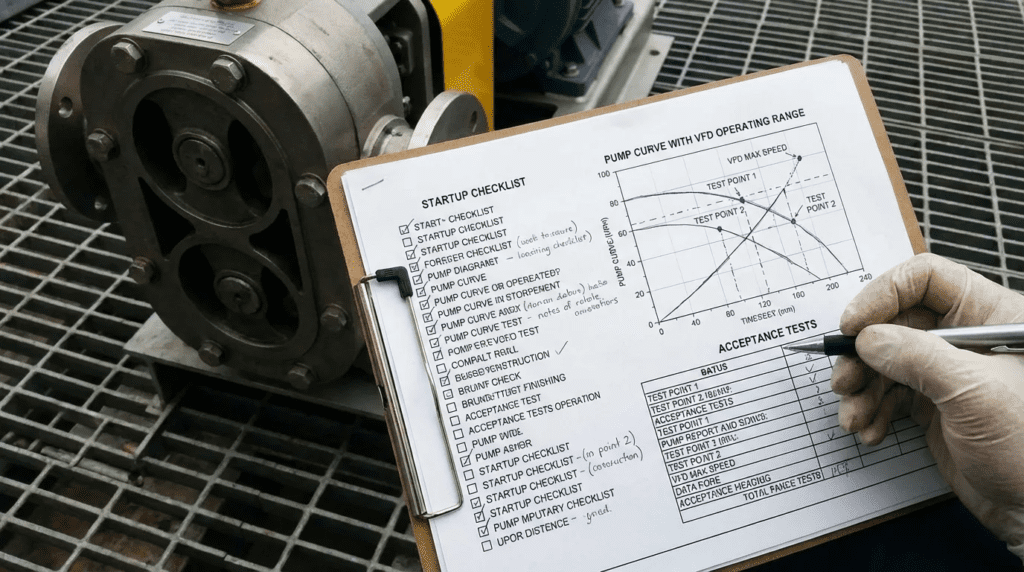
- Performance Curve Verification: Run the pump at 3-4 speed points (e.g., 25%, 50%, 75%, 100%) to plot the flow vs. speed curve. Note that factory tests usually use water; slip will be higher than with sludge.
- NPSH Testing: If suction conditions are critical, an NPSH test (vacuum suppression) should be requested to determine the onset of cavitation.
Site Acceptance Test (SAT) & Startup Checklist
The SAT validates the pump within the actual system. The following checklist items are mandatory:
- Alignment Check: Verify coupling alignment using laser tools. Pipe strain must be eliminated; disconnect flanges to ensure piping does not “spring” away from the pump.
- Oil Level & Type: Confirm gearbox oil level and type. Synthetic gear oils are often standard; mixing types can cause foaming and failure.
- Valve Status: CRITICAL: Ensure all suction and discharge valves are fully open. Verify pressure relief valves (PRV) or rupture disks are properly set.
- Instrumentation: Calibrate discharge pressure transmitters and flow meters. Test the high-pressure trip functionality by simulating a signal before running the pump.
- Bump Test: Bump the motor to verify rotation direction. Reverse rotation on a pump with directional check valves will cause immediate deadheading.
- Initial Run: Ramp up speed slowly (over 30-60 seconds). Monitor for knocking (cavitation) or rhythmic thumping (misaligned lobes).
- Vibration Analysis: Take baseline vibration readings on bearing housings. Typical alarm limits for rotary lobes are 0.15-0.25 in/sec velocity.
If the process fluid runs hot (>140°F), re-check the alignment after the pump has reached operating temperature. Thermal growth can throw a cold-aligned pump out of tolerance, leading to bearing stress.
Common Specification Mistakes
- Oversizing for “Safety”: Engineers often oversize pumps for future flows. Running a rotary lobe pump at very low speeds (<10% VFD output) can lead to motor overheating (insufficient cooling fan speed) and erratic flow control.
- Ignoring Pulsation: Rotary lobes generate pressure pulsations. Failing to specify pulsation dampeners on long discharge lines can lead to pipe fatigue and instrument damage.
- Ambiguous Material Specs: Specifying “rubber lobes” is insufficient. NBR swells in oil/grease; EPDM dissolves in oil but handles ozone well. Specify the elastomer based on chemical analysis of the waste stream.
O&M Burden & Strategy
Maintenance strategy should shift from reactive to predictive.
- Lobe Timing: Check timing gear backlash annually. If lobes touch, they will self-destruct.
- Seal Leakage: Monitor the intermediate quench chamber. Presence of product here indicates primary seal failure.
- Oil Analysis: Perform gearbox oil analysis every 6 months to detect metal shavings (gear wear) or water intrusion.
Troubleshooting Guide
- Symptom: Low Flow.
Root Cause: Excessive lobe wear (increased slip), low viscosity, or suction blockage.
Action: Measure lobe-to-housing clearance; check suction strainer. - Symptom: Excessive Noise/Knocking.
Root Cause: Cavitation (NPSH insufficient) or timing gear wear causing lobe contact.
Action: Check suction pressure gauge; inspect timing gears. - Symptom: Rapid Seal Failure.
Root Cause: Dry running, chemical attack, or shaft deflection due to pipe strain.
Action: Review chemical compatibility; verify pipe supports.
Design Details / Calculations
Proper system design precludes most operational issues. The following methodologies apply to the engineering phase preceding Commissioning Rotary Lobe: Startup Checklist and Acceptance Tests.
Sizing Logic & Methodology
Sizing a positive displacement pump differs fundamentally from sizing a centrifugal pump.
Step 1: Determine Theoretical Displacement
The pump displacement ($V_d$) is fixed per revolution.
$$ Q_{theoretical} = V_d times RPM $$
Step 2: Calculate Slip
Slip ($Q_{slip}$) is the leakage back across the clearances. It is a function of viscosity ($mu$), pressure differential ($Delta P$), and clearance dimensions.
$$ Q_{actual} = Q_{theoretical} – Q_{slip} $$
Note: Manufacturers provide slip coefficients based on viscosity. As viscosity increases, slip decreases.
Step 3: Calculate Torque and Horsepower
$$ HP = frac{Q_{actual} times Delta P}{1714 times eta_{mech}} $$
Unlike centrifugal pumps, HP requirements increase linearly with pressure. Always size the motor for the relief valve setting, not just the operating pressure, to prevent motor overload during upset conditions.
Specification Checklist
When preparing the Division 43 equipment specification, ensure these items are explicitly requested:
- Maximum RPM Limit: Cap the pump speed (e.g., max 350 RPM) to ensure longevity. High-speed operation accelerates abrasive wear exponentially.
- Clearance Adjustment: Require shims or adjustable timing gears to allow operators to re-time the lobes as gears wear.
- Seal Flush Plan: If pumping grit-laden sludge, specify an API Plan 53 or 54 equivalent (pressurized barrier fluid) or a simplified grease barrier depending on criticality.
- Testing Deliverables: Explicitly require certified reports for Hydrostatic Test, Performance Test (Flow/Head/Power), and Material Certifications (mill specs).
Be aware that factory performance tests run on water will show significantly higher slip than operation on sludge. Do not reject a pump during FAT solely because it underperforms on flow with water at high pressure; the slip will reduce once viscous sludge seals the clearances.
Standards & Compliance
- Hydraulic Institute (HI) Standards: Reference ANSI/HI 3.1-3.5 Rotary Pumps for Nomenclature, Definitions, Application, and Operation.
- AWWA: While specific AWWA standards for rotary lobes are less prescriptive than for centrifugals, general wastewater pumping guidelines apply.
- OSHA: Ensure all coupling guards and belt guards meet OSHA 1910.219 requirements.
Frequently Asked Questions
What is the primary difference between a rotary lobe and a progressive cavity pump?
The primary difference is the pumping element and flow characteristics. A rotary lobe pump uses two counter-rotating lobes that do not touch, relying on timing gears for synchronization. A progressive cavity (PC) pump uses a single metal rotor turning inside a rubber stator with an interference fit. Rotary lobe pumps are generally more compact, can run dry for short periods (if seals allow), and are easier to maintain in place (MIP). PC pumps generally handle higher pressures and shear-sensitive fluids better but have larger footprints and more complex maintenance procedures.
How do you perform a site acceptance test for Commissioning Rotary Lobe: Startup Checklist and Acceptance Tests?
A Site Acceptance Test (SAT) involves verifying the pump’s performance integrated with the plant’s piping and controls. Key steps include verifying alignment (laser), checking direction of rotation, testing safety interlocks (high-pressure trip, run-dry protection), and running the pump at various speeds to verify flow against the system head curve. Vibration and temperature baselines must be recorded. Refer to the [[Commissioning & Acceptance Testing]] section for a detailed checklist.
Can rotary lobe pumps run dry?
Generally, no, but they are more forgiving than progressive cavity pumps. Standard rotary lobe pumps rely on the pumped fluid to lubricate the mechanical seals and cool the housing. However, specific designs with hardened faces or external flush systems can tolerate dry running for short periods (minutes). Extended dry running will overheat the elastomers (lobes and seals), leading to failure. Dry run protection via thermal or flow sensors is highly recommended.
What is the typical maintenance interval for rotary lobe pumps?
Maintenance intervals vary by application severity. Typically, gearbox oil should be changed every 2,000-4,000 hours (or annually). Lobe wear should be inspected every 6 months. Mechanical seals typically last 12-24 months depending on the abrasiveness of the sludge and the efficacy of the seal flush system. In highly abrasive primary sludge applications, wear plates and lobes may require replacement annually.
Why is the pump vibrating excessively after startup?
Excessive vibration immediately after startup is usually caused by one of three factors: misalignment (pipe strain), cavitation (insufficient NPSH), or pulsation resonance. First, decouple the piping to check for strain. Second, check suction and discharge pressure gauges; low suction pressure indicates cavitation. Third, check if the discharge piping length is causing resonance; a pulsation dampener may be required.
How does viscosity affect rotary lobe pump sizing?
Viscosity is critical. As viscosity increases, “slip” decreases, improving volumetric efficiency. However, high viscosity also drastically increases friction losses in the suction piping, reducing NPSH available. The motor horsepower must be sized for the maximum expected viscosity (highest torque requirement) to prevent tripping on overload during cold weather or high-solids events.
Conclusion
Key Takeaways
- Safety First: Never start a positive displacement pump against a closed valve. Verify pressure relief protection immediately.
- Pipe Strain is Fatal: Ensure independent pipe supports are installed within 3 feet of the pump. Housing distortion causes catastrophic rotor contact.
- Viscosity Matters: Size motors for the highest viscosity (coldest temp/highest solids) to ensure sufficient torque.
- Acceptance Criteria: Don’t rely solely on water tests. Understand that slip will decrease (performance improves) with sludge.
- Protection: Mandate dry-run protection and high-pressure trips in the control logic.
The successful deployment of positive displacement technology relies heavily on the rigor applied during the specification and startup phases. Commissioning Rotary Lobe: Startup Checklist and Acceptance Tests is the engineering process that validates the compatibility of the machine with the hydraulic system. By focusing on accurate duty condition definition, ensuring robust material selection, and strictly adhering to installation protocols regarding alignment and pipe strain, engineers can maximize the return on investment for these critical assets.
For municipal and industrial applications, the rotary lobe pump offers a balance of efficiency, compactness, and maintainability. However, it is an unforgiving machine if installed carelessly. Engineers who enforce a detailed commissioning plan and empower operators with the correct acceptance criteria will ensure their facilities operate reliably for decades.