
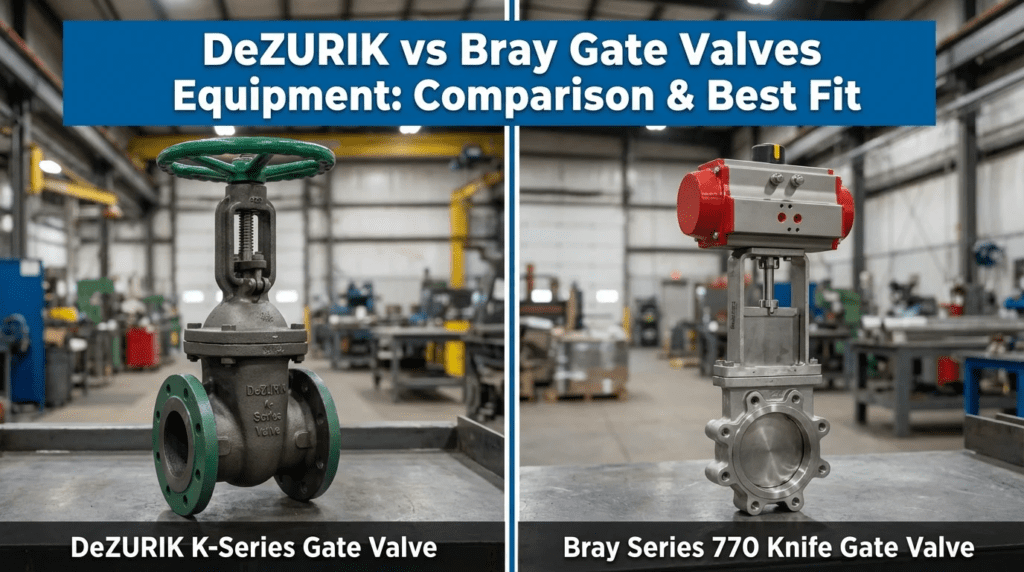
DeZURIK vs Bray Gate Valves Equipment: Comparison & Best Fit
Introduction
In municipal water and wastewater treatment, valve selection is rarely the most glamorous part of the design process, yet it accounts for a disproportionate amount of maintenance hours and operational frustration. A surprising industry statistic suggests that while valves represent approximately 5% of a plant’s capital cost, they can account for up to 60% of the maintenance budget over the facility’s lifecycle. For engineers and specifiers, the choice often comes down to navigating between legacy standards and modern versatility. This is particularly true when analyzing DeZURIK vs Bray Gate Valves Equipment: Comparison & Best Fit for critical isolation duties.
Isolation valves, specifically knife gates and resilient seated gate valves, are the sentinels of the process line. They sit dormant for months, yet must operate flawlessly during an emergency shutdown or routine pump maintenance. A failure here does not just mean a wet floor; it requires isolating upstream processes, potential bypass pumping, and significant downtime.
DeZURIK has long been considered a standard-bearer in the municipal sector, often written into “sole source” specifications due to decades of installed base performance. Bray, originally a powerhouse in industrial automation and butterfly valves, has aggressively expanded its portfolio (through acquisitions of brands like Ultraflo and Elite) to become a formidable competitor in the gate valve market. This article aims to strip away the brand loyalty and marketing rhetoric to provide a technical, rigorous analysis of DeZURIK vs Bray Gate Valves Equipment: Comparison & Best Fit. We will examine the engineering nuances of their designs, where each manufacturer excels, and how to specify the correct equipment for applications ranging from potable water distribution to abrasive grit slurries.
How to Select and Specify Gate Valve Equipment
Selecting between major manufacturers requires more than comparing price lists. It requires a deep dive into the specific engineering constraints of the application. When evaluating DeZURIK vs Bray Gate Valves Equipment: Comparison & Best Fit, engineers must categorize the application into one of two distinct “Gate” families: the Resilient Seated Gate Valve (typically AWWA C509/C515 for clean water) and the Knife Gate Valve (typically AWWA C520 for sludge and slurry). The selection criteria below apply to ensuring the right specification regardless of brand.
Duty Conditions & Operating Envelope
The primary driver for selection is the fluid matrix. Standard gate valves rely on a wedge seating into a groove or against a wall. In wastewater applications containing solids (RAS, WAS, Grit), a standard wedge gate will eventually fail to seat due to debris accumulation in the invert. Here, a knife gate is mandatory.
- Design Pressure (CWP): Municipal systems often operate at lower pressures (typically < 100 PSI), but the valve must be rated for the maximum shutoff head of the pumps. DeZURIK’s KGC and Bray’s Series 740 both offer 150 PSI ratings as standard, but higher pressure requirements (up to 250-300 PSI) may force a shift to specific heavy-duty models like DeZURIK’s KSV or Bray’s higher-pressure industrial lines.
- Fluid Velocity: Gate valves are isolation devices, not throttling devices. However, high-velocity scour can damage the seat rings in knife gates if the valve is left partially open. Specifications must explicitly ban throttling with these valves unless utilizing a V-port orifice (which is rare for standard isolation gates).
- Solids Content: For fluids with >2% solids, uni-directional knife gates are common, but bi-directional designs provide better versatility against backpressure.
Materials & Compatibility
Corrosion is the silent killer of valve longevity. Both DeZURIK and Bray offer a range of metallurgies, but the “standard” offering differs.

- Body Material: Cast Iron (ASTM A126) is the legacy standard, but Ductile Iron (ASTM A536) is superior for impact resistance and is increasingly the baseline specification. Stainless Steel (304/316) bodies are preferred for corrosive sludge or outdoor installations near coastal areas.
- Gate/Blade Material: The gate sees the most abuse. 304SS is often the base, but 316SS or 17-4PH hardened stainless is required for grit applications to prevent erosion.
- Seat Elastomers:
- EPDM: Standard for water and general wastewater (-20°F to 250°F). Good resistance to ozone and chloramines.
- Buna-N (Nitrile): Required if oils, greases, or hydrocarbons are present (e.g., scum lines, truck offloading).
- PTFE (Teflon): Used for chemical resistance or high friction reduction, but less forgiving on solids than elastomers.
Hydraulics & Process Performance
Gate valves are generally considered full-port devices, meaning the pressure drop across the valve in the open position is negligible. However, there are nuances:
- Port Area: Some “economy” knife gates have a slightly reduced port area compared to the pipe ID, creating a lip that can promote ragging. In DeZURIK vs Bray Gate Valves Equipment: Comparison & Best Fit analysis, verify the “Clearway” or “Full Port” dimension in the submittal drawings.
- Leakage Class: For knife gates, “Zero Leakage” is a term used loosely. MSS SP-81 allows for some leakage in metal-seated valves. For liquid service, specify “drip-tight” or “bubble-tight” shutoff, which requires a resilient perimeter seat.
Installation Environment & Constructability
Engineers often overlook the physical envelope of the valve, particularly when automation is involved.
- Bonnet Height: When the gate rises (OS&Y – Outside Screw and Yoke), the stem protrudes significantly. In tight pipe galleries, this vertical clearance is critical. Non-rising stem (NRS) configurations save space but remove visual position indication.
- Actuator Weight: Both DeZURIK and Bray offer heavy pneumatic and electric actuators. Engineers must verify that the pipe stress analysis accounts for this eccentric load, or specify pipe stands/supports immediately adjacent to the valve.
- Bolt Patterns: Ensure flange drilling matches the piping (ANSI 125/150). Note that some wafer-style knife gates use tapped lugs, which requires precise bolt length calculation to avoid bottoming out before compressing the gasket.

Reliability, Redundancy & Failure Modes
The most common failure mode for a knife gate valve is packing leakage. The packing gland seals the moving gate against the atmosphere.
- Packing Design: Look for rounded gate edges (which extend packing life) and live-loaded packing glands (using Belleville washers) that maintain seal pressure as the packing wears.
- Seat Failure: In knife gates, the gate cuts through the media. If a rock or metal debris is trapped, it can gouge the seat. DeZURIK’s “Extended Service” (ES) and Bray’s Elite lines feature designs intended to deflect solids away from the seating area.
Controls & Automation Interfaces
This is a major differentiator in the DeZURIK vs Bray Gate Valves Equipment: Comparison & Best Fit discussion. Bray’s heritage is in automation.
- Mounting Standards: ISO 5211 mounting pads are preferred for easy actuator retrofit.
- Solenoids and Positioners: For pneumatic actuation, integrated control boxes (solenoid, limit switches, speed controls) reduce field wiring. Bray often packages these modularly; DeZURIK often provides robust, heavy-duty external mounting.
- SCADA Integration: Specify 4-20mA feedback for modulating duties (rare for gates) or dry contacts for Open/Closed status.
Lifecycle Cost Drivers
Initial CAPEX often favors Bray or general industrial suppliers. However, OPEX analysis must include:
- Repacking frequency: Can the valve be repacked while under pressure? (Usually Yes for Wedge Gates, No for Knife Gates).
- Seat Replacement: Some designs require removing the valve from the line to replace the seat (DeZURIK KGC), while others might offer cartridge replacements. Removing a 24-inch valve from a rigid pipe gallery is a massive labor cost.
Comparison Tables: DeZURIK vs Bray
The following tables provide a side-by-side engineering analysis. Table 1 focuses on the equipment attributes, while Table 2 assists in selecting the best fit based on application constraints. These comparisons assume standard municipal product lines (e.g., DeZURIK KGC/KSV/RW against Bray Series 740/752/Resilient).
Table 1: Technical Attribute Comparison
| Feature / Attribute | DeZURIK (Typical Characteristics) | Bray (Typical Characteristics) | Engineering Implication |
|---|---|---|---|
| Primary Product Focus | Heavy Municipal / Pulp & Paper Heritage | Industrial / Automation / Modular Design | DeZURIK specs often exceed AWWA minimums; Bray focuses on versatility and global supply chain. |
| Casting & Ruggedness | Historically heavier wall thickness; known for massive “cast-in” quality. | Modern, optimized casting designs; lighter weight but meets pressure ratings. | DeZURIK often preferred for high vibration/water hammer risk zones. Bray easier to install due to weight. |
| Knife Gate Sealing | Premium packing systems; varying seat designs (Metal, Resilient, Urethane). | Strong focus on perimeter sealing and transverse seals (Elite/Ultraflo acquisitions). | Both achieve zero leakage, but mechanism differs. DeZURIK KGC is a municipal standard. |
| Automation Integration | Traditional cylinder actuators; robust but can be bulky. Custom mounting common. | Native integration with Bray controls; modular, compact, direct-mount options. | Bray has an edge in seamless “one-SKU” automated packages. DeZURIK excels in hydraulic cylinder actuation. |
| Maintenance Profile | Designed for long intervals; parts availability is excellent in North America. | Designed for easy component swap; global support network is extensive. | DeZURIK rep network is deeply embedded in municipal utilities. |
Table 2: Application Fit Matrix
| Application | Critical Constraint | DeZURIK Fit | Bray Fit | Selection Note |
|---|---|---|---|---|
| Raw Sewage / Headworks | Grit abrasion, ragging, heavy impact. | Excellent (KSV/KGC) | Good (Series 752/Elite) | Heavy solids favor the rugged casting mass of DeZURIK or Bray’s severe service lines. |
| Activated Sludge (RAS/WAS) | High frequency cycling, reliable shutoff. | Excellent | Excellent | A toss-up. Decision often drives by automation preference and price. |
| Potable Water Distribution | NSF-61, zero leakage, long dormancy. | Excellent (RW Gate) | Strong | DeZURIK Resilient Wedge is a standard spec. Bray is competitive but less dominant in buried service. |
| Chemical Feed / Dosing | Corrosion resistance, precise actuation. | Good | Excellent | Bray’s expertise in automation and stainless/teflon lined valves shines here. |
| HVAC / Plant Utility Water | Cost, space, weight. | Moderate | Excellent | Bray’s industrial/commercial roots offer cost-effective, lighter solutions for non-process water. |
Engineer & Operator Field Notes
Beyond the catalog data, the real test of DeZURIK vs Bray Gate Valves Equipment: Comparison & Best Fit happens in the field. These notes are compiled from commissioning experiences and operational logs.
Commissioning & Acceptance Testing
When commissioning these valves, generic checklists often miss the critical failure points of gate valves.
- The “Paper Test” (Knife Gates): During dry commissioning, insert a piece of paper between the gate and the seat and close the valve. Try to pull the paper out. If it slides easily, the seat compression is insufficient. This is a quick check before introducing fluid.
- Hydrostatic Duration: Do not just pressure up and leave. Hold test pressure for at least 15 minutes. Resilient seats can “creep,” and packing leaks often take time to weep through the gland.
- Actuator Setup: For pneumatic valves, verify the speed control valves are set. A knife gate slamming shut in 0.5 seconds can cause massive water hammer and damage the seat. Aim for a slow, controlled closure (e.g., 1 inch per second minimum).
Common Specification Mistakes
- Under-specifying Actuators: Engineers often calculate torque based on differential pressure alone. However, “breakaway torque” after a valve has sat closed for 6 months in sludge is significantly higher (sometimes 2-3x). Specifiers should require a 1.5x to 2.0x safety factor on actuator sizing for wastewater service.
- Ignoring Orientation: Installing a knife gate with the stem horizontal in a sludge line can lead to solids settling in the bonnet or packing area (depending on design), causing binding. Vertical stem (upright) is always best practice.
O&M Burden & Strategy
Maintenance teams often report different experiences with DeZURIK and Bray based on local support.
- Lubrication: Non-rising stems (NRS) are submerged in the fluid (for wedge gates) or hidden. Rising stems (OS&Y) gather dust and grit. Bray often utilizes coated stems that reduce greasing requirements, while DeZURIK heavy-duty valves may have grease fittings that must be included in the PM schedule.
- Packing Adjustment: DeZURIK packing glands are generally very accessible. Bray’s design is also accessible, but ensure the valve orientation doesn’t put the gland against a wall.
- Spares: DeZURIK parts are often stocked by local municipal reps. Bray parts are widely available through industrial distribution chains. The “best” choice often depends on who the local distributor is in your region.
Design Details and Calculations
To rigorously evaluate DeZURIK vs Bray Gate Valves Equipment: Comparison & Best Fit, engineers must perform basic sizing checks.
Sizing Logic & Methodology
Unlike control valves, isolation valves are usually line-sized. However, you must verify the velocity.
- Calculate Velocity: $V = Q / A$
Where $Q$ is flow and $A$ is the valve port area.
Rule of Thumb: Keep velocity below 10-12 ft/s for liquids to prevent cavitation and erosion during the closing cycle. - Verify Cv: Even wide open, valves have resistance.
$dP = SG times (Q / C_v)^2$
Ensure the pressure drop is negligible (< 1 PSI) at normal flow. Both DeZURIK and Bray provide Cv tables. A significant difference in Cv between the two for the same size implies one has a restricted port.
Specification Checklist
When writing the spec, ensure these items are included to force a fair comparison:
- Compliance: Must meet AWWA C520 (Knife Gate) or C509/C515 (Resilient Wedge).
- Flange Drilling: ANSI B16.1 Class 125 or B16.5 Class 150.
- Testing: MSS SP-81 for knife gate seat testing.
- Coating: Interior and exterior epoxy coating generally required for wastewater (min 8-10 mils).
- Hardware: 316 Stainless Steel bolting (avoid zinc-plated steel which rusts immediately in damp galleries).
Frequently Asked Questions
What is the primary difference between DeZURIK and Bray for municipal applications?
The primary difference lies in their heritage and product focus. DeZURIK is traditionally viewed as a heavy-duty, municipal-specification specialist with robust, conservative designs (like the KGC and Eccentric Plug Valve). Bray originated in industrial automation and butterfly valves, bringing a focus on modularity, advanced automation integration, and versatility. In terms of DeZURIK vs Bray Gate Valves Equipment: Comparison & Best Fit, DeZURIK is often the default for raw sewage and heavy solids, while Bray is increasingly favored for automated processes and balance-of-plant applications.
Can I use a standard gate valve for sludge?
No. Standard resilient wedge gate valves have a bottom pocket where the wedge seats. In sludge applications, solids settle in this pocket, preventing the valve from fully closing. You should specify a Knife Gate Valve (AWWA C520), where the blade cuts through the solids and seats against a perimeter or bottom seal that is self-clearing.
Which manufacturer offers better automation options?
Bray is generally considered to have a more integrated automation platform. Because they manufacture their own actuators and positioners, the compatibility is seamless. DeZURIK provides excellent automation, often utilizing heavy-duty cylinder actuators (pneumatic/hydraulic) that are incredibly durable but may require more external integration for smart feedback compared to Bray’s modular electronic accessories.
What is the typical lifespan of these valves?
In municipal water/wastewater service, a high-quality gate valve from either manufacturer should last 20-30 years with proper maintenance. However, “wetted” parts like rubber seats and packing typically require replacement every 5-10 years depending on the cycle frequency and abrasiveness of the fluid. DeZURIK heavy castings have been known to last 40+ years in the field.
Are DeZURIK and Bray valves dimensionally interchangeable?
Generally, yes, regarding “Face-to-Face” dimensions, provided you specify the correct standard (e.g., MSS SP-81 for knife gates). However, actuator height and width vary significantly. When retrofitting a Bray valve into a space designed for DeZURIK (or vice versa), you must verify the clearance for the stem travel and the actuator envelope to ensure it fits within piping galleries.
Conclusion
Key Takeaways: DeZURIK vs Bray Selection
- Application Specificity: Use DeZURIK KGC/KSV for heavy grit, raw sewage, and applications requiring maximum abuse resistance. Use Bray for applications requiring sophisticated automation, tight spaces, or cost-optimized utility service.
- Valve Type Rules: Never use Resilient Wedge Gate Valves for sludge; always spec Knife Gates.
- Actuation: If heavy hydraulic/pneumatic power is needed, DeZURIK excels. If electric/modular control is needed, Bray excels.
- Standardization: Consider the plant’s existing installed base. Stocking spare parts for two different manufacturers increases inventory costs.
- Safety Factors: Always size actuators with a 1.5x safety factor over the manufacturer’s torque chart for wastewater service.
Ultimately, the decision in the DeZURIK vs Bray Gate Valves Equipment: Comparison & Best Fit debate is rarely about one brand being objectively “better” than the other; it is about alignment with the specific design criteria. DeZURIK remains the heavyweight champion for severe municipal duty, offering peace of mind through sheer ruggedness and a massive installed base. Bray offers a compelling alternative with modern engineering, superior automation integration, and global versatility.
For the consulting engineer or plant manager, the best practice is to stop specifying by brand name alone and start specifying by performance attributes—material hardness, packing design, actuator safety factors, and leakage classes. By doing so, you ensure that whether DeZURIK or Bray wins the bid, the installed equipment will meet the rigorous demands of water and wastewater treatment for decades to come.