
ABB vs Emerson Instrumentation Equipment: Comparison & Best Fit
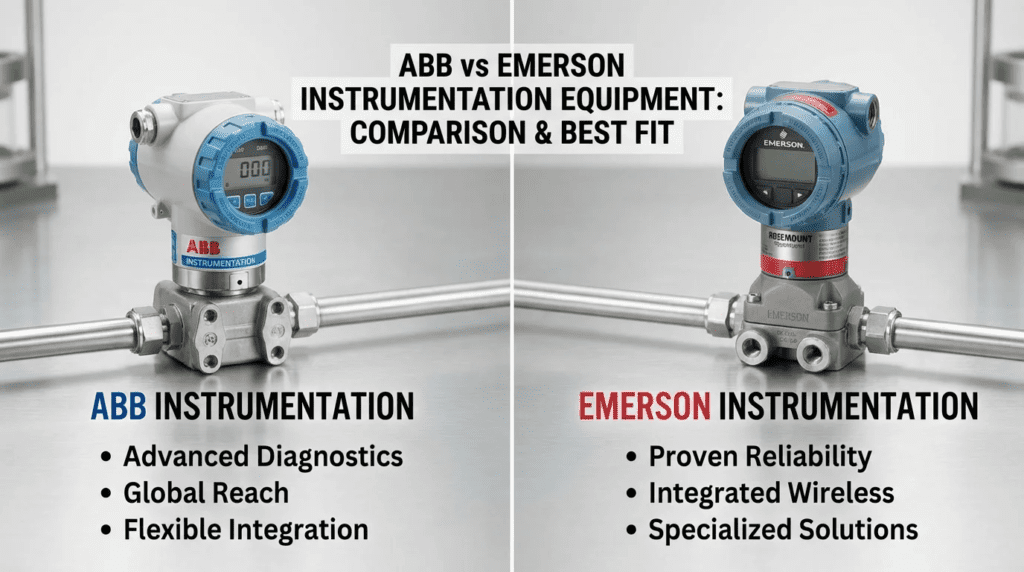
ABB vs Emerson Instrumentation Equipment: Comparison & Best Fit
Introduction
One of the most persistent problems in water and wastewater design is the specification inertia that dictates instrumentation choices. Engineers replicate previous specifications without re-evaluating whether the technology has evolved or whether the application demands have shifted. A meaningful share of minor process deviations trace back not to mechanical failure but to sensor drift, incorrect calibration ranges or material incompatibility in the instrumentation layer.
This is one of the few vendor pairings in this category where both companies genuinely compete in the named product class. ABB and Emerson are both established process instrumentation manufacturers, and instrumentation is exactly what they supply. When evaluating ABB vs Emerson Instrumentation Equipment: Comparison & Best Fit, the decision carries real weight for long-term reliability, data integrity and total cost of ownership.
Their philosophies and sweet spots within the water sector differ materially. Emerson, largely through its Rosemount and Micro Motion brands, is associated with heavy industrial and process-critical precision. ABB has cultivated a deep reputation in municipal water networks and distribution. The distinction is rarely good against bad but optimized against misapplied: a high-tier industrial sensor in a standard lift station wastes capital, while a standard municipal meter in a high-corrosion industrial stream invites premature failure. Broader supplier positioning is covered in our overview of the top water treatment equipment manufacturers.
How to Select and Specify
Duty Conditions & Operating Envelope
The primary differentiator lies in the hydraulic and physical extremes of the application. Water and wastewater systems present challenges that differ from the stable flows of chemical processing.
- Flow turndown: Municipal water usage follows diurnal patterns, so instrumentation must hold accuracy at nighttime minimums and peak flows alike. Compare the low-flow cutoff points across the candidate product lines rather than accepting a headline turndown figure.
- Pressure transients: Hammer and surge events are common in force mains. Pressure transmitters need adequate overpressure protection without shifting the zero point.
- Submersion: In vaults and wet wells, accidental submersion is inevitable. Specifying IP68 requires verifying the manufacturer’s definition of continuous submersion — some define it as a fixed duration, others as permanent depth.
Materials & Compatibility
- Liner selection: For abrasive activated sludge or grit service, soft rubber or polyurethane liners outperform PTFE, which can tear. For corrosive chemical dosing, PTFE or PFA becomes mandatory.
- Electrode materials: Standard 316L stainless often fails in coagulation processes through chemical attack or noise generation. Hastelloy or platinum alloy electrodes may be required.
- Drinking water approvals: Ensure all wetted parts carry NSF/ANSI 61 and 372 certification for potable applications. This is a standard check on ABB’s municipal lines but requires specific model selection within Emerson’s broader industrial portfolio.
Hydraulics & Process Performance
- Straight run requirements: Traditional magnetic meters require several pipe diameters upstream and downstream. Both manufacturers offer reduced-run options, but verify whether accuracy degrades under those conditions rather than assuming parity.
- Head loss: Full-bore magnetic meters have negligible head loss. Coriolis mass flow measurement for sludge density induces pressure drop that must be calculated against pump curves.
Installation Environment & Constructability
- Remote transmitters: In deep wet wells or classified hazardous areas, the transmitter often needs remote mounting. Check the maximum cable length for signal integrity, since limits vary widely between systems and cable types.
- Buried service: ABB has historically strong offerings for direct-buried magnetic meters that avoid vault construction cost, with potted sensors and robust cable potting. Emerson also offers buried service options, but specification details on coating and cathodic protection compatibility are vital.
Reliability, Redundancy & Failure Modes
- Coating detection: In wastewater, grease and struvite buildup on electrodes causes signal drift. Both manufacturers offer diagnostics — Emerson’s coating detection and ABB’s verification tools — that alert operators before measurement is lost.
- Empty pipe detection: Preventing phantom flow readings when a pipe drains is critical for accurate totalization and for protecting pumps from dry running.
Controls & Automation Interfaces
- Protocol positioning: Emerson is a primary driver of HART and wireless HART, offering deep diagnostic data over those networks. ABB provides strong native support for Modbus and fieldbus protocols common in European-influenced designs and package plants.
- Industrial Ethernet: As the industry moves toward Ethernet-connected field devices, verify native support against the need for gateway cards.
Maintainability, Safety & Access
- In-situ verification: Removing a large magnetic meter for calibration is costly and disruptive. Both manufacturers offer verification software and hardware that checks internal electronics and coil integrity without removal, which matters for regulatory reporting.
- Modular design: Can the transmitter head be replaced without depressurizing the line or removing the sensor body? This is a key maintainability feature for operators.
Lifecycle Cost Drivers
- Power consumption: For remote metering vaults without line power, battery life is the primary driver. ABB’s AquaMaster series is well regarded for battery management in district metered area zoning.
- Standardization: Selecting a single vendor for a plant reduces spare parts inventory — one set of transmitter electronics across multiple pipe sizes — and simplifies operator training.
Comparison Tables
| Manufacturer | Primary Strengths | Typical Applications | Considerations | Maintenance Profile |
|---|---|---|---|---|
| ABB WaterMaster, AquaMaster, Aztec |
|
|
|
Moderate: reliable install-and-forget hardware, well suited to remote, low-touch sites |
| Emerson Rosemount, Micro Motion |
|
|
|
Diagnostics-led: requires higher initial skill to configure advanced features, but verification reduces physical maintenance |
| Application | Service Type | Key Constraints | Recommended Fit | Rationale |
|---|---|---|---|---|
| Remote metering vault | Potable water | No line power; limited access; high moisture | ABB AquaMaster | Battery life management and robust buried or submersible design reduce civil cost |
| Thickened sludge and return sludge | Abrasive wastewater | Density changes; accuracy needed for process control | Emerson Micro Motion or Rosemount with high-signal excitation | Coriolis offers direct mass and density measurement; high-signal magnetic meters handle slurry noise better than standard coils |
| Digester gas monitoring | Wet, dirty biogas | Low pressure; variable composition; moisture | Emerson thermal mass or Coriolis | These technologies handle low flow and pressure with compensation for composition changes; standard magnetic meters cannot measure gas |
| General plant influent and effluent flow | Water or sewage | Budget constraints; large pipe diameter | Competitive tie | Typically driven by bid cost and the existing plant standard. Both perform reliably here. |
| Chemical dosing | Aggressive chemicals | Low flow rates; pulsating flow from diaphragm pumps | Emerson Rosemount or Micro Motion | High sampling frequencies handle pulsating flow from dosing pumps, with strong wetted-material options |
Engineer & Operator Field Notes
Commissioning & Acceptance Testing
For electromagnetic flowmeters, the most common startup failure is improper grounding.
- Grounding rings and electrodes: In plastic or lined pipe, the fluid must be referenced to the meter body. This is accomplished with grounding rings — flat conductive rings installed between the meter and pipe flanges, not to be confused with orifice plates — or with a third grounding electrode built into the sensor. Ensure the contractor has not installed grounding rings on unlined conductive pipe without isolation, which creates ground loops.
- Zero verification: Perform a zero adjustment only when the pipe is full and flow is genuinely zero. Zeroing with a partially full pipe or leaking isolation valves introduces a permanent offset.
- Verification baseline: Use the manufacturer’s verification tool to generate a baseline record of coil inductance and electrode resistance at commissioning. That baseline is what makes later verification meaningful.
Common Specification Mistakes
- Over-specifying turndown: Engineers often specify extreme turndown ratios drawn from marketing literature. Digital transmitters can display those ranges, but hydraulic accuracy at the extreme low end makes the data useless for process control. Stick to verified hydraulic velocity ranges.
- Ignoring cable lengths: Specifying remote transmitters without checking the manufacturer’s limit on cable capacitance produces signal noise. The two manufacturers have different limits for standard against proprietary cable.
- Material incompatibility: Specifying standard 316 stainless electrodes for ferric chloride or polymer dosing leads to rapid pitting and signal loss. Always cross-reference chemical compatibility charts.
O&M Burden & Strategy
- Emerson strategy: Relies on predictive intelligence, using diagnostics over the digital protocol to indicate when maintenance is needed. This requires a control system capable of reading and visualizing secondary variables — otherwise the diagnostics deliver nothing.
- ABB strategy: Leans toward robust simplicity. Maintenance is typically interval-based or reactive for non-critical loops, with high reliability in between. For battery units, replacement cycles must be programmed into the maintenance management system.
Troubleshooting
- Wandering or noisy signal. Often air entrainment or slurry noise. Check for upstream aeration or free-fall. For slurry, increase the damping time constant, or switch to a high-signal excitation mode where available.
- Output locked at zero or full scale. Check the fail-safe setting — is it configured to drive upscale or downscale? Verify whether self-diagnostics are triggering a fault such as an open coil.
Design Details and Calculations
Sizing Methodology
Do not size the flowmeter to match the pipe flange. This is the most common design error in flow instrumentation.
- Determine flow range: Identify minimum day, average day and peak hour flows.
- Calculate velocity: Velocity equals flow divided by cross-sectional area. Target an ideal range of roughly 2 to 15 ft/s, keeping velocity above about 2 ft/s to prevent solids settling in the meter and below roughly 20 ft/s to limit liner wear.
- Select bore size: It is common practice to reduce the meter one size below line size — a 6-inch meter on 8-inch pipe — to raise velocity at low flows and improve accuracy.
- Check pressure drop: Where bore size is reduced, calculate head loss as a function of velocity and the fitting loss coefficient, and confirm it does not restrict gravity flow capacity or choke the pump.
Specification Checklist
- Transmitter enclosure: NEMA 4X for general use, IP68 for vault installations
- Accuracy requirement: Specify as a percentage of rate rather than percentage of full scale, since full-scale specifications degrade low-flow accuracy
- Verification: Require onboard verification software capable of checking coil integrity, electrode resistance and transmitter electronics without external equipment
- Output: Analog with the required HART revision, and industrial digital protocol where the plant standard demands it
- Certifications: NSF/ANSI 61 for potable water; hazardous location rating for digesters and headworks
Standards
- AWWA C700 series: Governs cold water meters; ensure compliance where custody transfer or billing is involved
- NEC (NFPA 70): Verify separation of signal and power cables in cable trays to prevent induction noise
- IEC 62443: For network-connected instruments, ensure compliance where devices sit directly on the operational technology network
Frequently Asked Questions
What is the difference between ABB and Emerson magnetic meters for wastewater?
Both are capable. The difference lies in the sweet spot of application. ABB’s WaterMaster and AquaMaster lines are optimized for the water industry, featuring battery options and bore geometries that improve low-flow profiling. Emerson’s Rosemount series derives from heavy process industries, offering stronger diagnostics for coating, noise and grounding issues, which suits difficult industrial wastewater and sludge applications.
How do I select between HART and Modbus for these instruments?
It depends on the control architecture. HART overlays digital data on the analog signal, which is excellent for retrofits using existing wiring but requires HART-enabled input cards to access diagnostic data. Modbus allows daisy-chaining and provides all data digitally but is slower and can be harder to troubleshoot. ABB has historically strong Modbus integration; Emerson drives the industry standard for HART and its wireless variant.
Is it worth paying extra for non-contact radar level transmitters?
Generally yes for wastewater. Unlike ultrasonic sensors, which struggle with foam, condensation and debris in wet wells, non-contact radar is unaffected by vapor space conditions. Reduced maintenance — no cleaning required — typically produces a short payback relative to ultrasonic alternatives.
Can ABB and Emerson instruments be mixed in the same plant?
Yes, and it is common practice to select best of breed rather than a single vendor. A plant might use ABB battery-powered meters for the distribution network and clean water side while using Emerson Coriolis meters for sludge density and Rosemount radar for digester levels. The key is keeping the integration standard consistent to minimize complexity.
What is the typical lifespan of a magnetic flowmeter?
A properly specified magnetic flowmeter typically lasts fifteen to twenty-five years. The failure point is rarely the flow tube but the transmitter electronics, or liner damage from abrasive wear. Both manufacturers offer replaceable electronics, allowing the expensive flow tube to remain in service for decades.
Do I need grounding rings?
If the pipe is non-conductive or lined metal, you must provide a reference ground. Both manufacturers address this either with grounding rings — conductive rings between the meter and pipe flanges — or with a third grounding electrode in the sensor. Failure to install these per the manufacturer’s specific diagram is the leading cause of unstable readings during commissioning.
Conclusion
Key Takeaways
- Application context governs: Use ABB for general municipal water, distribution networks and battery-powered applications. Use Emerson for critical industrial wastewater, sludge density and hazardous areas requiring deep diagnostics.
- Don’t oversize: Size flowmeters for velocity, not pipe diameter, to preserve accuracy during low-flow periods.
- Diagnostics save labor: Invest in verification features. Verifying calibration without removing the meter pays for the premium in one maintenance cycle — but only if the control system can read the data.
- Material compatibility: Verify wetted parts against chemical injection streams. Do not assume stainless steel is safe for coagulants.
- Lifecycle cost: Consider power and civil works. Buried service or battery-powered units can significantly reduce capital cost.
The engineer’s goal is matching the technology class to the risk profile of the application. There is no single winner, only the right tool for the job.
For standard municipal water treatment, distribution monitoring and cost-sensitive potable water projects, ABB provides a purpose-built portfolio aligned with utility budgets and operational capabilities, with particular strength in battery-powered and buried applications. For complex industrial wastewater, sludge thickening, anaerobic digestion and critical process control where sensor failure could violate a permit or damage equipment, Emerson’s diagnostics and build quality justify the investment. Related evaluations appear in our comparisons of ABB and VEGA CSO and storm instrumentation, YSI and SCADATA instrumentation, and ABB and PRIMEX automation and controls.