
Diaphragm Lifecycle Cost: CAPEX vs OPEX and Energy Payback
Introduction to Diaphragm Pump Economics
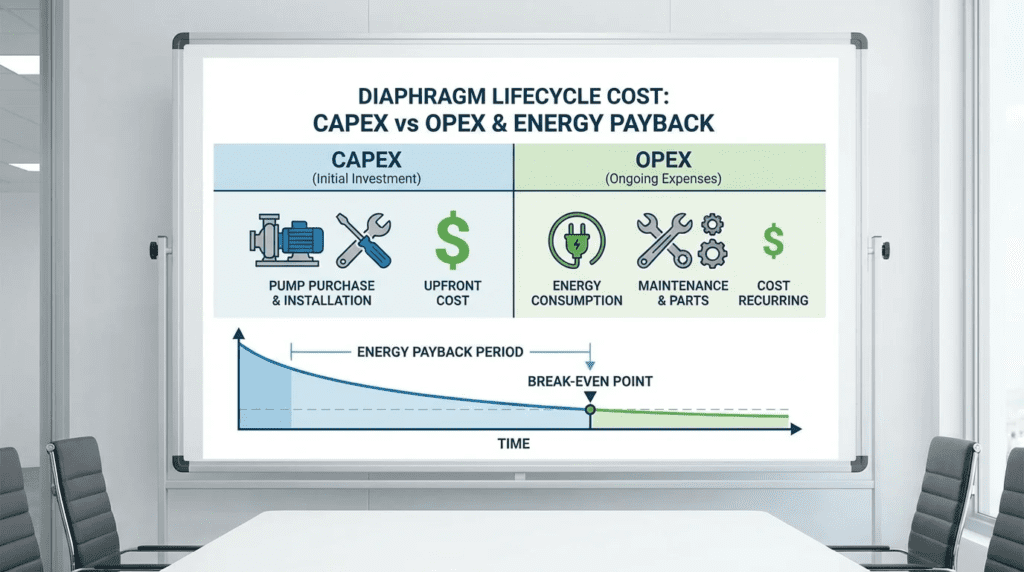
For municipal and industrial engineers, the initial purchase price of a pump often dominates the procurement conversation. However, in the realm of positive displacement technology, fixating on the sticker price is a critical specification error. A detailed analysis of Diaphragm Lifecycle Cost: CAPEX vs OPEX and Energy Payback reveals that the initial Capital Expenditure (CAPEX) frequently represents less than 15% of the total cost of ownership (TCO) over a 20-year asset life. The remaining 85% is consumed by energy, maintenance, spare parts, and, crucially, the cost of process downtime or chemical overdosing.
Diaphragm pumps—ranging from small solenoid metering units to massive high-pressure hydraulic sludge pumps—are the workhorses of chemical dosing, filter press feeding, and viscous slurry transfer. They are ubiquitous in water treatment plants (WTP) and wastewater treatment plants (WWTP), handling sodium hypochlorite, alum, lime slurry, and polymer. Yet, the energy conversion inefficiency of certain diaphragm technologies, particularly Air-Operated Double Diaphragm (AODD) pumps in continuous service, can silently bleed a utility’s operating budget.
This article provides a rigorous engineering framework for evaluating Diaphragm Lifecycle Cost: CAPEX vs OPEX and Energy Payback. It moves beyond catalog data to address the real-world economic impacts of efficiency curves, material selection, and maintenance intervals. We will explore why “cheap” pumps often result in the most expensive fluid handling solutions and provide the calculation methodologies necessary to justify higher-efficiency technologies to stakeholders.
How to Select and Specify for Lowest Total Cost of Ownership
Selecting the correct diaphragm pump requires balancing hydraulic capability with economic reality. The following criteria are designed to help engineers specify equipment that optimizes the Diaphragm Lifecycle Cost: CAPEX vs OPEX and Energy Payback equation.
Duty Conditions & Operating Envelope
The duty cycle is the primary determinant of the CAPEX/OPEX ratio. Engineers must distinguish between transfer applications and metering applications, as well as continuous versus intermittent service.
- Continuous Service: For 24/7 applications, energy efficiency is paramount. Using compressed air (AODD) for continuous transfer is rarely economically viable compared to electric motor-driven diaphragm pumps due to the energy losses in compressing air.
- Intermittent/Utility Service: For sump dewatering or infrequent tank transfers (e.g., < 2 hours per day), the lower CAPEX of an AODD or simple mechanical diaphragm pump may outweigh the high energy cost, resulting in a favorable TCO.
- Variable Flow Requirements: If the process requires significant turndown (e.g., flow pacing for chlorination), the pump’s ability to maintain accuracy at low speeds affects chemical costs. A pump that loses accuracy below 10% capacity may force overdosing, inflating OPEX significantly.
Materials & Compatibility
Material selection dictates the maintenance interval. A mismatch here leads to rapid failure, spiking labor and parts costs.
- Diaphragm Composition: PTFE (Teflon) offers superior chemical resistance but has less flex life and requires a larger pump for the same flow compared to elastomers like EPDM or Santoprene. Specifying PTFE when compatible elastomers would suffice increases CAPEX (larger pump) and potentially maintenance frequency.
- Check Valve Balls/Seats: In abrasive applications (lime, carbon slurry), standard ceramic or stainless balls may wear prematurely. Specifying exotic materials like Hastelloy or specialized polymers increases CAPEX but can extend MTBF (Mean Time Between Failures) from months to years.
- Liquid End Construction: For corrosive coagulants (Ferric Chloride), non-metallic heads (PVDF, PVC) are standard. However, in high-pressure applications, reinforced metallic heads with liners may be required to prevent creep and leaks, impacting the lifecycle budget.
Hydraulics & Process Performance
Unlike centrifugal pumps, diaphragm pumps are positive displacement devices, meaning flow is relatively independent of pressure. However, internal slip and volumetric efficiency play a role in energy payback.
- NPSH Available (NPSHa): Diaphragm pumps, utilizing reciprocating action, require significant NPSH to prevent cavitation. Cavitation destroys diaphragms and check valves. Ensuring NPSHa > NPSHr + 5 ft margin is critical for lifecycle longevity.
- Acceleration Head: The pulsating flow creates inertia losses in the suction line. Failing to account for acceleration head in the design phase leads to “starved” pumps, knocking, and rapid component failure—a massive hidden OPEX driver.
Installation Environment & Constructability
The physical footprint and auxiliary requirements influence the total installed cost.
- Pulsation Dampening: Almost all reciprocating diaphragm pumps require pulsation dampeners on the discharge (and often suction) side to protect piping. Omitting these to save CAPEX frequently results in pipe fatigue, joint leaks, and instrument damage.
- Air Supply vs. Electrical Drops: Installing a new compressed air loop for an AODD can be more expensive than running conduit for a motor-driven pump, depending on the facility layout. This infrastructure cost must be included in the CAPEX analysis.
Reliability, Redundancy & Failure Modes
Reliability engineering focuses on predicting the “weakest link.” In diaphragm pumps, the diaphragm itself is the consumable.
- Leak Detection: Double diaphragm designs with intermediate leak detection chambers prevent process fluid from contaminating the gearbox or air system upon failure. While this adds to CAPEX, it prevents catastrophic replacement costs (new gearbox, motor, or air system cleaning) and environmental cleanup fines.
- Hydraulic vs. Mechanical Actuation: Hydraulically actuated diaphragms (balanced pressure) last significantly longer than mechanically actuated ones (direct stress) in high-pressure applications. For pressures >100 psi, the hydraulic design usually offers a better ROI despite higher initial cost.
Controls & Automation Interfaces
Modern diaphragm pumps offer integral VFDs and smart controllers. Integrating these reduces external panel costs but increases the pump unit cost.
- Smart Dosing: Pumps that accept 4-20mA signals directly and provide flow feedback verification ensure process compliance.
- Remote Diagnostics: IoT-enabled pumps can warn of diaphragm wear or check valve fouling before failure, allowing for planned maintenance rather than emergency overtime repairs.
Maintainability, Safety & Access
Labor is often the largest component of OPEX after energy.
- Parts Count: AODD pumps have air distribution valves (air motors) that can stall or freeze. Electric diaphragm pumps eliminate this system entirely.
- Check Valve Access: Designs that allow check valves to be cleaned or replaced without disturbing the main piping reduce maintenance hours per event.
- Safety: Diaphragm pumps can deadhead and over-pressurize piping if the discharge is blocked. Integral pressure relief valves (PRV) are a safety necessity. External PRVs require additional piping and maintenance; internal ones simplify the installation.
Lifecycle Cost Drivers
This is the core of the specification strategy. Engineers must weigh the trade-offs explicitly.
- Energy Payback: This calculates how quickly the energy savings of a more efficient pump cover its price premium. For example, replacing a 2-inch AODD consuming 60 CFM of air with a 3 HP electric diaphragm pump often yields an energy payback of under 18 months.
- Chemical Costs: A metering pump with ±1% accuracy vs. one with ±5% accuracy can save tens of thousands of dollars annually in chemical spend, dwarfing the pump’s purchase price.
- Consumables: Calculate the annual cost of diaphragm kits, oil changes, and valve balls based on manufacturer-recommended intervals.
Technology and Application Comparison
The following tables provide a direct comparison of diaphragm pump technologies and their suitability for various municipal and industrial applications. Table 1 focuses on the technological trade-offs impacting Diaphragm Lifecycle Cost: CAPEX vs OPEX and Energy Payback, while Table 2 assists in application alignment.
| Pump Technology | Typical CAPEX | Energy Efficiency (OPEX) | Maintenance Profile | Best-Fit Scenario |
|---|---|---|---|---|
| Air-Operated Double Diaphragm (AODD) | Low | Very Low (High Cost). Compressed air is expensive to generate (approx. 10-15% efficient). | Moderate. Air valves sensitive to dirty air; diaphragms flex-stressed. High noise levels. | Intermittent transfer; portable utility pumps; explosive environments (intrinsically safe). |
| Solenoid Metering Pump | Very Low | Moderate. Electrical consumption is low, but limited to low flow/pressure. | Moderate/High. Solenoids generate heat; electronics can fail in poor environments. | Low-flow chemical dosing (< 20 GPH); light industrial/commercial water treatment. |
| Mechanical Motor-Driven Diaphragm | Moderate | High. Direct motor drive is efficient. VFDs add control without air losses. | Low. Straightforward gearbox; diaphragms are the primary wear part. | Water/Wastewater chemical metering; low-pressure transfer (< 150 PSI). |
| Hydraulic Motor-Driven Diaphragm | High | High. Can handle high pressures efficiently. | Very Low. Hydraulically balanced diaphragms last years. Complex gearbox requires oil changes. | Critical process metering; high-pressure injection; abrasive slurries; situations demanding high reliability. |
| Electric Double Diaphragm (EODD) | High | High. Replaces air motor with electric drive; 5-10x more efficient than AODD. | Low/Moderate. Similar fluid end to AODD but eliminates air system maintenance. | Replacing continuous-duty AODDs to capture energy ROI; filter press feed. |
| Application | Service Type | Critical Constraints | Recommended Tech | LCC Priority |
|---|---|---|---|---|
| Sodium Hypochlorite (Hypo) Dosing | Continuous / Flow Paced | Off-gassing (vapor lock); Corrosion | Motor-Driven Diaphragm (High speed stroking or degassing heads) | OPEX: Accuracy prevents chemical waste; reliability prevents vapor lock downtime. |
| Lime Slurry Transfer | Intermittent / Batch | Abrasion; Settling solids | AODD (if intermittent) or Peristaltic (alternative) | CAPEX/Maintenance: Abrasion resistance dominates; cheap pumps fail weekly. |
| Filter Press Feed | Variable Pressure | Deadhead capability; Variable flow | High-Pressure AODD or EODD | Energy Payback: EODD drastically reduces energy cost during long filtration cycles compared to AODD. |
| Polymer Injection | Continuous | Shear sensitivity; Viscosity | Hydraulic Diaphragm or Progressive Cavity (alternative) | Process Performance: Shearing polymer renders it useless (wasted chemical OPEX). |
| Sump / Utility Dewatering | Intermittent | Solids handling; Run-dry | Standard AODD | CAPEX: Low purchase price and portability are key; energy efficiency is negligible due to low runtime. |
Engineer & Operator Field Notes
Practical experience often reveals insights that data sheets conceal. The following notes address the realities of commissioning and maintaining diaphragm pumps to protect the Diaphragm Lifecycle Cost: CAPEX vs OPEX and Energy Payback model.
Commissioning & Acceptance Testing
A rigorous commissioning process is the baseline for future reliability.
- Calibration is Mandatory: Never assume the dial setting on a metering pump corresponds exactly to flow. Perform a drawdown test using a calibration column during SAT (Site Acceptance Test). Construct the specific pump performance curve (Flow vs. Hz or Flow vs. Stroke Length) for the operators.
- Backpressure Verification: Diaphragm metering pumps require backpressure to seat check valves and ensure accuracy. If dosing into an open channel, an artificial backpressure valve (BPV) must be installed. During commissioning, verify the BPV is set approx. 10-15 PSI above the suction pressure but below the relief valve setting.
- Safety Valve Setting: The external or internal Pressure Relief Valve (PRV) must be tested. Operators should witness the pump deadhead against a closed isolation valve and see the PRV open at the specified setpoint (typically 10-15% above system design pressure).
Common Specification Mistakes
Consequence: An engineer might specify a 2″ AODD for a lime loop because it handles solids well and costs $3,000. However, providing 100 CFM of compressed air continuously can cost >$15,000/year in electricity. A motor-driven alternative might cost $8,000 upfront but only $2,000/year to run. The “cheap” pump costs the utility $65,000 extra over 5 years.
- Oversizing: Engineers often apply excessive safety factors. A metering pump sized for 100 GPH running at 5 GPH (5% turndown) will suffer from poor check valve seating and erratic flow. Diaphragm pumps perform best in the 30%-90% range of their capacity.
- Ignoring Suction Piping: Undersized suction lines cause high fluid velocity and acceleration head losses. This leads to “hammering” in the pipes and cavitation, drastically shortening diaphragm life.
O&M Burden & Strategy
To minimize OPEX, maintenance must be proactive, not reactive.
- Oil Changes: Hydraulic diaphragm pumps have gearboxes and hydraulic reservoirs. Like a car, the oil degrades. Schedule oil changes annually or per manufacturer hours. Neglect here leads to catastrophic drive failure.
- Check Valve Hygiene: In lime or polymer applications, check valves foul. Operators should have easy access to flush or replace balls/seats. “Clean-in-place” or quick-disassembly connections can reduce maintenance labor hours by 50%.
- Diaphragm Replacement: Do not wait for failure. If the MTBF is known to be 18 months, schedule replacement at 15 months. A ruptured diaphragm can damage the pump internals or the air valve system (in AODDs), turning a $200 part replacement into a $2,000 repair.
Troubleshooting Guide
- Symptom: Pump running but no flow.
Root Cause: Air lock (vapor), debris in check valves, or excessive suction lift.
Fix: Bleed air; check suction strainer; inspect check valves for seating. - Symptom: Excessive Noise / Hammering.
Root Cause: Cavitation or acceleration head issues.
Fix: Increase suction pipe diameter; install pulsation dampener on suction side; reduce pump speed. - Symptom: Inaccurate Dosing.
Root Cause: Worn check valves or insufficient backpressure.
Fix: Replace balls/seats; install/adjust backpressure valve.
Design Details and Lifecycle Calculations
Quantifying the Diaphragm Lifecycle Cost: CAPEX vs OPEX and Energy Payback requires specific calculation methodologies.
Sizing Logic & Methodology
Proper sizing prevents energy waste and mechanical stress.
- Determine Flow and Pressure: Define the peak instantaneous flow, not just the average. Pressure must include static head + friction loss + acceleration head.
- Calculate Acceleration Head (Ha):
Formula:Ha = (L * V * N * C) / (g * k)
Where: L = Suction pipe length, V = Velocity, N = RPM/Strokes per min, C = Constant (pump type), g = gravity, k = fluid compressibility factor.
Note: If Ha is ignored, the pump may cavitate even if NPSHa appears sufficient. - Select Pump Speed: For abrasive fluids, keep stroking speed low (< 60-80 SPM) to reduce wear. For clean fluids, higher speeds allow for smaller, cheaper pumps.
Lifecycle Cost (LCC) Calculation Formula
To evaluate bids effectively, use the following TCO simplified formula:
LCC = Cic + Cin + (E * T) + (O * T) + (M * T) + (D * T)
- Cic: Initial Cost (Pump price)
- Cin: Installation Cost (Piping, electrical, foundations)
- E: Energy Cost per year
- O: Operation Cost (Operator labor, chemicals)
- M: Maintenance Cost (Parts + Labor) per year
- D: Downtime/Environmental Cost per year
- T: Time (Project lifecycle in years, e.g., 20)
Energy Payback Calculation: AODD vs. Electric
Calculation Example: The Hidden Cost of Air
Scenario: 2-inch pump moving 50 GPM at 60 PSI, operating 24/7 (8,760 hours/year).
Option A: AODD Pump
- Air Consumption: ~60 CFM @ 80 PSI.
- Compressor Power to generate 60 CFM: Approx 15 HP (11 kW).
- Annual Energy: 11 kW * 8,760 hrs * $0.10/kWh = $9,636 / year
Option B: Electric Diaphragm Pump
- Motor Size: 3 HP (2.2 kW).
- Annual Energy: 2.2 kW * 8,760 hrs * $0.10/kWh = $1,927 / year
The Payback:
- Annual Savings: $7,709.
- Price Premium for Electric Pump: ~$4,000 – $6,000.
- ROI: < 1 Year. Over 10 years, the electric pump saves >$75,000.
Standards & Compliance
Ensure specifications reference relevant standards:
- API 675: The gold standard for controlled volume (metering) pumps, defining accuracy (±1%), linearity, and steady-state flow.
- ANSI/HI 7.1-7.5: Hydraulic Institute standards for controlled volume pumps.
- NSF 61: Mandatory for any wetted parts in potable water applications.
Frequently Asked Questions
What is the biggest factor in Diaphragm Lifecycle Cost: CAPEX vs OPEX and Energy Payback?
For continuous duty applications, energy consumption is the largest factor, often comprising 40-60% of the lifecycle cost. For intermittent chemical dosing, the cost of chemical overfeed (due to poor pump accuracy) and maintenance labor (diaphragm replacement) are the dominant cost drivers. CAPEX is rarely the primary driver of TCO.
How do I choose between a hydraulic and mechanical diaphragm pump?
Select mechanical diaphragm pumps for lower pressures (< 150 PSI) and non-critical applications where lower CAPEX is desired. Select hydraulic diaphragm pumps for pressures > 150 PSI, critical metering applications requiring high reliability, or when pumping abrasive slurries. Hydraulic units balance the pressure across the diaphragm, significantly extending its life (OPEX savings).
Why are AODD pumps considered inefficient?
AODD pumps are driven by compressed air. Generating compressed air is inherently inefficient; it takes roughly 4-5 horsepower of electrical energy at the compressor to generate 1 horsepower of pneumatic work at the pump. While AODDs are excellent for stalling capability and portability, their energy conversion efficiency is very low compared to direct electric motor drives.
What is the typical lifespan of a diaphragm in wastewater service?
Diaphragm lifespan varies by material and duty. In clean chemical service (e.g., Alum), a quality diaphragm may last 12-24 months. In abrasive slurry service (e.g., Lime), this may drop to 3-6 months. Hydraulic diaphragms generally last 2-3 times longer than mechanical diaphragms because they are not physically pulled or pushed by a piston, but rather flexed by oil pressure.
Do I really need a pulsation dampener?
In 90% of diaphragm pump installations, yes. The reciprocating nature of the pump creates pressure spikes (acceleration head). Without a dampener, these spikes cause pipe vibration, loosen joints, damage instrumentation, and accelerate pump wear. Omitting dampeners to save CAPEX almost always results in higher maintenance OPEX.
How does pump turndown affect chemical costs?
If a pump is rated for 100:1 turndown but loses accuracy below 10:1, operators often set the stroke higher to ensure “enough” chemical is delivered. This leads to overdosing. A pump that maintains ±1% accuracy across a wide range ensures you only use the exact amount of expensive chemical required, directly reducing OPEX.
Conclusion: Optimizing the Lifecycle Equation
KEY TAKEAWAYS
- Analyze the Duty Cycle: Do not use air-operated pumps for continuous transfer unless electricity is unavailable; the energy penalty is severe.
- CAPEX is the Tip of the Iceberg: Purchase price typically represents < 15% of the 20-year Total Cost of Ownership.
- Material Selection Matters: Match elastomers to the fluid. PTFE is not always better; it increases pump size/cost and reduces flex life compared to high-grade rubber.
- Protect the Diaphragm: Proper suction conditions (NPSHa, acceleration head calculations) and pulsation dampening are non-negotiable for longevity.
- Safety First: Always include pressure relief valves and leak detection in the specification to prevent environmental and safety incidents.
The successful specification of diaphragm pumps requires a shift in perspective from “price per pump” to “cost per gallon pumped.” By rigorously evaluating Diaphragm Lifecycle Cost: CAPEX vs OPEX and Energy Payback, engineers can demonstrate that spending more upfront on hydraulic actuation, high-efficiency electric drives, and proper system accessories yields massive dividends in reliability and operational savings.
When designing water and wastewater systems, the goal is not merely to move fluid but to do so with predictability and efficiency. Whether dosing sodium hypochlorite or transferring thick sludge, the engineering choices made during the design phase—regarding speed, materials, and drive technology—will dictate the operational budget for decades to come. Prioritize efficiency and maintainability, and the lifecycle cost will take care of itself.