
Double Disc Pump Wet Well Design and Minimum Submergence to Prevent Vortexing
Introduction
One of the most persistent misconceptions in municipal wastewater engineering is that positive displacement (PD) pumps are immune to the hydraulic sensitivities that plague centrifugal systems. While it is true that double disc pumps (DDP) are robust, self-priming, and capable of handling high solids, they remain subject to the fundamental laws of fluid mechanics. Specifically, Double Disc Pump Wet Well Design and Minimum Submergence to Prevent Vortexing is a critical, yet frequently overlooked, discipline that dictates the long-term reliability of sludge and grit handling systems.
Double disc pumps have become the technology of choice for difficult applications such as thickened waste activated sludge (TWAS), scum, grit, and lime slurry due to their seal-less design and ability to run dry. However, their ability to create a high vacuum (up to 25 inches Hg) can work against them if the intake design is flawed. A poorly designed wet well or suction piping configuration can induce surface and subsurface vortices, leading to air entrainment. In a positive displacement system, entrained air reduces volumetric efficiency, creates inconsistent flow, and induces damaging cavitation-like shockwaves throughout the discharge piping.
The consequences of neglecting proper submergence depth or suction bell geometry range from nuisance tripping and reduced capacity to catastrophic failure of the trunnions and connecting rods. This article provides consulting engineers and plant operators with a rigorous technical framework for specifying, designing, and maintaining the suction side of double disc pumping systems. By focusing on the interface between the process fluid and the machine, engineers can eliminate the most common root causes of operational downtime.
How to Select / Specify
Selecting the correct pumping technology is only half the battle; specifying the installation environment is equally vital. When addressing Double Disc Pump Wet Well Design and Minimum Submergence to Prevent Vortexing, the engineer must look beyond the pump curve and analyze the entire suction system as a dynamic hydraulic circuit.
Duty Conditions & Operating Envelope
Unlike centrifugal pumps, double disc pumps offer a linear flow-to-speed relationship. However, this linearity breaks down if the suction conditions are compromised. Specifications must clearly define:
- Total Dynamic Suction Lift (TDSL): While DDPs are rated for lifts up to 25 feet, operating near this limit leaves little margin for error regarding friction losses and vapor pressure. A conservative design limits static lift to 15-18 feet to accommodate fluid viscosity changes.
- Fluid Rheology: Sludge viscosity changes with temperature and concentration. High-viscosity fluids (thixotropic sludge) increase friction losses in the suction line, effectively reducing the Net Positive Suction Head available (NPSHa).
- Duty Cycle: Intermittent operation allows solids to settle in the suction line. If the pump must “pull” through a plug of settled grit every start cycle, the vacuum spike may induce vortexing if the submergence is marginal.
Materials & Compatibility
The interaction between the fluid and the wet well components impacts hydraulic performance over time. Corrosion or accretion in suction piping changes the effective internal diameter, altering velocity profiles.
- Suction Piping Material: Ductile iron is standard, but for grit applications, hardened alloys or glass-lined pipe may be necessary to prevent scouring, which can create turbulence upstream of the pump intake.
- Vortex Breakers: If submergence is limited by tank geometry, stainless steel (304/316) floor-mounted vortex breakers are essential to disrupt rotational flow without restricting intake area.
- Elastomer Selection: The discs and trunnions are the heart of the DDP. Engineers must specify elastomers (e.g., Neoprene, Nitrile, EPDM, Viton) compatible not just with the chemical makeup of the fluid, but with the temperature range to prevent swelling, which can increase internal friction.
Hydraulics & Process Performance
The hydraulic design must prioritize NPSHa. In suction lift applications, the atmosphere pushes the fluid into the pump. If the pressure drop across the intake piping and lift height exceeds the atmospheric pressure minus vapor pressure, the fluid will flash.
“A common error is assuming that because a DDP can pump 50% solids, it can pump them through an undersized suction line. High solids require lower suction velocities to minimize friction, but high enough to maintain suspension.”
For DDPs, target suction line velocities between 3 to 6 ft/sec. Exceeding this increases friction losses exponentially; dropping below allows settling. The wet well design must ensure the fluid enters the suction pipe with minimal pre-swirl.
Installation Environment & Constructability
Space constraints often dictate wet well geometry, but hydraulic rules cannot be bent.
- Suction Line Geometry: Avoid 90-degree elbows immediately at the pump inlet. Use long-radius sweeps. The suction piping should be as short and straight as possible.
- Eccentric Reducers: When reducing pipe size at the suction, use eccentric reducers with the flat side on top to prevent air pocket formation, which can simulate the effects of vortexing.
- Clearance: Ensure sufficient clearance between the suction bell and the wet well floor (typically 0.3D to 0.5D, where D is the pipe diameter) to minimize entrance losses while preventing bottom vortex formation.
Reliability, Redundancy & Failure Modes
Reliability in DDP systems is heavily dependent on the suction side. Common failure modes linked to poor wet well design include:
- Cavitation/Aeration: Caused by air entrainment from surface vortices. This leads to loud “hammering” noise and accelerated wear on connecting rods.
- Starvation: Caused by inadequate submergence or clogged intakes, resulting in vacuum levels exceeding the elastomer’s recovery capability.
Redundancy strategies should include cross-connection of suction lines with isolation valves, allowing one pump to pull from multiple wet well cells, provided the hydraulic calculation supports the increased friction length.
Controls & Automation Interfaces
To prevent vortexing during low-level events, integration with level control is mandatory.
- Low Level Cutoff: Hardwire a specific “Low Level Stop” based on the calculated minimum submergence (S), not just an arbitrary tank percentage.
- Vacuum Monitoring: Install vacuum transducers on the suction side. A sudden drop in vacuum at constant speed suggests air entrainment (vortexing), while a spike suggests a blockage.
Maintainability, Safety & Access
Operators must be able to inspect the wet well and suction line.
- Cleanouts: Install cleanout wyes or tees on the suction line to allow for clearing blockages without entering the wet well.
- Gauge Ports: consistently specify isolation valves for vacuum gauges to allow for troubleshooting without draining the line.
Lifecycle Cost Drivers
While DDPs often have a higher CAPEX than centrifugal pumps, their OPEX advantage is lost if suction conditions are poor. Air entrainment reduces volumetric efficiency, meaning the pump must run longer (consuming more energy) to move the same volume of fluid. Furthermore, shock loads from aeration shorten the life of the proprietary discs and trunnions, increasing spare parts consumption.
Comparison Tables
The following tables assist engineers in differentiating between pumping technologies and evaluating application suitability. Table 1 compares Double Disc technology against other common wastewater pumps, specifically regarding suction capabilities. Table 2 provides a selection matrix for common plant applications.
Table 1: Technology Comparison – Suction Lift & Solids Handling
| Technology Type | Suction Lift Capability (Typical) | Vortex/Air Sensitivity | Dry Run Capability | Maintenance Profile | Best-Fit Application |
|---|---|---|---|---|---|
| Double Disc Pump (DDP) | High (up to 25 ft) | Moderate – Can handle air slugs, but continuous vortexing reduces efficiency. | Excellent – Indefinite dry run without damage. | Low – No mechanical seals; elastomers replaced in-line. | Scum, Grit, Thickened Sludge, Lime Slurry. |
| Progressive Cavity (PC) | Moderate (up to 20 ft) | High – Air causes stator dry-out and rapid failure. | Poor – Cannot run dry (burns stator). | High – Stator replacement is labor-intensive; expensive spares. | Dewatering feed, Polymer dosing (non-pulsing flow). |
| Self-Priming Centrifugal | Moderate (up to 20-25 ft) | High – Air breaks prime; requires repriming cycle. | Limited – Depends on seal flush arrangement. | Moderate – Wear plates and seal maintenance required. | Raw Sewage Lift Stations, Stormwater. |
| Rotary Lobe | Moderate (up to 20 ft) | Moderate – Slip increases with air; efficiency drops. | Good – If flush seals are maintained. | Moderate – Lobes and wear plates; tight tolerances sensitive to grit. | Thickened Sludge (cleaner applications), RAS. |
Table 2: Application Fit Matrix
| Application | Solids Content | Suction Static Lift | Risk of Vortexing | DDP Suitability Score (1-5) | Critical Design Consideration |
|---|---|---|---|---|---|
| Primary Scum | Variable / High Floatables | 0 – 10 ft | High (Surface layers) | 5 (Excellent) | Maximize submergence; consider decanting mechanisms to avoid pulling massive air slugs. |
| Grit Removal | High Abrasive | 10 – 15 ft | Low | 5 (Excellent) | High velocity suction piping to prevent settling; hard iron piping. |
| RAS / WAS | 1 – 4% | Flooded / Low Lift | Medium | 4 (Good) | NPSHa calculation critical if temperature is high; protect against air binding. |
| Lime Slurry | High Solids | Flooded Recommended | Low | 5 (Excellent) | Short suction lines to prevent scaling/clogging; low velocities. |
| Digester Recirculation | 3 – 6% | Positive Pressure | Low | 3 (Fair) | Usually better served by centrifugal due to high flow requirements; DDP good for cleanout. |
Engineer & Operator Field Notes
Successful deployment of Double Disc pumps requires attention to detail during commissioning and daily operation. The following notes are derived from field troubleshooting of installations where Double Disc Pump Wet Well Design and Minimum Submergence to Prevent Vortexing was initially neglected.
Commissioning & Acceptance Testing
Commissioning is the first real test of the suction design.
- Vacuum Test: With the suction valve closed, run the pump briefly. The vacuum gauge should rapidly climb to 25+ inches Hg and hold steady when the pump stops (if check valves are tight). Slow vacuum build-up indicates suction line leaks.
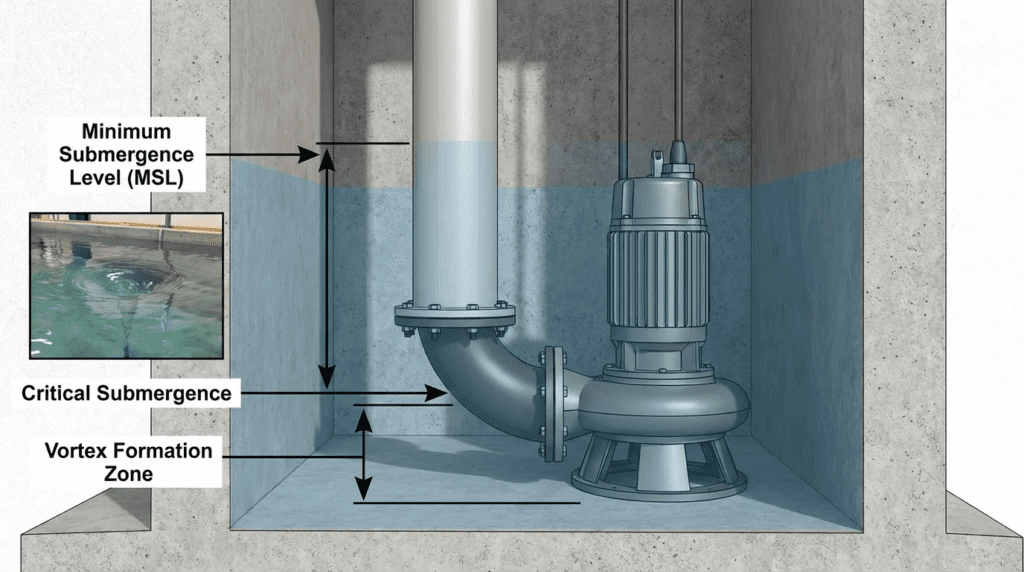
- Drawdown Test: Perform a drawdown test to verify flow rate. During this test, observe the wet well surface. If surface vortices (swirling dimples or full air cores) appear as the level drops, note the “Critical Submergence Depth” and adjust the Low Level Float switch accordingly.
- NPSH Verification: Measure suction pressure at the pump inlet while operating at full speed. Compare this to the theoretical calculation. A higher-than-expected vacuum reading suggests unexpected friction losses (e.g., debris in pipe, poor fitting quality).
Double Disc pumps have a rhythmic “clack-clack” sound. Listen to the rhythm. If the sound becomes erratic or sounds like gravel is tumbling inside (when pumping sludge), the pump is likely cavitating due to insufficient submergence or air entrainment.
Common Specification Mistakes
- Undersizing Suction Piping: Specifying a 4″ suction line for a 4″ pump sounds logical, but for viscous sludge, increasing the suction line to 6″ is often necessary to reduce friction losses and increase NPSHa.
- Ignoring High Points: Any high point in the suction piping created by poor routing will become an air trap. Unlike centrifugal pumps which may air-bind completely, a DDP will compress this air pocket repeatedly, causing loss of efficiency and flow surging.
- Vague Piping Material Specs: Using PVC for suction lines in grit applications is a common error. The pulsing nature of DDPs can fracture brittle PVC joints. Use Ductile Iron or HDPE.
O&M Burden & Strategy
Operations teams should focus on maintaining the integrity of the suction side vacuum.
- Weekly: Check vacuum and pressure gauges. A shift in baseline readings is the best early warning system.
- Monthly: Inspect belt tension. Vortexing causes load fluctuations that can stretch drive belts prematurely.
- Annually: Inspect suction piping supports. The reciprocating action of DDPs creates vibration. Loose pipe supports can lead to flange leaks, introducing air into the suction side.
Troubleshooting Guide
Symptom: Pump is running but flow is low/erratic.
- Cause 1: Air entrainment due to vortexing. Check: Raise wet well level. If flow smooths out, submergence was too low.
- Cause 2: Partial blockage in suction line. Check: High vacuum reading on suction gauge.
- Cause 3: Debris stuck in check valve (clack). Check: Listen for “blow-by” sound; pump may fail to hold prime.
Design Details / Calculations
This section outlines the specific methodologies for calculating Double Disc Pump Wet Well Design and Minimum Submergence to Prevent Vortexing. While DDPs are forgiving, adhering to Hydraulic Institute Standards (ANSI/HI 9.8) ensures optimal performance.
Sizing Logic & Methodology
The primary goal is to ensure the suction intake is submerged deeply enough to prevent the formation of air-entraining vortices (Type 3 or higher).
1. Calculate Minimum Submergence (S)
The simplified formula for minimum submergence ($S$) in inches, measured from the centerline of the inlet pipe to the minimum liquid surface, is:
$$S = D + (2.3 times F_d)$$
Where:
- $D$ = Inlet pipe diameter (inches)
- $F_d$ = Froude number (dimensionless)
However, a widely accepted rule of thumb for intake design in wastewater applications (to avoid complex Froude calculations for simple pits) is:
$$S ge 1.5 times D$$
Note: For Double Disc Pumps operating at high vacuum (high lift), increase this safety factor. Recommended design is $S ge 2.0 times D$. If the velocity in the suction bell exceeds 5 ft/s, deeper submergence is required.
2. Suction Bell Design
Do not simply end a raw pipe in the wet well. A flared suction bell reduces entrance velocity, thereby reducing the Froude number and the likelihood of vortex formation.
- Bell Diameter: Should be $1.5 times$ to $2.0 times$ the pipe diameter ($D$).
- Floor Clearance: The distance from the bell lip to the floor ($C$) should be $0.3 times D$ to $0.5 times D$.
- Wall Clearance: The distance from the back wall to the bell centerline ($B$) should be approx $0.75 times D$.
Specification Checklist
To ensure the contractor delivers a system capable of vortex-free operation, include these items in the specification:
- Vacuum Gauges: Diaphragm-protected vacuum gauges (0-30″ Hg) required on suction of every pump.
- Pulsation Dampeners: While DDPs pulse less than ball-valve pumps, suction side pulsation dampeners can be beneficial in long, high-friction suction lines to stabilize acceleration head.
- Piping Supports: Rigid bracing required within 2 feet of the pump suction and discharge flanges to isolate pump vibration from piping stresses.
- Testing: Mandatory site acceptance testing (SAT) must include a continuous run at Low Water Level (LWL) for 30 minutes to prove no vortexing occurs.
Designing the suction line based on the pump connection size rather than the hydraulic requirement. A 4″ pump may require a 6″ suction line to keep friction losses low enough to prevent cavitation, followed by an eccentric reducer at the pump flange.
Standards & Compliance
- ANSI/HI 9.8 (Intake Design): The governing standard for wet well geometry.
- ANSI/HI 9.6.6 (Pump Piping): Guidelines for piping layouts to minimize turbulence.
- AWWA C110/C115: Standards for Ductile Iron fittings typically used in these applications.
FAQ Section
What is a double disc pump?
A double disc pump is a positive displacement pump that uses a unique trunnion and disc mechanism to move fluid. Unlike diaphragm pumps, it does not use reciprocating flexible membranes that can fatigue. Instead, elastomeric discs are mechanically actuated to create suction and discharge pressure. They are known for handling high solids, rags, and grit, and are capable of running dry indefinitely without damage.
How do you calculate minimum submergence for a double disc pump?
Minimum submergence is calculated to prevent surface vortices that entrain air. A conservative calculation for wastewater applications is $S = 2.0 times D$, where $D$ is the suction pipe diameter. For example, a 6-inch suction line should have at least 12 inches of liquid above the inlet bell. Refer to the [[Design Details / Calculations]] section for ANSI/HI 9.8 formulas involving Froude numbers.
Why is vortexing bad for double disc pumps?
Vortexing introduces air into the suction line. In a Double Disc Pump, entrained air reduces volumetric efficiency (flow rate drops) and causes the internal check valves (discs) to slam shut violently, known as cavitation-like shock. This creates excessive noise, vibration, and accelerates wear on the trunnions and connecting rods. Severe vortexing can break the prime completely.
Can double disc pumps run dry?
Yes, Double Disc Pumps are inherently designed to run dry without damage. Because they do not rely on the pumped fluid to lubricate mechanical seals or cool stators (like progressive cavity pumps), they can operate indefinitely without fluid. However, running dry produces zero flow, so control logic should still protect the process.
What is the maximum suction lift for a double disc pump?
Most Double Disc Pumps are rated for a Total Dynamic Suction Lift (TDSL) of up to 25 feet at sea level. However, for reliable operation in wastewater applications (sludge/grit), engineers typically design for a maximum static lift of 15 to 18 feet to account for friction losses, specific gravity, and viscosity changes.
How does suction piping design affect pump performance?
Suction piping is the most critical factor in DDP performance. Undersized piping increases friction, robbing the pump of available NPSH. Elbows placed too close to the inlet cause turbulence and uneven loading on the discs. Improperly supported piping transmits vibration, leading to flange leaks and air entrainment.
Conclusion
KEY TAKEAWAYS
- Submergence is Critical: Even though DDPs are self-priming, minimum submergence ($S approx 1.5D – 2.0D$) is required to prevent air-entraining vortices that reduce efficiency and damage components.
- Velocity Matters: Design suction piping for velocities between 3 and 6 ft/sec. Too slow allows settling; too fast kills NPSHa.
- Spec for Friction: High-solids fluids (sludge) have higher friction factors. Upsize suction piping relative to the pump flange to minimize losses.
- Bell Design: Always use a flared suction bell with proper floor clearance ($0.3D – 0.5D$) to minimize entrance losses.
- Instrumentation: Mandatory vacuum gauges and proper low-level float switches prevent operation in vortex conditions.
The successful implementation of double disc pumping technology hinges on treating the pump and the wet well as a unified hydraulic system. While the pump itself is forgiving of abuse and capable of handling difficult solids, it cannot overcome the laws of physics governing vacuum and air entrainment. Double Disc Pump Wet Well Design and Minimum Submergence to Prevent Vortexing must be prioritized during the design phase to avoid a lifecycle of maintenance headaches.
Engineers should approach the design by first verifying the NPSH available under the worst-case scenario (lowest tank level, highest temperature, highest viscosity). From there, physical geometry—suction bells, split-flow intakes, and vortex breakers—must be detailed to ensure the fluid enters the pipe smoothly. By adhering to the guidelines in ANSI/HI 9.8 and the practical constraints outlined in this article, municipalities can realize the full benefits of double disc technology: low maintenance, high reliability, and superior solids handling.