
DuPont – Memcor vs Aqua-Aerobic for Filtration: Pros/Cons & Best-Fit Applications
Introduction
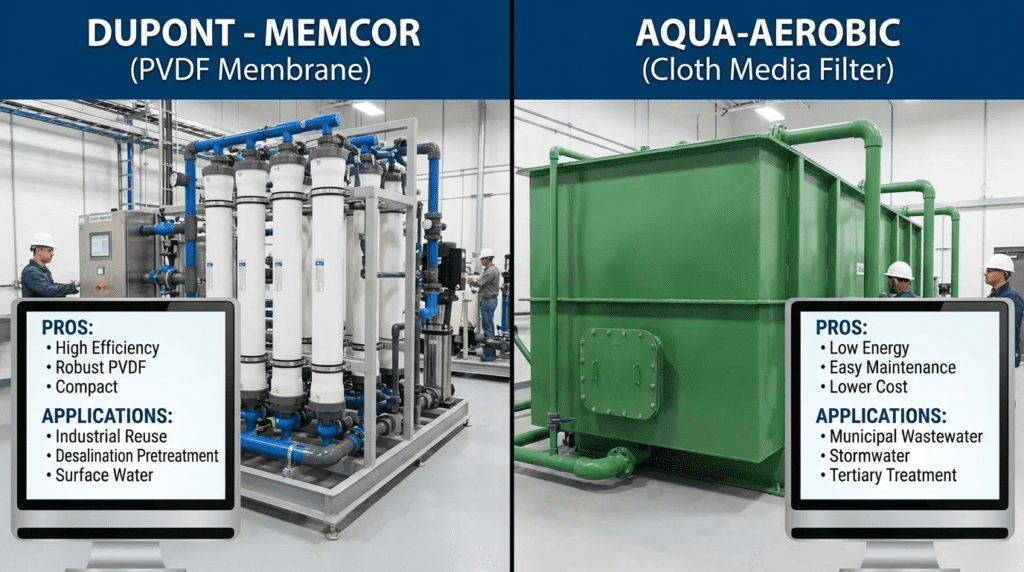
One of the most frequent debates in municipal advanced treatment design centers on the selection of tertiary filtration technology. Engineers are often tasked with balancing the stringent pathogen rejection of low-pressure membranes against the energy efficiency and simplicity of depth filtration. This dichotomy is best represented by analyzing DuPont – Memcor vs Aqua-Aerobic for Filtration: Pros/Cons & Best-Fit Applications.
While both manufacturers offer a range of solutions, the industry-standard comparison typically pits the DuPont Memcor line (specifically pressurized or submerged hollow-fiber Ultrafiltration/Microfiltration) against the Aqua-Aerobic Systems cloth media filtration line (AquaDisk, AquaDiamond). This is not merely a brand preference; it is a choice between two distinct filtration philosophies: physical barrier exclusion (membranes) versus depth filtration (pile cloth).
In municipal wastewater treatment, specifically for Title 22 reuse, low-level phosphorus removal, and protection of downstream RO processes, misapplying these technologies can lead to catastrophic operational expenditures. We see facilities undersizing membrane pre-screening, leading to fiber ragging, or misjudging the solids loading capacity of cloth media, resulting in hydraulic bottlenecks. This article provides a comprehensive, unbiased engineering analysis to guide the specification and selection process.
How to Select and Specify
Selecting between membrane systems and cloth media filtration requires a rigorous analysis of process requirements. The decision framework must go beyond capital cost to include hydraulic profiles, solids handling, and long-term maintainability. Below are the critical engineering criteria for evaluating DuPont – Memcor vs Aqua-Aerobic for Filtration: Pros/Cons & Best-Fit Applications.
Duty Conditions & Operating Envelope
The primary differentiator between these technologies is their response to influent variability. DuPont Memcor systems, utilizing PVDF hollow fibers, operate on a definite pore size (typically 0.04 to 0.1 microns). This provides an absolute barrier to suspended solids and pathogens (Giardia/Cryptosporidium) but makes the system hydraulically sensitive. As Total Suspended Solids (TSS) rise, Transmembrane Pressure (TMP) increases rapidly to maintain flux, necessitating frequent backwashing.
Aqua-Aerobic cloth media filters, conversely, utilize a pile cloth (typically 5 to 10-micron nominal rating). They operate via gravity or low-head pumping. They are significantly more forgiving of hydraulic surges and solids spikes. While a membrane system may require automatic shutdown or aggressive air scouring during a solids upset to prevent irreversible fouling, a cloth filter will simply backwash more frequently, often sustaining operation up to higher TSS loading rates before hydraulic bypass occurs.
Materials & Compatibility
Material compatibility drives the longevity of the asset. DuPont Memcor modules utilize PVDF (Polyvinylidene Fluoride), which offers excellent resistance to oxidants. This is critical because membrane systems rely on Clean-in-Place (CIP) protocols using high concentrations of Sodium Hypochlorite and Citric Acid. The engineering specification must account for chemical feed systems, neutralization tanks, and chemically resistant piping (Sch 80 PVC or Stainless Steel).
Aqua-Aerobic systems primarily use 304 or 316 Stainless Steel for the tankage and frame, with the filtration media being a nylon/polyester pile cloth. The cloth is resistant to biological degradation but is sensitive to high polymer overdoses which can “blind” the fabric. Unlike membranes, the cloth media does not require routine chemical cleaning, removing the need for hazardous chemical storage and handling infrastructure.
Hydraulics & Process Performance
Head Loss: This is a major design constraint. Aqua-Aerobic cloth filters typically operate with less than 12 inches (305 mm) of head loss across the media. This often allows for gravity flow through the tertiary step, eliminating intermediate pump stations.
DuPont Memcor pressurized systems (like the CP or XP series) require feed pumps capable of generating 30-50 psi to overcome membrane resistance and piping losses. Submerged systems (like the CS or Mempulse) use vacuum pumps. In both membrane cases, the parasitic energy load (feed pumps + air scour blowers + backwash pumps) is significantly higher than the cloth media alternative (low HP drive motors + backwash pumps).
Installation Environment & Constructability
Footprint: DuPont Memcor pressurized skids are extremely compact, offering a high surface area per square foot of floor space. However, they require significant vertical clearance for module removal and extensive peripheral space for air compressors, CIP skids, and break tanks.
Aqua-Aerobic AquaDisk units are often installed in concrete basins. While the mechanical footprint is efficient, they typically require more total civil work area than a pressurized membrane skid. However, the AquaDiamond is specifically designed to retrofit into existing traveling bridge sand filter basins, making it a superior choice for brownfield plant upgrades where civil modification costs must be minimized.
Reliability, Redundancy & Failure Modes
Failure modes differ drastically. A failure in a DuPont Memcor system usually involves fiber breakage or seal failure, leading to a breach in integrity. This is detected via daily Pressure Decay Tests (PDT) or Membrane Integrity Tests (MIT). While a single broken fiber releases pathogens, the system can be pinned/repaired. Redundancy typically requires an N+1 train configuration.
For Aqua-Aerobic cloth filters, failure involves cloth tearing or seal breaches. Because these are nominal filters, a small breach increases turbidity but does not constitute a “loss of barrier” in the same regulatory sense as membranes (unless strictly credited for pathogen removal). Reliability is generally higher due to fewer moving parts (no air scour blowers, no complex valve manifolds).
Controls & Automation Interfaces
Membrane automation is complex. The PLC must manage production, backwash, chemically enhanced backwash (CEB), and CIP cycles, along with intricate integrity testing sequences. SCADA integration requires mapping hundreds of tags for pressures, flows, and valve positions.
Cloth media filtration logic is comparatively simple: standard filtration, level-based backwash, and occasional sludge removal. The automation burden is low, making it ideal for plants with limited instrumentation staff or remote sites with limited telemetry bandwidth.
Lifecycle Cost Drivers
OPEX: Aqua-Aerobic generally offers lower OPEX due to lower energy consumption (gravity flow, no air scour) and zero chemical consumption for cleaning. Consumables are limited to cloth replacement every 3-7 years.
DuPont Memcor systems carry higher OPEX driven by pumping energy, process air energy, chemical costs (Hypo/Acid/Caustic), and module replacement reserves. Membrane modules typically have a 7-10 year life, but replacement costs are a significant percentage of the initial CAPEX.
Comparison Tables
The following tables provide a direct comparison to assist engineers in evaluating DuPont – Memcor vs Aqua-Aerobic for Filtration: Pros/Cons & Best-Fit Applications. Table 1 focuses on the technology characteristics, while Table 2 outlines the application suitability matrix.
| Feature | DuPont Memcor (UF/MF) | Aqua-Aerobic (Cloth Media) | Engineering Notes |
|---|---|---|---|
| Filtration Barrier | Physical Barrier (0.04 – 0.1 µm) | Depth/Pile Cloth (5.0 – 10.0 µm) | Membranes provide absolute barrier; Cloth provides nominal filtration. |
| Pathogen Rejection | High (4-log Virus, 6-log Protozoa possible) | Moderate (Title 22 approved, but lower log removal credits) | Select Memcor for direct potable reuse or strict pathogen limits. |
| Driving Head | Pressure (30-50 psi) or Vacuum | Gravity or Low Head (<2 ft) | Cloth media allows for gravity flow profiles; Membranes require pumping. |
| Pre-Treatment Reqs | High (300-500µm screening essential) | Low (Standard secondary clarification) | Membranes are prone to ragging/fouling without fine screening. |
| Cleaning Method | Air Scour + Backwash + Chemical (CIP) | Backwash (Suction Shoe) | Membranes require complex chemical handling systems. |
| Recovery | 90-95% | 90-98% | Both have high recovery, but backwash waste characteristics differ. |
| Chemical Usage | High (NaOCl, Citric Acid, Caustic) | None (Typically) | Significant OPEX difference in chemical procurement and safety. |
| Application Scenario | DuPont Memcor Fit | Aqua-Aerobic Fit | Decision Driver |
|---|---|---|---|
| Title 22 / Water Reuse | Excellent | Excellent | Both approved. Choose Aqua for lower OPEX if space allows; Memcor for smaller footprint/higher quality. |
| Phosphorus Removal (<0.1 mg/L) | Good (requires coagulant) | Excellent (requires coagulant) | Cloth media is industry standard for tertiary P-removal due to solids loading capacity. |
| RO Pre-treatment | Excellent | Poor/Fair | Membrane UF/MF is required to lower SDI (Silt Density Index) to protect RO. Cloth is insufficient. |
| Sand Filter Retrofit | Fair (complex civil work) | Excellent (AquaDiamond) | AquaDiamond specifically fits in traveling bridge basins. |
| Indirect Potable Reuse (IPR) | Preferred | Not Applicable | IPR typically requires the “Full Advanced Treatment” train (MF/RO/UV). |
| Remote/Unmanned Site | Poor | Excellent | Complexity of membrane skid is risky for unmanned sites. |
Engineer & Operator Field Notes
Beyond the catalog specifications, the real-world performance of these systems reveals nuances critical to long-term satisfaction. Here are observations from the field regarding the operation of DuPont – Memcor vs Aqua-Aerobic for Filtration: Pros/Cons & Best-Fit Applications.
Commissioning & Acceptance Testing
DuPont Memcor: The most critical phase is the Membrane Integrity Test (MIT). During commissioning, every rack must pass a pressure decay test. A common issue is “rolled seals” on the inter-module connectors during installation, which causes air leaks and test failures. Engineers should specify a rigorous 30-day performance test that includes calculating temperature-corrected flux and specific flux to establish a clean water baseline.
Aqua-Aerobic: The focus here is on the backwash shoe alignment and pile cloth tension. If the cloth is loose, the suction shoe will not clean effectively, leading to “mud-balling” or sludge accumulation on the media. Verify the level sensor calibration carefully; incorrect zeroing can lead to continuous backwashing or overflow. Verify the removal efficiency of the sludge pumps at the bottom of the hopper.
Common Specification Mistakes
Over-optimistic Flux Rates: Specifying membrane flux rates based on “average” conditions rather than “cold water, fouled condition” is a classic error. Always size Memcor systems for the worst-case scenario (typically winter temperatures with end-of-life permeability). Under-sized systems will spiral into irreversible fouling.
Ignoring Hydraulics for Cloth Media: While Aqua-Aerobic systems are gravity-fed, they still require hydraulic head to drive the flow. Engineers often forget to account for the headloss increase as the cloth fouls before a backwash is triggered. Ensure the upstream hydraulic profile allows for the full 12-24 inches of head build-up without flooding the upstream clarifier weirs.
O&M Burden & Strategy
Maintenance Intensity: Memcor systems require a higher caliber of operator skill. Troubleshooting a failed integrity test involves isolating modules, listening for air leaks (pinning), and managing chemical feeds. The CIP process generates a waste stream that must be neutralized, requiring pH probe maintenance and safety protocols.
Aqua-Aerobic systems are mechanically centered. Maintenance involves greasing drives, checking chain tension (for Diamond units), and replacing cloth socks. Cloth replacement is physically demanding (requires tank drainage and entry) but technically simple. It is less frequent but more labor-intensive per event than membrane maintenance.
Troubleshooting Guide
- Memcor – High TMP: Check for cold water temperature (viscosity effect), inadequate air scour (check blower amps), or organic fouling (requires hypo CIP) vs. mineral fouling (requires acid CIP).
- Aqua-Aerobic – Rapid Backwash Cycling: Indicates high solids loading or biological fouling of the cloth. Check upstream clarifier performance. If algae is present, the cloth may be blinded; a manual shock chlorination or pressure wash of the cloth may be required.
Design Details & Calculations
Sizing Logic & Methodology
DuPont Memcor (Membranes): Sizing is based on Flux, measured in Gallons per Square Foot per Day (gfd).
Typical Design Flux: 25 – 35 gfd for secondary effluent.
Calculation: Total Membrane Area Required = (Peak Flow (gpd)) / (Design Flux (gfd)).
Temperature Correction: Flux decreases approx. 3% for every 1°C drop. Designers must apply a temperature correction factor (TCF) for the minimum site temperature.
Aqua-Aerobic (Cloth Media): Sizing is based on Hydraulic Loading Rate (HLR), measured in gpm/ft².
Typical Loading Rate: 3.0 – 6.0 gpm/ft² depending on average vs. peak flow.
Vertical Surface Area: Unlike sand filters, AquaDisk filters utilize vertical surface area. Sizing must account for the number of disks and the effective submerged area.
Specification Checklist
When writing the RFP or detailed spec, ensure these items are included to differentiate and protect the utility:
- For Membranes (Memcor): Specify “Pressurized/Submerged PVDF Hollow Fiber.” Require “Automated Integrity Testing capable of detecting 3-micron breach.” Mandate “N+1 Redundancy on feed pumps and blower trains.” Specify the CIP tank volume to hold enough volume for a full rack soak.
- For Cloth Media (Aqua-Aerobic): Specify “Pile Cloth Media with nominal filtration of [5 or 10] microns.” Require “Suction scanning backwash mechanism allowing continuous filtration during backwash.” Specify “304/316 Stainless Steel tank construction” (if package unit).
Standards & Compliance
Title 22 (California): Both technologies are Title 22 approved. However, the approval conditions differ. Membranes are approved based on flux and integrity testing. Cloth media is approved based on loading rate (typically max 6 gpm/ft²) and turbidity performance.
NSF 61: If the water is intended for potable reuse or enters a potable system, all wetted materials (membranes, cloth, gaskets) must be NSF 61 certified.
Frequently Asked Questions
What is the primary cost difference between Memcor and Aqua-Aerobic systems?
Generally, Aqua-Aerobic cloth media systems have a lower Total Cost of Ownership (TCO) for standard tertiary filtration applications due to lower energy usage, lack of chemicals, and simpler construction. DuPont Memcor systems typically have higher CAPEX (due to pumps, blowers, and controls) and higher OPEX (energy and chemicals), but they provide a higher quality filtrate required for specific reuse applications.
Can Aqua-Aerobic filters replace membranes for RO pre-treatment?
Typically, no. Cloth media filters are depth filters with a nominal rating of 5-10 microns. Reverse Osmosis (RO) systems require a Silt Density Index (SDI) of less than 3-5. While cloth filters reduce TSS effectively, they do not remove the colloidal, sub-micron particles that foul RO membranes. DuPont Memcor ultrafiltration (0.04 micron) is the industry standard for RO pre-treatment.
How often do the media need to be replaced?
DuPont Memcor PVDF modules typically have a warrantied life of 5-7 years, though well-maintained systems can last 10+ years. Replacement requires purchasing new modules. Aqua-Aerobic pile cloth typically lasts 3-7 years depending on backwash frequency and exposure to UV or chlorine. Cloth replacement is generally cheaper than membrane module replacement.
What happens if the upstream clarifier loses a sludge blanket?
This is a critical scenario. Aqua-Aerobic systems are generally more robust; they will backwash continuously and may eventually bypass if the solids load is extreme, but they recover quickly once the load passes. DuPont Memcor systems will likely suffer from rapid pore plugging. If the solids load is too high, the system will alarm and shut down to protect the fibers, potentially causing a plant-wide hydraulic backup.
Do these systems remove phosphorus?
Neither system removes dissolved phosphorus on its own. Both require the upstream addition of a coagulant (Alum or Ferric) to precipitate the phosphorus into particulate form. Once precipitated, both systems are highly effective at removing the solids. Aqua-Aerobic is widely used for achieving P limits down to 0.1 mg/L. For limits below 0.05 mg/L, the absolute barrier of the Memcor system may provide greater assurance.
What is the difference between Memcor CS, XP, and CP systems?
These are model designations for DuPont (formerly Evoqua/Siemens). CP stands for Compact Pressurized (skid-mounted, pressure-driven). XP is a smaller, express package of the CP. CS stands for Compact Submerged, where membrane racks are dipped into an open tank and vacuum pumps draw water through the fibers. Submerged systems are typically used for larger flows (10+ MGD), while pressurized systems are favored for small to medium plants.
Conclusion
Key Takeaways
- Application Rule: Use Aqua-Aerobic (Cloth) for general Title 22 reuse, phosphorus removal, and retrofits where simplicity and low energy are paramount. Use DuPont Memcor (UF) when pathogen removal (virus), RO pre-treatment, or absolute barrier protection is required.
- Hydraulics: Cloth media can operate on gravity; Membranes almost always require pumping (OPEX impact).
- Complexity: Membranes require chemical CIP systems, air scour, and complex integrity testing. Cloth media requires simple mechanical maintenance.
- Pre-Treatment: Membranes demand fine screening (2mm) to prevent failure. Cloth media works with standard secondary effluent.
- Reliability: Cloth media is more robust against upset conditions; Membranes offer higher filtrate quality but are more sensitive to solids spikes.
The choice between DuPont – Memcor vs Aqua-Aerobic for Filtration: Pros/Cons & Best-Fit Applications ultimately comes down to the specific water quality goals of the facility. If the objective is to produce high-quality irrigation water or meet strict phosphorus limits with minimal operator intervention and energy cost, Aqua-Aerobic cloth media is often the superior engineering choice.
However, if the facility is designing for Indirect Potable Reuse (IPR), feeding a Reverse Osmosis system, or faces regulatory requirements for high log-reduction credits for viruses without high chlorine contact times, the DuPont Memcor ultrafiltration system is the necessary solution. Engineers should perform a lifecycle cost analysis that accurately reflects the chemical and energy intensity of membranes versus the cloth replacement and civil footprint of media filtration to make the final determination.