
DuPont – Memcor vs Aqua-Aerobic for Filtration: Pros/Cons & Best-Fit Applications
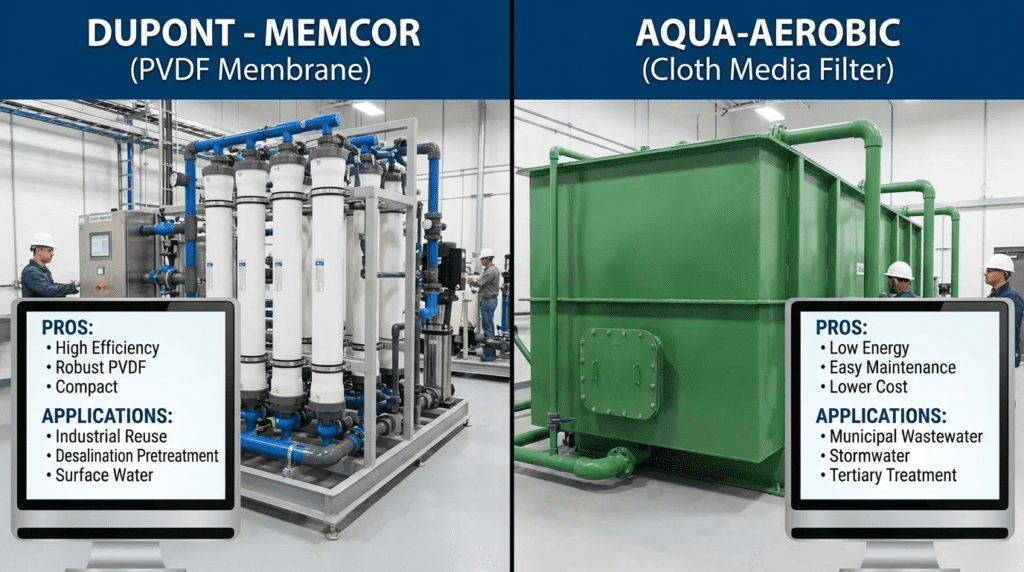
DuPont – Memcor vs Aqua-Aerobic for Filtration: Pros/Cons & Best-Fit Applications
Introduction
One of the most frequent debates in municipal advanced treatment design is the selection of tertiary filtration technology. Engineers must balance the pathogen rejection of low-pressure membranes against the energy efficiency and simplicity of cloth media filtration. That dichotomy is well represented by analyzing DuPont – Memcor vs Aqua-Aerobic for Filtration: Pros/Cons & Best-Fit Applications.
The standard comparison pits the DuPont Memcor line — pressurized or submerged hollow-fiber ultrafiltration and microfiltration, a product family that passed from Siemens through Evoqua to DuPont — against Aqua-Aerobic Systems pile cloth media filtration, the AquaDisk and AquaDiamond range. This is not a brand preference question but a choice between two filtration philosophies: physical barrier exclusion versus surface and depth filtration through pile cloth.
For water reuse, low-level phosphorus removal, and protection of downstream reverse osmosis, misapplying these technologies produces serious operating consequences — undersized membrane pre-screening leading to fiber ragging, or misjudged solids loading capacity on cloth media creating hydraulic bottlenecks. Comparable evaluations appear in our analysis of Xylem and WesTech filtration equipment.
How to Select and Specify
Duty Conditions & Operating Envelope
The primary differentiator is response to influent variability. Memcor systems using PVDF hollow fibers operate at a defined pore size, providing an absolute barrier to suspended solids and protozoan pathogens but making the system hydraulically sensitive. As suspended solids rise, transmembrane pressure increases rapidly to maintain flux, requiring more frequent backwashing.
Cloth media filters use a pile cloth with a nominal rating in the low micron range, operating on gravity or low-head pumping. They are considerably more forgiving of hydraulic surges and solids spikes. Where a membrane system may require automatic shutdown or aggressive air scouring during a solids upset to prevent irreversible fouling, a cloth filter simply backwashes more frequently and sustains operation to higher loading before hydraulic bypass.
Materials & Compatibility
Memcor modules use PVDF, which offers strong resistance to oxidants — critical because membrane systems rely on clean-in-place protocols using sodium hypochlorite and citric acid. The specification must account for chemical feed systems, neutralization tanks and chemically resistant piping.
Aqua-Aerobic systems use 304 or 316 stainless for tankage and frame, with nylon or polyester pile cloth as the filtration medium. The cloth resists biological degradation but is sensitive to polymer overdose, which blinds the fabric. Unlike membranes, the cloth requires no routine chemical cleaning, eliminating hazardous chemical storage and handling infrastructure.
Hydraulics & Process Performance
Head loss is a major design constraint. Cloth filters typically operate with around a foot of head loss across the media, often allowing gravity flow through the tertiary step and eliminating an intermediate pump station.
Memcor pressurized systems require feed pumps generating meaningful pressure to overcome membrane resistance and piping losses; submerged configurations use vacuum. In both cases the parasitic energy load — feed pumps, air scour blowers, backwash pumps — is substantially higher than the cloth media alternative.
Installation Environment & Constructability
Footprint: Memcor pressurized skids are compact, offering high membrane area per square foot. But they require vertical clearance for module removal and peripheral space for compressors, CIP skids and break tanks.
AquaDisk units are typically installed in concrete basins. While mechanically efficient, they require more total civil area than a pressurized skid. The AquaDiamond configuration is specifically designed to retrofit existing traveling bridge sand filter basins, which makes it a strong choice for brownfield upgrades where civil modification cost must be minimized.
Reliability & Failure Modes
Failure modes differ substantially. A Memcor failure typically involves fiber breakage or seal failure, producing a breach in integrity detected through pressure decay testing. A single broken fiber can be pinned and repaired. Redundancy requires an N+1 train configuration.
For cloth filters, failure involves cloth tearing or seal breaches. Because these are nominal filters, a small breach raises turbidity but does not constitute loss of an absolute barrier in the same regulatory sense. Reliability is generally higher owing to fewer moving parts — no air scour blowers, no complex valve manifolds.
Controls & Automation
Membrane automation is complex. The controller manages production, backwash, chemically enhanced backwash and CIP cycles along with integrity testing sequences, requiring extensive SCADA tag mapping.
Cloth media logic is comparatively simple: filtration, level-based backwash, occasional sludge removal. The lower automation burden suits plants with limited instrumentation staff or remote sites with constrained telemetry.
Lifecycle Cost Drivers
Aqua-Aerobic generally offers lower operating cost through lower energy consumption and zero cleaning chemical use, with consumables limited to periodic cloth replacement.
Memcor carries higher operating cost driven by pumping energy, process air, chemicals and module replacement reserves. Modules have a finite service life, and replacement represents a significant percentage of initial capital.
Comparison Tables
| Feature | DuPont Memcor | Aqua-Aerobic cloth media | Engineering Notes |
|---|---|---|---|
| Filtration barrier | Physical barrier at defined pore size | Pile cloth, nominal rating in low microns | Membranes provide an absolute barrier; cloth provides nominal filtration |
| Pathogen rejection | High, with substantial log removal credit available | Moderate; approved for reuse but with lower log credits | Select membranes for strict pathogen limits or potable reuse |
| Driving head | Pressure or vacuum | Gravity or low head | Cloth media permits gravity profiles; membranes require pumping |
| Pre-treatment | Fine screening essential | Standard secondary clarification | Membranes rag and foul without adequate fine screening |
| Cleaning method | Air scour, backwash and chemical CIP | Vacuum suction shoe backwash | Membranes require chemical handling infrastructure |
| Recovery | High | High | Both recover well, but backwash waste characteristics differ |
| Chemical usage | Significant — oxidant, acid, caustic | Typically none | A major operating cost and safety difference |
| Application | DuPont Memcor Fit | Aqua-Aerobic Fit | Decision Driver |
|---|---|---|---|
| Water reuse | Excellent | Excellent | Both approved. Cloth for lower operating cost where space allows; membrane for smaller footprint and higher quality |
| Low-level phosphorus removal | Good, with coagulant | Excellent, with coagulant | Cloth media is widely used for tertiary phosphorus polishing owing to solids loading capacity |
| RO pre-treatment | Excellent | Insufficient | Ultrafiltration is required to lower silt density index; cloth cannot achieve it |
| Sand filter retrofit | Complex civil work | Excellent | AquaDiamond is designed for traveling bridge basins |
| Indirect potable reuse | Preferred | Not applicable | Requires the full advanced treatment train |
| Remote or unmanned site | Poor | Excellent | Membrane skid complexity is risky without operator presence |
Engineer & Operator Field Notes
Commissioning & Acceptance Testing
Memcor: The critical phase is membrane integrity testing. Every rack must pass a pressure decay test during commissioning. A common issue is rolled seals on inter-module connectors during installation, producing air leaks and test failures. Specify a rigorous performance test including temperature-corrected flux calculation to establish a clean water baseline.
Aqua-Aerobic: Focus on backwash shoe alignment and cloth tension. Loose cloth prevents the suction shoe from cleaning effectively, leading to sludge accumulation on the media. Verify level sensor calibration carefully — incorrect zeroing causes continuous backwashing or overflow. Confirm sludge pump removal efficiency at the hopper.
Common Specification Mistakes
Over-optimistic flux rates: Specifying membrane flux on average conditions rather than cold water and fouled condition is a classic error. Size for the worst case — winter temperature with end-of-life permeability. Undersized membrane systems spiral into irreversible fouling.
Ignoring cloth media hydraulics: Gravity-fed does not mean head-free. Account for head loss increase as the cloth fouls before backwash triggers. Ensure the upstream profile allows the full head build-up without flooding clarifier weirs.
O&M Burden & Strategy
Memcor requires a higher caliber of operator skill. Troubleshooting a failed integrity test involves isolating modules, locating leaks and managing chemical feeds. The CIP process generates a waste stream requiring neutralization, pH probe maintenance and safety protocols.
Aqua-Aerobic maintenance is mechanically centered — greasing drives, checking chain tension, replacing cloth. Cloth replacement is physically demanding, requiring tank drainage and entry, but technically simple. It is less frequent though more labor-intensive per event than membrane maintenance.
Troubleshooting
- Memcor, high transmembrane pressure: Check for cold water viscosity effects, inadequate air scour, or fouling type — organic fouling requires oxidant CIP, mineral fouling requires acid.
- Aqua-Aerobic, rapid backwash cycling: Indicates high solids loading or biological fouling of the cloth. Check upstream clarifier performance. Where algae is present, the cloth may be blinded and require chemical cleaning or pressure washing.
Design Details & Calculations
Sizing Logic
Memcor: Sizing is based on flux in gallons per square foot per day. Required membrane area equals peak flow divided by design flux. Flux declines with temperature as viscosity rises, so apply a temperature correction factor for the minimum site temperature — this frequently governs the design.
Aqua-Aerobic: Sizing is based on hydraulic loading rate in gpm per square foot. Unlike sand filters, disk filters use vertical surface area, so sizing must account for the number of disks and effective submerged area at the operating level rather than the maximum level.
Specification Checklist
- For membranes: Specify PVDF hollow fiber configuration. Require automated integrity testing with a defined detection threshold. Mandate N+1 redundancy on feed pumps and blower trains. Specify CIP tank volume sufficient for a full rack soak.
- For cloth media: Specify pile cloth media with a defined nominal rating. Require a suction backwash mechanism permitting continuous filtration during backwash. Specify stainless tank construction for package units.
Standards
Reuse regulations: Both technologies carry approvals, but under different conditions. Membranes are approved on flux and integrity testing; cloth media on loading rate and turbidity performance. Verify the specific model proposed carries current acceptance at the loading rate you intend.
NSF/ANSI 61: Where water enters a potable system, all wetted materials must be certified.
Frequently Asked Questions
What is the primary cost difference?
Aqua-Aerobic cloth media generally has lower total cost of ownership for standard tertiary filtration, through lower energy use, absence of cleaning chemicals and simpler construction. Memcor carries higher capital and operating cost but provides filtrate quality required for specific reuse applications.
Can cloth filters replace membranes for RO pre-treatment?
Typically no. Cloth media are nominal filters at a low micron rating. Reverse osmosis requires a low silt density index, and while cloth reduces suspended solids effectively, it does not remove the colloidal sub-micron particles that foul RO membranes. Ultrafiltration is the standard for that duty.
How often does media need replacement?
Memcor PVDF modules carry a warrantied life measured in years, and well-maintained systems often exceed it. Aqua-Aerobic pile cloth typically lasts several years depending on backwash frequency and exposure to UV or chlorine. Cloth replacement is generally cheaper than membrane module replacement.
What happens if the upstream clarifier loses its sludge blanket?
A critical scenario. Cloth systems are more robust — they backwash continuously and may eventually bypass under extreme loading, but recover quickly once the load passes. Membrane systems suffer rapid pore plugging and will alarm and shut down to protect the fibers, potentially causing plant-wide hydraulic backup.
Do these systems remove phosphorus?
Neither removes dissolved phosphorus alone. Both require upstream coagulant addition to precipitate phosphorus into particulate form. Once precipitated, both remove the solids effectively. Cloth media is widely used for low-level phosphorus limits; for the tightest limits, the absolute barrier of a membrane provides greater assurance.
What distinguishes the Memcor system configurations?
The range includes pressurized skid-mounted configurations and submerged configurations where membrane racks sit in an open tank and vacuum draws water through the fibers. Submerged systems are generally applied at larger flows, pressurized at small to medium plants. Confirm which configuration is being quoted, as the ancillary equipment differs considerably.
Conclusion
Key Takeaways
- Application rule: Cloth media for general reuse, phosphorus removal and retrofits where simplicity and low energy matter. Membranes where virus removal credit, RO pre-treatment or absolute barrier protection is required.
- Hydraulics: Cloth media can operate on gravity; membranes almost always require pumping.
- Complexity: Membranes require chemical CIP, air scour and integrity testing. Cloth requires simple mechanical maintenance.
- Pre-treatment: Membranes demand fine screening. Cloth works with standard secondary effluent.
- Reliability: Cloth is more robust against upsets; membranes deliver higher filtrate quality but are more sensitive to solids spikes.
The choice in DuPont – Memcor vs Aqua-Aerobic for Filtration: Pros/Cons & Best-Fit Applications comes down to the water quality goals of the facility. For high-quality irrigation water or strict phosphorus limits with minimal operator intervention and energy cost, cloth media is often the stronger engineering choice.
Where the facility is designing for indirect potable reuse, feeding reverse osmosis, or facing requirements for high virus log-reduction credit, Memcor ultrafiltration is the necessary solution. Related evaluations appear in our comparisons of DuPont Memcor and WesTech and of Aqua-Aerobic and WesTech.