
Evoqua vs NEFCO Systems for Clarification: Pros/Cons & Best-Fit Applications
INTRODUCTION
In the landscape of wastewater treatment, the secondary clarifier is often the ultimate bottleneck of the activated sludge process. While biological reactors get the glory for nutrient removal, the clarifier is the final gatekeeper of effluent quality. A surprising statistic in the industry is that nearly 50% of clarifier performance issues are not related to biological settling characteristics, but rather to hydraulic inefficiencies—specifically density currents, short-circuiting, and poor energy dissipation. This is where the engineering decision becomes critical.
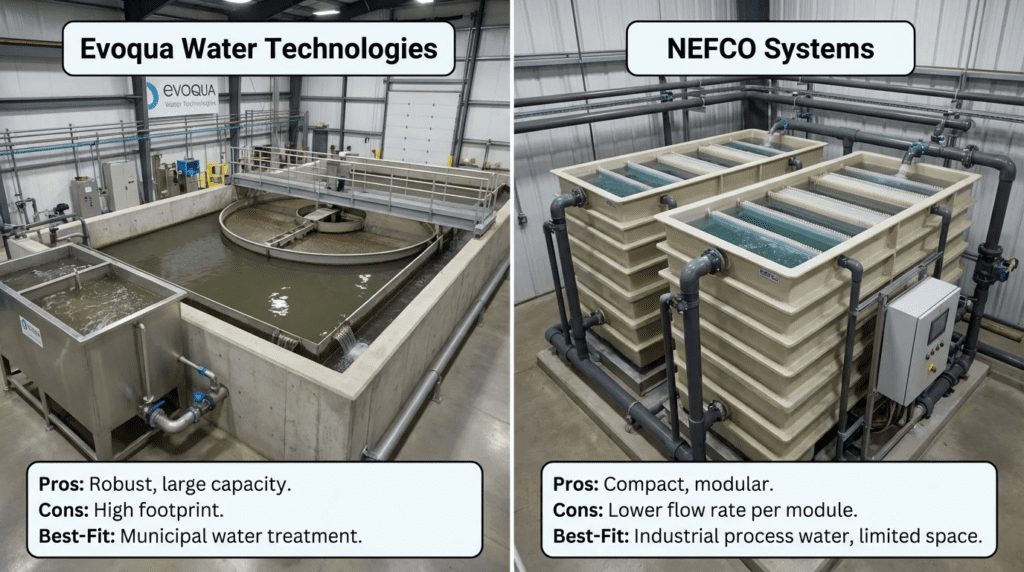
When specifying equipment for new builds or optimizing existing assets, consulting engineers frequently face a choice between integrated mechanical giants and specialized hydraulic optimizers. This brings us to the comparative analysis of Evoqua vs NEFCO Systems for Clarification: Pros/Cons & Best-Fit Applications. Evoqua (now part of Xylem) represents the legacy of the “Complete Mechanism,” holding the lineage of Envirex, Rex, and Link-Belt technologies. They provide the heavy iron—the rakes, drives, and suction headers. Conversely, NEFCO Systems has carved a niche as the leader in “Hydrodynamic Optimization,” specializing in engineered fiberglass reinforced plastic (FRP) density current baffles, launder covers, and weir accessories that fundamentally alter the hydraulic profile of the tank.
This article moves beyond the brochure. We will ignore marketing claims to focus on the physics of sedimentation, the reality of material science (Steel vs. FRP), and the operational lifecycle of these systems. We will examine why an engineer might pair an Evoqua Tow-Bro® with NEFCO Stamford Baffles, or why a utility might choose a single-source Evoqua package over a best-in-class component approach. By understanding the distinct engineering philosophies of these two entities, plant directors and design engineers can make specification-safe decisions that minimize total solids carryover (TSS) and maximize asset longevity.
HOW TO SELECT / SPECIFY
Selecting between or combining technologies from Evoqua and NEFCO requires a nuanced understanding of clarifier mechanics. The specification process must separate the sludge removal mechanism (Evoqua’s stronghold) from the hydraulic management system (NEFCO’s stronghold). Below are the critical engineering criteria for Evoqua vs NEFCO Systems for Clarification: Pros/Cons & Best-Fit Applications.
Duty Conditions & Operating Envelope
The first step in specification is defining the hydraulic and solids loading regimes.
- Surface Overflow Rate (SOR): For clarifiers operating near peak SOR (typically >800-1000 gpd/sq ft), hydraulic stability is paramount. NEFCO’s density current baffles are specifically designed to retain solids in high-flow scenarios where the “waterfall effect” of density currents usually causes blanket washout.
- Solids Loading Rate (SLR): If the plant operates with high MLSS or RAS rates, mechanical torque becomes the limiting factor. Evoqua’s drive units are engineered for high-torque applications. When specifying, engineers must calculate the running torque and alarm torque based on the worst-case SLR.
- Variable Flow (Diurnal Peaks): Plants with massive wet-weather flows require rapid sludge withdrawal to prevent denitrification and rising sludge. Here, the Evoqua Tow-Bro® hydraulic suction system offers a distinct advantage over standard scraper plows by actively removing sludge across the entire tank radius simultaneously.
Materials & Compatibility
The material of construction is a major differentiator between these two manufacturers.
- FRP vs. Steel: NEFCO systems are almost exclusively Fiberglass Reinforced Plastic (FRP). This offers superior corrosion resistance in the aggressive headspace environment of a clarifier (H2S presence). Evoqua typically utilizes coated carbon steel or stainless steel for structural mechanisms (bridges, rake arms), though they offer FRP baffles.
- UV Stability: For launder covers and exposed baffles, UV degradation is a failure mode. Specifications for NEFCO components must call out specific UV inhibitor additives in the resin matrix and surface veils to prevent “fiber blooming” after 10+ years of exposure.
- Dissimilar Metals: When retrofitting NEFCO FRP baffles onto an existing Evoqua steel tank or mechanism, dielectric isolation is less of a concern than steel-to-steel, but fastener selection (316SS) is critical to prevent galvanic corrosion at the anchor points.
Hydraulics & Process Performance
This is where the comparison of Evoqua vs NEFCO Systems for Clarification: Pros/Cons & Best-Fit Applications becomes a discussion of fluid dynamics.
- Density Current Management: The mixed liquor entering a clarifier is denser than the clarified water. It naturally plunges to the bottom and travels outward along the floor, hitting the outer wall and curling up—carrying solids over the weir. NEFCO’s Stamford Baffles are geometrically optimized to intercept this wall current and redirect it inward, enhancing the settling zone.
- Suction vs. Scraping: Evoqua’s primary hydraulic contribution is the Tow-Bro hydraulic removal system. Unlike a scraper that pushes sludge to a center hopper (which can take 30-60 minutes), the Tow-Bro removes sludge locally. In biological nutrient removal (BNR) plants, this rapid removal is essential to prevent phosphorus release.
Installation Environment & Constructability
- Retrofit Capability: NEFCO products are designed for constructability in existing tanks. Their modular baffle panels and bracket systems accommodate out-of-round concrete tanks—a common reality in municipal infrastructure.
- Structural Loads: Adding launder covers (Evoqua or NEFCO) changes the dead load and wind load profile on the tank wall or launder cantilever. Engineers must verify the concrete structural capacity, particularly for snow loads on covers in northern climates.
Reliability, Redundancy & Failure Modes
- Mechanical Failure: Evoqua mechanisms involve moving parts (gears, bearings, chains). The failure mode is typically wear-related or torque-overload related. MTBF for a well-maintained center drive is 20+ years, but requires regular oil analysis.
- Static Failure: NEFCO systems are largely static. The primary failure modes are bracket corrosion (if 304SS is used in high H2S instead of 316SS) or impact damage. Reliability is inherently higher for static baffles, but they do not actively remove sludge.
Maintainability, Safety & Access
- Algae Control: A major driver for specifying NEFCO launder covers is the reduction of O&M labor. Open launders require weekly scrubbing to prevent algae growth that clogs weirs. Covers block sunlight, eliminating this task.
- Walkway Safety: Both manufacturers offer access bridges. Evoqua’s bridges are structural steel supports for the mechanism. NEFCO often provides weir access for inspection. Specifications must mandate anti-slip surfaces and compliance with OSHA 1910 standards for guardrails.
Lifecycle Cost Drivers
- Energy: Evoqua drives consume continuous power. Efficiency of the worm gear or planetary reducer is a key OPEX calculation.
- Labor: NEFCO launder covers reduce cleaning labor by approximately 4-8 hours per week per clarifier during summer months. This operational savings often generates an ROI of under 3 years.
- Painting vs. Replacement: Steel mechanisms (Evoqua) require recoating every 15-20 years, a massive expense involving sandblasting and containment. FRP components (NEFCO) do not require painting, significantly lowering long-term asset management costs.
COMPARISON TABLES
The following tables provide a side-by-side analysis to assist engineers in distinguishing the primary competencies of each ecosystem. Table 1 focuses on the equipment attributes, while Table 2 outlines the application suitability matrix.
| Feature/Attribute | Evoqua (Envirex/Rex Legacy) | NEFCO Systems |
|---|---|---|
| Core Competency | Active Mechanical Sludge Removal (Drives, Rakes, Suction Headers). | Passive Hydraulic Optimization (Baffles, Weirs) & Algae Control (Covers). |
| Primary Materials | Carbon Steel (Coated), Stainless Steel, Cast Iron. | Fiberglass Reinforced Plastic (FRP), 316SS Hardware. |
| Key Proprietary Tech | Tow-Bro® (Hydraulic suction header), Rim-Flo® (Peripheral feed), Folded Flow®. | Stamford Baffles (Density current blocking), Launder Covers, Weir Wolf®. |
| Process Impact | Determines RAS concentration and sludge inventory control. Critical for BNR. | Reduces Effluent TSS by preventing short-circuiting; Inhibits algae growth. |
| Installation Type | Heavy construction; requires craneage for drives and bridges. Precision leveling of mechanism. | Lightweight modular assembly; often installed via hand-carrying components into tanks. |
| Maintenance Profile | Medium/High: Gearbox oil changes, torque calibration, seal replacement, structural recoating. | Low: Visual inspection of brackets/anchors. Occasional cleaning of covers. |
| Scenario / Constraint | Evoqua Recommendation | NEFCO Recommendation | Combined Approach (Best Practice) |
|---|---|---|---|
| New BNR Plant Construction | Specify Tow-Bro® for rapid sludge removal to prevent P-release. | Specify Density Current Baffles to maximize capacity. | Yes: Tow-Bro mechanism + NEFCO Baffles/Weirs. |
| Existing Plant with High TSS | Evaluate if mechanism speed/torque is sufficient. | Strong Fit: Retrofit baffles to correct hydraulics immediately. | Often NEFCO retrofit is the most cost-effective first step. |
| Odor & Algae Issues | Offer standard covers (often outsourced). | Strong Fit: Specialized modular launder covers. | Use NEFCO covers regardless of mechanism brand. |
| Circular vs. Rectangular | Dominates both (Circular Tow-Bro / Rectangular Chain & Flight). | Focuses on Circular (Baffles) but offers Rectangular Launder Covers. | Evoqua for Rectangular Chain & Flight mechanics; NEFCO for covers. |
| Tight Budget / Value Engineering | Standard scraper mechanism (lower cost than Tow-Bro). | Remove covers; Keep baffles (highest ROI for process). | Standard Evoqua scraper + NEFCO Baffles. |
ENGINEER & OPERATOR FIELD NOTES
Beyond the catalog data, the real-world performance of these systems is determined during commissioning and daily operation. The following notes are compiled from field experiences regarding Evoqua vs NEFCO Systems for Clarification: Pros/Cons & Best-Fit Applications.
Commissioning & Acceptance Testing
When commissioning an Evoqua mechanism, the critical path involves the torque test. Engineers must witness the full-load torque simulation to verify that the alarm and cutoff setpoints in the control panel match the structural rating of the drive cage. A common failure during SAT (Site Acceptance Testing) is the “hunting” of the rake arm due to uneven tank floors; the clearance must be verified by a “dry run” sweep before filling.
For NEFCO systems, commissioning focuses on level verification. The effectiveness of the effluent weir and the baffle submergence relies on precise elevation. If the weirs are not level, the tank will pull flow unevenly, negating the benefit of the baffles. During the wet test, dye testing is highly recommended. Injecting Rhodamine WT dye into the center well allows the engineer to visualize the density current. If the NEFCO baffle is working correctly, the dye should curl downward and inward upon hitting the baffle, rather than creeping up the wall to the weir.
Common Specification Mistakes
One of the most frequent errors in specifying clarification systems is the “Or Equal” trap regarding FRP thickness. An engineer might specify a generic “FRP Baffle,” allowing contractors to supply thin, chopped-strand mat products that warp within two years. When comparing Evoqua (who may supply their own baffles) vs NEFCO, the specification must detail the glass-to-resin ratio and minimum thickness (typically 1/4″ or 3/16″ depending on structural ribs). NEFCO panels are engineered laminates; generic replacements are often not equivalent.
Another mistake is neglecting the scum beach approach. If using an Evoqua skimmer with a NEFCO baffle, the interface where the skimmer arm passes the baffle brackets is a collision risk. The drawing submittals must be overlaid to ensure the skimmer arm has clearance and the “wiper” rubber properly seals without binding.
O&M Burden & Strategy
- Evoqua Mechanisms: Maintenance is mechanical.
- Monthly: Check gearbox oil levels and condensation.
- Semi-Annually: Grease the main bearing (if not an oil-bath design).
- Annually: Inspect the “squeegees” or plow blades for wear. If using Tow-Bro, inspect the orifices for clogging (rags/plastics).
- NEFCO Components: Maintenance is aesthetic and structural.
- Quarterly: Inspect launder covers for hinge integrity and snow load damage.
- Annually: Check baffle brackets for loose anchors. Inspect FRP surfaces for UV bloom (fiber exposure).
Troubleshooting Guide
Symptom: Rising Sludge Clouds near the Outer Wall.
Diagnosis: This is the classic density current signature.
Solution: If NEFCO baffles are installed, check for damage or gaps between panels. If not installed, this is the primary justification for a retrofit. If Evoqua Tow-Bro is installed, check if the suction ratio is balanced; the arm might be pulling too much from the center and not enough from the periphery.
Symptom: High Torque Alarms on Evoqua Drive.
Diagnosis: Heavy sludge blanket or mechanical binding.
Solution: First, verify the sludge blanket depth. If the blanket is low but torque is high, drain the tank and inspect the center bearing and the lower guide bearings on the cage. A common issue is a submerged obstruction (dropped tool, concrete chunk) jamming the rake.
DESIGN DETAILS / CALCULATIONS
Engineering the interface between the mechanical collection system and the hydraulic baffling requires precise calculation and adherence to standards.
Sizing Logic & Methodology
The interaction between the baffle depth and the clarifier side water depth (SWD) is critical. A general rule of thumb for NEFCO density current baffles is that the baffle should extend downward at roughly a 30-degree angle or be positioned on the wall to intercept the current.
Calculation for Baffle Placement:
Ideally, the bottom of the baffle should be located below the density current “nose.”
$$ H_{baffle} approx 0.3 times SWD $$
However, this must not interfere with the mechanical arm.
Clearance Check: $$ Elevation_{ArmTop} + 6″ Safety < Elevation_{BaffleBottom} $$
Engineers must verify this dimension in the shop drawing phase. If the clarifier is shallow (SWD < 12 ft), standard baffles may interfere with the mechanism, requiring a specialized "low profile" or horizontal shelf baffle design.
Specification Checklist
To ensure a robust system that leverages the strengths of Evoqua vs NEFCO Systems for Clarification, include the following in the project manual:
- Drive Mechanism (Evoqua Section):
- AGMA rated gear life (typically Class I or II, 20-year design life).
- Continuous torque rating and momentary peak torque rating (1.5x continuous).
- Overload protection: Electronic shear pin or load cell monitoring (preferred over mechanical shear pins).
- Hydraulic Accessories (NEFCO Section):
- Resin System: Isophthalic polyester or Vinyl Ester (for higher chemical resistance).
- UV Protection: Neopentyl Glycol (NPG) gel coat with UV inhibitors.
- Panel Thickness: Minimum 3/16″ nominal thickness for structural rigidity.
- Wind Load: Launder covers designed for 30-50 psf snow load and site-specific wind speeds (ASCE 7).
Standards & Compliance
- ANSI/AWWA F102: Matched Die-Molded Fiberglass-Reinforced Plastic Weir Plates, Scum Baffles, and Mounting Brackets. (Critical for NEFCO specs).
- AGMA 6013/6034: Standard for Enclosed Epicyclic Gear Units (Critical for Evoqua drive specs).
- OSHA 1910.23: Guarding floor and wall openings and holes (Critical for launder cover access hatches).
FAQ SECTION
What is the difference between Evoqua Tow-Bro and standard scrapers?
The Evoqua Tow-Bro® is a hydraulic suction mechanism, whereas standard scrapers are plow mechanisms. A standard scraper pushes sludge spirally toward a center hopper, which can take 30 to 60 minutes depending on tank size. This residence time allows secondary release of phosphorus in BNR plants. The Tow-Bro utilizes a hollow header arm with orifices to vacuum sludge directly from the tank floor across the entire radius simultaneously, reducing residence time and improving effluent quality. It is best suited for biological solids, while scrapers are better for heavy, inorganic solids.
Can NEFCO baffles be installed on a clarifier with an Evoqua mechanism?
Yes, this is a very common configuration. NEFCO baffles are mechanism-neutral. The key engineering constraint is ensuring physical clearance between the rotating Evoqua rake arm (or skimmer arm) and the static NEFCO baffle brackets. This typically requires a field measurement of the existing mechanism’s clearance envelope before manufacturing the baffles.
How much do NEFCO density current baffles improve performance?
While results vary by hydraulic loading, properly designed density current baffles typically reduce effluent Total Suspended Solids (TSS) by 30% to 50%. By redirecting the wall current back into the settling zone, they effectively utilize more of the tank’s volume, preventing the “short-circuiting” that causes solids washout during peak flow events.
Does Evoqua manufacture their own baffles?
Yes, Evoqua (Xylem) offers baffling systems, often made of steel or FRP, as part of their complete clarifier packages. However, NEFCO is considered a specialist in this specific component area, often offering more advanced hydrodynamic geometries and modular FRP designs. Engineers often perform a cost-benefit analysis between the OEM package baffle and a third-party specialist baffle.
What is the lifecycle of FRP components compared to steel?
FRP components (like NEFCO systems) typically have a design life of 20-30 years with minimal maintenance, as they do not rust. Steel components (like standard Evoqua mechanisms) also last 20-30 years but require significant maintenance, specifically recoating/painting every 10-15 years to prevent structural corrosion. In high H2S environments, FRP is superior for static components.
Why specify launder covers?
Launder covers are primarily an Operational Expenditure (OPEX) saving tool. They block sunlight, preventing algae growth on the weirs and troughs. This eliminates the need for operators to manually scrub the weirs, which is often a weekly task in summer. They also contain odors and prevent debris/leaves from entering the effluent stream.
CONCLUSION
KEY TAKEAWAYS
- Define the Goal: If the problem is mechanical reliability or sludge age control, look to the Mechanism (Evoqua). If the problem is effluent TSS spikes or algae maintenance, look to the Hydraulic Accessories (NEFCO).
- Don’t Settle for “Standard”: Standard clarifiers suffer from density currents. Specifying Stamford-type baffles (NEFCO or equal) is now considered best practice for BNR plants.
- Material Matters: Use FRP for static parts in the headspace (baffles, weirs) to eliminate painting costs. Use Steel for high-torque moving parts (drives, rakes).
- Verify Clearance: The interface between the rotating arm and static baffles is the #1 design conflict. Verify elevations during the submittal phase.
- Hybrid Approach: The highest performing clarifiers often utilize a heavy-duty mechanical drive (like Evoqua) paired with optimized FRP hydraulics (like NEFCO).
In the analysis of Evoqua vs NEFCO Systems for Clarification: Pros/Cons & Best-Fit Applications, the conclusion for the municipal engineer is not necessarily to choose one over the other, but to understand where their respective engineering philosophies provide value. Evoqua (Xylem) remains the powerhouse for the kinetic machinery required to move solids. Their Tow-Bro technology is largely unrivaled for rapid sludge removal in sensitive biological processes.
However, the static hydraulics of the tank are equally critical to permit compliance. NEFCO has demonstrated that treating the tank hydrodynamics with specialized FRP barriers and covers can significantly upgrade the capacity of the underlying mechanical system. For new plant designs, a specification that integrates a robust mechanical collector with advanced hydraulic baffling represents the gold standard. For existing plants, identifying whether the failure mode is mechanical (broken drives) or hydraulic (cloudy effluent) will dictate which manufacturer offers the necessary solution.
Ultimately, the best-performing clarification systems are those where the engineer has rigorously defined the interface between the machine and the water, ensuring that torque ratings meet solids loading, and baffle geometries tame the density currents.