
Evoqua vs ProMinent BioGas Equipment: Comparison & Best Fit
INTRODUCTION
In the realm of anaerobic digestion and cogeneration, the protection of downstream assets—whether internal combustion engines (ICE), boilers, or renewable natural gas (RNG) membranes—is paramount. Engineers often face a critical disconnect: the anaerobic digester produces valuable fuel, but that fuel is laden with hydrogen sulfide (H2S), siloxanes, and moisture that can destroy capital equipment in a matter of months. A frequent point of confusion in specification arises when selecting the subsystems responsible for gas conditioning and chemical support. This often leads to an evaluation of Evoqua vs ProMinent BioGas Equipment: Comparison & Best Fit.
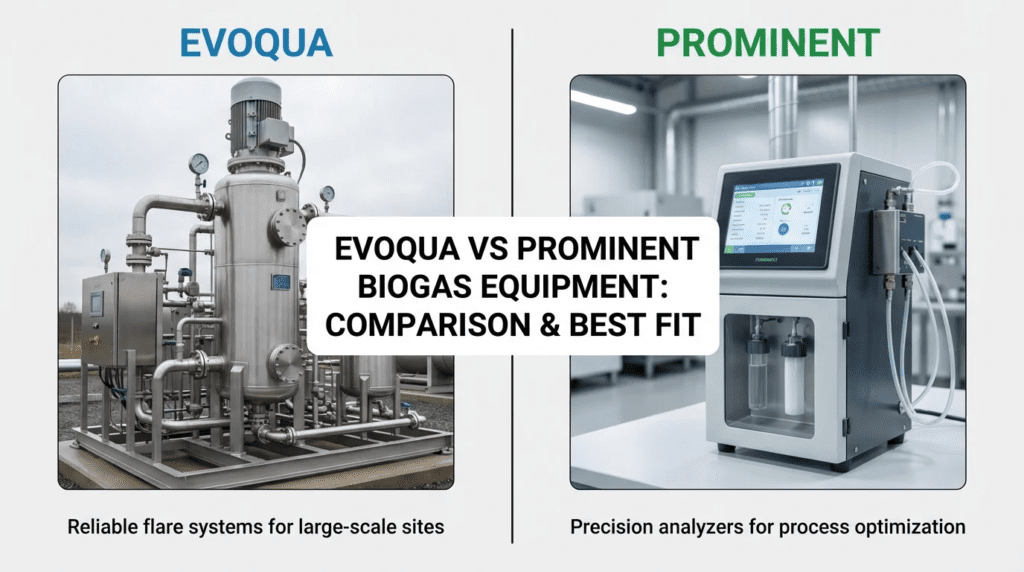
While Evoqua (now largely integrated into Xylem/Veralto portfolios) and ProMinent are both Tier-1 manufacturers in the water and wastewater sector, their approaches to biogas applications differ fundamentally. Evoqua is traditionally viewed as a systems integrator for the gas train itself—providing biological scrubbers, iron sponges, and the legacy Varec brand of gas safety equipment. ProMinent, conversely, dominates the precision chemical injection market, providing the critical dosing infrastructure required for wet scrubbers, pH control, and condensate treatment.
For the municipal engineer or plant superintendent, the choice isn’t always binary; it is about understanding where these technologies overlap (specifically in H2S removal and chemical handling) and where they diverge. A poor specification here results in more than just maintenance headaches; it leads to biological upsets in scrubbers, overdosing of expensive chelating agents, or catastrophic corrosion of cogeneration engines. This article provides a rigorous engineering analysis of Evoqua vs ProMinent BioGas Equipment: Comparison & Best Fit, focusing on performance, maintainability, and lifecycle considerations for wastewater treatment plants (WWTPs) and industrial digesters.
HOW TO SELECT / SPECIFY
When evaluating biogas conditioning and support equipment, engineers must move beyond simple catalogue data. The harsh, corrosive nature of biogas (classified often as NFPA 820 environments) demands specific engineering scrutiny. Below are the critical selection criteria.
Duty Conditions & Operating Envelope
The primary driver for selection is the variability of the gas stream. Biogas production is rarely steady-state; it fluctuates with digester loading and temperature.
- H2S Loading Variability: Systems must be sized not just for average H2S (e.g., 200-500 ppm) but for peak spikes (2000+ ppm) that occur during digester upsets or mixing events. Biological systems (typical of Evoqua) handle steady loads efficiently but may struggle with rapid, massive spikes compared to caustic wet scrubbers (often supported by ProMinent dosing).
- Turndown Ratio: Gas flow rates can vary significantly. Dosing pumps and blowers must have adequate turndown (often 10:1 or higher) to prevent over-treatment during low-flow periods.
- Moisture Content: Biogas is 100% saturated leaving the digester. Equipment must be specified to handle condensing environments. Materials that are chemically resistant in dry conditions may fail when wet H2S forms sulfuric acid.
Materials & Compatibility
Corrosion is the primary failure mode in biogas applications. Specification sections must be explicit regarding material grades.

- Wet End Construction: For chemical dosing (ProMinent focus), diaphragms and heads handling caustic or hypochlorite must be PVDF or PTFE. For gas vessels (Evoqua focus), FRP (Fiberglass Reinforced Plastic) or 316L Stainless Steel are standard. 304 Stainless Steel is generally insufficient for raw biogas service.
- Elastomers: Gaskets and O-rings are vulnerable. Viton (FKM) is generally preferred over EPDM for biogas service due to the presence of trace hydrocarbons and oils, although EPDM is superior for certain caustic scrubbing chemicals. Compatibility charts must be cross-referenced against the specific gas chromatography of the site.
Hydraulics & Process Performance
In the context of Evoqua vs ProMinent BioGas Equipment: Comparison & Best Fit, hydraulics refers to both gas flow and liquid chemical kinetics.
- Empty Bed Contact Time (EBCT): For Evoqua biological scrubbers or iron sponges, the vessel sizing is dictated by EBCT (typically 30-60 seconds minimum). Undersizing the vessel volume to save CAPEX results in “breakthrough,” where H2S passes untreated.
- Dosing Accuracy: For ProMinent systems, the focus is on stoichiometry. If a wet scrubber requires a specific molar ratio of NaOH to H2S, the pump must maintain accuracy against variable backpressure. Solenoid-driven metering pumps offer high precision but must be checked against the system pressure curve.
Installation Environment & Constructability
Biogas equipment is frequently installed in hazardous locations.
- NFPA 820 Compliance: Equipment installed in gas control rooms or near digesters often requires Class 1, Division 1 or 2 ratings. Motors must be explosion-proof (XP) or intrinsically safe (IS).
- Freeze Protection: Both chemical lines and biological media are susceptible to freezing. Heat tracing and insulation are mandatory specification items for northern climates. Biological scrubbers require media temperatures between 15°C and 35°C for optimal bacterial activity, necessitating immersion heaters or heat exchangers.
Reliability, Redundancy & Failure Modes
Engineers must analyze the consequences of failure. If the H2S removal system fails, does the flare operate? Does the cogen engine shut down?
- Pump Redundancy: Chemical feed systems should always be specified as Duty/Standby. ProMinent skids typically offer auto-switchover logic upon flow failure detection.
- Media Life: Evoqua iron sponge media is a consumable. The “failure mode” is saturation. Design must allow for media changeout (which is labor-intensive) without taking the entire gas train offline (bypass plumbing is critical).

Controls & Automation Interfaces
Modern biogas systems cannot operate in isolation.
- Feedback Loops: Effective treatment requires real-time H2S monitoring. The control loop typically involves an H2S analyzer on the outlet sending a 4-20mA signal to the PLC, which then adjusts the speed of ProMinent dosing pumps or the recirculation rate of Evoqua scrubbers.
- Data Logging: For regulatory compliance (air permits), sulfur emissions must be tracked. The equipment specification must require Modbus TCP/IP or Ethernet/IP integration to the plant SCADA for historian recording.
Lifecycle Cost Drivers
The total cost of ownership (TCO) diverges significantly between technologies.
- Chemical vs. Biological: Biological systems (Evoqua) have high CAPEX but low OPEX (nutrient feed is cheap). Chemical wet scrubbers (using ProMinent dosing) have lower CAPEX but very high OPEX due to the continuous consumption of caustic and bleach.
- Maintenance Labor: Biological systems require infrequent but messy media changeouts. Chemical systems require frequent pump diaphragm maintenance and rigid safety protocols for handling hazardous fluids.
COMPARISON TABLES
To assist in the determination of Evoqua vs ProMinent BioGas Equipment: Comparison & Best Fit, the following tables break down the manufacturers by their primary technology strengths and application suitability. Table 1 focuses on the equipment portfolio, while Table 2 outlines the decision matrix for specific plant scenarios.
| Manufacturer Focus | Primary BioGas Technologies | Engineering Strengths | Limitations / Considerations | Maintenance Profile |
|---|---|---|---|---|
| Evoqua (Veralto/Xylem) |
|
Systems integrator approach. Deep expertise in heavy mechanical gas handling and biological H2S oxidation. Can supply the entire “Gas Train” from digester to flare. | High CAPEX for biological systems. Large physical footprint required for media beds. Biological systems have slow recovery times after toxic upset. | Low Frequency / High Intensity. Media replacement is infrequent (years) but labor-intensive. Daily checks are minimal. |
| ProMinent |
|
Precision fluid handling. Best-in-class metering accuracy for caustic/bleach injection in wet scrubbers. Advanced sensor diagnostics and preventative maintenance integration. | Component focused. Typically does not manufacture the scrubber vessel or gas train itself. Requires integration into a larger system design. | High Frequency / Low Intensity. Regular calibration of sensors and diaphragm/valve replacements. Parts are small and easily handled. |
| Application Scenario | Preferred Approach | Key Decision Factor | Operator Skill Impact | Relative Cost Profile |
|---|---|---|---|---|
| High H2S (>1000 ppm), Continuous Flow | Evoqua Biological Scrubber | Chemical costs for this load would be prohibitive. Biological offers lowest OPEX. | Moderate (Biology management) | High CAPEX / Low OPEX |
| Variable H2S, Strict Zero-Emission limits | Hybrid (Bio + Chemical Polish) | Requires ProMinent dosing pumps for the polishing stage to handle peaks the bio-scrubber misses. | High (Managing two systems) | High CAPEX / Moderate OPEX |
| Small Plant, Space Constrained | Chemical Wet Scrubber (w/ ProMinent Skids) | Biological towers are too large. Chemical scrubbers have smaller footprints. | High (Hazmat handling) | Low CAPEX / High OPEX |
| Iron Sponge Regeneration | Evoqua Vessel + ProMinent Moisture/Temp Control | Requires simple vessel but precise moisture management to prevent media drying/fire. | Low | Moderate CAPEX / Moderate OPEX |
ENGINEER & OPERATOR FIELD NOTES
Real-world experience often diverges from the datasheet. The following notes are compiled from field observations regarding the commissioning and operation of these systems.
Commissioning & Acceptance Testing
Commissioning a biogas conditioning system is hazardous. It involves transitioning from air (safe) to methane (explosive) and H2S (toxic).
Factory Acceptance Test (FAT): For ProMinent skids, verify the pump curve at the actual specified backpressure. Many skids are tested with water at atmospheric pressure; however, injecting caustic into a pressurized scrubber line changes the hydraulic characteristic. Ensure the pressure relief valves are set correctly at the factory.
Site Acceptance Test (SAT): For Evoqua biological systems, the “seeding” phase is critical. You cannot simply turn on the gas and expect performance. The biomass requires weeks to acclimate. The SAT must define a “ramp-up” period where performance guarantees are phased in. Attempting to load the system to 100% capacity on Day 1 will result in failure.
Common Specification Mistakes
Over-specifying Pump Head: Engineers often apply excessive safety factors to discharge pressure requirements. If a ProMinent pump is sized for 100 PSI but operates at 10 PSI, the turndown accuracy may suffer, and the pulsation dampener may not function effectively.
Ignoring Condensate in Biological Systems: In Evoqua installations, the gas entering the scrubber is often warm and saturated. As it travels through the media, it cools, generating significant condensate. If the drain design is undersized or lacks a proper P-trap seal depth (must exceed gas pressure), gas will blow out the drain, or condensate will back up and flood the blower. P-trap design calculations are a common oversight.
O&M Burden & Strategy
ProMinent / Chemical Systems: Maintenance is centered on the “wet end.”
- Monthly: Check pump calibration (draw-down test).
- Quarterly: Inspect check valves and diaphragms for crystallization (especially with Caustic Soda).
- Safety: Flushing lines before maintenance is non-negotiable due to chemical hazards.
Evoqua / Biological Systems: Maintenance is centered on the “environment.”
- Weekly: Check nutrient tank levels and irrigation spray patterns. Nozzles often clog with biomass.
- Annually: Inspect media for compaction or channeling. Check pH of the recirculation water.
- Safety: Confined space entry protocols are critical when inspecting scrubber internals.
Troubleshooting Guide
Symptom: High H2S in Outlet (Breakthrough)
- Chemical System (ProMinent): Check for vapor lock in the pump head. Verify the pH sensor is clean; a fouled sensor may read “high pH” (sufficient chemical) when the solution is actually spent.
- Biological System (Evoqua): Check the irrigation rate. If the biomass dries out, it dies. Conversely, if the irrigation is too aggressive, it can shear the biofilm off the media. Also, check temperature; bacterial activity drops significantly below 15°C.
DESIGN DETAILS / CALCULATIONS
To accurately specify equipment in the Evoqua vs ProMinent BioGas Equipment: Comparison & Best Fit analysis, engineers must perform foundational sizing calculations.
Sizing Logic & Methodology
1. Determining H2S Mass Load
Before selecting a scrubber or dosing pump, calculate the mass load of sulfur.
Formula: Lbs/Day Sulfur = (Flow in SCFM) × (H2S ppm) × (1.44 × 10^-4) (Approximation constant depends on gas density/temp).
Example: A digester producing 500 SCFM with 500 ppm H2S.
Load ≈ 500 × 500 × 0.000144 ≈ 36 lbs of Sulfur/day.
This number dictates the biological volume (Evoqua) or the chemical consumption rate (ProMinent).
2. Chemical Dosing Rate (Stoichiometry)
For a chemical scrubber using ProMinent pumps:
Reaction: H2S + 2NaOH → Na2S + 2H2O
Theoretical consumption is roughly 2.4 lbs of NaOH per lb of H2S. However, in practice, due to CO2 absorption (which also consumes caustic), the ratio is often 3:1 or 4:1.
Sizing: Pump Capacity (GPH) = (Mass Load H2S × 4) / (Lbs NaOH per Gallon of Solution).
This calculation prevents undersizing pumps—a frequent error when engineers forget the parasitic consumption of caustic by CO2 in biogas.
Specification Checklist
When writing the RFP, ensure these line items are present:
- Performance Guarantee: “System shall reduce H2S from [Max Inlet] to [Max Outlet] under all flow conditions.”
- Material Certifications: “All wetted metallic parts shall be 316L SS. All elastomers shall be suitable for biogas service.”
- Testing: “Hydrostatic testing of all pressure vessels to 1.5x design pressure.”
- Documentation: “O&M manuals must include specific troubleshooting for biological upset recovery” (for Evoqua type systems).
Standards & Compliance
- NFPA 820: Standard for Fire Protection in Wastewater Treatment and Collection Facilities. Dictates ventilation rates and electrical classifications.
- ASME Section VIII: Required for any pressure vessels (scrubbers, filters) operating above 15 PSI.
- UL 508A: Standard for Industrial Control Panels.
FAQ SECTION
What is the primary difference between Evoqua and ProMinent in biogas applications?
The primary difference lies in the scope of supply. Evoqua (Varec/Xylem) typically provides the “macro” process equipment such as biological scrubber towers, iron sponge vessels, and gas safety plumbing (flame arresters). ProMinent specializes in the “micro” precision equipment, specifically chemical metering pumps, sensors, and control skids that support wet scrubbing or condensate treatment processes. Often, an Evoqua system will utilize ProMinent pumps as components.
How do you select between biological and chemical H2S scrubbers?
Selection is driven by Lifecycle Cost (LCC). Biological scrubbers (Evoqua style) have high initial capital cost but very low operating costs, making them ideal for high-flow, high-load applications. Chemical scrubbers (using ProMinent dosing) have lower capital cost but high operating costs due to chemical consumption, making them better suited for emergency backup, polishing, or intermittent use where steady biological growth is difficult to maintain.
What is the typical lifespan of a biogas chemical dosing pump?
A high-quality solenoid or motor-driven diaphragm pump (like ProMinent Sigma/Gamma) typically lasts 10-15 years. However, the “wet end” (diaphragm, check balls, seats) is a wear item. In clean water service, these last 1-2 years; in aggressive caustic or hypochlorite service required for biogas scrubbing, they may require replacement every 6-12 months depending on the duty cycle and chemical quality.
Why does H2S removal equipment fail prematurely?
The most common cause of failure is improper moisture management. Biogas is saturated with water. If condensate accumulates in media beds or blinds chemical sensors, performance drops. Additionally, the formation of sulfuric acid (H2SO4) from H2S and moisture attacks non-compatible materials like carbon steel, copper, or standard concrete, leading to structural failure. Always specify 316L SS or appropriate composites.
Can ProMinent pumps be integrated into Evoqua systems?
Yes, and this is a common specification strategy. An engineer might specify an Evoqua (or similar OEM) odor control vessel but mandate ProMinent metering pumps in the “Approved Manufacturers” list for the nutrient or chemical feed loops. This ensures the plant maintains standard pump inventory while utilizing Evoqua’s process expertise.
What are the safety risks associated with biogas equipment maintenance?
Biogas presents a triple threat: it is flammable (methane), toxic (H2S), and an asphyxiant (displaces oxygen). Maintenance on scrubbers or pumps requires strict Lockout/Tagout (LOTO) and gas detection. Opening a vessel containing “pyrophoric” iron sponge media can cause spontaneous combustion when the media contacts oxygen. Specialized training is required for handling spent media.
CONCLUSION
KEY TAKEAWAYS
- Role Distinction: Use Evoqua (Veralto/Varec) for heavy process equipment (towers, covers, flares). Use ProMinent for precision chemical injection and monitoring loops.
- Cost Analysis: Biological systems save money over 20 years (low chem use). Chemical systems save money on Day 1 (low CAPEX).
- Safety First: Prioritize NFPA 820 compliance and material compatibility (316L SS/Viton) over cost savings.
- Sizing Trap: Do not size purely for average flows; sizing for peak H2S events is critical to prevent engine damage or permit violations.
- Hybrid Approach: The best fit is often a biological bulk removal system followed by a chemical polishing stage (using precision dosing) to ensure <1ppm H2S.
The comparison of Evoqua vs ProMinent BioGas Equipment: Comparison & Best Fit ultimately reveals that these manufacturers are more complementary than competitive in a well-designed plant. For the consulting engineer or plant director, the goal is to leverage Evoqua’s strengths in biological process stability and gas handling safety, while utilizing ProMinent’s reliability in the critical chemical support systems that keep these processes running.
Successful implementation requires a rigorous look at the specific gas chromatography of the facility, a realistic assessment of operator bandwidth for maintenance (biology vs. chemistry), and a commitment to lifecycle cost analysis rather than lowest-bidder procurement. By clearly defining the boundaries—mechanical gas train versus chemical delivery—engineers can specify a robust system that protects downstream power generation assets and ensures environmental compliance for decades.