
Evoqua vs ProMinent BioGas Equipment: Comparison & Best Fit
Evoqua vs ProMinent BioGas Equipment: Comparison & Best Fit
Introduction
In anaerobic digestion and cogeneration, protecting downstream assets — internal combustion engines, boilers, or renewable natural gas upgrading membranes — is paramount. Engineers face a critical disconnect: the digester produces valuable fuel, but that fuel carries hydrogen sulfide (H2S), siloxanes and moisture capable of destroying capital equipment within months.
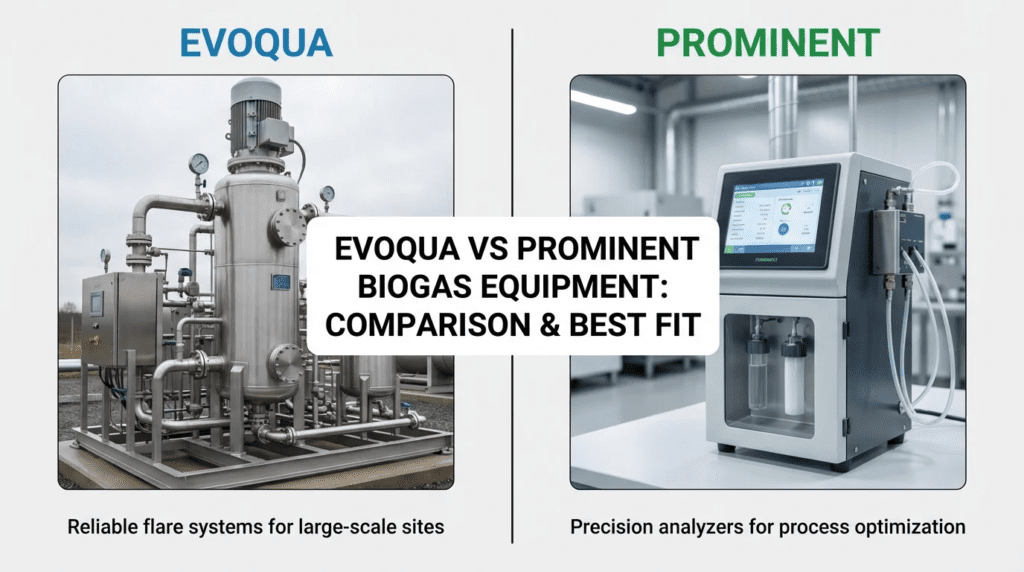
A scope note belongs at the top of any Evoqua vs ProMinent BioGas Equipment: Comparison & Best Fit evaluation, because neither company is a biogas systems manufacturer in the sense of digesters, gas holders or combined heat and power packages. Both supply equipment that touches the biogas train from different directions. Evoqua — acquired by Xylem in 2023 — brings gas handling and H2S removal equipment along with the Varec gas safety line of flame arresters, pressure relief and digester cover hardware. ProMinent dominates precision chemical injection, supplying the dosing infrastructure wet scrubbers require for caustic feed, pH control and condensate treatment. They are complementary rather than competing, and a plant frequently ends up with both.
For the municipal engineer or plant superintendent, the useful question is where these technologies overlap — specifically H2S removal and chemical handling — and where they diverge. Poor specification here produces more than maintenance headaches: biological upsets in scrubbers, overdosing of expensive chemicals, or catastrophic corrosion of cogeneration engines.
Broader supplier positioning is covered in our overview of the top OEMs for biogas systems.
How to Select and Specify
The corrosive nature of biogas, and the hazardous classifications that follow it, demand specific engineering scrutiny.
Duty Conditions & Operating Envelope
- H2S loading variability: Systems must be sized not for average concentration but for the spikes that occur during digester upsets or mixing events. Biological systems handle steady loads efficiently but struggle with rapid, large spikes compared with caustic wet scrubbers.
- Turndown ratio: Gas flow varies widely. Dosing pumps and blowers need adequate turndown to prevent over-treatment during low-flow periods.
- Moisture content: Biogas leaves the digester fully saturated. Equipment must be specified for condensing service. Materials that resist dry H2S may fail when wet H2S forms sulfuric acid.
Materials & Compatibility
- Wet end construction: For chemical dosing, diaphragms and heads handling caustic or hypochlorite must be PVDF or PTFE. For gas vessels, fiberglass reinforced plastic or 316L stainless is standard. 304 stainless is generally insufficient for raw biogas service.
- Elastomers: Gaskets and O-rings are vulnerable. Fluoroelastomers are generally preferred over EPDM for biogas because of trace hydrocarbons and oils, though EPDM performs better with certain caustic scrubbing chemicals. Cross-reference compatibility charts against the actual gas analysis for the site.
Hydraulics & Process Performance
- Empty bed contact time: For biological scrubbers or iron sponge media, vessel sizing is dictated by contact time. Undersizing vessel volume to save capital produces breakthrough, where H2S passes untreated.
- Dosing accuracy: For chemical systems, the focus is stoichiometry. If a wet scrubber requires a specific molar ratio of caustic to H2S, the pump must maintain accuracy against variable backpressure. Solenoid-driven metering pumps offer high precision but must be checked against the system pressure curve.
Installation Environment & Constructability
- NFPA 820 compliance: Equipment in gas control rooms or near digesters often requires hazardous location ratings. Motors must be explosion-proof or intrinsically safe.
- Freeze protection: Chemical lines and biological media both freeze. Heat tracing and insulation are mandatory in northern climates. Biological scrubbers require media temperatures in a specific band for bacterial activity, meaning immersion heaters or heat exchangers.
Reliability, Redundancy & Failure Modes
- Pump redundancy: Chemical feed systems should always be specified duty/standby with automatic switchover on flow failure detection.
- Media life: Iron sponge media is a consumable and its failure mode is saturation. Design must allow media changeout — which is labor-intensive — without taking the entire gas train offline. Bypass plumbing is critical.
Controls & Automation
- Feedback loops: Effective treatment requires real-time H2S monitoring. The loop typically runs from an outlet analyzer to the controller, which adjusts dosing pump speed or scrubber recirculation rate.
- Data logging: Air permits require sulfur emissions tracking. Specifications must require industrial protocol integration to the plant SCADA for historian recording.
Lifecycle Cost Drivers
- Chemical against biological: Biological systems carry high capital cost but low operating cost, since nutrient feed is cheap. Chemical wet scrubbers carry lower capital cost but high operating cost from continuous caustic consumption.
- Maintenance labor: Biological systems require infrequent but messy media changeouts. Chemical systems require frequent diaphragm maintenance and strict safety protocols for hazardous fluid handling.
Comparison Tables
| Supplier | Biogas-Related Equipment | Engineering Strengths | Limitations | Maintenance Profile |
|---|---|---|---|---|
| Evoqua (now Xylem) |
|
Systems integrator approach with depth in mechanical gas handling and H2S oxidation. Can supply much of the gas train from digester to flare. | High capital cost for biological systems. Large physical footprint for media beds. Biological systems recover slowly after toxic upset. Not a digester or CHP supplier. | Low frequency, high intensity. Media replacement is infrequent but labor-intensive. Daily checks minimal. |
| ProMinent |
|
Precision fluid handling. Strong metering accuracy for caustic and bleach injection in wet scrubbers. Advanced sensor diagnostics. | Component-focused. Does not manufacture the scrubber vessel or gas train, so integration into a larger system design is required. | High frequency, low intensity. Regular sensor calibration and diaphragm or valve replacement. Parts are small and easily handled. |
| Application | Preferred Approach | Key Decision Factor | Operator Skill Impact | Cost Profile |
|---|---|---|---|---|
| High H2S, continuous flow | Biological scrubber | Chemical costs at this load would be prohibitive. Biological offers lowest operating cost. | Moderate — biology management | High capital / low operating |
| Variable H2S, strict limits | Hybrid, biological plus chemical polish | Requires precision dosing for the polishing stage to catch peaks the bio-scrubber misses | High — two systems to manage | High capital / moderate operating |
| Small plant, space constrained | Chemical wet scrubber with dosing skid | Biological towers are too large. Chemical scrubbers have a smaller footprint. | High — hazardous material handling | Low capital / high operating |
| Iron sponge service | Media vessel with moisture and temperature control | Simple vessel but precise moisture management to prevent media drying and fire risk | Low | Moderate capital / moderate operating |
Engineer & Operator Field Notes
Commissioning & Acceptance Testing
Commissioning a biogas conditioning system is hazardous, involving a transition from air to methane and H2S.
Factory acceptance: For dosing skids, verify the pump curve at the actual specified backpressure. Many skids are tested with water at atmospheric pressure, but injecting caustic into a pressurized scrubber line changes the hydraulic characteristic. Confirm relief valve settings at the factory.
Site acceptance: For biological systems, the seeding phase is critical. Biomass requires weeks to acclimate, so the acceptance test must define a ramp-up period with phased performance guarantees. Loading the system to full capacity on day one will fail.
Common Specification Mistakes
Over-specifying pump head: Engineers often apply excessive safety factors to discharge pressure. A pump sized for far higher pressure than it sees operates with degraded turndown accuracy, and the pulsation dampener may not function effectively.
Ignoring condensate in biological systems: Gas entering the scrubber is warm and saturated. As it travels through the media it cools, generating significant condensate. If the drain design is undersized or the trap seal depth does not exceed gas pressure, gas blows out the drain or condensate backs up and floods the blower. Trap design calculations are a common oversight.
O&M Burden & Strategy
Chemical systems: Maintenance centers on the wet end.
- Monthly: Check pump calibration by drawdown test
- Quarterly: Inspect check valves and diaphragms for crystallization, particularly with caustic
- Safety: Flushing lines before maintenance is non-negotiable
Biological systems: Maintenance centers on the environment.
- Weekly: Check nutrient levels and irrigation spray patterns. Nozzles clog with biomass.
- Annually: Inspect media for compaction or channeling. Check recirculation water pH.
- Safety: Confined space protocols are critical when inspecting scrubber internals
Troubleshooting
High H2S in outlet (breakthrough)
- Chemical system: Check for vapor lock in the pump head. Verify the pH sensor is clean — a fouled sensor may indicate sufficient chemical when the solution is spent.
- Biological system: Check irrigation rate. If biomass dries out it dies; if irrigation is too aggressive it shears biofilm off the media. Check temperature, since bacterial activity drops sharply when cold.
Design Details & Calculations
Determining H2S Mass Load
Before selecting a scrubber or dosing pump, calculate the sulfur mass load from gas flow rate and H2S concentration, applying the appropriate conversion for gas density and temperature. That figure dictates biological reactor volume or chemical consumption rate, and it is the number every supplier will ask for first.
Chemical Dosing Stoichiometry
For a caustic wet scrubber, the governing reaction consumes two moles of sodium hydroxide per mole of H2S. Theoretical consumption is therefore straightforward, but in practice carbon dioxide in the biogas also consumes caustic, so real consumption ratios run substantially above stoichiometric. Forgetting this parasitic consumption is a frequent cause of undersized dosing pumps.
Specification Checklist
- Performance guarantee: System shall reduce H2S from stated maximum inlet to stated maximum outlet under all flow conditions
- Material certifications: Wetted metallic parts to stated grade; elastomers suitable for biogas service
- Testing: Hydrostatic testing of pressure vessels above design pressure
- Documentation: Manuals must include troubleshooting for biological upset recovery
Standards
- NFPA 820: Fire protection in wastewater treatment and collection facilities. Dictates ventilation rates and electrical classifications.
- ASME Section VIII: Required for pressure vessels above the code threshold
- UL 508A: Industrial control panels
Frequently Asked Questions
Are Evoqua and ProMinent biogas systems manufacturers?
Not in the full sense. Neither supplies digesters, gas holders or combined heat and power packages. Evoqua, now part of Xylem, supplies gas handling and H2S removal equipment plus the Varec gas safety line. ProMinent supplies the chemical metering pumps, sensors and dosing skids that support wet scrubbing and condensate treatment. Engineers procuring a complete biogas system will be working with digester and upgrading specialists, with these two supplying subsystems within it.
What is the primary difference between them in biogas applications?
Scope of supply. Evoqua provides the macro process equipment — scrubber vessels, media vessels, gas safety plumbing. ProMinent specializes in the micro precision equipment that supports wet scrubbing or condensate treatment. It is common for an Evoqua-supplied system to use ProMinent pumps as components.
How do you select between biological and chemical H2S scrubbers?
By lifecycle cost. Biological scrubbers carry high initial capital but very low operating cost, suiting high-flow, high-load applications. Chemical scrubbers carry lower capital but high operating cost from chemical consumption, making them better for backup, polishing or intermittent duty where steady biological growth is hard to maintain.
What is the typical lifespan of a biogas chemical dosing pump?
A quality solenoid or motor-driven diaphragm pump lasts many years, but the wet end — diaphragm, check balls, seats — is a wear item. In clean water service these last a year or two; in aggressive caustic or hypochlorite service they may need replacement within months depending on duty cycle and chemical quality.
Why does H2S removal equipment fail prematurely?
Most often from improper moisture management. Biogas is saturated with water. Condensate accumulating in media beds or blinding sensors degrades performance. Sulfuric acid forming from H2S and moisture attacks carbon steel, copper and standard concrete, leading to structural failure. Specify appropriate stainless grades or composites throughout.
Can precision dosing pumps be integrated into vessel supplier systems?
Yes, and this is a common specification strategy. An engineer may specify a vessel from one supplier while mandating a preferred metering pump brand in the approved manufacturers list for nutrient or chemical feed loops. This keeps plant pump inventory standardized while using the vessel supplier’s process expertise.
What are the safety risks during maintenance?
Biogas presents a triple threat: flammable methane, toxic H2S and oxygen displacement. Maintenance requires strict lockout/tagout and gas detection. Opening a vessel containing spent iron sponge media can cause spontaneous combustion when pyrophoric material contacts oxygen. Specialized training is required for handling spent media.
Conclusion
KEY TAKEAWAYS
- Neither is a full biogas systems supplier: Evoqua, now Xylem, covers gas handling and H2S removal; ProMinent covers chemical injection. Digesters and CHP come from elsewhere.
- Role distinction: Use one for heavy process equipment — towers, covers, flares — and the other for precision chemical injection and monitoring loops.
- Cost analysis: Biological systems save money over twenty years through low chemical use. Chemical systems save money on day one through low capital.
- Safety first: Prioritize NFPA 820 compliance and material compatibility over cost savings.
- Sizing trap: Do not size for average flow. Sizing for peak H2S events prevents engine damage and permit violations.
- Hybrid approach: The best fit is often biological bulk removal followed by a chemical polishing stage.
This comparison ultimately reveals two suppliers more complementary than competitive in a well-designed plant. The goal is to leverage strengths in process stability and gas handling safety while using reliable chemical support systems to keep those processes running.
Successful implementation requires a rigorous look at the actual gas analysis for the facility, a realistic assessment of operator bandwidth for maintenance, and commitment to lifecycle cost analysis rather than lowest-bidder procurement. Related evaluations appear in our comparison of Xylem Wedeco and Ozonia equipment in biogas-adjacent service.