
Hawaii Wastewater Treatment Plants: Complete Directory
INTRODUCTION
Designing, operating, and specifying equipment for wastewater infrastructure in an isolated, tropical archipelago presents engineering challenges found nowhere else in the United States. Hawaii faces the highest industrial electricity rates in the nation (often exceeding $0.35–$0.45 per kWh), requiring obsessive attention to aeration and pumping efficiency. Furthermore, extreme topographical variations, volcanic soil conditions, highly corrosive marine environments, and strict EPA/DOH environmental mandates—driven by the critical need to protect sensitive coral reef ecosystems and groundwater aquifers—dictate stringent engineering specifications. Navigating the Hawaii Wastewater Treatment Plants: Complete Directory is not just about locating facilities; it requires a deep understanding of the unique technological and jurisdictional categories that define the state’s water reclamation landscape.
This comprehensive engineering hub provides a structural breakdown of the Hawaii Wastewater Treatment Plants: Complete Directory. From massive municipal facilities managing urban flows in Honolulu under federal consent decrees, to localized, high-tech membrane bioreactors (MBRs) serving luxury resorts, to the state-mandated decentralization and cesspool replacement efforts, this guide covers the full spectrum. Engineers, plant directors, and public works officials must balance capital expenditures (CAPEX) with uniquely inflated operating expenses (OPEX) driven by imported energy and supply chain isolation. Specifying standard mainland equipment without “tropicalizing” the design or accounting for high wastewater temperatures and saline infiltration routinely results in premature asset failure.
This article serves as the foundational pillar page for Hawaii’s wastewater infrastructure. It details the various county jurisdictions, private treatment categories, specialized reclamation approaches, and localized disposal methods. By mapping out these subcategories, engineers will gain the necessary framework for proper equipment selection, regulatory compliance, and lifecycle optimization across the Hawaiian Islands.
SUBCATEGORY LANDSCAPE — TYPES, TECHNOLOGIES & APPROACHES
The wastewater treatment landscape in Hawaii is highly segmented by jurisdiction, application scale, and the ultimate destination of the effluent. Because the islands lack large river systems for conventional outfall dilution, discharge methodologies—ranging from deep ocean outfalls to groundwater injection and advanced R-1 reuse—heavily dictate plant design. Engineers must approach the following subcategories with distinct design parameters, recognizing that a solution suitable for Oahu’s urban core may be fundamentally unworkable for rural Big Island or Maui applications.
City and County of Honolulu Wastewater Treatment Plants
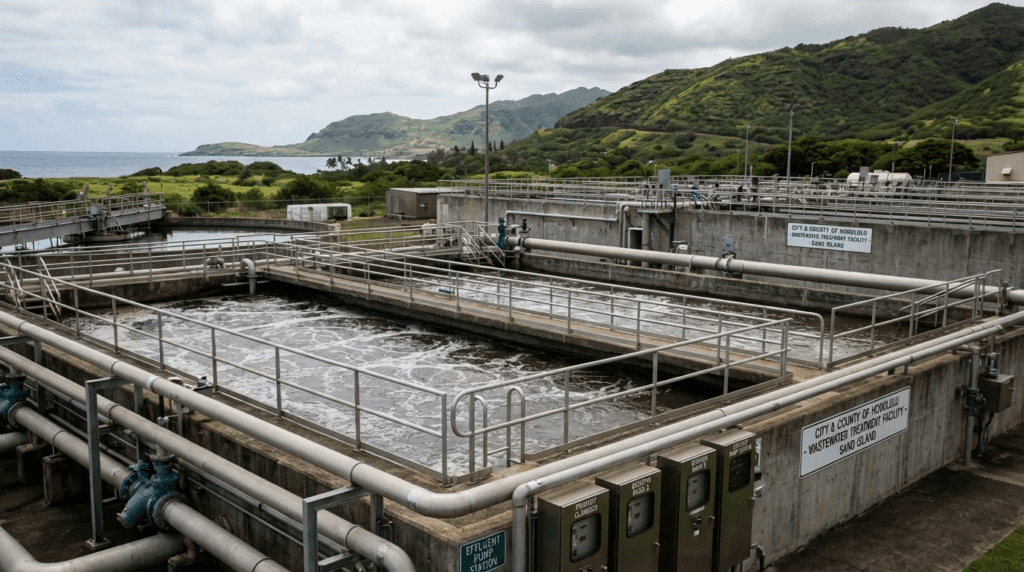
The City and County of Honolulu Wastewater Treatment Plants represent the largest scale of municipal treatment in the state, serving the highly urbanized island of Oahu. Facilities like Sand Island and Honouliuli process tens of millions of gallons per day (MGD) and utilize massive headworks, primary clarifiers, and deep ocean outfalls. Driven by EPA consent decrees, these mega-facilities are currently undergoing multi-billion-dollar upgrades from advanced primary to full secondary treatment using technologies such as activated sludge and membrane bioreactors. Engineers specifying for this subcategory must design for extreme wet-weather peaking factors, high influent salinity from coastal infiltration, and robust anaerobic digestion systems to capture biogas, offsetting immense electrical demands. Equipment here demands heavy-duty municipal specifications, long-lifecycle materials, and seamless integration into extensive SCADA networks.
Hawaii County Wastewater Treatment Plants
Operating on the “Big Island,” Hawaii County Wastewater Treatment Plants deal with unique geological constraints, primarily highly porous volcanic basalt that makes traditional gravity sewer installation prohibitively expensive. Facilities such as the Kealakehe and Hilo treatment plants manage lower overall flows than Honolulu but face significant challenges regarding effluent disposal and nutrient limits. Treatment approaches here often rely on aerated lagoons, trickling filters, or conventional activated sludge, with a growing mandate to upgrade to advanced tertiary treatment. Designing for this subcategory requires specialized excavation considerations for collection systems and robust mitigation for hydrogen sulfide (H2S) generation, which is exacerbated by long hydraulic retention times in extended pump station force mains.
Maui County Wastewater Treatment Plants
The Maui County Wastewater Treatment Plants serve the islands of Maui, Molokai, and Lanai, and have become ground zero for national wastewater regulations following the landmark Supreme Court case regarding groundwater connectivity to navigable waters. Facilities in Kihei, Lahaina, and Kahului historically relied heavily on underground injection control (UIC) wells. Today, engineering designs for this subcategory are heavily pivoted toward 100% water reuse and advanced nutrient removal (BNR/ENR) to prevent nitrogen and phosphorus from reaching coastal reefs. Ultraviolet (UV) disinfection systems and advanced filtration are mandatory specifications here, requiring engineers to account for tropical UV transmittance (UVT) variables and high peak tourist season loading rates.
Kauai County Wastewater Treatment Plants
Infrastructure within the Kauai County Wastewater Treatment Plants subcategory faces some of the most intense weather-related challenges in the state. Kauai experiences extraordinary rainfall, leading to massive Inflow and Infiltration (I&I) spikes during tropical storms and hurricanes. Plants in Lihue, Wailua, and Waimea require highly oversized headworks and surge basins to prevent biological washout during these events. Coastal erosion and sea-level rise are acute threats, meaning specification parameters must often include flood-proofing measures, elevated electrical motor control centers (MCCs), and submersible pump variants capable of surviving complete inundation. Corrosion control is paramount, with strict adherence to 316L stainless steel or fiberglass reinforced plastic (FRP) for exposed components.
Hawaii Military Wastewater Treatment Facilities
Governed by federal Unified Facilities Criteria (UFC) rather than solely state/county codes, Hawaii Military Wastewater Treatment Facilities operate at Joint Base Pearl Harbor-Hickam, Schofield Barracks, Marine Corps Base Hawaii, and other installations. These plants function almost as independent municipalities but require advanced security protocols, strict cybersecurity adherence for control systems (RMF compliance), and deep operational resilience. Specifications in this subcategory heavily favor redundancy, hardened microgrid power integration to survive island-wide grid failures, and standardized equipment that allows federal procurement to source parts efficiently. Engineers must navigate overlapping federal EPA and state DOH regulations to achieve compliance in these installations.
Hawaii Private Resort Wastewater Treatment Plants
Given the economic engine of tourism, Hawaii Private Resort Wastewater Treatment Plants form a critical, highly localized subcategory. Luxury resorts, golf courses, and isolated master-planned communities frequently sit outside municipal sewer service areas. These applications rely almost exclusively on packaged Membrane Bioreactor (MBR) or Sequencing Batch Reactor (SBR) systems to provide a microscopic footprint and produce pristine R-1 quality effluent for immediate on-site irrigation. Engineers designing these systems must prioritize acoustics, odor control (utilizing advanced bio-trickling filters or carbon scrubbers), and aesthetic integration, as these plants are often hidden within yards of guest accommodations. Wide seasonal flow variations dictate high turndown capabilities for aeration blowers and feed pumps.
Hawaii Decentralized Wastewater Treatment Systems
Driven by Act 125, which mandates the replacement of all 88,000+ cesspools in the state by 2050, Hawaii Decentralized Wastewater Treatment Systems represent the fastest-growing engineering sub-sector. This encompasses Aerobic Treatment Units (ATUs), advanced septic systems with engineered leach fields, and small-scale constructed wetlands. The engineering challenge is immense: residential footprints are small, the volcanic soil often provides zero percolation, and groundwater tables are high. Technologies specified here must be “plug-and-play,” require ultra-low maintenance, and tolerate long periods of neglect, as operator skill is virtually non-existent at the residential level. Dispersal methodologies, such as shallow drip irrigation, are critical components of these specifications.
Hawaii Industrial Pretreatment Facilities
While large-scale agriculture (sugar, pineapple) has waned, Hawaii Industrial Pretreatment Facilities remain vital for the food and beverage sector (breweries, bottling plants), aquaculture, petroleum refining, and power generation. These systems sit upstream of municipal sewers and focus heavily on pH neutralization, FOG (Fats, Oils, Grease) removal via Dissolved Air Flotation (DAF), and temperature reduction. High surcharges imposed by county municipalities for BOD/TSS overload make capital investments in robust pretreatment highly favorable. Engineers must specify heavy-duty chemical dosing systems, corrosion-resistant tanks, and automated effluent monitoring stations that interface directly with municipal inspectors.
Hawaii Water Reuse and Reclamation Facilities
Because the islands rely heavily on basal aquifers that are slow to recharge, Hawaii Water Reuse and Reclamation Facilities are critical infrastructure. This subcategory focuses on the tertiary treatment processes necessary to generate R-1 (highest quality), R-2, or R-3 recycled water according to Hawaii Administrative Rules (HAR) Chapter 11-62. Equipment specifications are heavily focused on continuous turbidity monitoring, advanced membrane filtration (UF/RO), and high-dose UV disinfection. The engineering calculus involves balancing the high OPEX of membranes and UV against the economic value of selling reclaimed water for agricultural, golf course, and urban landscaping irrigation.
Hawaii Deep Injection Well Systems
Historically utilized due to the lack of surface receiving waters, Hawaii Deep Injection Well Systems represent a disposal methodology rather than a treatment process, but dictate the upstream treatment requirements. Effluent is pumped hundreds of feet underground into porous basalt layers beneath the underground drinking water sources. Due to recent regulatory shifts proving connectivity between these wells and the ocean (impacting coral reefs), engineers must now design upstream processes to achieve near-potable water quality—virtually stripping all nitrogen and phosphorus—before injection. Specifications for the injection systems themselves require specialized vertical turbine pumps, rigorous well-casing metallurgy, and continuous pressure monitoring to detect bio-fouling or well blinding.
SELECTION & SPECIFICATION FRAMEWORK
Specifying wastewater technology for Hawaii requires a decision framework that radically departs from mainland U.S. norms. The primary drivers are high energy costs, corrosive environments, logistical isolation, and specific effluent disposal routes.
Step 1: Determine the Effluent Destination
The first branching point in the decision tree is where the water goes. If the facility discharges via a deep ocean outfall (typical of Honolulu), advanced primary or conventional secondary treatment (activated sludge) is generally sufficient, placing the focus on high-volume hydraulic handling. If the facility discharges via injection wells (Maui, Hawaii County) or intends to reuse the water (Resorts), tertiary treatment with rigorous Biological Nutrient Removal (BNR) and high-level disinfection is mandatory. This immediately shifts the specification toward MBRs, SBRs with advanced filtration, and UV.
Step 2: Lifecycle Cost Analysis (CAPEX vs. OPEX Tradeoffs)
In the contiguous U.S., a cheaper, less efficient blower might be acceptable due to low electricity rates ($0.08/kWh). In Hawaii, where rates can exceed $0.40/kWh, OPEX dominates the lifecycle cost. Engineers must aggressively specify premium-efficiency equipment:
- High-speed turbo blowers or highly optimized rotary lobe blowers.
- Fine bubble aeration diffusers with ultra-high oxygen transfer efficiency (OTE).
- Variable Frequency Drives (VFDs) on virtually all rotating equipment to match exact diurnal flows.
A higher CAPEX for a magnetic bearing turbo blower will typically yield a Return on Investment (ROI) in Hawaii in less than 24 months compared to a standard positive displacement blower.
Step 3: Materials of Construction & Tropicalization
The Hawaiian marine environment destroys standard equipment. A common specification pitfall is accepting “standard factory paint” or 304 stainless steel. Within 12 months, the salt-laden trade winds will cause severe pitting and failure.
- All wetted and exposed metal must be 316L Stainless Steel as a bare minimum, with duplex stainless or titanium specified for highly critical, high-salinity applications.
- Electrical enclosures must be NEMA 4X, preferably in 316SS or UV-resistant FRP.
- Control panels require internal climate control (vortex coolers or air conditioners) and conformal coating on all printed circuit boards to prevent catastrophic failure from high humidity and salt ingress.
Step 4: Logistics and Operator Skill Level
Lead times to Hawaii for heavy parts are typically 6 to 12 weeks via ocean freight. When choosing between technologies, engineers must evaluate the manufacturer’s local support network. A highly complex proprietary system without a Hawaii-based representative or local parts stocking will result in unacceptable downtime. Furthermore, for decentralized and localized systems, technologies with fewer moving parts (e.g., fixed-film systems or simple ATUs) are often chosen over more efficient but complex systems (like MBRs) simply because the requisite high-level operator licenses are difficult to source on outer islands.
COMPARISON TABLES
The following tables provide an engineering quick-reference to map out the different facility types across the islands and the application scenarios that dictate which subcategory fits best.
Table 1: Subcategory Comparison Map
| Facility Category | Typical Flows | Primary Technologies | Disposal / End Use | Primary Engineering Challenge |
|---|---|---|---|---|
| City and County of Honolulu Wastewater Treatment Plants | 10 – 100+ MGD | Adv. Primary, Activated Sludge, Digestion | Deep Ocean Outfalls | Massive wet weather peaking, aging collection I&I, federal consent decrees. |
| Hawaii County Wastewater Treatment Plants | 0.5 – 5 MGD | Aerated Lagoons, SBRs | Injection Wells, limited Reuse | Volcanic rock excavation, long force main H2S generation. |
| Maui County Wastewater Treatment Plants | 2 – 15 MGD | BNR Activated Sludge, UV Disinfection | 100% Reuse goals, Injection Wells | Stringent nutrient limits for reef protection (SCOTUS precedent). |
| Kauai County Wastewater Treatment Plants | 1 – 5 MGD | Oxidation Ditches, SBRs | Injection, limited Outfall | Extreme storm I&I, coastal inundation resilience. |
| Hawaii Military Wastewater Treatment Facilities | 1 – 10 MGD | MBR, BNR Activated Sludge | Reuse, Outfalls | UFC code compliance, cybersecurity, microgrid integration. |
| Hawaii Private Resort Wastewater Treatment Plants | 0.05 – 1.5 MGD | Packaged MBR, SBR | R-1 Golf Course / Landscaping Reuse | Tiny footprints, noise/odor elimination, high seasonal peaking. |
| Hawaii Decentralized Wastewater Treatment Systems | 300 – 5,000 GPD | ATUs, Septic Tanks, Leach fields | Subsurface Dispersal | Poor soil percolation, zero operator maintenance capability. |
| Hawaii Water Reuse and Reclamation Facilities | Varies (Side-stream) | UF/RO Membranes, High-Dose UV | R-1, R-2 Irrigation | Maintaining HAR 11-62 compliance with variable influent turbidity. |
Table 2: Application & Subcategory Fit Matrix
| Application Scenario | Best-Fit Subcategory | Key Engineering Constraints | Operator Requirement |
|---|---|---|---|
| Isolated luxury resort requiring golf course irrigation | Hawaii Private Resort Wastewater Treatment Plants (MBR) | Must meet R-1 limits; highly concealed; low noise profile (<60 dBA). | High (Grade III/IV) due to membrane complexity. |
| Rural Big Island subdivision with failing cesspools | Hawaii Decentralized Wastewater Treatment Systems | High basalt excavation costs; minimal footprint available. | Minimal/None (reliant on annual service contracts). |
| Coastal urban center with legacy underground disposal | Maui County Wastewater Treatment Plants & Hawaii Deep Injection Well Systems | Must strip Total Nitrogen (TN) < 3 mg/L to prevent reef algal blooms. | High (Continuous compliance monitoring required). |
| Large military base expansion | Hawaii Military Wastewater Treatment Facilities | Compliance with strict federal UFC standards; anti-terrorism force protection (ATFP). | Moderate to High (Federal contractors). |
ENGINEER & OPERATOR FIELD NOTES
Engineering success in Hawaii requires an understanding of how distinct local conditions impact the installation and long-term operation of the systems described above. These field notes address critical cross-subcategory realities.
Wastewater temperatures in Hawaii rarely drop below 22°C and frequently sit between 25°C–28°C. This significantly accelerates biological kinetics (nitrification occurs very rapidly), but it concurrently lowers the saturation point of dissolved oxygen (DO). Engineers must adjust their alpha and beta factors during aeration sizing; you will need more air volume to achieve the required DO concentration at 28°C than you would at 15°C on the mainland.
Commissioning Considerations
Commissioning delays are notoriously common across all subcategories due to logistics. When starting up Hawaii Private Resort Wastewater Treatment Plants or new municipal activated sludge basins, “seeding” the biological process requires trucking mixed liquor from existing island plants, as importing sludge from the mainland is logistically impossible and biologically risky. Furthermore, electrical grid power instability on outer islands means commissioning engineers must aggressively test UPS systems and generator auto-transfer protocols before passing functional checks.
Common Specification Mistakes
A fatal error among non-local engineering firms is neglecting localized I&I realities. Specifying systems for Kauai County Wastewater Treatment Plants based on standard diurnal curves will result in massive hydraulic washouts during winter storms, where influent can spike 500% to 800% in a matter of hours. Another common mistake is undersizing UV systems in Hawaii Water Reuse and Reclamation Facilities. Tropical island wastewater often contains different organic particulates that lower UV Transmittance (UVT) compared to mainland averages; assuming a standard 65% UVT without pilot testing often results in failed DOH compliance tests.
Specifying 304 SS or standard anodized aluminum for outdoor equipment near the windward coastlines. The constant salt spray and high humidity will degrade 304 SS rapidly. Always default to 316L SS, FRP, or robust epoxy-coated systems with marine-grade 3-coat paint specs.
O&M and Inventory Management
The operational burden shifts dramatically between subcategories. For large City and County of Honolulu Wastewater Treatment Plants, predictive maintenance (vibration analysis, thermal imaging) is standard. However, for Hawaii Decentralized Wastewater Treatment Systems, “run-to-fail” is the unfortunate reality. The overarching O&M mandate across Hawaii is critical spares inventory. A plant on Maui cannot afford a 6-week lead time for a custom blower impeller. Engineers must specify comprehensive spare parts packages in the initial CAPEX bid, ensuring the plant holds at least one full redundant assembly for every critical unit process (N+1 or N+2 redundancy).
Troubleshooting Cross-Subcategory Issues
A frequent troubleshooting scenario across coastal plants involves sudden loss of biological activity. In Hawaii, this is rarely due to cold weather or industrial toxic shock. Instead, it is frequently caused by acute salinity spikes. King tides or storm surges can infiltrate aging collection networks, sending slugs of highly saline water into the biological basins, shocking the biomass and causing severe deflocculation. Operators must monitor influent conductivity closely to bypass or equalize these events.
DESIGN DETAILS & STANDARDS
Sizing Methodology Overview
When sizing biological basins across Hawaii, engineers utilize standard ASM (Activated Sludge Models), but parameters are heavily skewed by the constant warm temperatures. Solids Retention Time (SRT) required for complete nitrification is much shorter—often 5 to 7 days instead of the 12 to 15 days required in colder climates. However, engineers must over-size aeration blowers to overcome the lower oxygen transfer efficiency in warm water. For Hawaii Private Resort Wastewater Treatment Plants, sizing is governed by extreme tourist peaking factors; resort occupancy can swing from 40% to 100% within a week, demanding highly modular, multi-train design topologies.
Differing Parameters by Subcategory
The selected subcategory dictates the foundational design parameters:
- Hawaii Deep Injection Well Systems: Must be sized to accommodate specific geological percolation rates. Standard practice requires continuous monitoring of injection pressure head; a gradual increase indicates bio-fouling or particulate blinding of the basalt pores, necessitating aggressive back-flushing or acid washing.
- Hawaii Industrial Pretreatment Facilities: Sizing focuses heavily on equalization (EQ). Municipalities in Hawaii impose severe limits on instantaneous flow and peak loading, so vast EQ tanks are specified to flatten the output curve to the municipal sewer.
- Hawaii Decentralized Wastewater Treatment Systems: Design is governed by HAR 11-62 percolation tests. In areas with pure lava rock, standard leach fields fail instantly. Engineers must specify above-ground mounds or advanced evapotranspiration systems.
Applicable Standards & Compliance
Design in this directory is bound by strict codes:
HAR Chapter 11-62: The Hawaii Administrative Rules detailing all wastewater system regulations, including R-1/R-2 recycled water standards and the state’s cesspool replacement mandates. All systems must achieve DOH (Department of Health) approval.
EPA Consent Decrees: Governing the City and County of Honolulu Wastewater Treatment Plants, dictating hard deadlines for secondary treatment upgrades.
UFC Series: Unified Facilities Criteria (e.g., UFC 3-240-01) dictating design for Hawaii Military Wastewater Treatment Facilities.
Specification Checklist for Hawaii Context
Regardless of the subcategory, an engineering specification for Hawaii must include:
- [ ] NEMA 4X 316SS or FRP Enclosures.
- [ ] Tropicalization of electronics (conformal coatings, anti-condensation heaters).
- [ ] Premium efficiency/IE4 motors and high-efficiency aeration (due to >$0.35/kWh power).
- [ ] Ocean freight compliant packaging (vapor barriers, desiccant packs inside sealed crates) to prevent salt corrosion during shipping.
- [ ] Hurricane-rated wind load certifications for all exposed tanks, clarifier bridges, and odor control stacks.
FAQ SECTION
What are the different types of Hawaii wastewater treatment plants?
The Hawaii Wastewater Treatment Plants: Complete Directory encompasses several key categories based on jurisdiction and technology. Major municipal flows are handled by City and County of Honolulu Wastewater Treatment Plants and other county-level facilities. The military manages Hawaii Military Wastewater Treatment Facilities. Private entities operate Hawaii Private Resort Wastewater Treatment Plants and Hawaii Industrial Pretreatment Facilities. Furthermore, distinct approaches like Hawaii Decentralized Wastewater Treatment Systems, Hawaii Water Reuse and Reclamation Facilities, and Hawaii Deep Injection Well Systems represent specific technological/disposal approaches dictated by island geography.
How do you choose between deep ocean outfalls and injection wells in Hawaii?
This is heavily dictated by geography and regulation. City and County of Honolulu Wastewater Treatment Plants utilize outfalls because the infrastructure exists and ocean bathymetry allows it. In contrast, Maui County Wastewater Treatment Plants and Big Island facilities historically relied on Hawaii Deep Injection Well Systems due to the lack of outfalls and specific coastal geology. However, due to recent Supreme Court rulings regarding groundwater-to-reef connectivity, new designs overwhelmingly favor upgrading to Hawaii Water Reuse and Reclamation Facilities instead of new injection wells.
What is the most critical factor when specifying equipment for Hawaii plants?
Two factors dominate: Operating Expense (OPEX) and corrosion resistance. Because electricity rates are the highest in the U.S., engineers must specify ultra-high-efficiency blowers and pumps. Secondly, the marine environment demands that all exposed metals be 316L stainless steel, duplex, or FRP to survive the salt-laden trade winds.
Why are private resorts utilizing their own treatment plants?
Many resorts are built in pristine, isolated areas far from municipal sewer tie-ins. Therefore, Hawaii Private Resort Wastewater Treatment Plants are built to manage localized flows. These are typically advanced Membrane Bioreactors (MBRs) that treat the water to R-1 standards, which is then immediately reused for golf course and landscape irrigation, solving both disposal and water scarcity issues simultaneously.
What is driving the growth of decentralized wastewater systems in Hawaii?
The state has over 88,000 active cesspools, which leach untreated sewage into the porous volcanic soil, contaminating aquifers and coral reefs. Act 125 legally mandates the replacement of all cesspools by 2050. This is driving a massive surge in the design and installation of Hawaii Decentralized Wastewater Treatment Systems, including Aerobic Treatment Units (ATUs) and advanced septic systems.
How does tropical weather affect wastewater plant design?
Consistent high wastewater temperatures (25°C+) accelerate biological activity but decrease oxygen transfer efficiency, requiring careful blower sizing. Additionally, facilities—especially Kauai County Wastewater Treatment Plants—must be designed to handle massive Inflow and Infiltration (I&I) hydraulic surges caused by frequent tropical storms and hurricanes, requiring oversized headworks and EQ basins.
CONCLUSION
KEY TAKEAWAYS: Designing for Hawaii
- OPEX Rules: With power costs exceeding $0.40/kWh, capital investments in premium-efficiency aeration and pumping yield rapid ROI across all subcategories.
- Corrosion is Relentless: Standard U.S. mainland specs will fail. Demand 316L SS, NEMA 4X FRP enclosures, and tropicalized electronics.
- Reuse is the Future: Driven by reef protection and water scarcity, systems are aggressively pivoting toward Hawaii Water Reuse and Reclamation Facilities producing R-1 effluent.
- Decentralization Mandate: The elimination of 88,000+ cesspools makes Hawaii Decentralized Wastewater Treatment Systems a massive, emerging engineering sector requiring robust, low-maintenance tech.
- Logistics Dictate Design: Ocean freight lead times mean engineers must specify extensive on-site spare part inventories to prevent disastrous downtime.
Navigating the Hawaii Wastewater Treatment Plants: Complete Directory requires engineers to abandon generalized mainland assumptions and adapt to a hyper-specific, isolated ecosystem. The matrix of solutions spans from the massive capacity requirements of the City and County of Honolulu Wastewater Treatment Plants to the hyper-localized, footprint-sensitive reality of Hawaii Private Resort Wastewater Treatment Plants and the burgeoning need for Hawaii Decentralized Wastewater Treatment Systems.
Ultimately, successful specification relies on balancing the exceptionally high cost of energy and imported parts with the absolute environmental necessity of protecting Hawaii’s aquifers and near-shore coral reefs. By categorizing the infrastructure into jurisdictional and technological subcategories, engineers can accurately apply the right regulatory frameworks, specify appropriate materials of construction, and design resilient systems capable of thriving in the Pacific’s demanding environment. Engaging with manufacturers who have an established, robust supply chain and local representative support on the islands remains a critical final step in moving any design from specification to successful, long-term operation.