
Hydro International vs Egger Turbo for Grit Removal
Introduction
Grit removal represents one of the most abrasive and maintenance-intensive unit processes in municipal wastewater treatment. Engineers and plant superintendents frequently grapple with a critical reliability paradox: while grit capture technologies have advanced significantly, the pumps tasked with transporting that captured slurry to classifiers often remain the weakest link. A single failure in the grit circuit can lead to heavy inorganic accumulation in primary clarifiers and digesters, reducing effective volume and requiring expensive cleanouts.
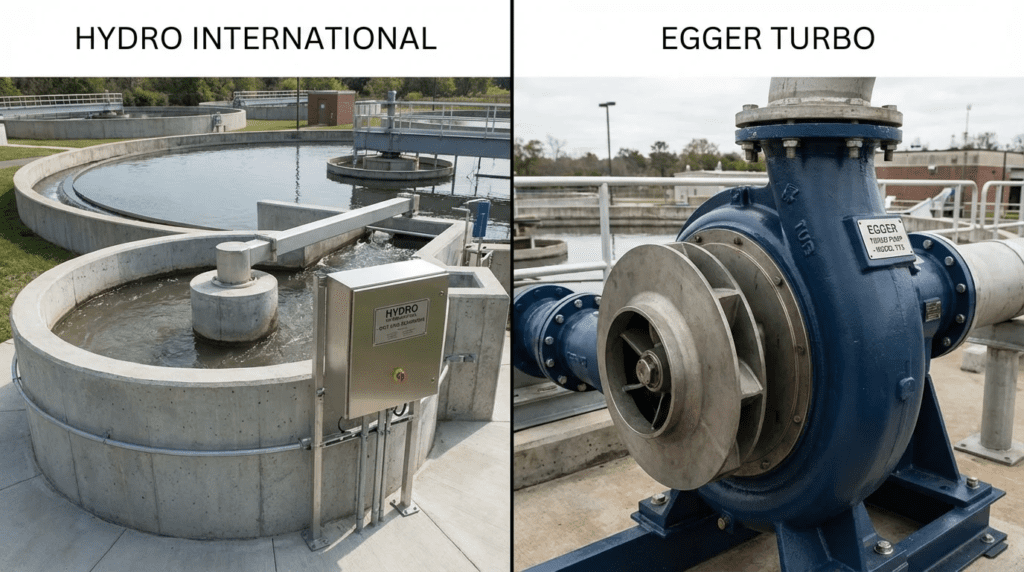
A common debate in the specification and retrofit sectors involves the choice between integrated system packages and premium standalone components. This brings us to the comparative analysis of Hydro International vs Egger Turbo for Grit Removal. While Hydro International is a process systems provider known for hydrodynamic separation technologies (such as the HeadCell® and SlurryCup), Egger is a specialized pump manufacturer renowned for the Turo® Vortex pump. The engineering challenge lies in determining whether to rely on the OEM-specified pump included in a process package or to decouple the specification and demand a heavy-duty standalone pump like the Egger Turbo.
This article is not a comparison of apples to apples, but rather a guide to the “System vs. Component” decision matrix. It explores where these technologies intersect, how their hydraulic philosophies differ regarding slurry transport, and why proper selection is critical for minimizing Operational Expenditure (OPEX). We will analyze these options based on hydraulic efficiency, material hardness, seal reliability, and long-term wear characteristics in high-grit environments.
Improper specification in this area leads to catastrophic outcomes: rapid impeller wear (sometimes within weeks), suction line “sanding out” due to insufficient transport velocity, and seal failures caused by grit intrusion. By understanding the distinct engineering merits of the Hydro International vs Egger Turbo for Grit Removal approaches, engineers can design circuits that maintain performance for decades rather than years.
How to Select / Specify Grit Pumping Technologies
Selecting the correct equipment for grit slurry transport requires a departure from standard clean-water pump curves. The fluid is non-Newtonian, highly abrasive, and variable in specific gravity. When evaluating options, engineers must look beyond the Best Efficiency Point (BEP) and focus on solids passage, internal velocities, and material hardness.
Duty Conditions & Operating Envelope
The primary constraint in grit applications is the highly variable nature of the influent load. During storm events, grit loading can increase by 500% or more.
- Flow Rates: The pump must maintain a minimum carrying velocity (typically 3.5 to 5.0 ft/sec) in the discharge piping to prevent the slurry from settling, regardless of the flow rate entering the plant.
- Specific Gravity (SG): While the bulk water is near SG 1.0, the grit slurry at the bottom of a hopper can reach SGs of 1.4 to 1.6, with individual silica particles at SG 2.65. The driver (motor) must be sized for the “worst-case” slurry density to prevent over-amping.
- Head Requirements: Grit systems typically operate at relatively low heads (20-40 ft TDH), primarily static lift from a basement or lower level to a classifier on a mezzanine. High-head requirements are rare but require multi-stage considerations or harder alloys to withstand the increased internal velocities.
- Intermittent Operation: Grit pumps often cycle on and off based on timers or torque sensing. This start/stop duty cycle places heavy loads on shafts and bearings, necessitating robust mechanical design factors (L10 bearing life > 50,000 hours).
Materials & Compatibility
Material selection is the single biggest driver of lifecycle cost in grit applications.
- Abrasion Resistance: Standard cast iron or ductile iron is unacceptable for wetted parts in grit service. The industry standard is, at minimum, Ni-Hard 4 (approx. 550-600 Brinell Hardness).
- Premium Alloys: For severe duty, High Chrome Iron (25-28% Cr) offers superior resistance, often exceeding 650 Brinell. When comparing Hydro International vs Egger Turbo for Grit Removal, verify the specific alloy hardness offered. Egger, for example, typically casts their Turo pumps in proprietary high-chrome alloys explicitly for this purpose.
- Corrosion-Abrasion Synergy: While grit is abrasive, the wastewater is also corrosive (H2S presence). Materials must resist the mechanical wear that strips away protective oxide layers, exposing the base metal to chemical attack.
Hydraulics & Process Performance
The hydraulic design must prioritize non-clogging capabilities over energy efficiency.
- Recessed Impeller (Vortex) Design: Both approaches typically utilize recessed impellers. This design creates a hydraulic vortex that transmits energy to the fluid without the fluid having to pass through the impeller vanes. This minimizes abrasive wear on the impeller itself and allows the passage of large solids (rags) that inevitably end up in grit chambers.
- NPSH Considerations: Grit pumps are frequently located in basements with flooded suction, which is ideal. However, if a suction lift is required, self-priming variants or vacuum priming systems are necessary. Engineers must calculate NPSH Available (NPSHa) carefully, de-rating for the vapor pressure and temperature, though temperature is rarely a limiting factor in influent grit.
- Curve Stability: A steep head-capacity curve is desirable. As the system piping wears or as grit accumulation changes the friction losses, a steep curve ensures the flow rate remains relatively stable, maintaining critical line velocities.
Installation Environment & Constructability
Space in headworks buildings is notoriously tight.
- Footprint: Hydro International systems are often sold as compact, vertical arrangements (e.g., TeaCup). The associated pumps must fit within the skid or designated footprint. Egger pumps, being heavy-duty industrial units, may have larger frame sizes and motor pedestals, requiring more floor space.
- Piping Configuration: Suction piping should be as straight and short as possible to minimize friction and wear. Long radius elbows are mandatory. When retrofitting an Egger pump into a space designed for a smaller OEM pump, flange-to-flange dimensions will likely differ, requiring spool pieces or piping modifications.
Reliability, Redundancy & Failure Modes
Grit pumps fail in three primary ways:
- Seal Failure: Grit intrusion into the seal face. Double mechanical seals with a clean water flush or oil barrier are standard. Packing is generally discouraged due to shaft sleeve wear.
- Impeller/Volute Washout: Even with hard metals, the turbulence eventually erodes the casing. High-quality pumps utilize extra-thick casing walls to extend service life.
- Bearing Failure: Caused by the radial loads of the vortex action and the imbalance of pumping slurries.
Redundancy is non-negotiable. N+1 configurations (Duty/Standby) are the minimum standard. For critical large plants, N+1 per train is recommended.
Lifecycle Cost Drivers
The Total Cost of Ownership (TCO) calculation often favors heavier, more expensive pumps over a 20-year horizon.
- CAPEX vs. OPEX: A specialized Egger pump may cost 30-50% more upfront than a standard grit pump supplied in a package. However, if the standard pump requires impeller replacement annually ($3,000 – $5,000 parts + labor) and the Egger lasts 5-7 years, the ROI is usually under 3 years.
- Energy: Vortex pumps are inherently inefficient (35-50% efficiency). However, since grit pumps operate intermittently or at low flows, the energy penalty is often negligible compared to the cost of maintenance and downtime.
Comparison Tables
The following tables provide a direct engineering comparison to assist in specification. Table 1 contrasts the “System Supplier” approach versus the “Dedicated Pump Manufacturer” approach. Table 2 outlines the application suitability based on plant constraints.
| Attribute | Hydro International (System Integration) | Egger Turo (Specialized Component) |
|---|---|---|
| Primary Focus | Process Performance. Focuses on the efficiency of grit separation (removal efficiency). The pump is a means to move captured grit to the classifier. | Mechanical Robustness. Focuses on the durability of the pump itself. The pump is designed to survive extreme abrasion and large solids passage. |
| Impeller Technology | Typically supplies recessed impeller vortex pumps. May utilize proprietary designs or partner with pump OEMs. | Turo® TA Vortex Impeller. A fully recessed impeller design specifically optimized for slurry handling with minimal solids contact. |
| Material Hardness | Standard supply is often Ni-Hard (approx. 550 HB). Specifications can often be upgraded upon request. | Standard supply usually includes proprietary High Chrome Iron (HG25.3) exceeding 600-650 HB, offering superior wear life. |
| System Integration | Seamless. Pump is sized and controlled specifically to match the classifier and grit trap hydraulics. Reduces risk of process imbalance. | Component Only. Requires engineering verification to ensure the pump curve matches the system head curve and process requirements. |
| Seal Design | Standard industrial mechanical seals (cartridge or component). Dependence on seal water availability varies by model. | Often features the Hydrodynamic Eurodyn® seal or heavy-duty cartridge seals designed for slurry without external flush (in specific configurations). |
| Maintenance Profile | Moderate. Wear parts are accessible, but lifecycle depends on the duty severity. Designed for “typical” municipal grit loading. | Low. Heavy wall thickness and superior metallurgy extend intervals between overhauls. Designed for “severe” industrial/municipal loading. |
| Application Scenario | Recommendation | Engineering Rationale |
|---|---|---|
| New Construction (Design-Build) | Hydro International Package | Single-source responsibility for process performance guarantees (grit removal efficiency) is critical. The pump is integral to the separation guarantee. |
| Chronic Failure Retrofit | Egger Turo | If an existing grit pump is failing every 6-12 months due to extreme abrasion, replacing it with a heavier-duty Egger unit is the technically sound solution. |
| Combined Sewer Systems (High Ragging) | Egger Turo | The full bore passage of the Turo design excels in combined systems where rags, rocks, and debris bypass screens and enter grit chambers. |
| Space-Constrained Basements | Evaluate Carefully | Hydro’s packaged arrangements are often more compact. An Egger retrofit may require piping modifications that are structurally or spatially difficult. |
| Limited Maintenance Staff | Egger Turo | Higher upfront cost buys longer MTBF (Mean Time Between Failures), reducing the burden on small maintenance teams. |
Engineer & Operator Field Notes
Real-world experience often diverges from the catalog data. The following observations are drawn from field commissioning and long-term operation of grit systems utilizing both Hydro International and Egger Turbo for Grit Removal contexts.
Commissioning & Acceptance Testing
When commissioning grit pumps, water testing is insufficient. The specific gravity of clear water (1.0) is significantly lower than the design grit slurry (1.4+).
- Amperage Draw: During SAT (Site Acceptance Testing), the motor amps on clear water should be significantly below Full Load Amps (FLA). If the pump draws near FLA on water, it will trip on overload as soon as grit is introduced.
- Vibration Baselines: Establish spectral vibration baselines immediately. Vortex pumps naturally have higher hydraulic noise than centrifugal pumps, but a baseline is essential to detect bearing wear later.
- Seal Water Pressure: If using flush seals, ensure the seal water pressure is 15-20 PSI higher than the pump discharge pressure. A common error is setting seal water pressure based on suction pressure, which allows grit to backflow into the seal faces.
O&M Burden & Strategy
Maintenance strategies differ slightly between the two approaches.
- Impeller Clearance Adjustment: Recessed impeller pumps are less sensitive to face clearance than semi-open impellers, but efficiency still degrades as the gap increases. Egger pumps typically feature an external adjustment mechanism that allows operators to re-optimize the gap without disassembling the casing, a feature that significantly reduces maintenance hours.
- Rotating Assemblies: For Hydro International systems, ensure that the spare parts kit matches the specific OEM pump supplied with the project. These systems evolve, and a pump supplied 10 years ago may have different internals than current models.
Troubleshooting Guide
Symptom: Low Flow / No Discharge
Probable Cause: Suction line plugged.
Diagnostics: Check suction gauge. High vacuum indicates a blockage on the suction side (ragging or sanded out).
Solution: Backflush capability is highly recommended in the design phase. If not available, mechanical cleanout is required.
Symptom: High Vibration / Noise
Probable Cause: Cavitation or Air Entrainment.
Context: Grit classifiers often aerate the grit. If the pump is drawing from an aerated source, air binding can occur.
Solution: Check submergence levels. Verify that the vortex breaker is intact in the suction hopper.
Design Details & Calculations
Successful implementation of either Hydro International or Egger Turbo for Grit Removal requires rigorous hydraulic calculation.
Sizing Logic & Methodology
Engineers must follow a specific logic path when sizing the grit circuit:
- Determine Grit Characterization: What is the target grit size (e.g., 95% removal of 150 micron)? This dictates the settling velocity.
- Calculate Critical Velocity: Use the Durand-Condolios correlation or simplified industry standards.
Vcrit = FL * sqrt(2 * g * D * (S-1))
Where D is pipe diameter and S is specific gravity of solids. Typically, target 4-6 ft/s in the discharge pipe. - Derate Pump Performance: Apply a Head Correction Factor (HR) and Efficiency Correction Factor (ER) for slurry service. While grit concentrations are often low by weight (<10%), the viscosity changes can affect performance curves.
Specification Checklist
When writing the Division 43 specification, ensure the following are explicitly defined to avoid “or equal” substitutions of inferior equipment:
- Hardness Testing: Require certified material test reports (CMTR) verifying Brinell hardness of the impeller and volute (>550 HB for Ni-Hard, >600 HB for High Chrome).
- Wall Thickness: Specify minimum casing wall thickness. Premium pumps like Egger will often have 2x the wall thickness of standard ANSI pumps adapted for grit.
- Shaft Deflection: Specify maximum shaft deflection at the seal face (typically <0.002 inches) at shut-off head.
- Motor Service Factor: Specify 1.15 SF, but size the motor non-overloading at 1.0 SF for the slurry specific gravity.
Standards & Compliance
Reference Hydraulic Institute (HI) Standard 12.1-12.6 for Rotodynamic Centrifugal Slurry Pumps. This standard provides the testing and acceptance criteria necessary for high-wear applications. Additionally, ensure motors meet NEMA MG-1 Premium Efficiency standards, although pump hydraulic efficiency will be secondary to solids handling capability.
Frequently Asked Questions
What is the primary difference between Hydro International and Egger Turbo for grit removal applications?
The primary difference is the scope of supply and design philosophy. Hydro International provides complete grit removal systems (including separation chambers and classifiers) and typically packages a pump suitable for standard duty. Egger Turbo is a pump manufacturer specializing in extreme-duty, recessed impeller pumps designed for high abrasion and difficult slurries. Engineers often choose Egger pumps as upgrades or specific components within a larger grit system.
How long should a grit pump impeller last?
In municipal wastewater grit applications, a standard cast iron impeller may last only 3-6 months. A Ni-Hard impeller (typical of standard packages) should last 1-3 years. A premium High Chrome Iron impeller (like those found in Egger Turo pumps) can last 5-10 years depending on the grit load and operation hours. If you are replacing impellers annually, the material selection is likely inadequate.
Can I retrofit an Egger Turo pump into an existing Hydro International system?
Yes, and this is a common upgrade for plants experiencing high wear. However, it is not a “drop-in” replacement. The Egger pump will likely have different flange-to-flange dimensions and a larger physical footprint. Engineers must verify piping alignment, baseplate dimensions, and ensure the new pump’s flow curve matches the hydraulic limit of the downstream grit classifier.
Why are recessed impeller pumps preferred for grit?
Recessed impeller (torque flow) pumps create a vortex that pumps the fluid without the majority of the solids passing through the impeller vanes. This drastically reduces abrasive wear on the impeller and allows for the passage of solids equal to the discharge diameter, preventing clogging from rags and debris often found in grit slurries.
What is the recommended line velocity for grit slurry?
The “sweet spot” is typically between 4.0 and 6.0 feet per second (ft/s). Velocities below 3.5 ft/s risk solids settling and plugging the line (“sanding out”). Velocities above 7-8 ft/s cause exponential increases in pipe and volute abrasion wear. VFDs should be used to maintain this velocity as pump internals wear.
Do Egger Turbo pumps require seal water?
Not necessarily. While seal water is common, Egger offers proprietary sealing technologies (like the Eurodyn® hydrodynamic seal) that can operate without external flush water in certain configurations. This is advantageous for remote headworks where clean water service is unreliable or expensive to maintain.
Conclusion
Key Takeaways
- Define the Goal: If buying a whole process, Hydro International offers the process guarantee. If buying longevity for a specific failure point, Egger offers mechanical superiority.
- Material Matters: Never accept standard cast iron for grit. Specify Ni-Hard 4 as a minimum, and High Chrome Iron (600+ HB) for best lifecycle value.
- Velocity Control: Design for 4-6 ft/s line velocity. Oversizing pumps leads to line clogging; undersizing leads to inability to lift heavy slurry.
- System vs. Component: Replacing an OEM pump with a heavy-duty Egger Turo requires hydraulic verification of the downstream classifier capacity.
- TCO Analysis: A 50% higher initial CAPEX for a premium pump is justified if it eliminates annual teardowns and seal failures.
The comparison of Hydro International vs Egger Turbo for Grit Removal is ultimately a study in application severity and risk management. Hydro International provides excellent, integrated solutions where the pump is balanced with the separation technology, suitable for the vast majority of municipal applications. Their systems are engineered to ensure the classifier is not overwhelmed, and their supplied pumps are generally fit for purpose.
However, for plants facing extreme grit loads, combined sewer networks with heavy debris, or those suffering from chronic pump failures, the Egger Turbo represents the “nuclear option” of reliability. It is a heavier, harder, and more expensive machine designed to survive conditions that destroy standard pumps. Engineers must evaluate the Total Cost of Ownership, weighing the premium CAPEX of an Egger unit against the OPEX savings in maintenance hours and spare parts over a 20-year lifecycle.
For the prudent engineer, the best path often lies in a hybrid approach: utilizing Hydro International’s advanced separation technologies (HeadCell, SlurryCup) while holding the pump specification to a rigorous standard that may lead to the selection of an Egger Turo or equivalently robust slurry pump for the transport circuit.