
ITT Goulds vs Seepex Inline Grinder Equipment: Comparison & Best Fit
Introduction
For municipal and industrial wastewater engineers, the management of solids—specifically the reduction of ragging, stringy materials, and debris—remains one of the costliest operational challenges. Unscheduled downtime due to clogged pumps or damaged downstream instrumentation costs utilities millions annually in labor and equipment replacement. When evaluating solids reduction technologies, engineers often face a critical fork in the road: choosing between an integrated centrifugal chopper solution (typified by ITT Goulds) or a dedicated inline maceration unit (typified by Seepex).
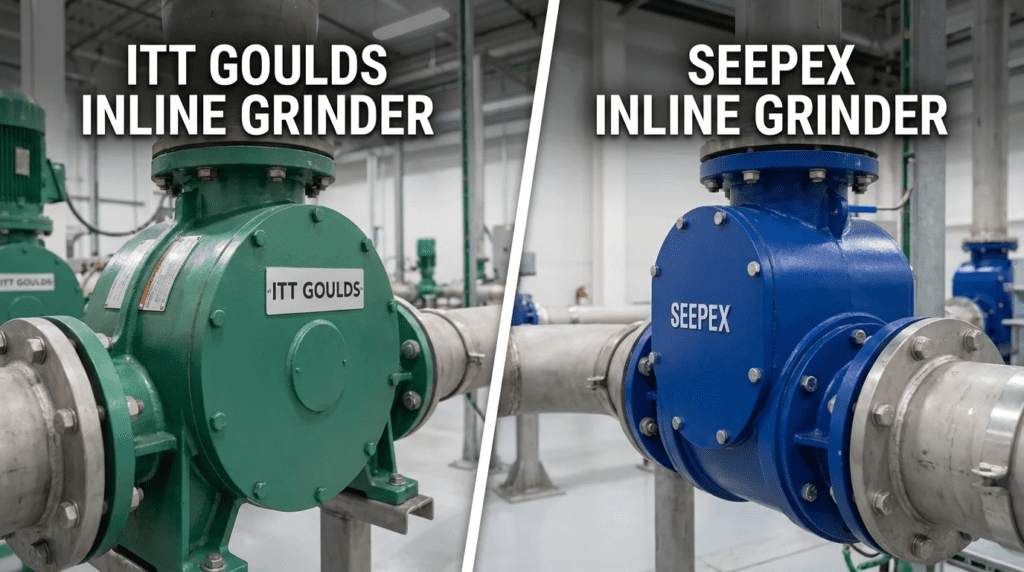
Performing an ITT Goulds vs Seepex Inline Grinder Equipment: Comparison & Best Fit analysis is not merely a brand comparison; it is a selection between two distinct process philosophies. ITT Goulds generally represents the “pump-integrated” approach, utilizing heavy-duty centrifugal chopper pumps to slice solids during transport. Conversely, Seepex represents the “upstream protection” approach, utilizing dedicated inline macerators (often paired with Progressive Cavity pumps) to condition fluid before it enters sensitive equipment.
This article provides consulting engineers and plant directors with a technical framework to determine which methodology suits their specific hydraulic and rheological constraints. We will move beyond marketing claims to examine shear mechanics, hydraulic penalties, maintenance intervals, and total lifecycle costs.
How to Select / Specify
Proper specification requires a clear understanding of the process goal: Is the primary objective to transport fluid while tolerating solids, or is it to condition solids to a specific particle size to protect downstream processes? The following criteria outline the engineering decision matrix for an ITT Goulds vs Seepex Inline Grinder Equipment: Comparison & Best Fit.
Duty Conditions & Operating Envelope
The hydraulic duty point is the first filter for technology selection. Centrifugal chopper pumps (ITT Goulds) and inline macerators (Seepex) operate in fundamentally different hydraulic regions.
- Flow Rates: ITT Goulds centrifugal units excel in higher flow applications (typically 100 GPM to 5,000+ GPM). They rely on velocity to generate the necessary head and cutting action. Seepex macerators are often constant-volume or low-flow devices designed to match the capacity of positive displacement pumps or sludge transfer lines (typically 5 GPM to 1,500 GPM).
- Head/Pressure: If the application requires high discharge pressures (e.g., long force mains) combined with solids handling, a Seepex macerator coupled with a PC pump is often superior due to the PC pump’s ability to handle high pressure independent of flow. However, the macerator itself introduces a pressure drop (∆P) that must be calculated.
- Solids Loading: For raw sewage with unpredictable debris, the open volute of a chopper pump offers better pass-through for hard solids (stones) that might jam a tight-tolerance macerator.
Materials & Compatibility
The metallurgy of the cutting elements determines the Mean Time Between Failures (MTBF) in abrasive environments.
- Cutting Elements: Seepex macerators typically utilize head plates and cutting knives made of hardened tool steel or stainless steel alloys hardened to 55-60 HRC. The focus is on shear tension.
- Impeller/Cutter Bars: ITT Goulds chopper pumps use cast steel or high-chrome iron impellers and suction plates. The material must withstand not just abrasion but also significant impact shock from solids entering the volute at high velocity.
- Chemical Compatibility: In industrial applications (pH extremes), the casing material becomes critical. Seepex housings are often cast iron or stainless steel. ITT Goulds offers a wider range of high-alloy materials (Duplex, CD4MCu) due to their extensive chemical pump heritage.
Hydraulics & Process Performance
Engineers must account for the impact of the equipment on system hydraulics.
Seepex Macerators: These are passive hydraulic elements (unless self-pumping versions are specified, which are rare). They introduce a friction loss coefficient (K-value) to the suction line. Pro Tip: Neglecting the head loss across a macerator plate, especially as it blinds with debris, is a leading cause of cavitation in downstream pumps.
ITT Goulds Chopper Pumps: These are active hydraulic elements. The chopping mechanism is integral to the impeller. While effective, chopper pumps typically suffer an efficiency penalty of 5-15% compared to non-clog solids handling pumps. This wire-to-water efficiency loss must be factored into the 20-year lifecycle energy cost.
Installation Environment & Constructability
- Space Constraints: The ITT Goulds approach is a “single footprint” solution—the motor, pump, and grinder are one unit. This is ideal for retrofitting existing wet wells or dry pits where space is at a premium.
- Dual-Unit Complication: The Seepex approach usually requires two pieces of equipment: the macerator and the pump (unless installed purely for gravity flow grinding). This increases the skid footprint and requires more complex piping layouts.
- Piping Configuration: Inline macerators require straight pipe runs upstream and downstream to ensure laminar flow into the cutting cartridge, whereas chopper pumps can often handle more turbulent intake conditions.
Reliability, Redundancy & Failure Modes
The failure modes differ significantly between the two technologies:
- Jamming: Macerators (Seepex) operate at lower speeds with high torque but can jam if a solid exceeds the shear strength of the drive or if hard tramp metal enters. Reversing controls are mandatory specifications to clear jams.
- Pass-Through vs. Clogging: Centrifugal choppers (Goulds) are less likely to “jam” in the traditional sense but can suffer from “roping”—where long fibers wrap around the impeller eye, reducing flow without tripping the motor overload immediately.
- Seal Failures: Both technologies rely on mechanical seals. Macerators often use cartridge seals. Chopper pumps, dealing with higher shaft deflection and vibration, require robust bearing frames (e.g., ANSI B73.1 standards or equivalent heavy-duty frames).
Controls & Automation Interfaces
Integration with SCADA is essential for solids management.
- Amp Monitoring: For Seepex macerators, current monitoring is used to detect dulling blades (trended increase in amperage) or jams (spike in amperage).
- VFD Integration: ITT Goulds chopper pumps are increasingly driven by VFDs to optimize tip speed for cutting versus pumping. However, slowing a chopper pump down too much reduces the kinetic energy available for cutting, potentially increasing clogging risks.
Maintainability, Safety & Access
Operator Safety: Inline macerators allow for “maintenance in place” (MIP) in many designs, where the cutting cartridge can be removed without breaking piping connections. This reduces operator exposure to raw sewage.
Access: Chopper pumps, particularly submersible models, require lifting the unit out of the wet well for cutter bar adjustment or sharpening, presenting hoist safety risks and confined space entry permit requirements.
Lifecycle Cost Drivers
- CAPEX: Generally, a single ITT Goulds chopper pump has a lower CAPEX than a Seepex Macerator + Pump combination.
- OPEX (Energy): Macerators consume energy purely for size reduction. However, if they protect a highly efficient PC pump, the total system energy might be lower than a less efficient centrifugal chopper pump.
- OPEX (Parts): Macerator cutter sets are consumables (1-3 year life). Chopper pump impellers last longer but are significantly more expensive to replace.
Comparison Tables
The following tables provide a direct side-by-side analysis to facilitate the ITT Goulds vs Seepex Inline Grinder Equipment: Comparison & Best Fit decision process. Table 1 compares the technologies, while Table 2 focuses on application suitability.
| Feature / Characteristic | ITT Goulds (Centrifugal Chopper Approach) | Seepex (Inline Macerator Approach) |
|---|---|---|
| Primary Mechanism | High-speed centrifugal slicing (Impeller against cutter bar) | Low-speed, high-torque shearing (Perforated plate & rotating knives) |
| Operating Speed | 1,200 – 3,600 RPM (High Velocity) | 100 – 300 RPM (Low Velocity) |
| Discharge Particle Size | Variable/Coarse (0.5″ – 2.0″ typical, depends on flow) | Controlled/Fine (controlled by shear plate perforation size) |
| Hydraulic Impact | Generates Head (Active Pumping) | Consumes Head (Passive Restriction / Pressure Drop) |
| Solids Handling Capability | Good for rags, plastics. Tolerates small stones/grit well. | Excellent for fibrous sludge. Vulnerable to large stones/metal (requires rock trap). |
| Maintenance Profile | Clearance adjustment requires pump disassembly/pulling. High seal wear potential. | Cartridge replacement often possible in-line. Keep-up maintenance (tensioning) required. |
| Dry Run Capability | Limited (Seal dependency) | Limited (Cutter lubrication dependency) |
| Application Scenario | Best Fit Technology | Engineering Rationale |
|---|---|---|
| Raw Sewage Lift Station (High Flow) | ITT Goulds Chopper | High volume throughput required; macerators create too much restriction. Centrifugal design handles variable debris sizes better. |
| Thickened Sludge Transfer (TWAS) | Seepex Macerator + Pump | Viscous fluid requires positive displacement pumping. Macerator ensures homogeneity and protects the PC stator from large objects. |
| Digester Recirculation / Heating | ITT Goulds Chopper | Need for mixing and scum blanket breaking. High velocity helps prevent heat exchanger fouling. |
| Filter Press / Centrifuge Feed | Seepex Macerator | Uniform particle size is critical for dewatering performance. Macerator prevents nozzle clogging on centrifuges or belt tears. |
| Septage Receiving Station | Seepex Macerator | Incoming load is highly unpredictable. Macerator (often with rock trap) grinds plastics/trash before it enters the main plant headworks. |
| Retrofit in Small Wet Well | ITT Goulds Chopper | Footprint constraint dictates a single unit solution. |
Engineer & Operator Field Notes
Specifications on paper often differ from reality in the field. The following notes are compiled from commissioning experiences and long-term operational data regarding ITT Goulds vs Seepex Inline Grinder Equipment: Comparison & Best Fit applications.
In Seepex macerators, if the flow rate drops too low, solids can accumulate on the suction side of the cutting plate without passing through, eventually forming a “rag ball” that blinds the unit. Always interlock the macerator speed or operation with the feed pump flow meter to ensure sufficient velocity to carry solids into the cutters.
Commissioning & Acceptance Testing
ITT Goulds Choppers: The critical check during FAT/SAT is the clearance setting between the impeller and the suction cutter plate. If this gap is too wide (>0.015″ typical, check manual), rags will fold over the blade rather than shear. If too tight, heat generation and galling occur. Require a clearance check certificate before installation.
Seepex Macerators: Verify the auto-reverse logic. During SAT, simulate a jam (using a soft wood block or manufacturer-approved test object) to confirm the controller senses the amperage spike, stops, reverses to clear the obstruction, and attempts to restart. Without this logic, the motor will burn out or the breaker will trip on the first heavy rag.
Common Specification Mistakes
- Oversizing the Macerator: Engineers often oversizing the Seepex macerator “to be safe.” However, macerators work best when the flow velocity forces solids into the cutting teeth. An oversized unit results in low velocity, settling of solids in the housing, and eventual blockage.
- Ignoring NPSH with Choppers: Specifying an ITT Goulds chopper pump for a lift station with low submergence is risky. Chopper impellers generally have higher NPSHr (Net Positive Suction Head required) than standard non-clog impellers. This can lead to cavitation damage, which is often misdiagnosed as abrasion.
- Material Mismatch: Specifying standard cast iron construction for sludge with high grit content (e.g., primary sludge). Both manufacturers offer hardened versions (Hard Iron for Goulds, hardened tool steel for Seepex). Failing to specify this results in rapid loss of cutting efficiency.
O&M Burden & Strategy
Maintenance Intervals:
- Seepex Macerator: Inspect cutter tension every 6 months. Typically replace cutter cartridge every 12-24 months depending on grit load.
- ITT Goulds Chopper: Adjust impeller clearance every 6-12 months to maintain cutting efficiency. Failure to adjust leads to vibration and seal failure.
Operators often attempt to manually sharpen Seepex cutter plates or Goulds cutter bars with an angle grinder. This removes the factory-hardened surface layer and alters the precise hydraulic profiles. Components should generally be replaced or re-machined by a certified shop, not hand-ground in the field.
Design Details / Calculations
When finalizing the design for an ITT Goulds vs Seepex Inline Grinder Equipment: Comparison & Best Fit scenario, specific calculations are required to ensure system viability.
Sizing Logic & Methodology: Macerator Head Loss
When inserting a Seepex macerator into a pipeline, it acts as a restriction. The head loss ($H_L$) can be estimated, but it is non-linear and dependent on sludge viscosity.
Calculation approach:
- Obtain the $K_v$ or $C_v$ value of the macerator from the manufacturer (Note: This value changes as the cutter plate open area is reduced by the cutting elements).
- Calculate Clean Water Head Loss: $$ Delta P = SG times (Q / C_v)^2 $$
- Viscosity Correction: Sludge is non-Newtonian. Apply a safety factor of 1.3 to 1.5 to the calculated head loss for sludge concentrations >3%.
- Clogging Factor: Add an additional 2-3 psi safety margin for partial blinding of the cutter plate between cleaning cycles.
System Curve Integration
When using an ITT Goulds chopper pump, the “grinding” is internal, but the pump curve itself is steeper than a standard pump.
- Derating: If retrofitting a standard pump with a chopper pump, overlay the chopper pump curve on the existing system curve. Chopper pumps often produce less flow at the same head due to the energy consumed by the chopping action.
- Motor Sizing: Chopper pumps require higher starting torque to overcome potential debris settled in the volute during idle periods. Specify NEMA Design B or C motors and verify Service Factor (1.15 is standard, but 1.25 is preferred for severe duty).
Specification Checklist
Ensure your Division 11 or Division 43 specifications include:
- For ITT Goulds (Chopper):
- Minimum Rockwell C hardness for impeller and suction plate (typically >60 HRC).
- Requirement for external clearance adjustment mechanism (to avoid disassembling the pump).
- Seal protection system (e.g., cyclone separator or flush plan) to keep grit away from faces.
- For Seepex (Macerator):
- Automatic jam sensing and reversing controller.
- In-line maintenance capability (cartridge removal).
- Dry-run protection sensor.
- Maximum particle size output requirement (e.g., “Must reduce solids to <10mm").
Frequently Asked Questions
What is the primary difference between a macerator and a chopper pump?
A macerator (like the Seepex M-Series) is a dedicated size-reduction device, usually installed upstream of a pump to condition solids and protect downstream equipment. It does not generate flow; it restricts it. A chopper pump (like the ITT Goulds 3171/3180 with chopper trim) is a centrifugal pump with an integrated cutting mechanism that transports fluid while simultaneously slicing solids. Macerators chop finer; chopper pumps move more volume.
When should I specify a rock trap with these units?
A rock trap is highly recommended upstream of any Seepex inline macerator. While macerators can handle rags and sludge, hard objects like bolts, rocks, or large bone fragments can catastrophic damage the cutter plates. ITT Goulds chopper pumps are generally more forgiving of small hard solids due to their open volute design, but a rock trap is still good practice in Combined Sewer Overflow (CSO) applications.
How does the energy efficiency compare?
Comparing efficiency is difficult because they perform different functions. An ITT Goulds chopper pump typically has 5-15% lower hydraulic efficiency than a standard non-clog pump. A Seepex macerator consumes separate electrical power (typically 2-5 HP for small units, up to 10-15 HP for large) and adds hydraulic head loss (increasing the main pump’s energy usage). Generally, the Chopper Pump is more energy-efficient for transport, while the Macerator + Pump combo is more efficient for high-pressure, high-viscosity sludge handling.
Can I retrofit an existing station with this equipment?
Yes. ITT Goulds chopper pumps are often designed with ANSI standard flanges or specific dimensions to drop into existing wet wells (e.g., replacing a Flygt or ABS unit via guide rail adapters). Seepex macerators are compact and can often be flanged directly into existing piping, provided there is enough straight run length to ensure proper flow into the cutters.
What is the typical lifespan of the cutters?
This varies heavily by grit load. In typical municipal sludge:
– Seepex Macerator Cutters: 12 to 24 months before sharpening or replacement is needed.
– ITT Goulds Chopper Components: 2 to 5 years, provided regular clearance adjustments are made. If allowed to run with wide clearances, wear accelerates rapidly.
Why do chopper pumps sometimes still clog?
Chopper pumps clog primarily due to “roping.” If the flow velocity at the suction is too low, or if the rag content is extreme (e.g., prison or hospital waste), rags can spin into a rope that stays in the center of the suction eye without engaging the cutter bars. This is often a system design issue (oversized pump / low velocity) rather than a pump defect.
Conclusion
Key Takeaways for Decision Makers
- Flow vs. Conditioning: Use ITT Goulds Chopper pumps when hydraulic transport is the priority and solids are incidental. Use Seepex Macerators when product conditioning (homogeneity) and downstream protection are the priorities.
- Viscosity Rule: For sludge >4% solids, the Seepex Macerator (paired with a PC pump) is the superior engineering choice.
- Hydraulic Penalty: Always calculate the head loss introduced by an inline macerator; neglecting this can starve downstream pumps.
- Maintenance Philosophy: Goulds requires riggers/hoists to pull pumps for adjustment. Seepex requires pipefitters to swap cartridges inline. Align choice with your available labor skills.
- Total Cost: While chopper pumps have lower initial CAPEX, the Macerator + PC Pump combination often offers lower lifecycle costs for high-head, abrasive sludge applications due to extended stator life.
In the final analysis of ITT Goulds vs Seepex Inline Grinder Equipment: Comparison & Best Fit, the “best fit” is determined by the fluid rheology and the consequences of failure. For raw sewage lift stations and high-volume recirculation, the ITT Goulds centrifugal chopper offers a robust, small-footprint solution that balances transport with size reduction. For thickened sludge, dewatering feed, and applications requiring precise particle control to protect sensitive stators or membranes, the Seepex inline macerator is the industry standard for process conditioning.
Engineers should resist the urge to copy-paste previous specifications. Analyze the grit content, the required discharge pressure, and the criticality of the downstream process. By matching the solids reduction strategy to the specific hydraulic environment, utilities can transform their maintenance budget from reactive unclogging to proactive asset management.