
Magnetic Descalers
Understanding Magnetic Descalers: A Comprehensive Guide
Introduction to Magnetic Descalers
In recent years, there’s been a growing interest in finding efficient, environmentally friendly solutions to deal with scale buildup. One such solution is the magnetic descaler. This device, often touted as an innovative way to combat limescale in water systems, promises a chemical-free approach to maintaining the efficiency and longevity of plumbing systems and appliances. But what exactly is a magnetic descaler, and how does it work?
Although they are often marketed alongside magnetic water softeners, magnetic descalers do not actually soften water. Calcium and magnesium stay in the water, so measured hardness is unchanged. At most, these devices aim to change how scale forms, not how much hardness is present.
What is Scale Buildup?
Before diving into the intricacies of magnetic descalers, it’s crucial to understand what scale buildup is. Scale, or limescale, is a hard, chalky deposit that forms on water-contact surfaces when hard water evaporates or heats. It’s primarily composed of calcium carbonate but can also include other minerals like magnesium carbonate. Hard water, which has high calcium and magnesium ion concentrations, is the main contributor to this problem. Over time, scale can accumulate and present significant challenges by reducing the efficiency of appliances, clogging pipes, and increasing energy bills.
Traditional Methods vs. Magnetic Descalers
Traditionally, scale prevention and removal have relied heavily on chemical treatments. Water softeners, which use salt to swap calcium and magnesium ions with sodium ions, are widely used. However, these solutions often involve extensive maintenance, frequent refilling with salt, and environmental concerns over excessive salt discharge.
Magnetic descalers, on the other hand, offer a non-chemical alternative. These devices are designed to change the properties of the minerals in hard water so that they don’t adhere to surfaces, thereby reducing the potential for scale buildup.
How Magnetic Descalers Work
The Principle Behind Magnetic Descalers
Magnetic descalers operate on the principle that placing a magnetic field across a water pipe can alter the characteristics of scale-forming minerals. The theory, often referred to as Lorentz force effect or magnetohydrodynamics, suggests that when hard water passes through a magnetic field, the ions responsible for scale formation become polarized. This polarization changes the crystal structure of the minerals, inhibiting their ability to bind to surfaces and form scale.
The physics here is less settled than marketing materials suggest. Dissolved calcium and bicarbonate ions are already charged, and the Lorentz force a permanent magnet exerts on them at household flow velocities is very small. The explanations researchers propose most often involve the field promoting precipitation of calcium carbonate as suspended particles, or favoring aragonite over the harder, more adherent calcite form. Neither mechanism has been demonstrated consistently under controlled conditions.
Installation and Usage
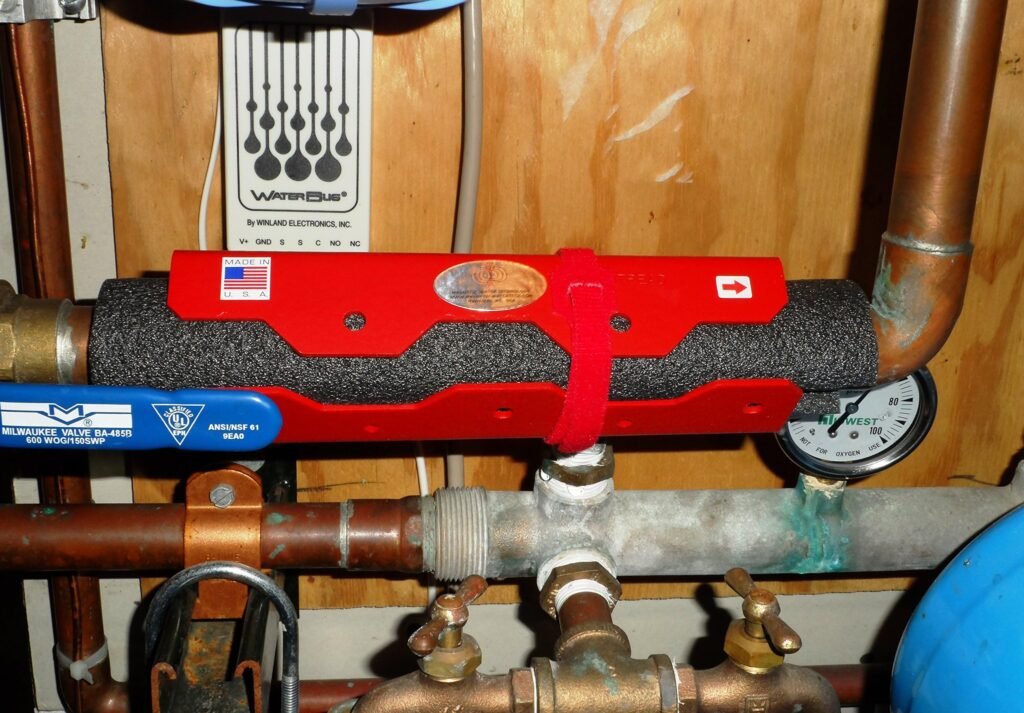
These devices are typically clamped around water pipes and are non-invasive, meaning they don’t require cutting into pipes or altering plumbing. This makes them a convenient option for many homeowners and businesses. They are often cylindrical and contain powerful magnets or electromagnets positioned to maximize the field’s effect on the passing water.
Clamp-on units vary widely in magnet strength, field geometry, and recommended pipe sizes. Those design differences are covered in more detail in our overview of the magnetic water descaler.
Advantages of Magnetic Descalers
- Environmentally Friendly:
- Since they require no chemicals, magnetic descalers don’t contribute to chemical runoff and are safer for the ecosystem.
- Low Maintenance:
- Unlike traditional water softeners, magnetic descalers don’t need any refilling or regular maintenance checks.
- Energy Efficient:
- These devices use minimal energy, especially in the case of permanent magnets, leading to cost savings.
- Cost-Effective:
- Initial investment in magnetic descalers is relatively low, especially when considering the potential savings from reduced energy bills and maintenance costs.
Limitations and Considerations
- Efficacy Debate:
- The scientific community is divided over the effectiveness of magnetic descalers. While some studies report positive outcomes, others find negligible differences. This disparity often results from varying water compositions and flow conditions.
- System Compatibility:
- Magnetic descalers may not be suitable for all plumbing systems. The material of the pipes and the water’s flow rate can influence the performance of these devices.
- Long-Term Effectiveness:
- Some users report needing additional solutions in areas with extremely hard water, as magnetic descalers might not completely eliminate scale buildup over time.
Scientific Scrutiny and Debates
Studies and Findings
Research on magnetic descalers has delivered mixed results. Some studies suggest they can reduce the adherence of scale to piping and appliances, while others see little to no effect. Given the complex nature of water chemistry, results may vary significantly based on local water characteristics and system design.
A prominent study at the Danish Technological Institute found that magnetic treatment reduced scale substantially. However, conflicting reports from other institutes highlight the complex interaction of regional water chemistries with magnetic fields.
Because results vary so widely, buyers can ask whether a device has been tested under a recognized protocol, such as Germany’s DVGW W 512 test for scale-inhibiting water treatment devices, rather than relying on testimonials. A closer review of the published evidence is available in our article on whether magnetic descalers work.
Mechanisms of Action
Several hypotheses exist regarding how magnetic fields may influence water chemistry:
- Ion Hydration: Magnetic fields may alter the hydration shell around ions, affecting how they interact and crystallize.
- Nucleation Theory: Magnetic fields could influence the nucleation process, changing scale’s crystalline structure to one less likely to adhere.
Scientific consensus remains elusive, with ongoing research attempting to isolate specific conditions and mechanisms under which magnetic descalers are most effective.
Practical Applications and Case Studies
Domestic Use
Magnetic descalers are often used in homes to protect appliances like kettles, coffee machines, and boilers from scale buildup. Homeowners appreciate their low maintenance requirements and the potential for longer lifespans for household appliances.
Industrial Use
In the industrial sector, maintaining efficient systems is critical. Magnetic descalers find applications in cooling towers, boilers, and heat exchangers, where scale can severely impact efficiency and lifespan. Here, regular maintenance and water testing help assess the descaler’s performance over time.
Business and Commercial Use
Hotels, restaurants, and laundries where water use is intensive have turned to magnetic descalers as a means to reduce maintenance costs and downtime. The success in these settings often hinges on integrating descalers with solid maintenance practices and occasionally supplemental treatments.
Case Studies
Some businesses report significant reductions in scale and maintenance costs following the installation of magnetic descalers. For instance, a hotel chain documented a 30% reduction in heating element maintenance across 10 properties after employing magnetic treatment, showcasing their potential benefits when conditions are suitable.
Alternative Technologies
Electromagnetic Water Conditioners
Operating similarly to magnetic descalers, these devices use a generated electromagnetic field rather than a permanent magnet. This approach can offer additional control over the field’s strength and direction, potentially enhancing effectiveness.
Template-Assisted Crystallization (TAC) Systems
TAC systems influence water chemistry differently, encouraging the formation of scale crystals in suspension rather than allowing them to adhere to surfaces. Unlike magnetic descalers, these systems have received broader scientific validation yet remain more costly.
Electronic Water Conditioners
These devices rely on electrical pulses to alter the properties of scale-forming minerals. Similar to magnetic descalers, they are non-invasive and require minimal maintenance, making them a popular alternative.
Consumer Considerations
Choosing the Right System
When selecting a magnetic descaler, consider water hardness, plumbing material, and flow rates to ensure effectiveness. Consumer reviews and professional assessments can provide additional insights into a specific product’s capabilities.
For product-level comparisons, see our review of the best magnetic descaler options.
Integration with Existing Systems
While magnetic descalers offer a standalone solution, they can complement existing water treatment systems. Combining multiple approaches may offer the best protection against scale and other water-related issues in some cases.
Where scale control must be reliable, for example to protect water heater warranties or boiler feed water, conventional ion exchange softening remains the only method in this article that actually removes hardness, and its performance can be confirmed with a simple hardness test.
Cost-Benefit Analysis
Prospective buyers should compare the initial investment, potential savings on maintenance and energy, and environmental impact against other available methods. This assessment will help determine whether a magnetic descaler represents the most suitable solution for their needs.
Conclusion: The Future of Magnetic Descalers
As the push for sustainable and eco-friendly solutions intensifies, magnetic descalers will likely remain a part of the conversation. While current science is divided on their efficacy, ongoing research and technological advances may reveal conditions where these devices are most beneficial.
Their appeal lies in their simplicity, affordability, and eco-friendly nature, making them an attractive option for those looking to reduce the environmental footprint of their water systems. As more data emerges, the role of magnetic descalers in both domestic and industrial settings will become more defined, shaping the next generation of water treatment solutions.