
McWane vs Henry Pratt for Gate Valves: Pros/Cons & Best-Fit Applications
Introduction
In municipal water distribution and wastewater treatment, the isolation valve is the most critical yet frequently overlooked asset. Industry data suggests that up to 20% of installed gate valves in North America are inoperable or pass water when isolation is attempted during an emergency. For the consulting engineer or utility director, the choice of manufacturer is not merely about brand preference; it is a calculation of metallurgy, supply chain reliability, and long-term actuation performance.
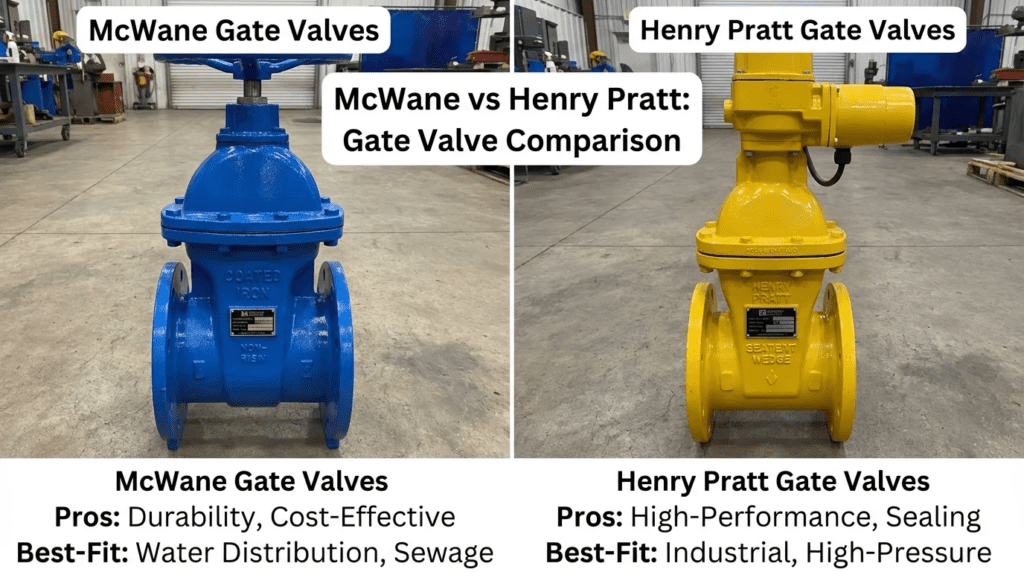
Two of the most prominent names in the North American market are the McWane family of companies (including Kennedy, Clow, and M&H) and the Henry Pratt Company (a division of Mueller Water Products). While both entities dominate specifications, their strengths lie in different sectors of the hydraulic envelope. Determining McWane vs Henry Pratt for Gate Valves: Pros/Cons & Best-Fit Applications requires moving beyond catalog cut sheets to understand the manufacturing philosophy and specific engineering merits of each.
Gate valves are predominantly used for ON/OFF service in clean water distribution, fire protection systems, and wastewater force mains. Unlike control valves, they are designed to operate infrequently but must hold a bubble-tight seal after years of dormancy. A poor specification choice here leads to “frozen” stems, stripped operating nuts, and inevitably, costly excavation to replace a buried asset.
This article provides a rigorous, engineer-to-engineer analysis of these two manufacturing giants. We will strip away marketing claims to focus on material standards (AWWA C509/C515), wedge encapsulation quality, stem engineering, and the specific application environments where one manufacturer may hold a technical advantage over the other.
How to Select and Specify Gate Valves
Selecting the correct gate valve involves balancing hydraulic efficiency with mechanical durability. When evaluating McWane vs Henry Pratt for Gate Valves: Pros/Cons & Best-Fit Applications, engineers must first define the operational envelope. The following criteria should form the basis of your technical specifications.
Duty Conditions & Operating Envelope
The first step in specification is defining the pressure class and operation frequency. Standard Resilient Wedge Gate Valves (RWGV) are typically rated for 250 psi or 350 psi working pressure.
- Working Pressure: For most municipal distribution grids, 250 psi is sufficient. However, high-service pump station discharges and mountainous terrain zones often require 350 psi rated valves. Both McWane (via Kennedy/Clow) and Pratt (via Mueller/US Pipe) offer options here, but verify the specific bonnet bolt configuration for higher pressures.
- Flow Velocity: Gate valves are full-port devices, minimizing head loss. However, operating them in a throttled position (partially open) causes high-velocity scour across the seating surface (wire drawing). Specifications must explicitly state that gate valves are for isolation only, not flow control.
- Cyclic Duty: If the valve will be actuated frequently (e.g., filter backwash sequencing), a standard gate valve represents a poor selection due to the sliding friction of the wedge. In these scenarios, confirm the manufacturer’s cycle life rating.
Materials & Compatibility
The longevity of a valve is dictated by its resistance to galvanic corrosion and dezincification.
- Body Materials: The industry has largely shifted from Cast Iron (AWWA C509) to Ductile Iron (AWWA C515). Ductile iron offers a higher strength-to-weight ratio. McWane’s Clow and Kennedy lines feature robust ductile iron bodies. Pratt’s industrial gate offerings often focus on fabricated steel or specific alloys for knife gates.
- Stem Materials: This is a common failure point. “Standard” bronze stems can suffer from dezincification in aggressive soils or water chemistries. Engineers should specify Low Zinc Bronze (NDZ) or 304/316 Stainless Steel stems for critical applications.
- Wedge Encapsulation: The iron wedge is fully encapsulated in rubber (usually EPDM or NBR). The bond between the rubber and iron is critical. If the bond fails, the iron corrodes, the rubber swells, and the valve becomes inoperable. Look for verification of rubber bonding per ASTM D429 standards.
Hydraulics & Process Performance
While gate valves have low head loss when fully open, the transition period is critical.
- Head Loss Coefficient (K): For a fully open gate valve, K is typically 0.15 to 0.2. This makes them superior to butterfly valves (K=0.3-0.5) for pump suction isolation where NPSHa is critical.
- Debris Tolerance: In wastewater applications, the bottom of the valve body (the track) can accumulate grit, preventing full closure. Resilient wedge designs (common to McWane’s Kennedy line) eliminate the bottom pocket found in older double-disc gates, allowing the wedge to seal around minor debris.
Installation Environment & Constructability
Physical constraints often dictate the choice between a gate valve and a butterfly valve, but within gate valve selection, form factor matters.
- Laying Length: Most flanged gate valves follow ANSI/ASME B16.10 dimensions. However, when replacing vintage double-disc valves with modern resilient wedge valves, engineers must verify the face-to-face dimensions to avoid costly piping modifications.
- Vertical vs. Horizontal: Large diameter gate valves (above 24″) are heavy. Installing them horizontally (stem horizontal) requires tracks and rollers to support the wedge weight, preventing seal deformation. McWane and Pratt both have specific guidelines for horizontal mounting that must be followed to maintain warranty.
Reliability, Redundancy & Failure Modes
Understanding how a valve fails is as important as how it operates.
- Stem Failure: The most common failure mode is the shearing of the stem or stripping of the stem nut due to over-torquing. “Safe” failure design ensures the failure occurs at the top of the stem (accessible) rather than inside the bonnet (requiring excavation).
- Bolt Corrosion: Bonnet bolts are exposed to the soil environment. Specifying 316 Stainless Steel bolts fully encapsulated in wax tape or mastic is a best practice for direct bury applications.
Controls & Automation Interfaces
For treatment plants, gate valves are often motorized.
- Multi-Turn Actuation: Gate valves are multi-turn devices (requiring 15-100+ turns to close). Actuators must be sized for the running torque and the unseating/seating torque.
- Over-Torque Protection: Electric actuators must have torque switches configured to protect the valve stem. If the wedge hits an obstruction, the actuator must trip before snapping the stem.
Lifecycle Cost Drivers
The purchase price of a gate valve is often less than 10% of the cost to replace it (excavation, permitting, restoration).
- CAPEX: Ductile iron resilient wedge valves are generally commodity-priced in sizes 4″-12″.
- OPEX: The primary OPEX cost is the “exercising” program. Valves that are not exercised annually will eventually seize. Designs that utilize superior coating systems and high-grade stem materials reduce the likelihood of seizure, lowering long-term labor costs.
Comparison Tables
The following tables provide a direct technical comparison. Table 1 focuses on the specific brand positioning within the McWane and Pratt portfolios. Table 2 provides an application fit matrix to assist engineers in selecting the right technology for the specific process node.
Table 1: Manufacturer & Product Line Analysis
| Manufacturer / Brand Family | Primary Strengths | Typical Applications | Limitations / Considerations | Maintenance Profile |
|---|---|---|---|---|
| McWane Inc. (Kennedy Valve, Clow Valve, M&H Valve) |
– Massive installed base in North America – Robust AWWA C509/C515 compliance – Vertical integration (owns foundries) – Rotating disc options available |
– Municipal Water Distribution (4″-48″) – Fire Protection Systems (UL/FM) – Wastewater Force Mains |
– Primarily focused on standard municipal specs – Less focus on exotic industrial alloys than niche manufacturers |
– Standard exercising required – Parts widely available through distribution |
| Henry Pratt Company (Div. of Mueller Water Products) |
– Industry leader in Knife Gate Valves (Industrial) – Dominant in Large Diameter Butterfly Valves – Rectangular Gate Valves specialist |
– Wastewater Headworks (Knife/Slide Gates) – Industrial Slurry handling – Large transmission mains (Butterfly) |
– For standard RWGV, Mueller brand is usually the spec, not “Pratt” – Premium pricing on specialized industrial gates |
– Knife gates require packing adjustments – Rectangular gates require guide rail maintenance |
| Mueller Co. / U.S. Pipe Valve (Direct competitor to McWane RWGV) |
– 2361 Series is a municipal standard – 350 psi rating standard on many lines – Advanced polymer coatings |
– Municipal Distribution – Potable Water Plants |
– Similar commodity focus as McWane – Regional availability varies by distributor |
– Low maintenance encapsulated wedge design |
When specifying McWane vs Henry Pratt for Gate Valves, note that for standard AWWA Resilient Wedge Gate Valves (C509/C515), you are technically comparing McWane (Kennedy/Clow) vs. Mueller/U.S. Pipe. The Henry Pratt brand is most often specified for Knife Gate Valves, Rectangular Gates, or Butterfly Valves. Ensure your specification references the correct product division.
Table 2: Application Fit Matrix
| Application Scenario | Best-Fit Technology | McWane (Kennedy/Clow) Fit | Pratt (Industrial/Knife) Fit | Engineering Justification |
|---|---|---|---|---|
| Potable Water Distribution (Buried) | Resilient Wedge Gate (C509/C515) | High – Core Competency | Low – Use Mueller Brand | Zero leakage, clear waterway, robust for burial. |
| Wastewater Sludge / Grit | Knife Gate Valve | Low – Limited offerings | High – Core Competency | Knife gates cut through solids/rags that would jam a wedge gate. |
| Raw Water Intake (Large Dia.) | Butterfly Valve (or Large RWGV) | Medium (Large RWGV) | High (Large Butterfly) | Above 30″, Butterfly valves save significant weight and space vs. Gate valves. |
| Pump Station Isolation (Suction) | Resilient Wedge Gate | High | Medium | Gate valves provide full unobstructed flow, critical for NPSH availability. |
| Throttling / Flow Control | Plunger or Plug Valve | Not Recommended | Not Recommended | Gate valves vibrate and erode under throttling duty. |
Engineer & Operator Field Notes
Field experience often reveals truths that are absent from manufacturing brochures. The following notes are compiled from commissioning and operational feedback regarding gate valve performance.
Commissioning & Acceptance Testing
When commissioning gate valves, particularly in the McWane vs Henry Pratt for Gate Valves: Pros/Cons & Best-Fit Applications context, the following checks are mandatory:
- Turns-to-Close Verification: Count the turns. A common field issue is a valve that stops halfway due to debris in the track. If a 12″ valve requires 38 turns but stops at 20, it is not sealed. Document the turns count against the submittal data.
- Direction of Rotation: Open-Left (OL) vs. Open-Right (OR). Mixing these in a single municipality is a recipe for disaster. Color-code the operating nuts (e.g., Red for OR, Black for OL) if mixed inventory exists.
- Torque Testing: For actuated valves, set the torque limit switches to the manufacturer’s seating torque requirement + safety factor (typically 10-15%). Do not simply set them to the actuator’s maximum, or you risk bending the stem during a “torque-out” event.
Common Specification Mistakes
A common error in specifications for larger gate valves (14″+) is failing to specify spur or bevel gearing. While a 12″ valve can be operated directly, opening an 18″ gate valve against full differential pressure without a gearbox is ergonomically dangerous and often physically impossible for a single operator. Always require gearing for 14″ and larger.
- Copy-Paste Specs: Using outdated “Double Disc” specs for modern “Resilient Wedge” projects. Double disc gates leak more and are more expensive/complex. Ensure specs cite AWWA C509 (Cast Iron) or C515 (Ductile Iron).
- Ignoring Bypass Valves: On large diameter gates (24″+), the differential pressure can make the valve impossible to crack open. Specifying an integral bypass valve allows pressure equalization before operating the main gate.
O&M Burden & Strategy
The “install and forget” mentality is the primary cause of gate valve failure.
- Exercising Interval: AWWA recommends operating every valve once per year. In practice, critical isolation valves should be cycled at least every 2-3 years. This clears tuberculation from the stem threads and prevents the wedge from bonding to the body.
- Stem Lubrication: For rising stem (OS&Y) valves in vaults, the exposed stem threads must be lubricated annually with food-grade grease to prevent corrosion and galling.
- Packing Adjustment: Traditional packing glands may drip over time. Modern RWGVs often use O-ring seals which are non-adjustable but maintenance-free. If specifying Pratt Knife Gates, operators must be trained to tighten the packing follower as part of routine PMs.
Troubleshooting Guide
Symptom: Valve won’t close fully.
Root Cause: Debris in the bottom track.
Fix: “Flushing technique.” Open the valve slightly to create high velocity, then close. Repeat 3-4 times to scour the debris.
Symptom: Valve leaks past the seat.
Root Cause: Damaged rubber on wedge or scored body.
Fix: For RWGVs, the wedge must be replaced. This usually requires depressurization and bonnet removal.
Design Details and Calculations
For the design engineer, specifying the valve requires specific dimensional and force calculations.
Sizing Logic & Methodology
Unlike control valves, gate valves are line-sized. If the pipe is 12″, the valve is 12″. However, checking the Cv (Flow Coefficient) is prudent for high-velocity lines to ensure head loss is acceptable.
Typical Calculation:
Head Loss (hL) = (Q / Cv)²
Where Q is flow in GPM. Because the Cv of a full-port gate valve is very high (e.g., Cv ≈ 12,000 for a 24″ valve), the head loss is usually negligible (< 0.1 psi). If head loss is significant, check if the piping design is undersized, not the valve.
Specification Checklist
When preparing bid documents for McWane vs Henry Pratt for Gate Valves, include:
- Compliance: Must meet AWWA C509 (thick wall) or C515 (thin wall ductile).
- Coating: Fusion Bonded Epoxy (FBE) interior and exterior per AWWA C550. NSF 61 certification for potable water is mandatory.
- Stem: Low Zinc Bronze (ASTM B763) or 304 Stainless Steel.
- End Connections: Mechanical Joint (MJ) for buried pipe, Flanged (CL125/250) for vaults/plants.
- Warranty: 10-year warranty is becoming standard for RWGVs; ensure the spec demands this.
Standards & Compliance
Strict adherence to standards protects the utility:
- AWWA C509: Resilient-Seated Gate Valves for Water Supply Service (Cast Iron).
- AWWA C515: Reduced-Wall, Resilient-Seated Gate Valves for Water Supply Service (Ductile Iron). *Note: This is the most common modern standard.*
- AWWA C550: Protective Interior Coatings for Valves and Hydrants.
- NSF/ANSI 61 & 372: Drinking Water System Components – Health Effects & Lead Content.
Frequently Asked Questions
What is the difference between AWWA C509 and C515 gate valves?
The primary difference is the body material and wall thickness. AWWA C509 typically refers to Cast Iron bodies with thicker walls, while AWWA C515 allows for Ductile Iron bodies with reduced wall thickness. Ductile iron is stronger than cast iron, allowing for lighter valves without sacrificing pressure rating. Both McWane (Kennedy/Clow) and Mueller/Pratt offer C515 valves as the modern industry standard, though some conservative utilities still prefer the “heavier” C509 spec.
When should I choose a Pratt Knife Gate over a McWane RWGV?
You should select a Pratt Knife Gate Valve for applications involving high solids, sludge, or slurry (wastewater, industrial processes). A standard McWane Resilient Wedge Gate Valve (RWGV) is designed for clean water or light wastewater. Thick sludge or rags can get trapped under the wedge of an RWGV, preventing a seal. A knife gate cuts through these solids to seal effectively.
Are McWane and Kennedy Valve the same company?
Yes. Kennedy Valve is a division of McWane, Inc. When you specify a “McWane” valve, you are often supplied a valve manufactured by Kennedy Valve, Clow Valve, or M&H Valve, depending on your region and distributor. They share similar quality standards and corporate ownership but maintain distinct product lineages.
What is the typical lifespan of a resilient wedge gate valve?
In a municipal clean water application, a properly installed RWGV typically lasts 40 to 50 years. The limiting factor is usually the rubber encapsulation on the wedge (which can degrade after 30+ years) or stem corrosion if the valve is not exercised. High-quality epoxy coatings (AWWA C550) are critical to achieving this lifespan in corrosive soils.
Can I use a gate valve for flow throttling?
No. Gate valves are designed for isolation only (fully open or fully closed). Using a gate valve in a partially open position for throttling causes “wire drawing” (erosion of the seat) and induces vibration that can damage the wedge and stem. For throttling applications, specify a plug valve, butterfly valve, or control valve.
How much does a 12-inch gate valve cost?
While prices vary by region and steel commodity costs, a typical 12-inch Mechanical Joint (MJ) Resilient Wedge Gate Valve generally costs between $2,500 and $4,000. Installation costs (excavation, backfill, restoration) are usually 3x to 5x the material cost, emphasizing the importance of choosing a reliable manufacturer like McWane or Pratt/Mueller to avoid premature replacement.
Conclusion
Key Takeaways for Engineers
- Know the Brand Families: McWane includes Kennedy, Clow, and M&H. Henry Pratt is part of Mueller Water Products. For standard RWGVs, you are comparing McWane vs. Mueller. For specialty/industrial gates, Pratt is the distinct player.
- Spec the Application: Use Resilient Wedge Gate Valves (C515) for water distribution. Use Knife Gate Valves for wastewater sludge. Do not interchange them.
- Material Matters: Always specify Low Zinc Bronze or Stainless Steel stems to prevent failure in aggressive soils.
- Actuation Safety: Ensure electric actuators have torque protection to prevent stem damage during obstruction.
- The 14-inch Rule: Always specify gearing for gate valves 14 inches and larger to ensure safe manual operation.
The choice between McWane vs Henry Pratt for Gate Valves: Pros/Cons & Best-Fit Applications ultimately depends on the specific service conditions of your project. For standard municipal water distribution, the McWane family (Kennedy/Clow) offers a ubiquitous, reliable solution that is familiar to almost every maintenance crew in North America. Their vertical integration ensures consistent iron quality and availability.
Conversely, for complex industrial applications, large diameter transmission mains requiring butterfly valves, or wastewater process streams requiring knife gates, the Henry Pratt Company (and the broader Mueller portfolio) offers specialized engineering that may exceed the capabilities of a standard waterworks valve.
Engineers should focus less on brand loyalty and more on the technical match: define the fluid, the pressure class, and the actuation requirements. A rigorous specification that adheres to AWWA C515/C509 and demands strict coating and testing protocols will ensure that whether the bonnet bears the name McWane or Pratt, the valve will perform when the critical moment for isolation arrives.