
Metropolitan Water Reclamation District Hanover Park Water Reclamation Plant
FACILITY BASIC INFORMATION
- Plant Name: Hanover Park Water Reclamation Plant (WRP)
- Location: Hanover Park, Cook County, Illinois
- Operating Authority: Metropolitan Water Reclamation District of Greater Chicago (MWRD)
- Design Capacity: 12.0 MGD
- Current Average Flow: ~8.5 MGD
- Population Served: ~59,000 residents
- Service Area: Northwest Cook County (Hanover Park, Schaumburg, Hoffman Estates, Streamwood)
- Receiving Water Body: West Branch of the DuPage River
- NPDES Permit Number: IL0036137
- Year Commissioned: 1964
1. INTRODUCTION
The Hanover Park Water Reclamation Plant (WRP) serves as a critical satellite facility within the Metropolitan Water Reclamation District of Greater Chicago (MWRD) infrastructure network. Located in the northwest suburbs of Cook County, this 12.0 MGD design capacity plant provides advanced tertiary treatment for a population of approximately 59,000 residents. Originally commissioned in 1964 to support the rapid suburban expansion of the Chicago metropolitan area, the facility plays a vital role in maintaining the water quality of the West Branch of the DuPage River.
Unique among MWRD facilities, the Hanover Park WRP is physically and operationally integrated with the nearby 185-acre Fischer Farm, utilized for experimental biosolids application and agricultural research. While smaller than the District’s massive Stickney or O’Brien plants, Hanover Park represents a crucial node in regional watershed management. Currently, the facility is the subject of significant long-term engineering planning, as the District evaluates the “Upper DuPage River Trunk Sewer” project, which aims to decommission the aging plant and divert flows to the Kirie and O’Brien WRPs to optimize regional operational efficiency and reduce long-term capital costs.

2. FACILITY OVERVIEW
A. Service Area & Coverage
The facility services an 11.2-square-mile area in the upper northwest corner of Cook County. The sewershed is primarily residential, with light commercial corridors and minimal heavy industrial input. The service area encompasses the municipality of Hanover Park and portions of Hoffman Estates, Schaumburg, Streamwood, Roselle, and Bartlett. The collection system feeding the plant is distinct from the larger tunnel and reservoir plan (TARP) system that serves the central Chicago area, operating as an independent interceptor network.
B. Operational Capacity
The plant is designed for an average daily flow of 12.0 Million Gallons per Day (MGD) with a peak hydraulic capacity of roughly 22 MGD. Historical flow data indicates the plant operates at approximately 70% of its design capacity, treating an average of 8.5 MGD. Due to the suburban nature of the collection system, the facility experiences significant diurnal flow variations and peak flow events during heavy precipitation, necessitating robust hydraulic controls at the headworks.
C. Discharge & Compliance
Treated effluent is discharged into the West Branch of the DuPage River. Because this receiving water body is a smaller inland stream compared to the Chicago Sanitary and Ship Canal, the NPDES permit limits for Hanover Park are stringent, particularly regarding Ammonia-Nitrogen, suspended solids, and dissolved oxygen. The plant consistently achieves high compliance rates, earning recognition from the National Association of Clean Water Agencies (NACWA) for peak performance.
3. TREATMENT PROCESS
The Hanover Park WRP utilizes a multi-stage reclamation process designed to achieve tertiary effluent quality suitable for discharge into a sensitive riverine ecosystem.
A. Preliminary Treatment
Raw wastewater enters the plant via the main interceptor, passing through coarse bar screens to remove large debris, rags, and non-biological solids that could damage downstream pumping equipment. Following screening, the flow enters aerated grit chambers. These chambers reduce the velocity of the influent, allowing inorganic grit (sand, gravel, coffee grounds) to settle while keeping lighter organic material in suspension. The removed grit is washed, dewatered, and hauled off-site to a sanitary landfill.
B. Primary Treatment
Unlike some of the MWRD’s larger facilities that utilize extensive batteries of primary clarifiers, the Hanover Park configuration is streamlined. The flow moves from preliminary treatment into the secondary biological stage. Note: Depending on specific operational modes, some settling may occur, but the facility heavily relies on the biological train for solids separation.
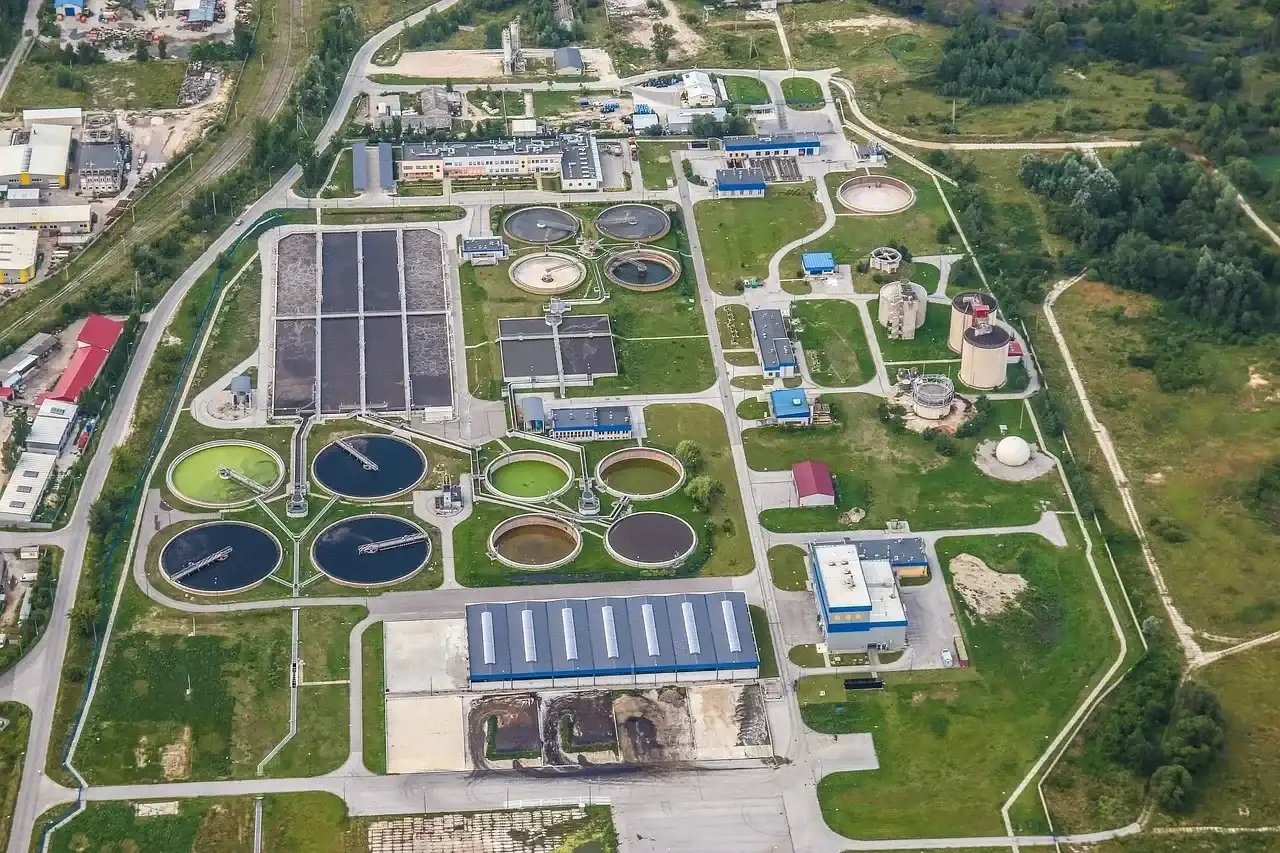
C. Secondary Treatment (Activated Sludge)
The core of the treatment process is a conventional activated sludge system. The wastewater enters aeration tanks where it is mixed with Return Activated Sludge (RAS) to form mixed liquor.
- Aeration: Large centrifugal blowers supply air through fine-bubble diffusers located at the bottom of the tanks. This provides the oxygen necessary for aerobic bacteria to metabolize organic matter (BOD) and convert ammonia to nitrate (nitrification).
- Clarification: The mixed liquor flows into circular secondary clarifiers. Here, the biological floc settles to the bottom via gravity. Clean supernatant overflows the weirs. A portion of the settled sludge is returned to the head of the aeration tanks (RAS), while the excess growth is removed as Waste Activated Sludge (WAS).
D. Tertiary Treatment
To meet the strict TSS (Total Suspended Solids) and BOD limits of the NPDES permit, the secondary effluent undergoes tertiary filtration. The plant utilizes rapid sand filters (or similar media filtration) to physically remove remaining particulate matter that did not settle in the secondary clarifiers. This step is critical for maintaining water clarity and removing particulate-bound phosphorus.
E. Disinfection
Before discharge, the filtered effluent is disinfected to eliminate pathogenic organisms. Hanover Park WRP utilizes chlorination (sodium hypochlorite) in contact tanks to ensure adequate kill rates for fecal coliform. Following the contact period, the water is dechlorinated using sodium bisulfite to prevent toxicity to aquatic life in the West Branch of the DuPage River.
F. Solids Handling & Biosolids (Fischer Farm)
Solids handling at Hanover Park is unique. Waste Activated Sludge is thickened and digested anaerobically to reduce volatile solids and pathogen counts.
The Fischer Farm Connection: The digested biosolids, in liquid form, are transported via pipeline to the adjacent 185-acre Fischer Farm. This site, operated by the MWRD, serves as a dedicated land application site. The biosolids are injected below the soil surface to fertilize crops (corn and soybeans), effectively recycling nutrients back into the environment. This system eliminates the need for mechanical dewatering (centrifuges/presses) at the plant, reducing energy consumption.
4. INFRASTRUCTURE & FACILITIES
A. Physical Plant
The treatment plant occupies a compact footprint adjacent to residential zones, necessitating strict aesthetic and odor controls. The site includes the main pump building, blower building, digester complex, and the tertiary filtration building. The architecture is utilitarian, consistent with 1960s/70s municipal infrastructure.
B. Energy Systems
Energy management is a priority for the MWRD. The Hanover Park facility relies on grid power for major drivers (blowers and pumps). However, the anaerobic digesters produce biogas (methane). While larger MWRD plants utilize this gas for cogeneration, at Hanover Park, biogas is primarily used to fire boilers that maintain the temperature of the digesters, offsetting natural gas usage.
C. Odor Control
Given the facility’s proximity to the Village of Hanover Park residential areas, odor control is paramount. Covers are utilized on sludge holding tanks, and chemical scrubbers or biofilters are employed at critical emission points (headworks and solids processing areas) to treat hydrogen sulfide and other odorous compounds before air release.
5. RECENT UPGRADES & MAJOR PROJECTS
While the plant has undergone routine maintenance, the most significant engineering focus is on the future of the site itself. The MWRD is currently executing a strategic plan that involves the eventual decommissioning of this facility.
PROJECT SPOTLIGHT: Upper DuPage River Trunk Sewer & Plant Decommissioning
Status: In Planning/Design Phase
Est. Budget: $100M+ (Part of larger regional strategy)
Project Scope: The MWRD has determined that upgrading the aging Hanover Park WRP to meet future nutrient removal standards is less cost-effective than consolidating flows. The plan involves constructing a new conveyance system, the “Upper DuPage River Trunk Sewer.”
Technical Highlights:
- Construction of a deep tunnel or large-diameter interceptor to divert flow away from Hanover Park.
- Flows will be conveyed to the Kirie Water Reclamation Plant and/or the O’Brien Water Reclamation Plant via the mainstream tunnel system.
- Conversion of the Hanover Park site into a wet-weather storage reservoir to mitigate regional flooding.
Drivers: This project is driven by the need to reduce long-term O&M costs, avoid costly nutrient removal retrofits (phosphorus/nitrogen) required at the smaller plant, and leverage the economies of scale at the District’s larger facilities.
Recent Historical Upgrades (2015-2022)
Variable Frequency Drive (VFD) Installations: Replacement of constant speed drives on main lift pumps and aeration blowers with VFDs to improve energy efficiency and process control.
Diffuser Replacement: Upgrade of aeration tank diffusers to high-efficiency fine bubble membranes to improve oxygen transfer rates (OTR) and reduce blower energy consumption.
6. REGULATORY COMPLIANCE & ENVIRONMENTAL PERFORMANCE
A. Permit Requirements
The facility operates under NPDES Permit IL0036137 issued by the Illinois EPA. Key parameters include:
- CBOD5: Monthly average limits typically ≤ 10 mg/L.
- Suspended Solids (TSS): Monthly average limits typically ≤ 12 mg/L.
- Ammonia Nitrogen: Seasonally variable, with limits as low as 1.5 mg/L in summer months.
- Phosphorus: Pending stricter limits (0.5 mg/L or 1.0 mg/L) which are driving the decommissioning strategy.
B. Compliance History
The Hanover Park WRP maintains an exemplary compliance record. The facility has received multiple Platinum Peak Performance Awards from NACWA, indicating years of operation without a single NPDES permit violation. This reliability is attributed to the conservative design of the activated sludge system and the redundancy provided by the tertiary filtration step.
7. CHALLENGES & FUTURE PLANNING
A. Infrastructure Age vs. Regulatory Tightening
The primary engineering challenge is the age of the civil and mechanical assets (circa 1964) contrasted against modern nutrient limits. Retrofitting a compact, land-locked site for Biological Nutrient Removal (BNR) to meet new Illinois EPA phosphorus standards would be prohibitively expensive compared to conveyance alternatives.
B. Strategic Consolidation
The future planning for Hanover Park is defined by the MWRD’s Strategic Plan. The District aims to consolidate operations to its three major plants (Stickney, O’Brien, Calumet) and select satellite plants (Kirie, Egan). Hanover Park is slated for phase-out. Engineering firms engaged with this facility currently focus on maintaining operational continuity during the transition period and designing the complex conveyance structures required for the diversion.
8. TECHNICAL SPECIFICATIONS SUMMARY
| Parameter | Specification |
|---|---|
| Facility Type | Tertiary Treatment (Activated Sludge + Filtration) |
| Design Capacity | 12.0 MGD |
| Average Daily Flow | 8.5 MGD |
| Peak Hydraulic Capacity | ~22 MGD |
| Biological Process | Conventional Activated Sludge |
| Tertiary Treatment | Rapid Sand Filtration |
| Disinfection | Chlorination / Dechlorination |
| Biosolids Handling | Anaerobic Digestion + Liquid Land Application (Fischer Farm) |
| Receiving Water | West Branch DuPage River |
| Operating Authority | MWRD of Greater Chicago |
| Total Site Area | ~20 Acres (Plant) + 185 Acres (Farm) |
| Future Status | Slated for decommissioning/flow diversion |
9. FREQUENTLY ASKED QUESTIONS
1. What is the treatment capacity of the Hanover Park WRP?
The plant has a design capacity of 12.0 Million Gallons per Day (MGD) and typically treats an average of 8.5 MGD.
2. Does Hanover Park WRP use chemical disinfection?
Yes, the facility uses sodium hypochlorite for disinfection followed by sodium bisulfite for dechlorination before discharge.
3. What is Fischer Farm and how is it related to the plant?
Fischer Farm is a 185-acre agricultural site adjacent to the plant. Treated biosolids (in liquid form) are piped directly to the farm for subsurface injection, providing nutrients for corn and soybean crops. This is a unique beneficial reuse program within the MWRD.
4. Is the Hanover Park WRP closing down?
Long-term plans by the MWRD involve decommissioning the treatment plant and converting the site into a stormwater management reservoir. Wastewater flows will be diverted via a new interceptor to the Kirie or O’Brien Water Reclamation Plants.
5. Who operates the facility?
The plant is owned and operated by the Metropolitan Water Reclamation District of Greater Chicago (MWRD), a special-purpose district responsible for wastewater treatment and stormwater management in Cook County.
6. What level of treatment does the plant provide?
The plant provides Tertiary Treatment. This includes preliminary screening, secondary biological treatment (activated sludge), and tertiary filtration (sand filters), resulting in high-quality effluent.