
Metropolitan Water Reclamation District Kirie Water Reclamation Plant Des Plaines
The Authoritative Technical Resource for Engineers and Operators
FACILITY BASIC INFORMATION
- Plant Name: James C. Kirie Water Reclamation Plant (Kirie WRP)
- Location: 701 West Oakton Street, Des Plaines, Cook County, Illinois
- Operating Authority: Metropolitan Water Reclamation District of Greater Chicago (MWRD)
- Design Average Capacity: 52 MGD
- Design Maximum Flow: 110 MGD
- Population Served: ~217,000 residents
- Service Area: 65 square miles (Cook County)
- Receiving Water Body: Higgins Creek (tributary to Des Plaines River)
- NPDES Permit Number: IL0028126
- Year Commissioned: 1980
1. INTRODUCTION
The James C. Kirie Water Reclamation Plant (Kirie WRP) represents a critical node in the Metropolitan Water Reclamation District of Greater Chicago’s (MWRD) extensive wastewater infrastructure. Serving the northwest suburbs of Cook County, this facility is distinct among MWRD assets as a “satellite” water reclamation plant, engineered specifically to process wastewater for high-quality effluent discharge without on-site solids processing. Commissioned in 1980, the plant has a design average capacity of 52 million gallons per day (MGD) and serves approximately 217,000 residents.

Unlike conventional plants that utilize primary settling, the Kirie WRP employs a specialized process configuration designed to maximize footprint efficiency and odor control in a dense suburban environment. With recent capital investments in Ultraviolet (UV) disinfection and biological phosphorus removal, the facility stands as a model for tertiary treatment standards in the Midwest, consistently achieving compliance with stringent Illinois Environmental Protection Agency (IEPA) effluent limits for discharge into the sensitive Higgins Creek watershed.
2. FACILITY OVERVIEW
A. Service Area & Coverage
The Kirie WRP services a 65.4-square-mile area in northeastern Illinois. The sewershed encompasses a blend of residential, commercial, and light industrial zones. The specific municipalities served include Arlington Heights, Buffalo Grove, Des Plaines, Elk Grove Village, Mount Prospect, Prospect Heights, Rolling Meadows, and Wheeling. The collection system feeding the plant relies on deep tunnel interceptors that are integrated with the District’s Tunnel and Reservoir Plan (TARP) to manage wet weather flows.
B. Operational Capacity
The facility is rated for an average design flow of 52 MGD, with a hydraulic peak capacity of roughly 110 MGD. Current average daily flows typically range between 35 and 45 MGD, providing the facility with adequate reserve capacity for dry-weather growth, though wet-weather peaking remains a primary operational consideration. The plant operates in conjunction with the adjacent Majewski Reservoir to manage excess stormwater flows, preventing combined sewer overflows (CSOs).
C. Discharge & Compliance
Treated effluent is discharged into Higgins Creek, a low-flow tributary that feeds into the Des Plaines River. Because the plant’s effluent often constitutes the majority of the creek’s base flow, the NPDES permit requirements are stringent, particularly regarding dissolved oxygen (DO), ammonia nitrogen, and suspended solids. The plant consistently achieves 99%+ removal efficiencies for BOD and TSS.
3. TREATMENT PROCESS
The Kirie WRP utilizes an advanced secondary and tertiary treatment train. A unique engineering feature of this facility is the absence of primary clarifiers. The process moves directly from preliminary screening to activated sludge, a design choice that necessitates robust headworks performance.
A. PRELIMINARY TREATMENT
Influent wastewater enters via the interceptor sewer system at the pump station. The headworks utilize mechanically cleaned bar screens to remove large debris. Following screening, flow enters aerated grit chambers where inorganic solids (sand, gravel, coffee grounds) settle out. The grit is washed, dewatered, and transported off-site to landfills. The absence of primary sedimentation tanks places a higher load on the biological stage but reduces on-site odor potential and sludge handling complexity.
B. SECONDARY TREATMENT (Activated Sludge)
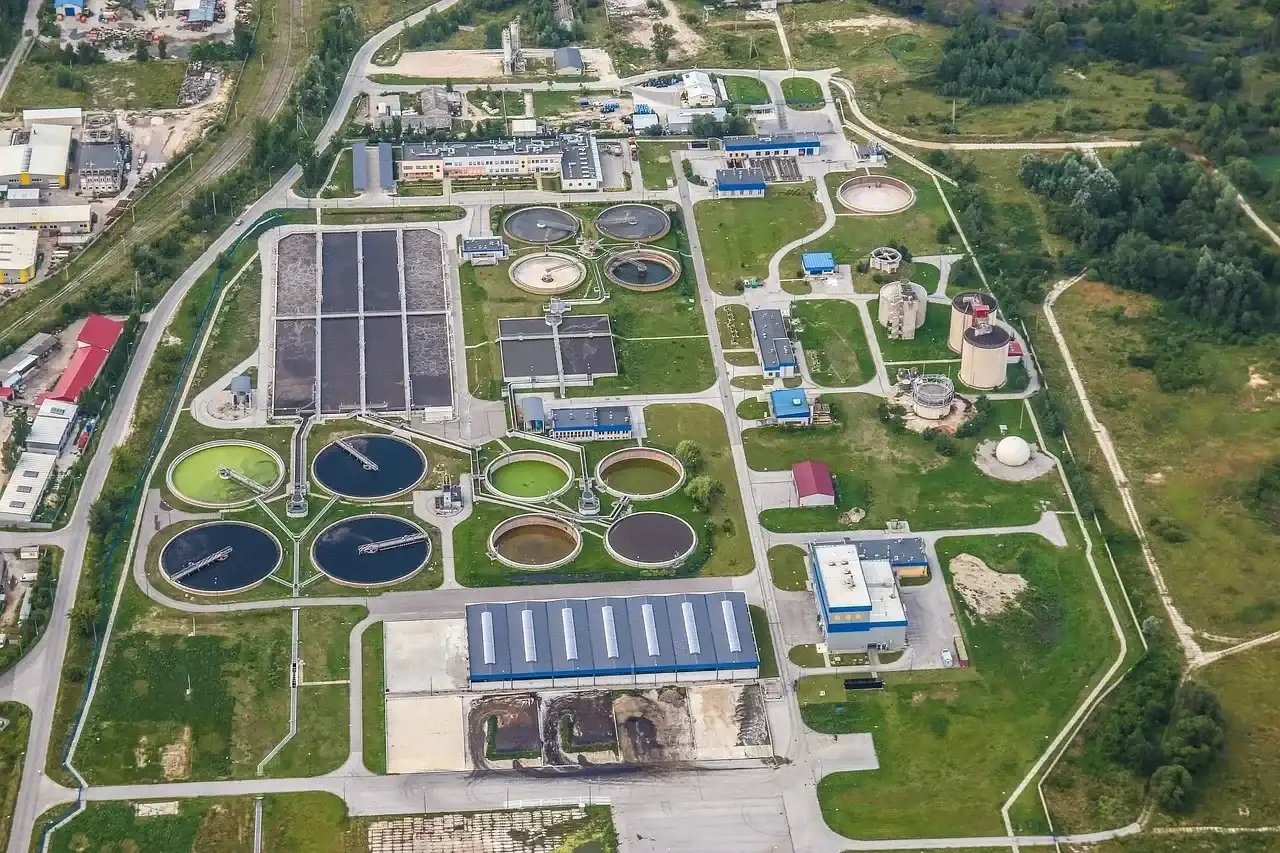
The biological treatment stage utilizes an activated sludge process configured for nitrification. The facility operates four large aeration batteries. The aeration basins are equipped with fine-bubble diffusers to maximize oxygen transfer efficiency.
- Configuration: Plug-flow regime.
- Biological Nutrient Removal (BNR): The plant has been retrofitted to support biological phosphorus removal (Bio-P) by creating anaerobic zones at the head of the aeration tanks.
- Solids Separation: The mixed liquor flows to circular secondary clarifiers. Here, the biological floc settles, and clear supernatant rises to the weirs.
- RAS/WAS: Return Activated Sludge (RAS) is pumped back to the aeration basins. Waste Activated Sludge (WAS) is not processed on-site; it is discharged into the collection system for transport to the Stickney Water Reclamation Plant or Egan WRP for digestion and dewatering.
C. TERTIARY TREATMENT
To meet high-quality effluent standards required for Higgins Creek, the secondary effluent undergoes tertiary filtration. The plant utilizes rapid sand filters (gravity down-flow type). These filters are critical for polishing the effluent, removing remaining suspended solids and particulate-bound phosphorus, ensuring turbidity limits are met prior to disinfection.
D. DISINFECTION
Historically a chlorination/dechlorination facility, Kirie WRP was upgraded to Ultraviolet (UV) Disinfection. This conversion eliminates the handling of hazardous liquid chlorine and sulfur dioxide gas, improving safety and reducing chemical byproducts in the effluent. The UV system consists of in-channel banks of low-pressure, high-output lamps designed to inactivate pathogens such as fecal coliform and E. coli.
E. SOLIDS HANDLING
As a satellite facility, Kirie WRP does not have anaerobic digesters, centrifuges, or drying beds. All solids generated (screenings, grit, and WAS) are either landfilled (grit/screenings) or conveyed via the interceptor system (WAS) to the massive Stickney WRP for stabilization and biosolids production. This operational strategy significantly reduces the physical footprint and odor profile of the Kirie site.
4. INFRASTRUCTURE & FACILITIES
A. Physical Plant
The site occupies approximately 100 acres in a suburban setting. The architecture is functional, with low-profile tankage to minimize visual impact on neighboring residential areas. Key structures include the Main Pump Station, Aeration Batteries, Secondary Clarifiers, Filtration Building, and the UV Disinfection Facility.
B. Energy Systems
Energy consumption is dominated by the aeration blowers and the main influent pumps. MWRD has implemented variable frequency drives (VFDs) on major process motors to optimize energy usage. While the plant does not produce biogas (due to lack of digestion), it participates in MWRD’s district-wide energy neutrality goals through efficiency audits and process control optimization.
C. Odor Control
Given its proximity to residential zones, odor control is paramount. The facility utilizes biological soil filters and activated carbon adsorption systems covering the coarse screen area, wet well, and grit chambers. The export of sludge eliminates the most significant source of odors typically associated with WWTPs.
5. RECENT UPGRADES & MAJOR PROJECTS
Disinfection Facilities (UV) Upgrade – Contract 12-406-3P
- Status: Completed
- Scope: Replacement of sodium hypochlorite disinfection with a state-of-the-art Ultraviolet (UV) irradiation system.
- Budget: ~$15 Million
- Project Drivers: Safety improvement (eliminating hazardous chemicals), reducing disinfection byproducts, and meeting new NPDES fecal coliform limits.
- Technical Highlights: Installation of horizontal UV lamp banks in existing contact channels; new electrical distribution and canopy structures.
Phosphorus Removal Modifications
- Status: Ongoing/Optimization Phase
- Scope: Retrofitting aeration tanks to facilitate Enhanced Biological Phosphorus Removal (EBPR).
- Project Drivers: Compliance with IEPA nutrient limits (NPDES special conditions) to reduce eutrophication in downstream waterways.
- Technical Highlights: Creation of anaerobic zones and baffle wall installation to select for Polyphosphate Accumulating Organisms (PAOs).
Odor Control Master Plan Implementation
- Status: Phased Implementation
- Scope: Upgrading biotowers and carbon scrubbers at headworks and concentration points.
- Results: Significant reduction in hydrogen sulfide complaints from adjacent neighborhoods.
6. REGULATORY COMPLIANCE & ENVIRONMENTAL PERFORMANCE
A. Permit Requirements
The facility operates under NPDES Permit IL0028126. Key discharge parameters include:
- CBOD5: Monthly avg limits typically < 10 mg/L.
- Suspended Solids (TSS): Monthly avg limits < 12 mg/L.
- Ammonia Nitrogen: Seasonal limits, often < 1.5 mg/L in summer.
- Phosphorus: Moving toward a 1.0 mg/L or lower limit.
B. Compliance History
The Kirie WRP maintains an exemplary compliance record, frequently receiving the NACWA (National Association of Clean Water Agencies) Peak Performance Awards (Platinum and Gold) for consecutive years without permit violations. The adoption of tertiary filtration and UV disinfection has ensured consistent adherence to pathogen and turbidity standards.
7. OPERATIONAL EXCELLENCE
The plant is staffed by MWRD personnel, including licensed Class 1 Wastewater Operators, tradesmen, and engineers. Operational strategy relies heavily on a centralized SCADA (Supervisory Control and Data Acquisition) system that allows for real-time monitoring of DO profiles, pump status, and flow rates. The facility also utilizes an on-site process laboratory for immediate process control testing (settleability, microscopy), while compliance samples are analyzed at MWRD’s central laboratories.
8. CHALLENGES & FUTURE PLANNING
Inflow and Infiltration (I/I): Like many mature systems, the collection system feeding Kirie experiences significant I/I during heavy storm events. The plant must manage rapid hydraulic peaking, necessitating tight coordination with the TARP system.
Nutrient Limits: Future regulatory tightening regarding total nitrogen and ultra-low phosphorus remains a planning priority. The plant is currently optimizing Bio-P, but future limits may require supplemental chemical polishing or carbon augmentation.
Aging Infrastructure: As the plant passes its 40-year mark, capital planning is focused on structural rehabilitation of concrete tanks and the replacement of aging electrical switchgear and mechanical conveyance systems.
9. COMMUNITY & REGIONAL IMPACT
The Kirie WRP is a cornerstone of the Des Plaines River watershed management plan. By treating wastewater to tertiary standards, it protects the aquatic life in Higgins Creek and the Des Plaines River. The facility also engages with the community through the MWRD’s open house events and offers educational tours to engineering students and civic groups, demonstrating the vital “hidden” work of water reclamation.
10. TECHNICAL SPECIFICATIONS SUMMARY
| Parameter | Specification |
|---|---|
| Facility Type | Tertiary Water Reclamation Plant |
| Design Average Capacity | 52 MGD |
| Design Peak Capacity | ~110 MGD |
| Preliminary Treatment | Coarse/Fine Screens, Aerated Grit Chambers |
| Primary Treatment | None (Direct to Secondary) |
| Secondary Treatment | Activated Sludge (Fine Bubble Aeration) |
| Tertiary Treatment | Rapid Sand Gravity Filtration |
| Disinfection | Ultraviolet (UV) Irradiation |
| Nutrient Removal | Biological Phosphorus Removal (Bio-P) |
| Solids Handling | Off-site processing (Pumped to Stickney/Egan) |
| Service Area | 65.4 Square Miles |
| NPDES Permit | IL0028126 |
| Receiving Water | Higgins Creek |
| Year Commissioned | 1980 |
11. FAQ SECTION
Technical & Professional Questions
1. Why does Kirie WRP not have primary clarifiers?
The plant was designed as a satellite facility. Omitting primary clarification reduces the site footprint and odor potential. The design relies on the activated sludge process to handle the full organic load, with waste sludge pumped off-site for processing.
2. How is WAS handled if there are no digesters?
Waste Activated Sludge (WAS) is discharged into the interceptor sewer system, where it flows to the Stickney Water Reclamation Plant. Stickney has massive anaerobic digestion capacity to stabilize solids from multiple satellite plants.
3. What is the hydraulic retention time (HRT) for the aeration basins?
While variable based on flow, the HRT is generally designed for 6-8 hours at average flow to ensure complete nitrification.
4. Does the plant have energy recovery systems?
No. Because there is no anaerobic digestion on-site, there is no biogas production for cogeneration. Energy efficiency is achieved through VFDs and aeration control.
Public Interest Questions
5. Is the water safe to touch after it leaves the plant?
Yes, the effluent is disinfected using UV light and filtered through sand. While it is not potable (drinking) water, it meets stringent environmental safety standards for contact and aquatic life.
6. Does the plant smell?
Odor control is a top priority. The plant uses biological and carbon filters to scrub air from the headworks. Because raw sludge isn’t processed on-site, typical “sewage” odors are significantly minimized compared to conventional plants.
7. How can I tour the facility?
MWRD offers tours for educational groups and holds periodic open houses. Requests can be made through the MWRD Office of Public Affairs.