
Metropolitan Water Reclamation District OBrien Water Reclamation Plant Skokie
The authoritative technical resource for the Metropolitan Water Reclamation District of Greater Chicago’s primary northern facility.
FACILITY BASIC INFORMATION
- Plant Name: Terrence J. O’Brien Water Reclamation Plant (O’Brien WRP)
- Location: 3500 Howard Street, Skokie, Cook County, Illinois
- Operating Authority: Metropolitan Water Reclamation District of Greater Chicago (MWRD)
- Design Average Capacity: 333 MGD
- Design Maximum Capacity: 450 MGD
- Current Average Flow: ~230 MGD
- Population Served: ~1.3 million residents
- Service Area: 143 square miles (North Chicago and northern suburbs)
- Receiving Water Body: North Shore Channel (Chicago Area Waterway System)
- NPDES Permit Number: IL0028088
- Year Commissioned: 1928 (Modernized continually)
1. INTRODUCTION

The Terrence J. O’Brien Water Reclamation Plant (formerly the North Side Water Reclamation Plant) stands as a critical pillar of the Metropolitan Water Reclamation District of Greater Chicago’s (MWRD) infrastructure. Serving more than 1.3 million residents across 143 square miles of Northern Cook County, the facility is one of the largest wastewater treatment plants in the Midwest. Commissioned in 1928, the plant was an early pioneer in the activated sludge process and has recently garnered international engineering attention for retrofitting one of the world’s largest ultraviolet (UV) disinfection systems.
Unlike standard standalone facilities, the O’Brien WRP operates as a highly specialized liquid-stream treatment facility; it processes wastewater to high effluent standards while pumping resultant solids 17 miles away to the Stickney Water Reclamation Plant for digestion. This integration allows for optimized solids management at a regional scale. With recent capital investments exceeding $100 million focused on disinfection and odor control, the O’Brien plant exemplifies the transition from conventional sanitation to modern resource recovery and environmental stewardship within the dense urban fabric of the Chicago metropolitan area.
2. FACILITY OVERVIEW
A. Service Area & Coverage
The O’Brien WRP services a densely populated, mixed-use region covering 143 square miles. The service area encompasses the northern side of the City of Chicago and 17 surrounding suburban municipalities, including Skokie, Evanston, Lincolnwood, and Niles. The collection system feeding the plant is primarily a combined sewer system, necessitating robust wet-weather management strategies. The demographics of the service area include significant residential zones, light industrial corridors, and major commercial districts.
B. Operational Capacity
The facility is designed for an average daily flow of 333 Million Gallons per Day (MGD), with a hydraulic peak capacity of 450 MGD. Historically, the plant operates at an average of approximately 220–230 MGD. Due to the combined sewer system, the plant experiences rapid hydraulic loading changes during storm events. The facility works in concert with the MWRD’s Tunnel and Reservoir Plan (TARP), which captures excess combined sewage to prevent plant washout and combined sewer overflows (CSOs).
C. Discharge & Compliance
Treated effluent is discharged into the North Shore Channel, an artificial waterway that connects Lake Michigan to the North Branch of the Chicago River. The discharge is governed by NPDES Permit No. IL0028088. The receiving water body has been reclassified by the Illinois Pollution Control Board for primary contact recreation, driving the recent installation of disinfection technologies. The facility consistently earns the National Association of Clean Water Agencies (NACWA) Platinum Award for compliance.
3. TREATMENT PROCESS
The O’Brien WRP utilizes a conventional activated sludge process, recently augmented with tertiary disinfection. The plant is distinct in its lack of on-site anaerobic digesters; it functions as a “scalping” plant for solids, which are exported for regional processing.
A. PRELIMINARY TREATMENT
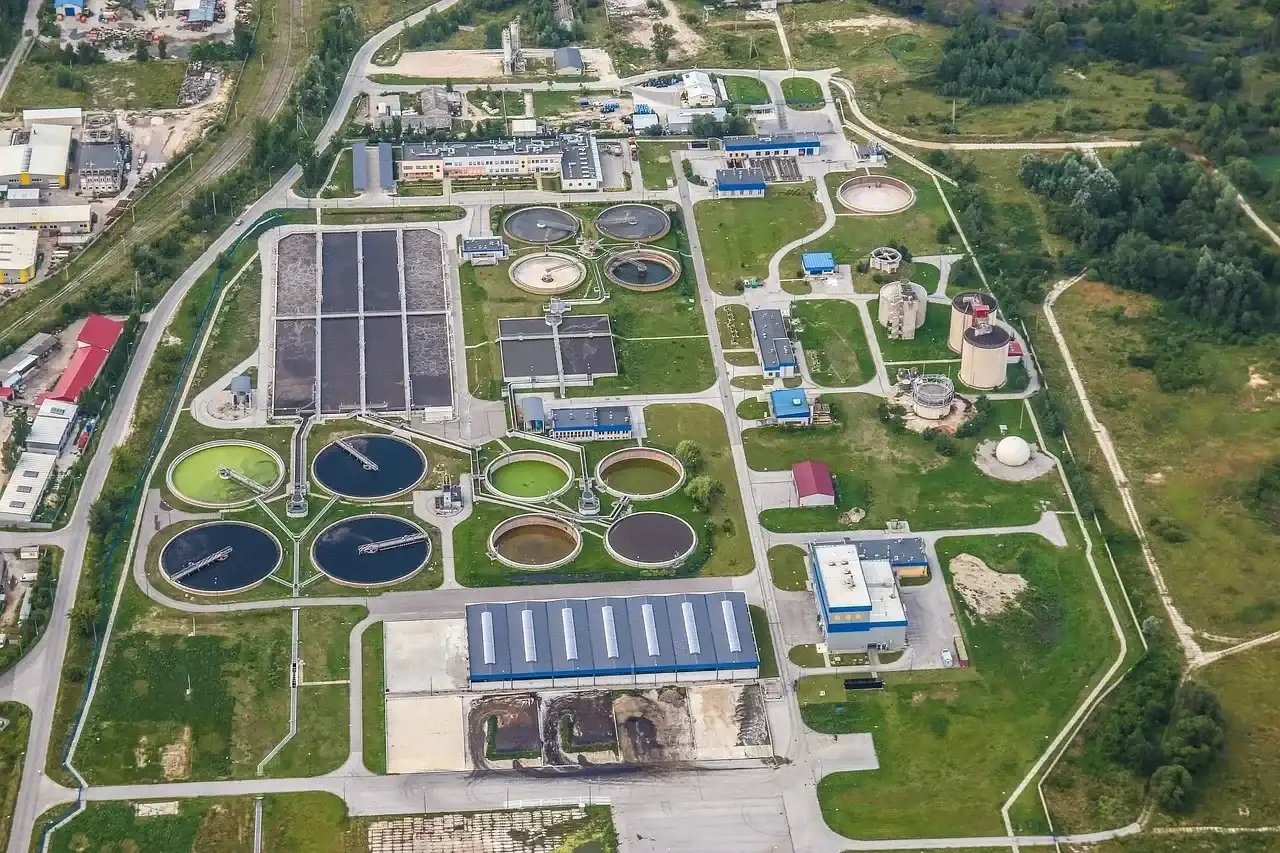
Influent wastewater enters the plant via high-level interceptors. The headworks facility includes:
- Coarse Screening: Multiple mechanically cleaned bar screens remove large debris (rags, wood, plastics) to protect downstream pumps.
- Grit Removal: Aerated grit chambers decrease the specific gravity of the wastewater, allowing heavier inorganic grit (sand, gravel) to settle while keeping organic solids in suspension.
- Screenings/Grit Handling: Captured material is washed, dewatered, and hauled to landfills.
B. PRIMARY TREATMENT
The flow proceeds to primary settling tanks. The plant utilizes a battery of rectangular tanks equipped with chain-and-flight sludge collectors.
- Configuration: Rectangular longitudinal settlers.
- Removal Efficiency: Designed to remove approximately 50-60% of Total Suspended Solids (TSS) and 30-35% of Biochemical Oxygen Demand (BOD).
- Scum Removal: Surface skimmers remove fats, oils, and grease (FOG), which are concentrated and processed separately.
C. SECONDARY TREATMENT (Activated Sludge)
The biological heart of the plant is the activated sludge process, divided into three main batteries (Battery A, B, and C).
- Aeration Basins: The plant utilizes a plug-flow configuration with fine-bubble diffusion to maximize oxygen transfer efficiency.
- Nitrification: The system is operated to achieve nitrification, converting ammonia-nitrogen to nitrate, crucial for the water quality of the North Shore Channel.
- Secondary Clarifiers: Following aeration, the mixed liquor flows to final settling tanks. These gravity clarifiers separate the treated water from the biomass.
- RAS/WAS: Return Activated Sludge (RAS) is pumped back to the aeration tanks to maintain Mean Cell Residence Time (MCRT). Waste Activated Sludge (WAS) is co-settled or sent to the concentration facility.
D. TERTIARY DISINFECTION
In 2016, the MWRD commissioned a massive UV disinfection retrofit to meet new recreation standards.
- Technology: TrojanUV Signa system.
- Configuration: Seven concrete channels utilizing inclined lamp arrays.
- Capacity: The system is sized to treat the full peak design flow of 450 MGD.
- Efficiency: The system inactivates pathogens (specifically fecal coliform and E. coli) without the creation of disinfection byproducts common in chlorination, and eliminates the need for dechlorination chemicals.
E. SOLIDS HANDLING (Regional Integration)
This is the unique engineering feature of the O’Brien WRP. The plant does not perform digestion or final dewatering on-site.
- Concentration: Primary sludge and Waste Activated Sludge are thickened in concentration tanks.
- Transport: The thickened sludge is pumped via an 17-mile pressurized force main to the Stickney Water Reclamation Plant in Cicero/Stickney, IL.
- Processing at Stickney: Once at Stickney, the O’Brien solids are blended with Stickney’s solids for anaerobic digestion, centrifugal dewatering, and final biosolids reuse.
4. INFRASTRUCTURE & FACILITIES
A. Physical Plant
The site occupies approximately 97 acres in Skokie. The architecture is historically significant; the main pump and blower building, constructed in the 1920s, features distinct Art Deco styling and remains a landmark. The site includes extensive maintenance shops, a process control laboratory, and administrative offices.
B. Energy Systems
The O’Brien WRP is a major energy consumer, primarily due to the aeration blowers and influent pumping.
- Turbo Blowers: The District has progressively replaced older centrifugal blowers with high-efficiency air foil bearing turbo blowers to reduce electrical load.
- Heat Recovery: The plant utilizes heat recovery systems in HVAC applications for the large building envelopes.
C. Odor Control
Because the plant is located adjacent to residential neighborhoods and the Skokie sculpture park, odor control is paramount. The facility utilizes biological scrubbers and activated carbon adsorption systems, particularly at the coarse screen building and the sludge concentration facilities, to mitigate H2S and organic odors.
5. RECENT UPGRADES & MAJOR PROJECTS
Disinfection Facilities (UV) Project – $60+ Million (Completed 2016)
- Project Scope: Installation of a tertiary disinfection process to meet NPDES requirements for fecal coliform during the recreational season (March-November).
- Technical Highlights: Installation of the TrojanUV Signa system. This was one of the largest UV retrofits in the world. It involved the construction of a new disinfection building and seven flow channels over the existing effluent conduits.
- Results: The plant now consistently meets the limit of 400 CFU/100mL for fecal coliform, enabling the safe use of the North Shore Channel for kayaking and rowing.
Phosphorus Removal Feasibility & Optimization (Ongoing)
- Driver: Illinois EPA nutrient loss reduction strategy and impending NPDES permit limits (0.5 mg/L annual geometric mean).
- Scope: The MWRD is implementing Enhanced Biological Phosphorus Removal (EBPR) capabilities. This involves retrofitting aeration batteries to create anaerobic selector zones that promote the growth of Phosphorus Accumulating Organisms (PAOs).
- Budget: Part of a district-wide multi-year nutrient management plan.
Switchgear and Electrical Distribution Replacement (2020-2023)
- Scope: Replacement of aging 13.2kV switchgear and distribution transformers critical for plant redundancy.
- Importance: Ensures reliability of the main effluent pumps and blower systems during storm events.
6. REGULATORY COMPLIANCE & ENVIRONMENTAL PERFORMANCE
A. Permit Requirements
Operating under NPDES Permit IL0028088, the facility faces stringent limits:
- CBOD5: Monthly average limits are typically 10-15 mg/L.
- Suspended Solids: Monthly average limits ~15 mg/L.
- Ammonia Nitrogen: Seasonal limits, often as low as 1.5 mg/L in summer to prevent toxicity in the receiving waterway.
- Fecal Coliform: Daily maximum and monthly geometric mean limits applicable March through November.
B. Compliance History
The O’Brien WRP holds an exemplary compliance record. It frequently receives the NACWA Platinum Peak Performance Award, signifying five or more consecutive years of 100% compliance with NPDES permit limits.
7. CHALLENGES & FUTURE PLANNING
A. Nutrient Removal
The most significant engineering challenge facing the O’Brien WRP is the tightening of phosphorus limits. While the plant has excellent nitrification capabilities, the original 1928 footprint makes retrofitting for full Biological Nutrient Removal (BNR) hydraulically and spatially challenging. Current plans involve optimizing the EBPR process to minimize chemical coagulant usage (ferric chloride) while ensuring compliance.
B. Wet Weather Management
Managing peak flows from the combined sewer system remains a priority. While the TARP system (Deep Tunnel) absorbs the “first flush” and massive volumes, the O’Brien plant must rapidly scale operations from 230 MGD to 450 MGD during storms. This requires highly responsive blower control and automated step-feed strategies in the aeration basins to prevent solids washout.
C. Energy Neutrality
MWRD has a district-wide goal of energy neutrality by 2023 and beyond. Since O’Brien exports its carbon-rich sludge to Stickney, it cannot generate biogas on-site for cogeneration. The facility’s path to neutrality relies on extreme energy efficiency (blower upgrades), solar installations, and purchasing renewable credits.
8. TECHNICAL SPECIFICATIONS SUMMARY
| Parameter | Specification |
|---|---|
| Facility Type | Advanced Secondary with UV Disinfection |
| Design Average Capacity | 333 MGD |
| Design Peak Capacity | 450 MGD |
| Treatment Process | Activated Sludge (Single Stage Nitrification) |
| Disinfection | UV (TrojanUV Signa) |
| Nutrient Removal | Nitrification (Ammonia); EBPR (Phosphorus – In Progress) |
| Solids Processing | Gravity concentration only; piped to Stickney WRP |
| Sludge Force Main | 17 miles (connects O’Brien to Stickney) |
| Site Area | 97 Acres |
| Service Area | 143 Square Miles |
| Receiving Water | North Shore Channel |
| NPDES Permit | IL0028088 |
| Year Commissioned | 1928 |
9. FAQ SECTION
Technical Questions
Q: Why doesn’t the O’Brien Plant have anaerobic digesters?
A: To centralize solids processing and maximize economies of scale, MWRD designed the system to pump thickened sludge from O’Brien 17 miles south to the Stickney WRP, which has massive digestion capacity and biogas utilization infrastructure.
Q: What is the UV Transmittance (UVT) design parameter for the disinfection system?
A: The system is generally designed to operate effectively with a UVT of approximately 65% or greater, typical for high-quality secondary effluent.
Q: Does the plant provide tertiary filtration?
A: Currently, the plant does not utilize tertiary media or membrane filtration. The activated sludge process and secondary clarifiers are operated to produce low TSS effluent sufficient for UV disinfection efficacy.
Q: What is the hydraulic retention time (HRT) of the aeration basins?
A: The HRT varies by flow, but under average daily flow conditions (333 MGD design), it typically ranges between 4 to 8 hours.
General Questions
Q: Why was the name changed from North Side WRP?
A: The plant was renamed in 2012 to honor Terrence J. O’Brien, a former President of the MWRD Board of Commissioners, recognizing his service to the District.
Q: Can the public tour the facility?
A: Yes, MWRD offers guided tours for educational groups, engineering associations, and the general public. Tours must be scheduled in advance through the MWRD Office of Public Affairs.
Q: Does the plant produce odors?
A: While wastewater treatment naturally produces odors, the O’Brien plant utilizes advanced carbon scrubbers and biological filters, particularly at the headworks and sludge concentration areas, to minimize impact on the surrounding residential community.