
Nevada Wastewater Treatment Plants
1. Introduction
Nevada operates within one of the most challenging hydrological environments in the United States. As the nation’s driest state, the engineering focus of Nevada’s wastewater infrastructure is uniquely centered on advanced water reclamation and indirect potable reuse (IPR). Unlike many states where “disposal” is the primary goal, Nevada’s major facilities view effluent as a critical water resource, particularly in the Colorado River Basin.
The state serves a population of roughly 3.2 million, heavily concentrated in two metropolitan areas: Las Vegas (Clark County) and Reno-Sparks (Washoe County). Consequently, the infrastructure is characterized by a few massive, world-class advanced treatment facilities, supported by a network of smaller rural systems. The regulatory environment, overseen by the Nevada Division of Environmental Protection (NDEP), enforces some of the strictest nutrient and Total Dissolved Solids (TDS) standards in the country to protect Lake Mead and the Truckee River.
- Total Population Served: ~3.1 Million
- Total Treatment Capacity: ~400+ MGD (Statewide)
- Water Reuse Rate: Near 100% in Southern Nevada (via Return Flow Credits)
- Primary Regulatory Driver: Salinity Management and Nutrient Removal
2. Recent Developments & Projects
In the last 36 months, Nevada’s wastewater sector has shifted aggressively toward advanced water purification (AWP) and infrastructure resilience. The Southern Nevada Water Authority (SNWA) and member agencies are pioneering projects to maximize “return flow credits”—a system where every gallon of treated wastewater returned to Lake Mead allows Nevada to withdraw a corresponding gallon of potable water.
Major recent developments include:
- OneWater Nevada: A collaborative effort in Northern Nevada (Reno/Sparks/TMWA) moving toward full-scale Advanced Water Purification for aquifer recharge.
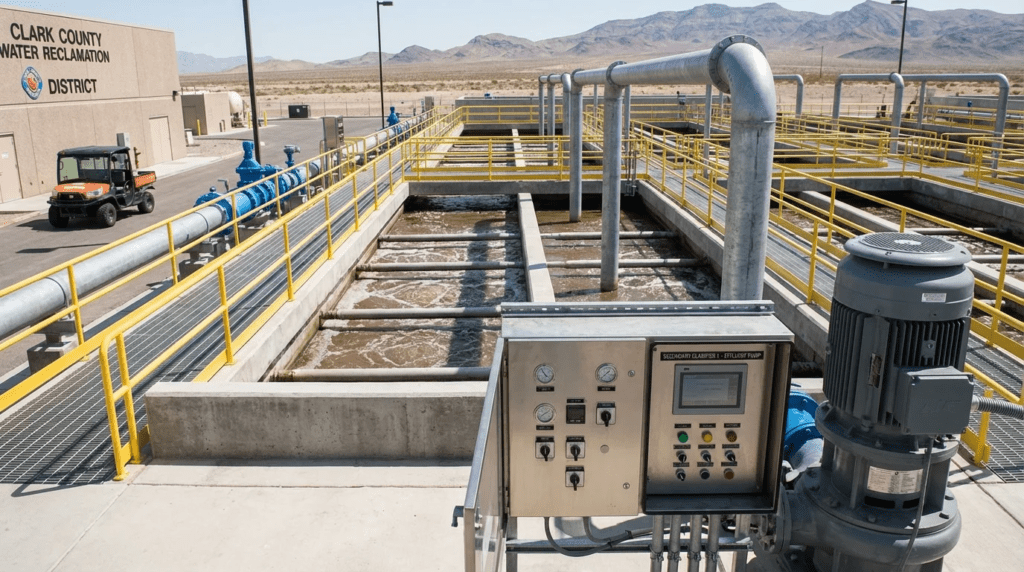
- Regionalization in Clark County: Continued expansion of the Clark County Water Reclamation District (CCWRD) infrastructure to handle rapid urbanization in unincorporated Las Vegas.
- Federal Funding: Significant influx of capital via the Infrastructure Investment and Jobs Act (IIJA), specifically targeting emerging contaminants (PFAS) and rural water connectivity.
- Septic to Sewer Conversions: An accelerated push to decommission failing septic systems in groundwater-sensitive areas, driven by state SRF loans.

3. Top 20 Largest Treatment Plants in Nevada
The following table ranks Nevada’s largest wastewater treatment facilities by design capacity. Due to the population distribution, the top 4 plants handle the vast majority of the state’s flow.
| Rank | Plant Name | Location | Design Capacity (MGD) | Population Served | Operating Authority |
|---|---|---|---|---|---|
| 1 | Flamingo Water Resource Center | Las Vegas | 150.0 | 1.1 Million | Clark Co. Water Reclamation District |
| 2 | City of Las Vegas WPCF | Las Vegas | 91.0 | 750,000 | City of Las Vegas |
| 3 | Truckee Meadows WRF (TMWRF) | Reno | 41.5 | 425,000 | Cities of Reno/Sparks |
| 4 | Kurt R. Segler WRF | Henderson | 32.0 | 320,000 | City of Henderson |
| 5 | Southwest WRF | Henderson | 12.0 | Regional | City of Henderson |
| 6 | Carson City WRF | Carson City | 6.9 | 55,000 | Carson City Public Works |
| 7 | Laughlin WRF | Laughlin | 5.0 | 10,000 | CCWRD |
| 8 | Desert Breeze WRF | Las Vegas | 5.0 | Satellite | CCWRD |
| 9 | Durango Hills WRF | Las Vegas | 5.0 | Satellite | City of Las Vegas |
| 10 | Apex Wastewater Treatment Plant | N. Las Vegas | 5.0 | Industrial/Res | City of North Las Vegas |
| 11 | Elko WRF | Elko | 4.0 | 20,000 | City of Elko |
| 12 | Moapa Valley WRF | Overton | 3.5 | 8,000 | CCWRD |
| 13 | Mesquite WRF | Mesquite | 3.2 | 22,000 | Virgin Valley Water District |
| 14 | Fernley Wastewater Plant | Fernley | 3.0 | 19,000 | City of Fernley |
| 15 | South Truckee Meadows WRF | Reno | 2.5 | Development | Washoe County |
| 16 | Fallon WWTP | Fallon | 2.2 | 8,500 | City of Fallon |
| 17 | Winnemucca WWTP | Winnemucca | 2.0 | 7,500 | City of Winnemucca |
| 18 | Boulder City WWTP | Boulder City | 2.0 | 16,000 | City of Boulder City |
| 19 | Minden-Gardnerville Sanitation | Minden | 1.8 | 12,000 | MGSD |
| 20 | Indian Springs WWTP | Indian Springs | 1.5 | 1,500 | CCWRD |

Profiles of the Largest Facilities
1. Flamingo Water Resource Center – Rank #1
- Location: Las Vegas, Clark County
- Design Capacity: 150 MGD
- Current Average Flow: ~110 MGD
- Operating Authority: Clark County Water Reclamation District (CCWRD)
- Receiving Water: Las Vegas Wash (tributary to Lake Mead)
Treatment Process: The Flamingo WRC utilizes advanced tertiary treatment. The process includes preliminary screening, primary clarification, activated sludge with Biological Nutrient Removal (BNR) for phosphorus and nitrogen control, secondary clarification, and tertiary filtration via deep-bed multimedia filters. Disinfection is achieved via UV irradiation before discharge.
Infrastructure & Innovation: The facility is a net-zero ambition site, heavily utilizing biogas cogeneration. It features one of the most sophisticated SCADA systems in the West due to the critical nature of the Las Vegas Wash discharge.
2. City of Las Vegas Water Pollution Control Facility – Rank #2
- Location: Las Vegas, Clark County
- Design Capacity: 91 MGD
- Operating Authority: City of Las Vegas
- Receiving Water: Las Vegas Wash
Treatment Process: This facility employs advanced nitrification-denitrification processes to meet extremely low nutrient limits (TP < 0.1 mg/L). It utilizes advanced activated sludge followed by chemical polishing and extensive filtration.
Recent Upgrades: Recently completed a major “Membrane Bioreactor (MBR)” pilot for future satellite expansion and has invested heavily in new headworks odor control technologies to mitigate impacts on encroaching residential zones.
3. Truckee Meadows Water Reclamation Facility (TMWRF) – Rank #3
- Location: Reno, Washoe County
- Design Capacity: 41.5 MGD
- Operating Authority: Jointly owned by Reno and Sparks
- Receiving Water: Truckee River
Treatment Process: TMWRF is renowned for its nitrogen removal capabilities, utilizing the Phoredox (A/O) process and rigorous nitrification/denitrification. It discharges to the sensitive Truckee River, requiring strict thermal and nutrient compliance.
Innovation: A partner in the “OneWater Nevada” initiative, TMWRF is currently the site of advanced purification pilot studies testing ozone-BAC and UV-AOP for future Category A+ reclaimed water production.
4. Kurt R. Segler Water Reclamation Facility – Rank #4
- Location: Henderson, Clark County
- Design Capacity: 32 MGD
- Operating Authority: City of Henderson
Treatment Process: Features extended aeration and oxidation ditches optimized for nitrogen removal. The facility is a key component in Henderson’s reuse portfolio, supplying irrigation water to numerous golf courses and greenbelts.
5. Southwest Water Reclamation Facility – Rank #5
- Location: Henderson, Clark County
- Design Capacity: 12 MGD
- Operating Authority: City of Henderson
Significance: A newer satellite facility designed to intercept flow upstream, treat it to high standards (Title 22 equivalent), and provide reuse water directly to developing communities, reducing pumping costs to the main plant.
4. Plants with Approved Budgets & Expansion Projects
Nevada’s wastewater sector currently has over $800 million in active or planned capital improvements. The primary drivers are capacity for population growth in the Las Vegas Valley and aging infrastructure rehabilitation.
A. Major Projects Under Construction (2024-2026)
CCWRD Flamingo WRC – Resource Recovery Expansion
- Location: Las Vegas, NV
- Project Scope: Comprehensive rehabilitation of primary and secondary clarifiers, installation of new high-efficiency aeration blowers, and upgrades to solids handling dewatering centrifuges.
- Total Budget: ~$150 Million (Multi-phase)
- Funding: Revenue Bonds and SRF Loans
- Timeline: Construction ongoing; Phases completing 2025.
- Key Contractors: Carollo Engineers (Design), various GC packages.
- Expected Benefits: Increased energy efficiency by 20%, improved solids capture, and extended asset life by 30 years.
City of Henderson – West Henderson Infrastructure
- Location: Henderson, NV
- Project Scope: Expansion of the Southwest Water Reclamation Facility and installation of new reuse distribution pipelines to support the rapidly growing West Henderson corridor.
- Total Budget: $65 Million
- Funding: Developer connection fees and Municipal Bonds
- Timeline: Construction 2023-2025
- Drivers: Capacity expansion for new residential/commercial zones.
B. Projects in Design/Planning Phase (2025-2027)
- TMWRF Nitrogen Removal Upgrade (Reno):
- Budget: ~$40 Million
- Scope: Retrofitting biological basins to meet new, stricter nitrogen discharge limits for the Truckee River.
- Status: Final Design.
- City of North Las Vegas – Apex Expansion:
- Budget: $80 Million (Est)
- Scope: Expansion of the Apex facility to support industrial growth in the Apex Industrial Park.
- Status: Planning/Preliminary Design.
- Carson City WRF Master Plan Improvements:
- Budget: $18 Million
- Scope: Headworks replacement and electrical distribution upgrades.
- Status: Design.
Summary Statistics
- Total Active Capital Investment: ~$820 Million
- Number of Major Active Projects: 12 Facilities
- Primary Drivers:
- Growth/Capacity: 45%
- Asset Renewal/Rehab: 35%
- Regulatory Compliance: 20%
- Funding Source Breakdown: 50% Bonds, 30% SRF Loans, 20% Grants/Cash.
Industry Implications
For engineering firms and vendors, the trend in Nevada is process optimization rather than greenfield construction. Opportunities abound for high-efficiency pumps, aeration control systems, and advanced sensors/SCADA integration. The push for “OneWater” creates specific opportunities for advanced oxidation and membrane filtration vendors.
5. Regulatory & Compliance Landscape
The Nevada Division of Environmental Protection (NDEP) Bureau of Water Pollution Control administers the NPDES program. The regulatory landscape is defined by the unique geography of the end-users:
- Lake Mead/Colorado River: Dischargers (Las Vegas, Henderson, CCWRD) operate under a “return flow credit” system. Effluent must meet near-drinking water standards for salinity and nutrients to prevent algal blooms in the lake.
- Truckee River: In the north, Total Maximum Daily Loads (TMDLs) for nitrogen and phosphorus are strictly enforced to protect the Pyramid Lake ecosystem.
- PFAS Regulations: Nevada is currently in the monitoring phase for PFAS, with NDEP expecting to align closely with upcoming federal EPA MCLs. Many utilities are proactively piloting GAC and Ion Exchange solutions.
6. Infrastructure Challenges & Opportunities
- Aridity & Reuse: The absolute scarcity of water means Nevada plants must achieve higher recovery rates than almost anywhere else. Brine management (from RO processes) remains a significant technical challenge for inland desalination/reuse projects.
- Flash Flooding: Despite the dry climate, intense monsoonal rains require robust stormwater integration and protection of treatment assets from inundation.
- Energy Costs: With high aeration demands in hot climates, energy optimization is a top priority. Utilities are heavily investing in solar arrays and biogas-to-energy systems.
7. Technology Trends in Nevada
Nevada is an early adopter of several key technologies:
- Membrane Bioreactors (MBR): Increasingly used in satellite water reclamation facilities to produce high-quality reuse water with a small footprint.
- Advanced Oxidation Processes (AOP): UV/Peroxide and Ozone systems are being deployed for indirect potable reuse projects.
- Digital Twins: Large utilities like CCWRD are adopting digital twin technology to model collection systems and plant hydraulics for predictive maintenance.
8. Directory of Facilities
Browse our comprehensive directory of wastewater treatment plants in Nevada. Facilities are categorized by region and size.
Southern Nevada (Clark County)
- Flamingo Water Resource Center (CCWRD)
- City of Las Vegas WPCF
- Kurt R. Segler WRF (Henderson)
- Southwest WRF (Henderson)
- Laughlin WRF
- Moapa Valley WRF
- Mesquite WRF
Northern Nevada (Washoe/Carson)
- Truckee Meadows WRF (Reno/Sparks)
- Carson City WRF
- South Truckee Meadows WRF
- Stead Water Reclamation Facility
- Cold Springs WRF
Rural Nevada
- Elko Water Reclamation Facility
- Ely Wastewater Treatment Plant
- Fallon Wastewater Treatment Plant
- Fernley Wastewater Treatment Plant
- Winnemucca Wastewater Treatment Plant
9. Resources for Engineers & Operators
- Nevada Water Environment Association (NWEA): The primary professional body for operators and engineers in the state. Visit Website
- NDEP Bureau of Water Pollution Control: For permitting and regulatory guidance.
- State Revolving Fund (SRF): Information on low-interest loans for infrastructure projects.
- Operator Certification: Managed by NDEP; requires continuing education units (CEUs) available through NWEA conferences.
10. Frequently Asked Questions
- What is the largest wastewater treatment plant in Nevada?
- The Flamingo Water Resource Center, operated by the Clark County Water Reclamation District, is the largest, with a design capacity of 150 MGD.
- How does Nevada fund wastewater projects?
- Projects are primarily funded through the Clean Water State Revolving Fund (CWSRF), municipal revenue bonds, and recently, federal grants from the IIJA/Bipartisan Infrastructure Law.
- What is the status of Potable Reuse in Nevada?
- Nevada currently practices Indirect Potable Reuse (IPR) via Lake Mead. Northern Nevada is actively piloting advanced purification for groundwater recharge (OneWater Nevada).
- Are there specific seismic requirements for Nevada plants?
- Yes. Nevada is seismically active. All treatment infrastructure must meet strict seismic design categories (SDC) outlined in the IBC and local amendments.
- Who regulates wastewater treatment in Nevada?
- The Nevada Division of Environmental Protection (NDEP) is the primary regulatory authority.