
Ozone Systems for Water Treatment: Equipment and Applications
INTRODUCTION
One of the most critical specification mistakes in designing Ozone Systems for Water Treatment: Equipment and Applications lies not in the generator itself, but in the mass transfer efficiency and feed gas preparation. Engineers frequently over-specify ozone generation capacity (CAPEX) to compensate for poorly designed injection and dissolution systems (OPEX). With ozone being one of the most powerful commercially available oxidants—exceeding the oxidation potential of chlorine, chlorine dioxide, and hydrogen peroxide—proper system integration is paramount to maximizing its benefits without incurring exorbitant energy costs or hazardous off-gas scenarios.
The landscape of Ozone Systems for Water Treatment: Equipment and Applications is vast, bridging municipal drinking water disinfection, industrial advanced oxidation, and wastewater micropollutant polishing. Understanding this domain requires a holistic view of the interconnected sub-systems: feed gas generation, ozone synthesis, gas-liquid mass transfer, off-gas destruction, and rigorous ambient safety monitoring. Because ozone cannot be stored and must be generated on-site on demand, the reliability of each component is absolute.
This pillar page serves as a comprehensive hub for engineers, plant directors, and specification writers. It categorizes the diverse variants of ozone technologies, detailing the applications, operational profiles, lifecycle cost considerations, and design standards necessary to engineer safe, efficient, and compliant ozone treatment facilities. Future deep-dive articles will expand upon the bolded subcategories introduced here.
SUBCATEGORY LANDSCAPE — TYPES, TECHNOLOGIES & APPROACHES
Designing an ozone system is an exercise in process train integration. A complete system comprises several distinct technological stages: feed gas supply, ozone generation, mass transfer (dissolution), and safety/control. The following subcategories represent the major equipment types, technologies, and application approaches that engineers must navigate. Each component must be precisely matched to the others to prevent bottlenecks, ensure optimal dissolution, and maintain safety.
Ozone Generation Technologies
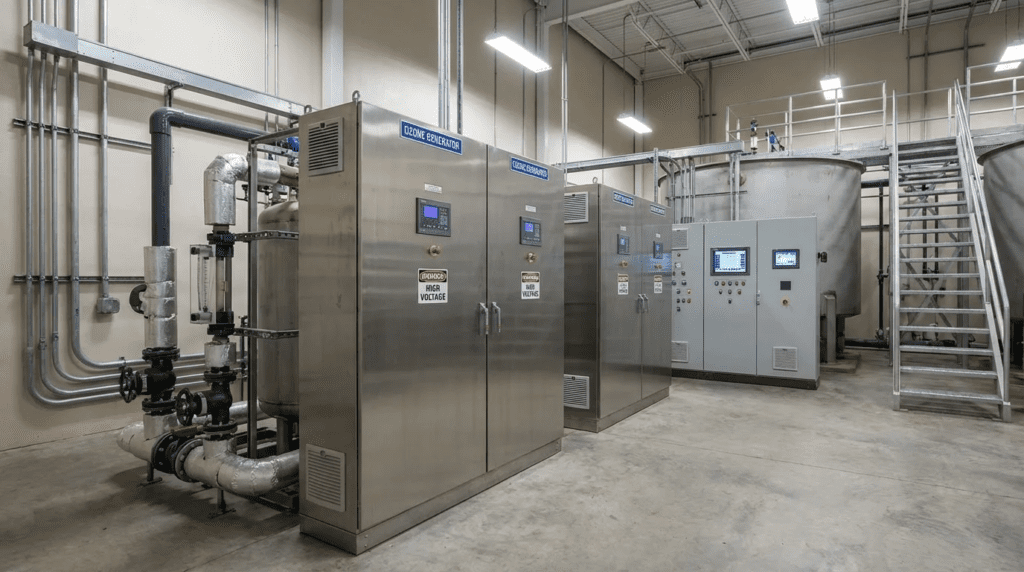
Corona Discharge Ozone Generators are the industry standard for medium to large-scale municipal and industrial water treatment. They operate by passing a dry, oxygen-rich feed gas through a high-voltage electrical field (the corona) created between two dielectrics (typically glass or ceramic and a stainless steel tube). This field splits diatomic oxygen (O2) into elemental oxygen, which quickly recombines to form ozone (O3). These systems are highly scalable, capable of producing hundreds to thousands of pounds per day (ppd) at concentrations up to 10-15% by weight. Engineers must carefully design the cooling water loop, as corona discharge produces immense heat, and elevated temperatures severely degrade ozone yield and increase power consumption.
Electrolytic Ozone Generators synthesize ozone directly within the water stream via the electrolysis of water molecules, eliminating the need for complex feed gas preparation or gas-liquid mass transfer equipment. Using a diamond-doped anode or proprietary membrane technology, these systems apply a low-voltage DC current to split water into hydrogen and ozone/oxygen gas. They are typically utilized in highly pure water applications (such as pharmaceutical, semiconductor, or high-end food and beverage) where the introduction of external air or ionic contaminants is strictly prohibited. While highly efficient for low-dose, high-purity applications, they are generally cost-prohibitive and scale-limited for large municipal flows.
UV Ozone Generators utilize specific wavelengths of ultraviolet light (typically 185 nm) to photochemically split oxygen molecules in a feed gas to form ozone. Because this method produces a very low concentration of ozone (typically under 1% by weight), it is relegated to small-scale residential, commercial pool, or niche laboratory applications. For municipal or industrial engineers, UV generation is generally disregarded due to its prohibitive power-to-yield ratio at scale and inability to provide the concentrated dosing required for primary disinfection or heavy oxidation tasks.
Feed Gas Preparation Systems
Liquid Oxygen (LOX) Feed Systems supply ultra-pure (99%+) oxygen from bulk cryogenic storage tanks, evaporated into gas prior to entering the ozone generator. This is the preferred feed gas approach for large municipal drinking water plants requiring maximum ozone output and high concentrations (10-12% wt). LOX systems offer the lowest physical equipment footprint and require minimal maintenance since there are no moving compressor parts. However, they tether the facility to continuous cryogenic oxygen deliveries, creating a recurring OPEX burden and supply chain dependency. Engineers must also specify precise nitrogen doping (typically 0.5-1%) to prevent dielectric degradation and optimize the corona discharge reaction.
Pressure Swing Adsorption (PSA) Oxygen Generators extract oxygen from ambient air by utilizing zeolite molecular sieves that trap nitrogen under pressure, yielding a feed gas of roughly 90-95% oxygen. PSA systems are the backbone of remote installations, wastewater plants, and industrial sites that prefer energy-intensive capital equipment over ongoing LOX deliveries. While they provide independence from chemical suppliers, PSA systems carry heavy O&M requirements, requiring robust air compressors, rigorous filtration to remove oil aerosols, and careful monitoring of the zeolite beds. A failure in upstream moisture removal will permanently blind the PSA zeolite, destroying the oxygen yield.
Desiccant Air Preparation Systems condition ambient air to an extremely low dew point (typically -60°C or lower) before feeding it directly into the ozone generator. Because ambient air is only 21% oxygen, the resulting ozone concentration is much lower (typically 1-3% wt) compared to oxygen-fed systems, significantly increasing the volume of gas that must be dissolved into the water. Though highly reliable and avoiding the complexities of oxygen enrichment, dry air systems are largely being phased out of modern high-capacity municipal designs due to the massive physical footprint of the contactors required to handle the high gas-to-liquid ratios.
Ozone Mass Transfer (Dissolution) Equipment
Side-Stream Venturi Injection Systems represent the modern gold standard for ozone mass transfer, pulling gaseous ozone into a pressurized slipstream of water via a machined venturi nozzle. The extreme pressure drop across the venturi creates a vacuum that aspirates the ozone, shearing it into microscopic bubbles to maximize gas-liquid surface area. This side-stream is then violently mixed back into the main process flow using static mixers or specialized nozzle manifolds. Engineers favor venturi systems because they offer mass transfer efficiencies (MTE) routinely exceeding 95%, isolate the gas handling to a highly controlled loop, and require significantly smaller contact basin footprints than legacy diffusion systems.
Fine Bubble Diffusion Contactors rely on porous ceramic or sintered stainless steel diffusion domes installed at the bottom of deep concrete contact basins (typically 18 to 25 feet deep). Gaseous ozone is pumped down to the diffusers, creating columns of fine bubbles that dissolve into the water as they rise through the basin. While mechanically simple with no moving parts in the water, they are limited by Henry’s Law—requiring immense water depth to achieve acceptable transfer efficiency (often maxing out at 85-90%). Maintenance requires complete basin draining to clean or replace fouled ceramic stones.
Deep U-Tube Contactors are specialized mass transfer systems consisting of two concentric pipes sunk deep into the ground (often 50 to 100 feet deep). Water and ozone gas flow down the inner pipe, where the massive hydrostatic pressure forces near 100% dissolution, before the dosed water rises back up the outer pipe. They are highly specialized systems used in high-flow, space-constrained municipal environments where pumping costs must be minimized and maximum dissolution of high-concentration ozone is required without the footprint of traditional contact basins.
Ozone Destruction & Safety Systems
Thermal-Catalytic Ozone Destruct Units are mandatory safety equipment required to neutralize undissolved off-gas collected from the headspace of contact basins or degassing separators. These units utilize a heated catalyst bed (typically Carulite or a proprietary manganese dioxide/copper oxide blend) to accelerate the decomposition of O3 back into O2. The heating element (operating around 120°F to 150°F) is critical not for the destruction itself, but to prevent moisture from condensing on and blinding the catalyst. They are the standard for municipal and industrial systems, offering high destruction efficiency with a relatively low power draw.
Thermal Ozone Destruct Units use sheer heat (typically exceeding 600°F / 315°C) to break the molecular bonds of ozone without the use of a chemical catalyst. While they consume significantly more power than catalytic units, they are highly favored in applications where the off-gas may contain volatile organic compounds (VOCs), sulfur compounds, or halogens that would rapidly poison a standard catalyst bed. Engineers often specify thermal destructs in heavy industrial wastewater or complex remediation sites.
Dissolved Ozone Analyzers are precision electrochemical or optical instruments used to measure the residual ozone concentration in the process water, acting as the primary feedback loop for pacing the ozone generator output. Modern systems heavily favor amperometric membrane-covered sensors or UV-absorbance optical sensors. The strict accuracy of these analyzers is vital for maintaining required CT (Concentration x Time) values for regulatory disinfection, while preventing over-dosing that leads to bromate formation or excessive chemical destruct costs downstream.
Ambient Ozone Safety Monitors are life-safety devices installed throughout the ozone generation room, LOX storage area, and contactor galleries. Because ozone is highly toxic at low concentrations (OSHA Permissible Exposure Limit is 0.1 ppm over an 8-hour shift), these electrochemical sensors are wired directly to the master PLC and emergency ventilation systems. Upon detecting elevated ozone, they instantly shut down the generators and trigger high-velocity exhaust fans to evacuate the space.
Key Applications
Municipal Drinking Water Ozone Treatment utilizes ozone primarily for primary disinfection (targeting Cryptosporidium and Giardia), taste and odor (T&O) control (oxidizing geosmin and MIB), and the breakdown of complex organics to reduce downstream disinfection byproduct (DBP) formation when chlorine is added. The critical design parameter here is balancing sufficient CT for log-inactivation against the risk of oxidizing naturally occurring bromide into bromate (a regulated carcinogen).
Wastewater Ozone Contaminant of Emerging Concern (CEC) Treatment is a rapidly growing application focused on tertiary polishing of municipal effluent to destroy micro-pollutants, endocrine disruptors, pharmaceuticals, and personal care products before environmental discharge or water reuse. Because of the high background organic load (COD/BOD) in wastewater, ozone dosing in these applications is significantly higher than in drinking water, requiring massive generation capacity and advanced side-stream injection to maintain efficiency in turbid conditions.
Industrial Cooling Tower Ozone Systems deploy ozone as a complete substitute for traditional biocide, scale, and corrosion inhibitor chemicals. Ozone effectively lyses biological growth (preventing Legionella), breaks down the biofilm that harbors scale-forming minerals, and allows cooling towers to operate at higher cycles of concentration. However, engineers must carefully manage dosing, as excessive ozone can aggressively corrode system metallurgy and degrade cooling tower fill media.
Advanced Oxidation Processes (AOP) Using Ozone involve the deliberate combination of ozone with hydrogen peroxide (H2O2) or UV light to generate hydroxyl radicals (•OH)—an oxidant even more powerful and non-selective than ozone itself. AOP is deployed in complex groundwater remediation, industrial chemical wastewater, and direct potable reuse (DPR) to destroy stubborn compounds like 1,4-dioxane, trichloroethylene (TCE), and PFAS precursors that resist standard ozonation.
Major Manufacturers (OEMs)
While the physics of ozone remain constant, system packaging varies. De Nora Water Technologies Ozone Systems are known for robust, large-scale municipal installations utilizing advanced dielectric technology. Xylem Wedeco Ozone Generators are highly prevalent in both water and wastewater, featuring highly efficient Effizon dielectrics that offer excellent turndown capabilities. SUEZ Ozonia Systems (now largely under Veolia) are global leaders offering high-concentration, large-capacity generators using advanced Intelligent Gap System (IGS) technology. Primozone Ozone Generators utilize high-frequency power supplies to generate very high concentrations with an exceptionally small footprint, often favored in retrofits. Pinnacle Ozone Solutions offers fully modular, solid-state generator blocks that provide high redundancy and eliminate the need for traditional, massive glass-tube vessels.
SELECTION & SPECIFICATION FRAMEWORK
Choosing the correct subset of Ozone Systems for Water Treatment: Equipment and Applications requires balancing CAPEX limitations, available footprint, operator sophistication, and regulatory targets. Engineers should employ the following decision framework.
- Determine the Feed Gas Strategy (LOX vs. PSA): If the plant is located in an urban/suburban municipal setting with reliable delivery infrastructure, and generation exceeds 500 lbs/day, LOX is almost universally preferred due to lowest CAPEX and highest reliability. If the site is remote, is a wastewater facility without strict purity requirements, or wishes to eliminate supply chain vulnerability, PSA oxygen generation is specified.
- Select the Mass Transfer Methodology: For new construction or plant upgrades where footprint is tight, specify Side-Stream Venturi Injection Systems. This allows for above-ground, highly controlled mixing. Fine Bubble Diffusion Contactors should only be considered for massive, high-flow municipal plants where deep basin construction is already planned and hydraulic head loss must be strictly minimized.
- Establish the Cooling Loop Requirements: Ozone generation generates roughly 2.5 to 3 times more heat energy than ozone gas. Open-loop cooling using raw plant water is prone to fouling the generator’s heat exchangers. Engineers must specify closed-loop cooling systems (using a chiller or a secondary plate-and-frame heat exchanger) to maintain cooling water at roughly 60°F (15°C); any higher, and ozone yield collapses exponentially.
COMPARISON TABLES
The following tables provide a quick-reference engineering map for differentiating the primary technologies within Ozone Systems for Water Treatment: Equipment and Applications. Table 1 contrasts the major subcategories, while Table 2 maps equipment to specific application scenarios.
Table 1: Subcategory Technology Comparison
| Technology / Subcategory | Key Feature | Best-Fit Application | Primary Limitation | Relative CAPEX |
|---|---|---|---|---|
| Corona Discharge Ozone Generators | High yield (10-15% wt) | Municipal & Industrial Mainline | Requires rigorous cooling & dry gas | Medium |
| Electrolytic Ozone Generators | No feed gas required | Ultrapure, Pharma, F&B | Cost-prohibitive at municipal scale | Very High (Per lb) |
| Liquid Oxygen (LOX) Feed Systems | 99%+ O2 purity | Large municipal (>500 ppd) | Dependent on cryogenic deliveries | Low (High OPEX) |
| Pressure Swing Adsorption (PSA) Oxygen Generators | On-site O2 generation | Remote sites, Wastewater | High compressor maintenance | High (Lower OPEX) |
| Side-Stream Venturi Injection Systems | 95%+ Mass Transfer | Compact layouts, High doses | Requires booster pumps (power) | Medium |
| Fine Bubble Diffusion Contactors | No moving parts in water | Deep basin municipal plants | Basin must be >18ft deep | High (Civil Works) |
Table 2: Application Fit Matrix
| Application Scenario | Recommended Subcategory Fit | Key Engineering Constraint |
|---|---|---|
| Municipal DW Disinfection (>10 MGD) | Corona Discharge Ozone Generators + LOX Feed Systems | Bromate formation limits (<10 ppb) requires precise dosing control. |
| Industrial WW with Heavy VOCs | Thermal Ozone Destruct Units + Side-Stream Venturi Injection Systems | Catalyst poisoning risk; thermal destruct ensures reliability. |
| High-Purity Pharma Water Loop | Electrolytic Ozone Generators | Zero air introduction permitted; conductivity must be extremely low. |
| 1,4-Dioxane / TCE Remediation | Advanced Oxidation Processes (AOP) Using Ozone (+ H2O2) | Requires high radical yield; optimization of H2O2 to O3 ratio is critical. |
ENGINEER & OPERATOR FIELD NOTES
While the theoretical chemistry of ozone is exact, real-world application requires rigorous attention to environmental variables, materials compatibility, and operator capabilities. The following notes highlight critical differences across subcategories.
Commissioning Considerations
Commissioning protocols vary aggressively based on the chosen technologies. For Liquid Oxygen (LOX) Feed Systems, commissioning requires careful tuning of the nitrogen mass flow controllers. Without 0.5% to 1% nitrogen doping, the corona discharge will strip the oxygen plasma, severely dropping output over the first 48 hours. Conversely, when commissioning Pressure Swing Adsorption (PSA) Oxygen Generators, the focus is purely on air prep: validating that the feed air dew point achieves exactly -60°C to -70°C before entering the PSA bed. Any moisture pass-through during startup will permanently brick the zeolite media.
Materials of Construction Specification Mistakes
The highly corrosive nature of ozone necessitates strict material selection. A common failure in Side-Stream Venturi Injection Systems is specifying natural rubber, standard EPDM, or Buna-N for gaskets and seals in the ozone gas piping. Gaseous ozone will disintegrate these materials in days. Engineers must specify 316L Stainless Steel, PTFE (Teflon), Viton (for short term), or Kynar (PVDF). In Fine Bubble Diffusion Contactors, PVC is completely forbidden for the drop pipes carrying concentrated ozone gas; 316L SS is mandatory to prevent subsurface catastrophic pipe failure.
5C) O&M Comparison Across Subcategories
The daily maintenance burden differs drastically depending on the system architecture. Which subcategories require the most daily operator attention versus which are relatively hands-off?
- Most Hands-Off: LOX Feed Systems combined with Side-Stream Venturi Injection Systems. Operators generally only monitor LOX tank levels and verify booster pump pressures. Maintenance is largely preventative, with annual generator inspections.
- Most Operator-Intensive: Desiccant Air Preparation Systems and PSA Oxygen Generators require high operator involvement. Operators must constantly monitor compressor oil levels, change coalescing filters frequently, and monitor air dryer regeneration cycles to ensure the strict dew point is maintained.
- Consumables: Thermal-Catalytic Ozone Destruct Units require catalyst replacement (Carulite) typically every 3 to 5 years, depending on moisture exposure. Dissolved Ozone Analyzers require electrolyte solution and membrane replacements every 3 to 6 months to maintain accuracy.
- Spare Parts Requirements: Facilities utilizing Corona Discharge Ozone Generators must keep a minimum of 5-10% spare dielectric tubes on the shelf, along with a full set of high-voltage fuses and PTFE gaskets.
Troubleshooting Overview
When an ozone system fails to meet dose targets, the root cause varies by equipment. In Fine Bubble Diffusion Contactors, a gradual drop in dissolved ozone residual often indicates fouled diffusers (calcification), requiring the basin to be drained and acid-washed. In Side-Stream Venturi Injection Systems, a drop in transfer efficiency is usually mechanical: the booster pump impeller is worn, failing to provide the necessary pressure differential (typically 30-45 PSI delta) across the venturi nozzle to create the vacuum. For the generators themselves, a sudden loss of ozone production while power remains high indicates either a failed cooling water system (overheating) or blown high-voltage fuses within the dielectric array.
DESIGN DETAILS & STANDARDS
Sizing Methodology Overview
Proper sizing of any ozone system starts with calculating the Maximum Ozone Demand, which requires understanding the specific water matrix. The fundamental sizing equation is: Capacity (lbs/day) = Flow (MGD) × Dose (mg/L) × 8.34 / MTE
If a plant processes 10 MGD, requires a target dose of 2.5 mg/L, and utilizes Side-Stream Venturi Injection Systems with an MTE (Mass Transfer Efficiency) of 95%, the sizing is: `(10 * 2.5 * 8.34) / 0.95 = 219.4 lbs/day`. A minimum 20% redundancy factor is standard engineering practice, requiring a 265 lbs/day generator system.
Key Parameters That Differ by Subcategory
The choice of equipment drastically alters downstream sizing. If a design shifts from a LOX Feed Systems generating 10% wt ozone to a Desiccant Air Preparation Systems generating 2% wt ozone, the total volume of gas pumped into the contactor increases by a factor of roughly five. This massive increase in gas volume means the venturi sizing, degassing separators, and Thermal-Catalytic Ozone Destruct Units must all be oversized by 500% to handle the excess air/gas mixture, radically altering the hydraulic design of the plant.
Applicable Standards & Compliance
Engineers must ensure compliance with rigorous industry standards when specifying Ozone Systems for Water Treatment: Equipment and Applications:
- AWWA B304: The definitive standard for liquid oxygen used for ozone generation, detailing maximum acceptable levels of hydrocarbons and moisture.
- OSHA 29 CFR 1910.1000: Dictates the permissible exposure limits for ozone in the workplace (0.1 ppm for 8 hours, 0.3 ppm for 15 min STEL), dictating the deployment and interlocking of Ambient Ozone Safety Monitors.
- ASME B31.3: Process piping standards required for the safe handling of both pressurized cryogenic LOX and highly concentrated gaseous ozone in 316L SS tubing.
- UL 508A / NEMA 4X: Required for the power supply and control panels housing the high-voltage components of the generators.
Specification Checklist
To ensure a robust bid and successful project, specifications must explicitly state:
- Minimum required Mass Transfer Efficiency (MTE) at maximum peak flow.
- Cooling water maximum inlet temperature and required flow rate (GPM per kW).
- Specific nitrogen doping percentage requirements for LOX setups.
- Mandatory inclusion of Dissolved Ozone Analyzers at both the contactor outlet and post-destruct to ensure complete residual quenching.
- Warranty stipulations specifically for the dielectrics (typically 5 to 10 years) under standard municipal operating conditions.
FAQ SECTION
What are the different types of ozone generators used in water treatment?
The primary technologies include Corona Discharge Ozone Generators (the standard for high-capacity municipal/industrial uses), Electrolytic Ozone Generators (used for high-purity, air-free pharmaceutical water), and UV Ozone Generators (limited to low-yield residential applications).
How do you choose between LOX and PSA feed gas systems?
Choosing between Liquid Oxygen (LOX) Feed Systems and Pressure Swing Adsorption (PSA) Oxygen Generators depends on site location and OPEX tolerance. LOX is preferred for large municipal plants (>500 lbs/day) due to low equipment footprint and high purity, but requires truck deliveries. PSA is ideal for remote locations or Wastewater Ozone Contaminant of Emerging Concern (CEC) Treatment where truck deliveries are impractical, though it requires heavier compressor maintenance.
What is the most cost-effective ozone dissolution method for small plants?
For small to medium plants, Side-Stream Venturi Injection Systems are the most cost-effective. Unlike Fine Bubble Diffusion Contactors, which require deep concrete basins that drive up civil engineering costs, venturi systems are compact, skid-mounted, and achieve >95% mass transfer efficiency without the need for massive vertical infrastructure.
Why is off-gas destruction required in ozone systems?
Ozone cannot be 100% dissolved into water. The excess undissolved gas collects in contactor headspaces. Because ozone is highly toxic and highly corrosive, it must be vented through Thermal-Catalytic Ozone Destruct Units or Thermal Ozone Destruct Units to reduce the concentration to safe, breathable levels (<0.1 ppm) before exhausting to the atmosphere.
What is the role of AOP in ozone treatment?
Advanced Oxidation Processes (AOP) Using Ozone involve injecting hydrogen peroxide (H2O2) alongside ozone to create hydroxyl radicals. This is deployed for highly recalcitrant compounds (like 1,4-Dioxane, pesticides, or TCE) that standard Municipal Drinking Water Ozone Treatment cannot fully oxidize.
How often do dissolved ozone analyzers need maintenance?
Dissolved Ozone Analyzers are highly sensitive instruments. Membrane-covered amperometric sensors generally require a membrane cap replacement and fresh electrolyte solution every 3 to 6 months. Calibration against a portable colorimetric DPD test should be performed weekly to ensure dosing accuracy.
CONCLUSION
- Match Gas Prep to Capacity: Use Liquid Oxygen (LOX) Feed Systems for heavy municipal demands and Pressure Swing Adsorption (PSA) Oxygen Generators for remote or off-grid industrial/wastewater sites.
- Mass Transfer Dictates Efficiency: Side-Stream Venturi Injection Systems yield >95% dissolution and reduce basin footprint compared to legacy Fine Bubble Diffusion Contactors.
- Cooling is Non-Negotiable: Ozone generation is exothermic. Failure to specify adequate closed-loop cooling will destroy ozone yield and damage the dielectrics.
- Safety Must be Automated: Interlock Ambient Ozone Safety Monitors directly to master PLCs and exhaust fans to ensure compliance with strict OSHA regulations.
- Materials Matter: Never use PVC, Buna-N, or standard rubber for dry ozone gas lines; always default to 316L SS, PTFE, and Viton.
The successful deployment of Ozone Systems for Water Treatment: Equipment and Applications relies on recognizing that ozone is not a solitary piece of equipment, but a highly sensitive, interconnected process train. The specification methodology must balance the low-OPEX purity of liquid oxygen against the high-CAPEX independence of PSA systems. It must balance the hydraulic simplicity of fine bubble diffusion against the compact, high-efficiency mass transfer of venturi injection. By prioritizing exact materials of construction, rigorous gas preparation standards, and uncompromising safety monitoring via destruct units and ambient sensors, engineers can harness the supreme oxidative power of ozone safely and reliably across municipal, industrial, and wastewater landscapes.