
PFAS Removal by Compound: PFOA PFOS GenX and More
INTRODUCTION
The promulgation of stringent regulatory limits—including the EPA’s National Primary Drinking Water Regulation (NPDWR) setting Maximum Contaminant Levels (MCLs) for PFOA and PFOS at an unprecedented 4.0 parts per trillion (ppt)—has fundamentally shifted the landscape of municipal and industrial water treatment. For engineers, treating per- and polyfluoroalkyl substances as a monolithic contaminant class is no longer viable. Successful process design now demands an approach centered on PFAS Removal by Compound: PFOA PFOS GenX and More. Because these molecules exhibit drastically different chemical and physical properties based on their carbon chain length and functional groups, a treatment train that effectively sequesters heavy, long-chain PFOS may suffer immediate, catastrophic breakthrough when subjected to short-chain compounds like GenX or ultra-short molecules like TFA.
The core challenge in engineering PFAS Removal by Compound: PFOA PFOS GenX and More lies in the intersection of adsorption kinetics, competitive inhibition, and lifecycle cost. Different molecular structures require highly specific mass transfer zones (MTZ) and empty bed contact times (EBCT). A facility designed purely for long-chain removal using legacy carbon parameters may inadvertently act as a chromatographic column—adsorbing heavy compounds while actively displacing and concentrating lighter PFAS into the effluent. This article serves as the master pillar page for navigating the full breadth of PFAS treatment methodologies, mapped specifically to the compounds they target.
We will dissect the specific subcategories of compounds, the variant treatment technologies, operational variables, and specification frameworks required to ensure regulatory compliance. Whether you are designing a 50 MGD municipal groundwater plant, retrofitting an industrial wastewater facility handling aqueous film-forming foam (AFFF) runoff, or managing high-strength landfill leachate, understanding the compound-specific nuances of PFAS treatment is critical to avoiding multi-million-dollar specification failures.
SUBCATEGORY LANDSCAPE — TYPES, TECHNOLOGIES & APPROACHES
The landscape of PFAS treatment is bifurcated into two dimensions: the specific classes of compounds requiring removal, and the targeted technologies engineered to separate, concentrate, or destroy them. Engineers must select from this matrix based on background water chemistry, primary contaminants of concern (COCs), and effluent targets. Below are the major subcategories that define the current state of compound-specific PFAS treatment.
Long-Chain PFAS Removal (PFOA, PFOS, PFHxS, PFNA)
Long-Chain PFAS Removal (PFOA, PFOS, PFHxS, PFNA) refers to the targeting of legacy compounds containing six or more carbons (for sulfonates) or eight or more carbons (for carboxylates). Because of their longer perfluorinated carbon tails, these compounds are highly hydrophobic and exhibit strong affinities for adsorptive media. They are typically removed with high efficiency using conventional Granular Activated Carbon (GAC) or Ion Exchange (IX) resins. In multi-component mixtures, long-chain PFAS will preferentially adsorb, actively displacing shorter-chain compounds if the media bed becomes saturated. Engineers sizing systems primarily for these compounds can often rely on longer run times between media changeouts, typically achieving 30,000 to 80,000 bed volumes (BV) before breakthrough occurs, depending heavily on background total organic carbon (TOC).
Short-Chain PFAS Removal (GenX, PFBS, PFBA, PFHxA)
As legacy long-chain compounds were phased out, chemical manufacturers pivoted to replacement molecules, necessitating dedicated strategies for Short-Chain PFAS Removal (GenX, PFBS, PFBA, PFHxA). GenX (HFPO-DA) and other short-chain variants have fewer carbon atoms, rendering them significantly more hydrophilic and mobile in aqueous environments. Consequently, their adsorption kinetics on standard bituminous GAC are poor, often resulting in rapid breakthrough (sometimes under 10,000 BV). Removal of these compounds typically mandates the use of highly selective, engineered Ion Exchange resins or high-pressure membrane systems. When specifying treatment for short chains, engineers must carefully evaluate the functional headgroup (sulfonate vs. carboxylate), as short-chain carboxylates (like PFBA) are among the first to break through any adsorptive bed.
Ultra-Short Chain PFAS Removal (TFA, PFPrA)
Ultra-Short Chain PFAS Removal (TFA, PFPrA) addresses compounds with three or fewer carbons, such as trifluoroacetic acid (TFA). These molecules are extremely polar, highly soluble, and essentially bypass conventional adsorption mechanisms like GAC and standard IX completely. They are becoming a major focus in European regulations and emerging industrial wastewater permits. Removing ultra-short chains generally requires Reverse Osmosis (RO) or specialized, highly cross-linked selective resins. Because TFA is notoriously difficult to capture via adsorption, the presence of ultra-short chains in a water matrix often forces an engineer away from pump-and-treat media vessels and toward capital-intensive membrane separation or destructive technologies.
PFAS Precursor Treatment and Transformation
Many contaminated sites, particularly AFFF-impacted military bases and airports, contain polyfluoroalkyl substances that are not regulated themselves but degrade into regulated terminal PFAS. PFAS Precursor Treatment and Transformation focuses on managing these “dark matter” compounds before or during treatment. Precursors can oxidize in the environment—or within advanced oxidation treatment plants—converting into measurable PFOA or PFOS, causing an apparent “increase” in PFAS across a treatment train. Engineers must account for precursors by specifying the Total Oxidizable Precursor (TOP) assay during the design phase to ensure the treatment system is sized for the final potential PFAS load, not just the initial measured compounds.
Granular Activated Carbon (GAC) Systems for PFAS
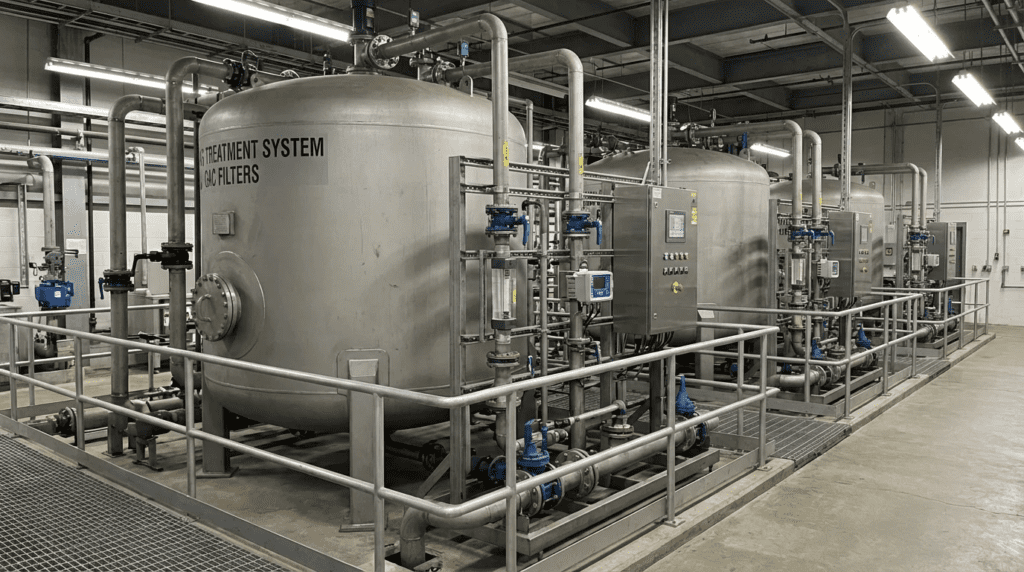
Granular Activated Carbon (GAC) Systems for PFAS represent the most established and widely deployed technology in municipal drinking water. Relying primarily on hydrophobic interactions and van der Waals forces, GAC is highly effective for long-chain compounds like PFOS and PFOA. Standard configurations use pressure vessels in a lead-lag arrangement to maximize media utilization and protect against breakthrough. While GAC has a lower capital cost and uses non-proprietary media, it requires a large footprint due to the high Empty Bed Contact Time (EBCT) needed—typically 10 to 20 minutes per vessel. GAC performance is heavily degraded by background organic matter (TOC/DOC), which competes for pore space.
Single-Use Ion Exchange (IX) Resin for PFAS
For compact footprints and stringent short-chain targets, Single-Use Ion Exchange (IX) Resin for PFAS is frequently specified. These engineered synthetic resins feature positively charged functional groups (usually quaternary amines) that attract the negatively charged PFAS headgroups, coupled with a polystyrene or polyacrylic backbone that provides a hydrophobic interaction for the fluorinated tail. This dual-mechanism adsorption provides exceptional capacity, often treating 100,000 to 200,000+ bed volumes before breakthrough. Because IX requires a much shorter EBCT (typically 2 to 3 minutes), the vessels are significantly smaller than GAC systems. “Single-use” denotes that once exhausted, the highly concentrated resin is removed and incinerated or disposed of, rather than regenerated on-site.
Regenerable Ion Exchange (IX) for PFAS
In highly contaminated industrial applications or complex wastewaters where single-use media would exhaust un-economically fast, engineers specify Regenerable Ion Exchange (IX) for PFAS. These systems utilize similar anion exchange resins but include complex on-site regeneration equipment utilizing a solvent/brine mixture (such as methanol and sodium chloride) to strip the PFAS from the resin. This process restores the resin’s capacity while producing a highly concentrated, low-volume liquid PFAS waste stream. While it drastically reduces media replacement costs, regenerable IX introduces immense operational complexity, hazardous chemical handling, and the secondary challenge of disposing of or destroying the concentrated solvent-brine waste.
High-Pressure Membranes (RO and NF) for PFAS
When dealing with ultra-short chains, extreme background competition, or when seeking total PFAS rejection alongside other dissolved solids, High-Pressure Membranes (RO and NF) for PFAS are utilized. Reverse Osmosis (RO) and tight Nanofiltration (NF) membranes operate on size exclusion and charge repulsion, rejecting virtually all PFAS compounds (greater than 99% removal), regardless of chain length. This makes RO the ultimate “catch-all” barrier. However, membrane systems require significant electrical energy for high-pressure feed pumps, necessitate extensive chemical pretreatment to prevent scaling, and generate a continuous reject waste stream (brine or concentrate) comprising 15-25% of the feed flow, which then requires secondary management.
Foam Fractionation for Landfill Leachate PFAS
For high-strength, complex matrices where media and membranes would rapidly foul, Foam Fractionation for Landfill Leachate PFAS is emerging as a premier separation technology. This process exploits the surfactant nature of PFAS molecules. By injecting fine air bubbles into a water column, hydrophobic PFAS tails align with the air-water interface, rising to the surface to form a concentrated foam. The foam is then vacuumed off and collapsed. Foam fractionation is highly effective for bulk removal of long-chain and precursor compounds in dirty water, though it generally serves as a pre-concentration step rather than a polishing step, as it struggles to achieve low parts-per-trillion effluent limits for short chains without secondary treatment.
PFAS Destruction Technologies (SCWO, EO, HALT)
Because traditional treatments only separate and concentrate the compounds, the industry is rapidly moving toward closed-loop disposal via PFAS Destruction Technologies (SCWO, EO, HALT). These processes—Supercritical Water Oxidation (SCWO), Electrochemical Oxidation (EO), and Hydrothermal Alkaline Treatment (HALT)—are designed to break the exceptionally strong carbon-fluorine bonds, mineralizing PFAS into benign fluoride ions, carbon dioxide, and water. These technologies are currently deployed at relatively small scales to treat the concentrates generated by RO, regenerable IX, or foam fractionation. They represent the frontier of PFAS engineering, requiring exotic materials of construction (like titanium or specialized alloys) to withstand extreme temperatures, pressures, and highly corrosive local environments.
PFAS Co-Contaminant Pretreatment (Iron, Manganese, TOC)
No PFAS treatment system operates in a vacuum, making PFAS Co-Contaminant Pretreatment (Iron, Manganese, TOC) a mandatory subcategory of any successful design. High levels of naturally occurring iron and manganese will rapidly oxidize and foul the pores of GAC, blind IX resins, and scale RO membranes. Similarly, high Total Organic Carbon (TOC) will exhaust GAC capacity prematurely. Pretreatment typically involves aeration, chemical oxidation (using chlorine or potassium permanganate), followed by green sand filtration or ultrafiltration. Neglecting rigorous co-contaminant profiling is the single most common cause of premature PFAS system failure.
SELECTION & SPECIFICATION FRAMEWORK
Choosing the optimal treatment train for PFAS Removal by Compound: PFOA PFOS GenX and More requires balancing regulatory targets against the background water matrix and lifecycle costs. Engineers should approach selection using a compound-first decision tree.
Step 1: Compound Profiling & Regulatory Targets
Determine the specific chain lengths driving compliance. If the regulatory driver is strictly long-chain compounds (PFOA/PFOS) and the required effluent limit is around 10-20 ppt, GAC is often the most cost-effective solution. If the permit includes short-chain compounds like GenX, PFBS, or ultra-low limits (e.g., the EPA 4.0 ppt MCL), the rapid breakthrough of these compounds on GAC makes IX resin the mathematically superior choice due to its higher selectivity and longer runtime. If ultra-short chains (TFA) are regulated, RO membranes must be strongly considered.
Step 2: Water Matrix and Competition
The background water chemistry dictates media feasibility.
- TOC/DOC: High background organics (>2.0 mg/L) will competitively inhibit GAC, slashing its bed life. IX is generally more resistant to TOC interference, though certain humic acids can cause resin fouling.
- Inorganic Ions: High sulfate or nitrate levels can compete for exchange sites on IX resins, particularly non-selective variants. In high-sulfate waters, the resin may dump accumulated short-chain PFAS if sulfate displacement occurs (chromatographic peaking).
- Foulants: Iron > 0.3 mg/L, Manganese > 0.05 mg/L, or high suspended solids necessitate robust upstream pretreatment regardless of whether GAC, IX, or RO is chosen.
Step 3: Lifecycle Cost Analysis (CAPEX vs OPEX)
GAC generally presents a higher CAPEX (due to large stainless steel or carbon steel pressure vessels and extensive concrete pad requirements) but utilizes cheaper bulk media. Single-use IX features a lower CAPEX (smaller footprint, smaller vessels) but demands higher OPEX due to the premium cost of proprietary resin. Membrane systems present both high CAPEX and high OPEX (energy, membrane replacement, chemical dosing) but offer absolute barrier protection.
COMPARISON TABLES
The following tables provide a quick-reference engineering map for navigating the landscape of compound-specific treatment. Table 1 compares the core technologies across functionality and cost, while Table 2 provides a matrix for matching technologies to specific application profiles.
Table 1: Subcategory Technology Comparison
| Type / Technology | Primary Target Compounds | Typical EBCT / Flux | Key Advantage | Major Limitation | Relative Footprint |
|---|---|---|---|---|---|
| Granular Activated Carbon (GAC) Systems for PFAS | Long-Chain (PFOA, PFOS, PFHxS) | 10 – 20 mins | Well understood; non-proprietary media; thermal reactivation possible | Poor short-chain removal; highly susceptible to TOC competition | Large |
| Single-Use Ion Exchange (IX) Resin for PFAS | Short & Long-Chain (GenX, PFBS, PFOS) | 2 – 3 mins | High capacity (>100k BV); excellent short-chain retention; compact | High media replacement cost; requires upstream particulate filtration | Small |
| High-Pressure Membranes (RO and NF) for PFAS | All Chains (incl. Ultra-Short TFA) | 10 – 15 gfd (flux) | Absolute physical barrier (>99% rejection for all PFAS) | Generates high-volume liquid reject brine (15-25% of feed); energy intensive | Medium |
| Foam Fractionation for Landfill Leachate PFAS | Long-Chain, Precursors, Surfactants | Application Specific | Operates well in extremely dirty, high-TSS, high-TOC water (leachate) | Not a polishing technology; struggles to reach ultra-low ppt levels alone | Medium |
| PFAS Destruction Technologies (SCWO, EO, HALT) | Total PFAS Destruction | N/A (Reaction Time) | Breaks C-F bond; eliminates long-term liability and disposal risks | Emerging tech; highly corrosive environments; massive energy usage | Small (Treating Concentrate Only) |
Table 2: Application Fit Matrix
| Application Scenario | Best-Fit Subcategory | Key Engineering Constraints | O&M Complexity |
|---|---|---|---|
| Municipal Groundwater (< 1 mg/L TOC), Primarily Long-Chain PFAS | Granular Activated Carbon (GAC) Systems for PFAS | Available land footprint for large vessels; backwash water handling | Low |
| Municipal Surface Water, High TOC, Mix of GenX and PFOA | Single-Use Ion Exchange (IX) Resin for PFAS | Protection from TSS blinding; humic acid fouling potential | Medium |
| Industrial Plating Wastewater, Ultra-Short Chains (TFA), Stringent Permit | High-Pressure Membranes (RO and NF) for PFAS | Brine disposal pathways; scaling prevention; energy access | High |
| AFFF-Impacted Soil Washing or High-Strength Landfill Leachate | Foam Fractionation for Landfill Leachate PFAS | Foam collapse chemistry; secondary treatment for short chains | High |
| Concentrate Management (RO Brine or IX Regenerant Waste) | PFAS Destruction Technologies (SCWO, EO, HALT) | Material corrosion resistance; specialized safety protocols | Very High |
ENGINEER & OPERATOR FIELD NOTES
Implementing a strategy for PFAS Removal by Compound: PFOA PFOS GenX and More requires translating design models into reliable field operations. While all systems aim to remove “forever chemicals,” the practical realities of starting, maintaining, and troubleshooting these systems vary drastically based on the selected subcategory.
Commissioning Considerations
Proper commissioning dictates the long-term viability of the media. For Granular Activated Carbon (GAC) Systems for PFAS, initial media wetting and backwashing are critical. Carbon must soak for 24-48 hours to fully evacuate air from the micropores. Prematurely placing dry carbon into service will result in air-binding, channeling, and immediate PFAS slip. Additionally, bituminous GAC will temporarily spike the effluent pH (often above 9.0) during startup, requiring a run-to-waste period or pH adjustment.
Conversely, Single-Use Ion Exchange (IX) Resin for PFAS does not require soaking but must be protected from physical abrasion. IX vessels should never be subjected to violent backwashes, as the spherical beads can fracture, creating fines that blind the bed. IX resins are typically commissioned with a slow, low-flow rinse to displace preservative solutions before ramping up to the design hydraulic loading rate.
Common Specification Mistakes
One of the most frequent errors in defining PFAS Precursor Treatment and Transformation systems is failing to account for oxidative conversion in the pretreatment step. If an engineer specifies a robust ozone or chlorine pre-oxidation system for iron removal, they may inadvertently convert undetected precursors into terminal PFOA/PFOS before the water reaches the media vessels. This results in a higher applied load than the column testing predicted. Pretreatment specifications must include a TOP assay evaluation to gauge this risk.
Another error occurs when engineers specify single-vessel (simplex) configurations. Whether using GAC or IX, regulatory compliance for Short-Chain PFAS Removal (GenX, PFBS, PFBA, PFHxA) virtually mandates a Lead-Lag (series) configuration. Short chains have shallow mass transfer zones. Without a secondary “lag” vessel to polish the effluent, the plant must take the system offline the moment initial breakthrough is detected on the primary vessel, severely wasting unexhausted media capacity.
O&M Comparison Across Subcategories (REQUIRED)
Operational burdens differ radically depending on the chosen technology path.
- Daily Operator Attention: Granular Activated Carbon (GAC) Systems for PFAS and single-use IX are generally “hands-off” pump-and-treat systems requiring minimal daily intervention beyond verifying differential pressure and flow rates. Conversely, High-Pressure Membranes (RO and NF) for PFAS and Regenerable Ion Exchange (IX) for PFAS demand rigorous daily oversight, including monitoring normalized flux, chemical dosing rates (antiscalants), and managing continuous concentrate flows.
- Maintenance Intervals & Labor: GAC media changeouts are heavy industrial events requiring specialized vacuum trucks, slurry handling, and significant operator coordination, occurring every 6 to 18 months. IX media changeouts are less frequent (every 1 to 3 years) and involve smaller volumes, but the beads require careful eduction. RO systems require routine clean-in-place (CIP) events every 3 to 6 months, requiring a high degree of operator labor to handle harsh acids and bases.
- Consumable Costs: GAC relies on higher-volume but lower-cost media (typically $1.50 – $3.00/lb). IX relies on lower-volume, high-cost proprietary resin (typically $300 – $500/ft³). RO heavily consumes electrical power, antiscalant chemicals, and replacement membrane elements every 3 to 7 years.
- Training Requirements: Standard adsorptive vessels require basic operator skill levels consistent with conventional filtration. PFAS Destruction Technologies (SCWO, EO, HALT) and complex regenerable IX systems require highly advanced training, strict hazardous materials protocols, and sophisticated SCADA interaction.
- Spare Parts Inventory: RO systems require extensive inventory (spare membrane elements, O-rings, pressure vessel end caps, specialty pump seals). Media vessels primarily require spare distribution laterals, pressure gauges, and automated valve actuators.
Troubleshooting Overview: Common Issues by Subcategory
When an effluent limit is breached, the root cause is usually tied to the specific subcategory in use.
- GAC: Premature breakthrough of Long-Chain PFAS Removal (PFOA, PFOS, PFHxS, PFNA) usually points to TOC blinding or channeling. If differential pressure is simultaneously rising, biological growth or iron/manganese fouling has likely blinded the micropores.
- Ion Exchange: Sudden spikes of short chains (like PFBA) on the effluent side of an IX vessel, sometimes exceeding influent concentrations, indicates “chromatographic peaking.” This occurs when heavier compounds or competing inorganic anions (like sulfates) build up and physically push the lighter, weakly bound short chains off the active exchange sites.
- Reverse Osmosis: A drop in PFAS rejection across an RO array indicates physical damage to the membrane (O-ring failure, telescope failure, or chemical oxidation of the polyamide layer by free chlorine).
The most common “troubleshooting” issue isn’t equipment failure, but sample contamination. Because current EPA Methods require measuring down to parts-per-trillion, operators wearing Gore-Tex jackets, using certain sunscreens, or writing with Teflon-coated clipboards during sampling will register false-positive PFAS spikes in the laboratory data. Strict adherence to PFAS-free sampling protocols is mandatory.
DESIGN DETAILS & STANDARDS
Engineering a system for PFAS Removal by Compound: PFOA PFOS GenX and More requires strict adherence to sizing kinetics and regulatory testing methodologies. Rule-of-thumb sizing from conventional water treatment is inadequate for low-ppt targets.
Sizing Methodology Overview
Adsorptive media systems are governed by the Empty Bed Contact Time (EBCT), defined as the volume of the media bed divided by the volumetric flow rate.
EBCT (min) = (Bed Volume in Gallons) / (Flow Rate in GPM)
The depth of the media bed is equally important to ensure the Mass Transfer Zone (MTZ) is fully contained within the vessel. To prevent early breakthrough, particularly for Short-Chain PFAS Removal (GenX, PFBS, PFBA, PFHxA), the hydraulic loading rate (HLR) must be carefully controlled. HLR is calculated as the flow rate divided by the cross-sectional area of the bed, typically designed between 3.0 and 6.0 gpm/ft².
Key Design Parameters by Subcategory
Sizing changes drastically depending on the chosen path:
- GAC Systems: Require a long EBCT of 10-20 minutes. Because carbon is lighter (approx. 25-30 lbs/ft³), backwash rates are relatively low (10-15 gpm/ft²) to achieve the required 30% bed expansion during maintenance.
- IX Systems: Exhibit exceptionally fast kinetics, allowing for a short EBCT of 2-3 minutes. IX beads are heavier (approx. 40-45 lbs/ft³), but backwashing is generally discouraged to maintain the distinct MTZ profile. Vessels must be designed with specialized internal lateral networks to ensure perfect flow distribution, as even minor channeling will bypass the rapid kinetics zone.
- Membrane Systems: RO design relies on flux rates, typically 10 to 15 gallons per square foot per day (gfd). The system recovery must be modeled against the saturation index of silica, calcium, and barium in the concentrate stream to prevent irreversible scaling.
Applicable Standards & Compliance
Municipal specifications must align with established standards. Media systems must carry NSF/ANSI Standard 61 certification for drinking water system components (health effects), and ideally NSF/ANSI 53/58 certifications specifically validating PFAS reduction claims.
Laboratory validation of system performance must utilize proper EPA methodologies. EPA Method 533 focuses on short-chain compounds (utilizing isotope dilution), while EPA Method 537.1 targets long-chain and legacy compounds. Engineers must specify which analytical method laboratories should use based on the specific permit requirements.
Specification Checklist
When drafting technical specs, ensure the following are included:
- Defined influent water quality profile including TOC, pH, TSS, Iron, Manganese, and individual PFAS compounds.
- Target effluent requirements by specific compound (e.g., PFOA < 4.0 ppt, PFOS < 4.0 ppt).
- Requirement for multi-vessel Lead-Lag configuration with intermediate sampling ports.
- Detailed media specifications (e.g., Iodine number and mesh size for GAC; moisture content and total capacity for IX).
- Requirement for PFAS Co-Contaminant Pretreatment (Iron, Manganese, TOC) if influent triggers limits.
- Specific testing protocols (RSSCT for GAC, rapid column tests for IX) utilizing site-specific water prior to final sizing approval.
FAQ SECTION
What are the different types of PFAS removal technologies?
PFAS treatment technologies are categorized by the target compounds and mechanisms. Major subcategories include Granular Activated Carbon (GAC) Systems for PFAS and Single-Use Ion Exchange (IX) Resin for PFAS for standard adsorption. High-Pressure Membranes (RO and NF) for PFAS are used for ultra-short chains and physical separation. Complex matrices utilize Foam Fractionation for Landfill Leachate PFAS. Finally, end-of-life disposal relies on emerging PFAS Destruction Technologies (SCWO, EO, HALT).
How do you choose between GAC and Ion Exchange for PFAS?
The choice between Granular Activated Carbon (GAC) Systems for PFAS and Single-Use Ion Exchange (IX) Resin for PFAS depends on the compound profile and TOC. If the primary targets are Long-Chain PFAS Removal (PFOA, PFOS, PFHxS, PFNA) and background TOC is very low, GAC is highly cost-effective. However, if strict limits apply to Short-Chain PFAS Removal (GenX, PFBS, PFBA, PFHxA), IX resin is necessary due to its faster kinetics, higher capacity, and resistance to competitive breakthrough.
What is the most cost-effective PFAS treatment for small municipal plants?
For smaller flows (under 1 MGD), Single-Use Ion Exchange (IX) Resin for PFAS is frequently the most cost-effective. While the resin is more expensive per cubic foot than carbon, the required footprint and vessel sizes are drastically smaller due to the short EBCT (2-3 minutes vs 15 minutes for GAC). This minimizes the initial capital expenditure, concrete padding, and housing requirements, which often dominate project costs for small municipalities.
Can you treat ultra-short chain PFAS like TFA with carbon?
No. Standard adsorption technologies are largely ineffective for Ultra-Short Chain PFAS Removal (TFA, PFPrA). Because these molecules are highly hydrophilic and lack an extended fluorinated tail, they pass directly through GAC and standard IX media beds. Capturing TFA effectively requires absolute barriers like High-Pressure Membranes (RO and NF) for PFAS or specialized, novel tight-pore resins.
Why does my PFAS treatment system show higher PFAS levels in the effluent than the influent?
This occurs for two reasons. First, chromatographic peaking: heavy compounds displace lighter ones, pushing a concentrated wave of short chains out of the media bed. Second, incomplete PFAS Precursor Treatment and Transformation: undetected polyfluoroalkyl precursors oxidized inside the treatment train, transforming into regulated terminal PFAS (like PFOA/PFOS) before exiting the plant, giving the false appearance of PFAS creation.
Does backwashing improve PFAS removal media life?
For Granular Activated Carbon (GAC) Systems for PFAS, backwashing is required to remove suspended solids and prevent channeling, though it disrupts the mass transfer zone and can cause a temporary spike in effluent PFAS. However, for Single-Use Ion Exchange (IX) Resin for PFAS, backwashing is highly discouraged. It completely destroys the mass transfer zone profiling within the bed, pulling saturated beads to the bottom and accelerating breakthrough. Proper PFAS Co-Contaminant Pretreatment (Iron, Manganese, TOC) should negate the need for backwashing.
CONCLUSION
KEY TAKEAWAYS: PFAS Removal by Compound
- Treating PFAS as a single contaminant leads to specification failure. Designs must account for the distinct behaviors of long-chain vs. short-chain vs. ultra-short-chain molecules.
- Granular Activated Carbon (GAC) Systems for PFAS are ideal for long-chain compliance (PFOA/PFOS) in low-TOC water due to low media costs.
- Single-Use Ion Exchange (IX) Resin for PFAS is superior for highly regulated short chains (GenX, PFBS) and smaller plant footprints due to ultra-fast 2-3 minute EBCTs.
- High-Pressure Membranes (RO and NF) for PFAS are mandatory when dealing with ultra-short chains (TFA) or when complete physical rejection is required.
- Never bypass PFAS Co-Contaminant Pretreatment (Iron, Manganese, TOC). Iron above 0.3 mg/L or TOC above 2 mg/L will financially ruin media replacement budgets.
- Always specify Lead-Lag configurations to maximize bed volumes and prevent unexpected compliance violations from early short-chain breakthrough.
Mastering PFAS Removal by Compound: PFOA PFOS GenX and More requires engineers to pivot away from broad “bulk” treatment mindsets and focus intensely on molecular behavior, competitive kinetics, and specific regulatory thresholds. The differences between a six-carbon sulfonate and a three-carbon carboxylate fundamentally dictate whether a plant requires a pair of passive GAC vessels or a highly complex RO array feeding an electrochemical destruction cell. By strictly mapping the targeted compounds against the appropriate subcategory technologies—and rigorously protecting those systems through adequate pre-filtration—engineers can design treatment trains that balance reliable regulatory compliance with defensible lifecycle costs.