
Plug Valves for Slurry and High-Solids Service: What Works and What Fails
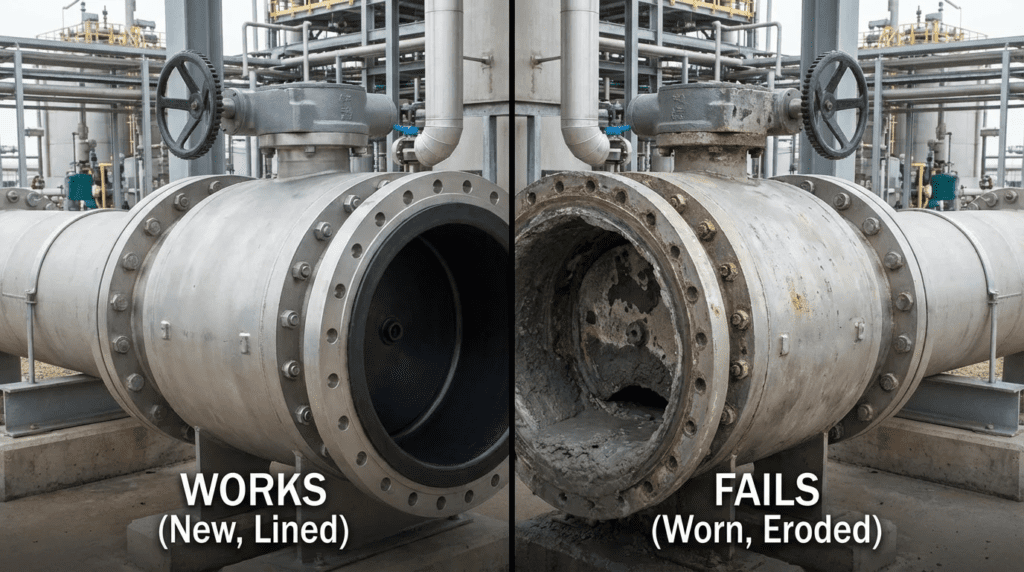
INTRODUCTION
Handling heavy primary sludge, raw grit, lime slurries, or industrial tailings presents one of the most punishing fluid handling challenges in any treatment facility. In these applications, standard valving rapidly falls victim to severe abrasion, chronic clogging, and debilitating torque spikes. A surprising number of facilities experience premature valve failures—sometimes within months of commissioning—simply because a standard water-service valve was specified for a high-solids duty. The cost implications of these specification errors are staggering when accounting for emergency bypass pumping, ruined actuators, and unscheduled maintenance downtime.
When engineering isolation or control points for difficult fluids, understanding Plug Valves for Slurry and High-Solids Service: What Works and What Fails is the critical difference between a 20-year asset and a persistent operational nightmare. Plug valves—particularly eccentric and lubricated designs—are widely considered the industry standard for wastewater and heavy industrial slurries due to their straight-through flow profiles, quarter-turn operation, and ability to sheer through accumulated solids.
However, simply specifying a generic “plug valve” is insufficient. Slurry applications demand precise engineering regarding port geometry, internal metallurgy, elastomeric linings, seating mechanisms, and actuator sizing multipliers. When these variables are ignored, operators are left with seized shafts, torn elastomer coatings, and valves that leak continuously past the seat.
This comprehensive technical guide is designed for municipal consulting engineers, plant superintendents, and utility decision-makers. It will bypass the marketing claims and delve deeply into the mechanical realities of plug valves in heavy service environments. By examining empirical performance data, common failure modes, and lifecycle cost drivers, this article will help engineers specify the correct plug valve architecture, materials, and automation packages to ensure reliable operation in the harshest high-solids applications.
HOW TO SELECT / SPECIFY
Specifying the right equipment requires balancing fluid mechanics with metallurgical durability. The following parameters dictate the operational envelope when applying plug valves in high-solids environments.
Duty Conditions & Operating Envelope
The first step in specification is strictly defining the operating conditions. Fluid velocity is the single most critical factor in slurry valve lifespan. In high-solids service, velocity must be high enough to maintain suspension (typically > 3.0 ft/s to prevent solid dropout) but low enough to prevent accelerated erosion of the valve body and plug face (typically < 8.0 ft/s). If the system operates outside this narrow band, the valve will either pack with grit or erode prematurely.
Operating pressure and differential pressure (ΔP) across the valve also dictate selection. Slurry lines often experience pressure surges due to positive displacement pump operations (like progressive cavity or ram pumps). The valve’s pressure rating must account for these cyclic fatigue loads, not just the static head. Furthermore, operating mode matters: is the valve used for strictly open/close isolation, or is it required to throttle? Standard eccentric plug valves can throttle clean water, but throttling high-solids slurries will rapidly destroy the plug facing due to high-velocity localized scouring (wire-drawing) at the partially open seat.
Materials & Compatibility
Material selection is the primary battleground against abrasion and corrosion. In standard wastewater (0.5% to 2% solids), a standard cast iron or ductile iron body with a Chloroprene (Neoprene) or NBR (Buna-N) coated plug is typical. However, for severe slurries (e.g., > 5% solids, raw grit, or lime slurry), these standard materials will fail.
For highly abrasive grit or mining tailings, engineers must specify hardened materials. Unlined cast iron bodies are often upgraded to ductile iron for structural integrity against water hammer. The plug itself should be specified as hardened, such as Ni-Hard or high-chrome iron, avoiding elastomeric coatings entirely, as sharp aggregate will simply tear the rubber from the plug core. If chemical compatibility is also a factor (e.g., corrosive industrial slurries), duplex stainless steels or specially formulated polyurethane linings may be required. Temperature limits must also be respected; while slurries are typically ambient, industrial processes exceeding 150°F (65°C) will rule out certain polyurethane or standard NBR linings, requiring FKM (Viton) or metal-to-metal seating.
Hydraulics & Process Performance
A critical specification point for plug valves is the port area. Eccentric plug valves are rarely “full port” (having an internal flow area equal to the mating pipe). Manufacturers typically offer 80% port or 100% port configurations. For high-solids and stringy materials (ragging), a 100% full-port design is strongly recommended to minimize head loss and reduce the risk of bridging.
The head-capacity characteristics (Cv value) of the chosen valve must be factored into the system hydraulic model. A standard 80% port plug valve has a significantly lower Cv than a gate valve of the same nominal size. In pump discharge applications, this additional friction must be accounted for in the pump curve intersection and Net Positive Suction Head (NPSH) calculations if the valve is located on the suction side (though suction-side throttling should always be avoided).
Installation Environment & Constructability
Space constraints heavily influence plug valve selection, as eccentric plug valves require substantial lateral clearance for the actuator and gear operator. Constructability also involves flange standards; AWWA and ANSI Class 125/150 flanges are standard, but dimensional face-to-face standards must match the piping layout.
PRO TIP: Installation Orientation is Critical
The most common design failure with eccentric plug valves in slurry service is incorrect orientation. The valve shaft must be installed horizontally. Furthermore, the valve must be oriented so that when the plug rotates to the open position, it rotates to the top of the pipe. This allows any settled grit or solids to sweep through the bottom of the body cleanly. If the plug rotates to the bottom, the cavity will fill with solids, preventing the valve from fully closing and leading to extreme torque failures.
Reliability, Redundancy & Failure Modes
In high-solids service, the most common failure modes are: 1) Torn plug encapsulation, 2) Seized trunnion bearings, and 3) Packing leaks. Mean Time Between Failures (MTBF) drops drastically if grit intrudes into the upper or lower shaft journals. To combat this, engineers should specify grit excluders (V-type PTFE seals) and stainless steel permanently lubricated radial bearings.
Redundancy is critical in primary sludge and grit lines. Double block-and-bleed configurations or dual isolation valves are highly recommended, allowing one valve to be safely maintained while the other holds back process fluid. Critical spare parts, including pre-coated replacement plugs, upper/lower packing kits, and spare gear operators, should be specified in the initial procurement package.
Controls & Automation Interfaces
When automating plug valves for slurry service, actuator sizing is the paramount concern. Heavy slurries increase seating and unseating torque significantly compared to clean water. Engineers must mandate a torque safety factor of 1.5 to 2.0 over the manufacturer’s clean-water breakaway torque ratings when sizing electric (e.g., AUMA, Rotork) or pneumatic actuators.
For SCADA integration, continuous position feedback (4-20mA) and discrete limit switches (open/close) are standard. Because heavy solids can prevent a valve from reaching 100% closure, smart electric actuators with torque-sensing limits are highly recommended. These actuators will stop rotation and trigger a SCADA alarm if a solid object blocks the seat, rather than destroying the plug lining or snapping the shaft by over-torquing.
Maintainability, Safety & Access
Maintenance access defines operator safety. Valves must be installed at ergonomic heights or provided with chain wheels for manual operation. However, chain wheels should be avoided on high-torque slurry valves larger than 12 inches due to the physical exertion required.
For maintainability, the specification must include requirements for adjustable, replaceable packing while the valve is under pressure. Operators cannot shut down entire primary treatment trains to repack a leaking valve stem. Additionally, Lockout/Tagout (LOTO) provisions on the gear operator or automated actuator must be robust and clearly visible. Flush ports (tapped holes in the valve body) should be specified to allow operators to inject high-pressure water to clear out packed grit before cycling.
Lifecycle Cost Drivers
When analyzing Total Cost of Ownership (TCO), CAPEX represents a fraction of the lifetime cost. A standard cast-iron, rubber-lined plug valve might cost $3,000 upfront, whereas a severe-service, metal-seated, 100% port valve might cost $7,000. However, if the standard valve requires replacement every 18 months, plus bypass pumping costs, the OPEX quickly eclipses the initial savings.
Energy consumption is also a hidden OPEX factor. An 80% port plug valve introduces higher head loss than a 100% port valve, forcing pumps to work harder over their 20-year lifespan. For high-volume pumping stations, specifying full-port plug valves can yield thousands of dollars in annual electrical savings, easily justifying the initial CAPEX premium.
COMPARISON TABLES
The following tables provide an objective framework for comparing different plug valve architectures and matching them to specific high-solids application scenarios. Use Table 1 to evaluate technological tradeoffs and Table 2 to map those technologies to plant-specific constraints.
| Technology / Architecture | Key Features | Best-Fit High-Solids Applications | Limitations / Failures | Typical Maintenance Profile |
|---|---|---|---|---|
| Eccentric Plug Valve (Resilient Seated) | Camming action lifts plug off seat before rotation; rubber-coated plug. | Primary sludge, thickened WAS, RAS, standard raw sewage. | Rubber lining shreds in raw grit or sharp aggregate slurries. | Low. Periodic exercising required; stem packing adjustments. |
| Eccentric Plug Valve (Metal-to-Metal / Hardened) | Ni-Hard or Chrome-iron plug with hardened body seats. | Raw grit handling, lime slurry, mining tailings, heavy ash. | Does not provide drop-tight shutoff (Class IV/V leakage typical). | Low. Very durable, requires larger actuators due to higher torque. |
| Lubricated Cylindrical Plug Valve | Metal plug with injected sealant/lubricant providing the seal. | High-pressure sludge pumping, abrasive media where drop-tight seal is needed. | Requires constant, diligent maintenance. If unlubricated, will permanently seize. | High. Regular injection of specialized sealant via grease gun is mandatory. |
| PTFE-Sleeved Plug Valve | Plug rotates within a fixed, full-circumference PTFE sleeve. | Corrosive chemical slurries, acid rock drainage. | Large jagged solids will gouge the PTFE sleeve causing severe leaks. | Medium. Sleeve replacement requires valve removal from pipeline. |
| Service Type | Solids Concentration (Typical) | Primary Engineering Constraint | Recommended Valve Specification | Relative Cost Index |
|---|---|---|---|---|
| Primary Raw Sludge | 3% – 6% | Ragging, high grease content, bridging. | 100% Full-Port Eccentric, Resilient Seated (NBR), Horizontal shaft. | $$ |
| Grit Cyclone Underflow | 10% – 30% (Highly Abrasive) | Extreme scouring, tearing of elastomers. | Metal-to-Metal Eccentric (Ni-Hard Plug), or severe-service knife gate. | $$$$ |
| Digested Sludge (Anaerobic) | 2% – 5% | Struvite scale buildup, biogas entrainment. | Glass-lined eccentric plug body to resist struvite adhesion. | $$$ |
| Lime / Carbon Slurry | 10% – 20% | Rapid settling, cementing in dead zones. | Eccentric with flush-ports, oversize pneumatic actuator. | $$$ |
ENGINEER & OPERATOR FIELD NOTES
Bridging the gap between design theory and operational reality is where true reliability is found. Field operators routinely face the consequences of design oversights. The following field notes address practical testing, mistakes, and O&M realities.
Commissioning & Acceptance Testing
During the Factory Acceptance Test (FAT) and Site Acceptance Test (SAT), plug valves must be rigorously tested before they are buried or rendered inaccessible. For resilient-seated eccentric valves, an AWWA C517 shell test (typically 2.0x rated working pressure) and seat leak test (at rated working pressure) are mandatory. Do not accept “spot checks” on a large slurry valve order; 100% of the valves must be hydrostatically tested.
In the field, stroke testing is vital. Actuators must be cycled fully from 0% to 100% to verify that travel limits are set correctly. A common punch list item is the failure of the limit switches to accurately report the “fully closed” position. In slurry applications, if the valve indicates “closed” but is physically open 2%, high-velocity abrasive fluid will bypass the seat, destroying the plug coating in a matter of weeks.
Common Specification Mistakes
The phrase Plug Valves for Slurry and High-Solids Service: What Works and What Fails is most relevant when examining bid documents. The most frequent specification error is failing to explicitly require a “100% full rectangular port” for raw primary sludge. When an 80% port is supplied, the sudden reduction in pipeline diameter causes localized velocity spikes and creates a ledge where fibrous material (wipes, rags) hangs up, eventually blinding the valve.
Another classic error is under-specifying the actuator. Standard specifications often reuse boilerplate language for clean water valves. Slurry has high viscosity and specific gravity, requiring substantially higher seating torque. If an engineer allows a 1.0 or 1.25 safety factor, operators will inevitably find the electric actuator stalling out on “high torque” faults during mid-stroke.
O&M Burden & Strategy
Plug valves are not “install and forget” assets. They require a dedicated preventive maintenance strategy. The single most important task is exercising the valve. Slurry valves left in the open position for six months will likely become entombed in compacted solids. A predictive maintenance schedule should require operators to cycle critical isolation valves full-stroke at least once a month.
Lubrication of the upper and lower trunnion bearings is another critical labor requirement. While many modern designs tout “permanently lubricated” bearings, harsh environments with high-pressure washdowns often compromise these seals. Specifying external grease zerks for the journals allows operators to purge water and grit out of the bearing cavities. Critical spare parts inventory must always include replacement packing kits; repacking a stem takes approximately 1-2 labor hours and should be done at the first sign of a weeping gland.
COMMON MISTAKE: Misusing Plug Valves for Throttling Slurry
While eccentric plug valves can be used for throttling in clean fluid, doing so in severe slurry service is a guaranteed failure. Throttling creates a high-velocity jet stream through the partially open plug. In a heavy grit environment, this acts like a sandblaster, eroding the body wall and tearing off the rubber encapsulation. For throttling slurries, engineers should specify specialized pinch valves or robust characterized ball valves, reserving plug valves strictly for isolation.
Troubleshooting Guide
When a plug valve malfunctions, operators need systematic diagnostic procedures.
- Symptom: Valve will not fully close / Actuator stalls on high torque.
Root Cause: Debris is packed in the bottom cavity, or a large object (e.g., a rock or 2×4) is wedged between the plug and seat.
Fix: Do not bypass the torque limit. Open the valve fully to attempt to flush the debris, then re-close. If equipped with a flush port, inject high-pressure water. If unsuccessful, the line must be drained and the bonnet removed. - Symptom: Valve closes fully but fluid leaks past the seat.
Root Cause: The resilient elastomer on the plug has been torn, or the body seat has been gouged by wire-drawing.
Fix: The plug must be removed and re-vulcanized/replaced. A permanent solution requires evaluating whether the media contains too much sharp aggregate for rubber linings (consider metal-to-metal seating). - Symptom: Process fluid leaking from the valve stem.
Root Cause: Packing failure due to cycling wear or lateral shaft deflection.
Fix: Tighten the packing gland nuts evenly by a quarter turn. If the gland is fully bottomed out, insert new packing rings.
DESIGN DETAILS / CALCULATIONS
Proper sizing and specification require adherence to fundamental fluid dynamics and industry standards.
Sizing Logic & Methodology
Line sizing rules for slurries are stringent. The standard sizing methodology involves determining the flow rate ($Q$) and ensuring the cross-sectional area ($A$) of the pipe and valve maintains the target velocity ($V = Q/A$).
Rule of Thumb: Target an operating velocity of 4.0 to 6.0 ft/s (1.2 to 1.8 m/s) for primary sludge and grit.
If the velocity drops below 3.0 ft/s, grit will settle out of suspension, accumulating in the pipe invert and the bottom cavity of the plug valve. If the velocity exceeds 8.0 ft/s, the rate of abrasive wear on the valve internals increases exponentially (wear is generally proportional to the cube of velocity). Therefore, do not arbitrarily oversize a plug valve “just to be safe.” A 12-inch valve on a system that only flows 500 GPM will result in a velocity of roughly 1.4 ft/s—guaranteeing massive solids settling and inevitable valve failure.
When computing system head loss, consult the manufacturer for specific Cv values. The formula for pressure drop across the valve is:
ΔP = (Q / Cv)² * S.G.
Where S.G. is the Specific Gravity of the slurry (often 1.02 to 1.15 for thick sludges).
Specification Checklist
To ensure robust procurement, your master specification must include the following line items:
- Body Material: Cast Iron (ASTM A126 Class B) or Ductile Iron (ASTM A536) depending on pressure rating.
- Plug Coating: Specify NBR (Buna-N) for standard organics/FOG, Neoprene for general wastewater, or Ni-Hard/Hardened Metal for raw grit/lime.
- Port Area: Must clearly state “100% full port area” if handling rags/heavy solids.
- Bearings: Sintered 316 Stainless Steel, permanently lubricated, with upper and lower grit excluders (PTFE thrust washers).
- Seat Testing: Drop-tight bi-directional seating required at maximum operating pressure (for resilient seated).
- Installation Geometry: “Contractor must install valve with shaft horizontal, such that the plug rotates to the top of the pipeline when opened.”
Standards & Compliance
The definitive standard for municipal applications in North America is AWWA C517: Resilient-Seated Cast-Iron Eccentric Plug Valves. Specifications should demand strict adherence to this standard regarding wall thickness, hydro-testing, and coating requirements. For flange drilling, ANSI B16.1 (Class 125) or B16.42 (Class 150) are standard. If the valve is automated, electrical components must comply with NEMA 4X (corrosion resistant/watertight) or NEMA 7 (explosion-proof) if installed in classified areas like anaerobic digester galleries or raw wet wells.
FAQ SECTION
Engineers and operators frequently ask these critical questions when navigating Plug Valves for Slurry and High-Solids Service: What Works and What Fails.
What is the difference between an eccentric and concentric plug valve?
An eccentric plug valve features an offset shaft. As the valve opens, the plug swings back and slightly away from the seat, breaking contact almost immediately. This “camming” action minimizes friction and wear. A concentric (or standard) plug valve rotates directly on its center axis, meaning the plug face rubs against the body for the entire quarter-turn, which leads to rapid failure in abrasive slurry service.
Why do plug valves get stuck or seize in high-solids service?
Seizing is usually caused by incorrect installation or lack of maintenance. If a valve is installed with the shaft vertical, or with the plug rotating to the bottom, heavy solids (like grit) will fall into the valve cavity. When the operator attempts to close it, the plug compresses against solid rock/sand, exceeding the actuator’s torque limits. [[Installation Environment & Constructability]] covers correct orientation.
How do you select plug valves for slurry and high-solids service: what works and what fails?
What works: 100% full-port eccentric valves, horizontal shaft installation, hardened metal plugs (Ni-Hard) for raw grit, and over-sized actuators (1.5x to 2.0x safety factor). What fails: standard 80% port water valves, vertical shaft installation, resilient rubber plugs in sharp aggregate, and using plug valves for continuous throttling duty.
How long should a plug valve last in primary sludge service?
With proper sizing (velocities between 3-6 ft/s) and routine exercising, a high-quality resilient-seated eccentric plug valve in primary sludge can last 15-20 years. Packing glands typically require adjustment every 1-2 years, and the plug itself may require re-coating every 7-10 years depending on the abrasiveness of the incoming grit.
Is it better to use a gate valve or a plug valve for wastewater sludge?
Plug valves are vastly superior to standard gate valves for sludge. Gate valves have bottom tracks/grooves that instantly fill with solids, preventing the gate from seating and causing major leaks. Eccentric plug valves have no bottom cavities to trap debris and feature a shearing edge that cuts through rags and solids to ensure a seal.
Can you use a plug valve for flow control / throttling?
In clean water, yes. In slurry and high-solids, absolutely not. Throttling slurry through a partially open plug valve creates a high-velocity jet that causes extreme abrasive scouring. The rubber coating will tear off, or the metal seat will erode (wire-drawing), ruining the valve’s ability to isolate within months. Use pinch valves or specific control valves for throttling slurries.
What is the standard port size vs full port?
Standard port (often called 80% port) means the cross-sectional area of the open valve is roughly 80% of the adjacent pipe area. This increases head loss and velocity. A full port (100% port) means the flow area equals the pipe area, which is highly recommended for thick sludges and rag-laden wastewater to prevent bridging and minimize friction losses.
CONCLUSION
Key Takeaways for Engineers & Operators
- Velocity is King: Size piping and valves to maintain slurry velocities between 3.0 and 8.0 ft/s to prevent dropout while minimizing severe abrasion.
- Orientation Dictates Survival: Always specify horizontal shaft installation with the plug rotating to the top of the pipe to allow solids to flush out of the bottom cavity.
- Match Port to Process: Specify 100% full-port valves for raw sludge and rag-heavy services to prevent bridging and minimize head loss.
- Upgrade Materials for Grit: Standard elastomers will shred in raw grit or mining slurries. Upgrade to metal-to-metal seating with Ni-Hard or Chrome-iron plugs.
- Oversize Actuators: Apply a torque safety factor of 1.5x to 2.0x for automated slurry valves. Ensure smart actuators have over-torque protection.
- Strictly Isolate: Never use standard plug valves to throttle abrasive high-solids fluid. Use them exclusively for open/close isolation.
Designing fluid handling systems for wastewater and heavy industry requires a deep appreciation for the destructive nature of the media. When addressing Plug Valves for Slurry and High-Solids Service: What Works and What Fails, engineers must abandon the “standard boilerplate” mindset. Specifying generic valves for severe duty applications guarantees premature failure, frustrated operators, and blown maintenance budgets.
A successful design framework relies on three pillars: precise hydraulic sizing to control velocity, metallurgical matching to combat abrasion, and rigorous mechanical specification regarding installation geometry and automation safety factors. By enforcing 100% port requirements where necessary, stipulating horizontal shaft alignments, and demanding strict adherence to AWWA C517 standards, engineers can deliver resilient infrastructure.
Operators, in turn, must champion proactive maintenance. The most meticulously engineered valve will still fail if it is never exercised or if its packing is allowed to leak continuously. By integrating robust, application-specific plug valves into a facility’s design and supporting them with dedicated O&M strategies, utilities can confidently manage even the most punishing high-solids slurries for decades to come.