
Progressive Cavity Seal Failures: Causes
Introduction
For municipal and industrial engineers, few equipment failures are as frustrating—or as messy—as a mechanical seal breach on a progressive cavity (PC) pump. While the stator and rotor are generally viewed as the primary wear components, the shaft seal is frequently the weakest link in the reliability chain. A seal failure in a sludge or polymer application doesn’t just mean downtime; it often results in significant environmental cleanup costs, safety hazards from slippery fluids, and potential bearing housing contamination that can total the drive unit.
Understanding Progressive Cavity Seal Failures: Causes is critical because these pumps operate in unique hydrodynamic environments. Unlike centrifugal pumps, PC pumps generate significant pressure independent of speed, handle multiphase fluids with high solids content, and exert complex radial loads on the drive shaft. Engineers often overlook the fact that the eccentric motion inherent to the PC design, if not properly isolated by the universal joint, translates into shaft runout that standard cartridge seals cannot accommodate.
This article is designed for utility engineers, plant superintendents, and reliability professionals. We will move beyond basic maintenance tips to explore the root engineering causes of seal failure—from incorrect API plan selection to hydraulic instability—and provide actionable specifications to prevent them.
How to Select and Specify to Prevent Failure
Preventing Progressive Cavity Seal Failures: Causes begins at the specification stage. A “standard manufacturer seal” is rarely sufficient for severe duty wastewater sludge or industrial chemical metering. The specification must explicitly define the operating envelope and the support systems required to keep the seal environment stable.
Duty Conditions & Operating Envelope
The first step in specification is defining the true duty point versus the worst-case scenario. Seal faces are rated for specific Pressure-Velocity (PV) limits. In PC pumps, while rotational speeds are generally low (often 100-300 RPM), the pressure differential across the seal faces can be extreme.
- Suction Pressure Variations: Engineers must account for the full range of suction conditions. A PC pump drawing from the bottom of a silo may experience high static head, while the same pump drawing from a nearly empty tank may operate in a vacuum. High suction pressure can force seal faces open if the spring compression is insufficient, while vacuum conditions can draw air across the faces, leading to dry running.
- Viscosity and Shear: High-viscosity fluids (dewatered sludge cake, polymers) generate significant heat at the seal interface. If the fluid does not circulate well within the stuffing box, a “dead zone” is created where heat builds up, cooking elastomers and causing face checking.
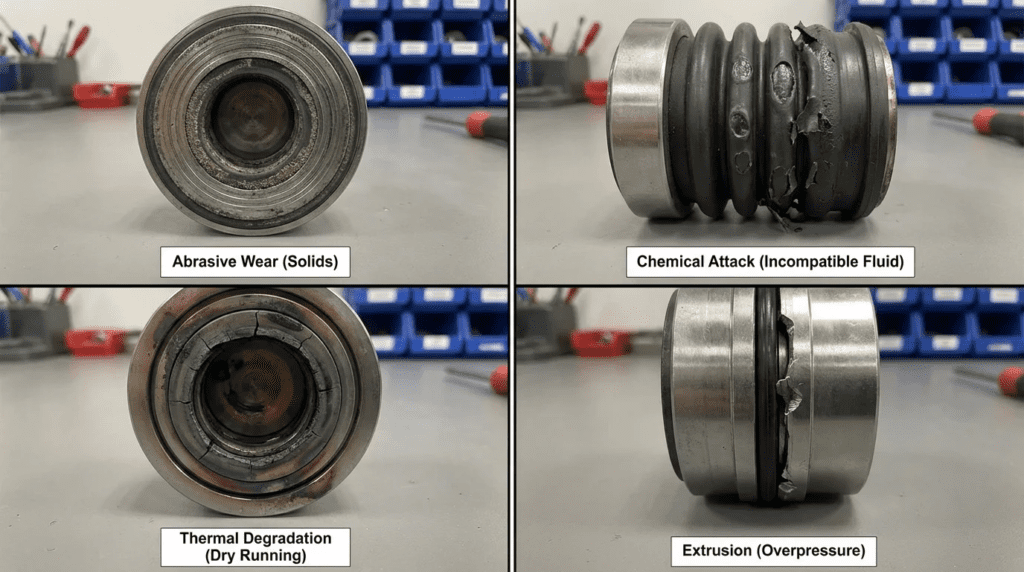
- Solids Content: The percentage and abrasiveness of solids dictate the seal type. For fluids with >1% abrasive solids, single mechanical seals without an external flush are highly prone to failure.
Materials & Compatibility
Material incompatibility is a leading contributor to Progressive Cavity Seal Failures: Causes. The selection must balance chemical resistance with mechanical toughness.

- Seal Faces: For wastewater applications, Reaction Bonded Silicon Carbide (SiC) vs. Silicon Carbide is the industry standard due to its hardness and heat dissipation properties. Tungsten Carbide is an alternative for extreme impact resistance but offers lower heat dissipation. Carbon faces should generally be avoided in abrasive PC applications as they wear too quickly.
- Elastomers (O-rings/Bellows): The secondary seals must be compatible with the process fluid and any cleaning chemicals (CIP) used. FKM (Viton) is standard, but EPDM is required for certain caustics, and FFKM (Kalrez/Chemraz) may be necessary for aggressive industrial solvents. Swelling elastomers can lock up a pusher seal, preventing it from compensating for face wear.
- Hardware Metallurgy: 316 Stainless Steel is the baseline. However, in high-chloride environments (such as ferric chloride dosing or brine applications), Duplex 2205 or Hastelloy C-276 hardware is required to prevent crevice corrosion within the seal gland.
Hydraulics & Process Performance
The hydraulic design of the pump directly impacts seal longevity. PC pumps are positive displacement machines; if the discharge is blocked, pressure rises until something breaks. While pressure relief valves protect the piping, the pressure spike can blow out seal O-rings or fracture seal faces before the relief valve lifts.
Furthermore, Net Positive Suction Head Available (NPSHa) is critical. If the pump cavitates, the vibration and hydraulic shock loads are transmitted directly to the seal faces, causing chipping and premature opening.
Installation Environment & Constructability
The physical installation dictates the feasibility of seal support systems.
- Water Supply: If a double mechanical seal with a water flush (API Plan 54 or 53) is specified, is clean, pressurized plant water available? If not, a thermosyphon pot (Plan 52/53) system is required.
- Access for Maintenance: PC pumps are often long. Engineers must verify that there is enough clearance behind the drive end to remove the seal cartridge without dismantling the entire pump or motor assembly. Split seal designs may be considered for extremely tight spaces, though they often carry a higher leak risk in high-pressure applications.
Reliability, Redundancy & Failure Modes
Analyzing Progressive Cavity Seal Failures: Causes requires understanding the dominant failure modes:
- Dry Running: The most common failure. PC pumps often run dry during tank changeovers or priming. Even 30 seconds of dry running can destroy Silicon Carbide faces due to thermal shock.
- Shaft Deflection: The “wobble” of the rotor is transmitted via the connecting rod. If the intermediate driveshaft bearings are worn or the U-joints are stiff, this radial motion transfers to the seal area. Mechanical seals can typically tolerate only 0.003-0.005 inches of runout.

Controls & Automation Interfaces
Passive protection is insufficient for high-value PC pumps. Active monitoring must be specified:
- Dry Run Protection: Ultrasonic or conductive sensors on the suction piping, or stator temperature probes, must be interlocked to trip the motor immediately upon loss of fluid.
- Seal Pot Level/Pressure: For double seals, the barrier fluid pot should have low-level and high/low-pressure transmitters integrated into SCADA to warn operators of seal breeches before catastrophic failure occurs.
Maintainability, Safety & Access
For safety, double mechanical seals are preferred for hazardous fluids (acids, raw sewage) to provide a backup containment. Cartridge seals are strongly recommended over component seals. Component seals require precise setting of the working length on the shaft—a task difficult to perform accurately in a dimly lit pump gallery. Cartridge seals come pre-set from the factory, eliminating installation errors.
Lifecycle Cost Drivers
While packing glands are cheap initially ($50 for rings vs. $1,500 for a seal), the lifecycle cost favors mechanical seals in most continuous applications. Packing requires constant leakage (increasing housekeeping/safety costs), frequent adjustment, and eventually wears the shaft sleeve, necessitating expensive rotor/shaft replacement. A properly selected double mechanical seal with a seal water management system can run for 3-5 years maintenance-free, offering a lower Total Cost of Ownership (TCO).
Seal Technology Comparison and Selection Matrix
The following tables provide a direct comparison of sealing technologies used in progressive cavity pumps, along with an application fit matrix to assist engineers in matching the seal strategy to the process constraints.
Table 1: PC Pump Seal Technology Comparison
| Seal Technology | Primary Features | Best-Fit Applications | Limitations & Risks | Typical Maintenance |
|---|---|---|---|---|
| Braided Packing | Low initial cost; allows visible leakage for cooling; highly forgiving of misalignment. | Water transfer; non-hazardous sludge; intermittent storm water; budget-constrained projects. | Requires constant leakage; housekeeping issues; wears shaft sleeves; not suitable for hazardous/toxic fluids. | Weekly adjustment; quarterly re-packing; sleeve replacement every 1-2 years. |
| Single Mechanical Seal (Cartridge) | Zero leakage; factory assembled; no shaft wear; lower power consumption than packing. | Clean liquids; polymers; dilute chemicals; fluids with <5% solids (if hard faces used). | Catastrophic failure if run dry; clog prone in heavy sludge without flush; single containment only. | Inspection every 6 months; replace faces/elastomers every 3-5 years. |
| Double Mechanical Seal (Back-to-Back or Tandem) | Two sets of faces; barrier fluid creates clean environment for faces; double containment safety. | Thickened sludge (TWAS/RAS); abrasives; hazardous chemicals; high-pressure applications. | Higher CAPEX; requires support system (Plan 53/54); complex installation. | Check barrier fluid levels daily/weekly; replace seal every 5+ years if barrier maintained. |
| Component Seal | Individual parts assembled on shaft; lowest cost mechanical option. | OEM standard replacements; tight space constraints where cartridges don’t fit. | High risk of installation error (setting spring compression); sensitive to shaft handling; difficult to replace in situ. | Same as cartridge, but higher MTBF risk due to installation variance. |
Table 2: Application Fit Matrix
| Application Scenario | Recommended Seal Type | Critical Flush/Plan | Key Constraint | Relative Cost (1-5) |
|---|---|---|---|---|
| Polymer Dosing (Clean) | Single Cartridge (SiC/SiC) | Plan 11 (Discharge Recirculation) | Chemical Compatibility (Elastomers) | 2 |
| Raw Sewage / RAS (Abrasive) | Double Cartridge | Plan 53A (Pressurized Pot) | Abrasion / Solids intrusion | 4 |
| Dewatered Sludge Cake (High Pressure/Solids) | Double Cartridge / Knife Gate Protection | Plan 54 (External Pressurized Water) | High Pressure / Heat Dissipation | 5 |
| Lime Slurry (Scaling/Abrasive) | Double Cartridge (Isolated Springs) | Plan 54 (High Flow Flush) | Scaling on atmospheric side | 4 |
| Storm Water / General Utility | Braided Packing | Plan 32 (Clean Water Flush) | Intermittent Ops / Dry Run Risk | 1 |
Engineer & Operator Field Notes
Specifications set the stage, but the battle against failure is won in the field. The following notes are compiled from commissioning reports and root cause analysis (RCA) of actual installations.
Commissioning & Acceptance Testing
The transition from construction to operation is where many seals are damaged before they process a gallon of fluid.
- The “Dry” Bump Test: Electricians often “bump” the motor to check rotation direction. In a PC pump with mechanical seals, even a 2-second bump without fluid can glaze the seal faces. Requirement: Ensure the pump is flooded or the seal faces are lubricated (using a compatible lubricant) before any rotational testing.
- Flush Pressure Verification: For double seals, the barrier fluid pressure must typically be 15-20 PSI higher than the stuffing box pressure to prevent process fluid from entering the seal. A common mistake is setting the flush pressure based on suction pressure, ignoring that the stuffing box pressure in a PC pump is often closer to discharge pressure depending on the rotor/stator geometry.
Program the PLC so that the seal water solenoid opens 30 seconds before the pump motor starts, and remains open for 60 seconds after the pump stops. This ensures the seal is pressurized and lubricated during the critical startup torque transient and flushes away solids during spindown.
Common Specification Mistakes
One of the most frequent causes of Progressive Cavity Seal Failures: Causes involves “Plan 11” misuse. API Plan 11 recirculates discharge fluid back to the seal to cool it. In a PC pump handling sludge, this effectively sandblasts the seal faces with concentrated solids. Rule of Thumb: Never use Plan 11 for abrasive fluids. Use Plan 53 (Barrier Fluid) or Plan 32 (External Clean Flush) instead.
O&M Burden & Strategy
Operators should focus on “health indicators” rather than just leakage.
- Thermosyphon Pot Levels: For Plan 53 systems, a rising fluid level in the pot indicates the inner seal has failed and process fluid is pushing into the barrier system. A dropping level indicates the outer seal is leaking barrier fluid to the atmosphere (or into the process).
- Heat Checking: Operators should use IR guns to check the seal gland temperature during rounds. A sharp rise in temperature usually precedes failure, indicating a loss of flush or face contact issues.
Troubleshooting Guide
When analyzing a failed seal, do not simply replace it. Examine the faces:
- Symptom: Radial cracks on the seal face (Heat Checking).
Root Cause: Dry running or insufficient cooling flush. - Symptom: Deep circular grooves on the faces.
Root Cause: Abrasive particles embedded in the softer face (often Carbon). Upgrade to SiC vs. SiC faces. - Symptom: Uneven wear pattern (360-degree contact not visible).
Root Cause: Shaft misalignment or excessive runout/deflection. Check drive bearings and U-joints.
Design Details and Sizing Logic
Engineers must perform specific checks to ensure the selected seal system can withstand the PC pump’s operating dynamics.
Sizing Logic & Methodology
To correctly specify a seal support system, one must estimate the Stuffing Box Pressure. Unlike centrifugal pumps, where stuffing box pressure is predictable based on impeller balance holes, PC pump stuffing box pressure depends on the proximity to the suction port and the number of stages.
Estimation Rule of Thumb:
For a suction-housing mounted seal: Pbox = Psuction + (0.10 × Pdischarge)
*Note: This varies by manufacturer. Always request the “Maximum Stuffing Box Pressure” from the OEM for the worst-case duty point.*
Specification Checklist
Ensure these items appear in the Section 11300 or 43 20 00 specifications:
- Seal Type: Cartridge-style, balanced, single or double mechanical.
- Face Materials: Reaction Bonded Silicon Carbide vs. Reaction Bonded Silicon Carbide (for sludge).
- Metal Parts: 316SS minimum; exotic alloys for corrosive feeds.
- Drive Mechanism: The seal must be driven by a mechanism (pins, keys) capable of handling the start-up torque, not just friction drive (set screws), which can slip on PC pumps.
- Deflection Limit: Specification should limit shaft deflection at the seal face to <0.002 inches (0.05 mm) at max pressure.
Standards & Compliance
While API 682 is written for centrifugal pumps in oil/gas, its piping plans (Plan 53A, Plan 54, Plan 32) are the standard language for PC pump seal support. Reference these plans to ensure clarity. For drinking water applications (polymer dosing), NSF/ANSI 61 certification for the seal materials (specifically elastomers and face lubes) is mandatory.
Frequently Asked Questions
What are the primary Progressive Cavity Seal Failures: Causes in sludge applications?
The primary causes are dry running (thermal shock), abrasive wear from solids intrusion, and excessive shaft deflection. In sludge applications, if the seal faces are not flushed with clean water or a barrier fluid, grit enters the microscopic gap between faces, grinding them down. Additionally, worn U-joints in the pump can transmit vibration to the seal, causing the faces to open and leak.
How does shaft runout affect PC pump seals?
Progressive cavity pumps rely on an eccentric rotor motion. While the drive shaft is supported by bearings to spin firmly, wear in the connecting rod U-joints or main bearings can allow the eccentric “wobble” to transfer to the seal area. Mechanical seals are precise devices; if the shaft moves radially more than 0.003-0.005 inches, the seal faces cannot maintain flat contact, leading to leakage.
When should I use a double mechanical seal versus a single seal?
Use a single seal for clean, non-hazardous fluids with good lubricity (e.g., polymer, oil). Use a double mechanical seal for fluids that are abrasive (sludge >1% solids), hazardous (acids, raw sewage), or prone to crystallizing (sugar, lime). The double seal provides a clean barrier fluid that lubricates the faces, independent of the dirty process fluid.
What is the correct flush pressure for a double seal?
For a double seal to function as a true barrier, the barrier fluid pressure must be maintained 15-20 PSI (1-1.5 bar) higher than the maximum pressure in the stuffing box. This ensures that if a leak occurs, clean barrier fluid leaks into the pump, rather than dirty sludge leaking into the seal (and atmosphere).
Why do PC pump stators sometimes outlast the seals?
Stators are made of resilient rubber designed to deform around solids. Mechanical seal faces are rigid and brittle (ceramic/carbide). If the pump runs dry, the stator may survive for a few minutes due to the rubber’s thermal mass, but the seal faces can overheat and crack in seconds. Proper selection of seal materials and dry-run protection usually aligns the seal life with the stator life.
Can I retrofit a packing gland pump with a mechanical seal?
Yes, but it requires verifying the shaft condition. Packing wears grooves into the shaft or sleeve. To retrofit a mechanical seal, you typically need to replace the shaft sleeve or the drive shaft itself to provide a smooth, unblemished surface for the mechanical seal o-rings to seal against. You must also ensure the pump housing has clearance for the seal gland.
Conclusion
KEY TAKEAWAYS
- Analyze the Fluid: If solids are >1% or the fluid is hazardous, specify a Double Mechanical Seal with an appropriate API flush plan (Plan 53A or 54).
- Control the Environment: Prevent the most common Progressive Cavity Seal Failures: Causes by installing dry-run protection and ensuring flush water is active before the pump starts.
- Watch the Deflection: Seal life is directly tied to the condition of the pump’s U-joints and bearings. Maintain the drive train to save the seal.
- Material Selection: Default to Silicon Carbide vs. Silicon Carbide faces for wastewater applications to resist abrasion.
- Calculate Flush Pressure: Set barrier pressure 15-20 PSI above stuffing box pressure, not suction pressure.
Successfully specifying and operating progressive cavity pumps requires an engineering approach that treats the mechanical seal as a critical asset rather than an afterthought. By understanding that Progressive Cavity Seal Failures: Causes are often rooted in hydraulic instability, poor material selection, or inadequate support systems, engineers can design reliability into the system from Day 1.
The goal is to move from reactive maintenance—changing seals every time they leak—to proactive reliability, where the seal life matches or exceeds the overhaul interval of the rotor and stator. Through proper duty definition, rigorous specification of API plans, and disciplined acceptance testing, utilities and plants can significantly reduce lifecycle costs and operational risk.