
Ross Valve vs Val-Matic for Ball Valves: Pros/Cons & Best-Fit Applications
INTRODUCTION
In the design of high-head municipal pump stations and critical transmission mains, the selection of isolation and pump control valves is a decision that dictates facility reliability for decades. Engineers frequently default to standard butterfly or gate valves to save on capital expenditure, only to face catastrophic surge events, premature seat failure, or excessive energy costs due to head loss. When the application demands virtually zero head loss, high-pressure tolerance, and the ability to operate as a check valve substitute (pump control), the AWWA ball valve is the undisputed standard.
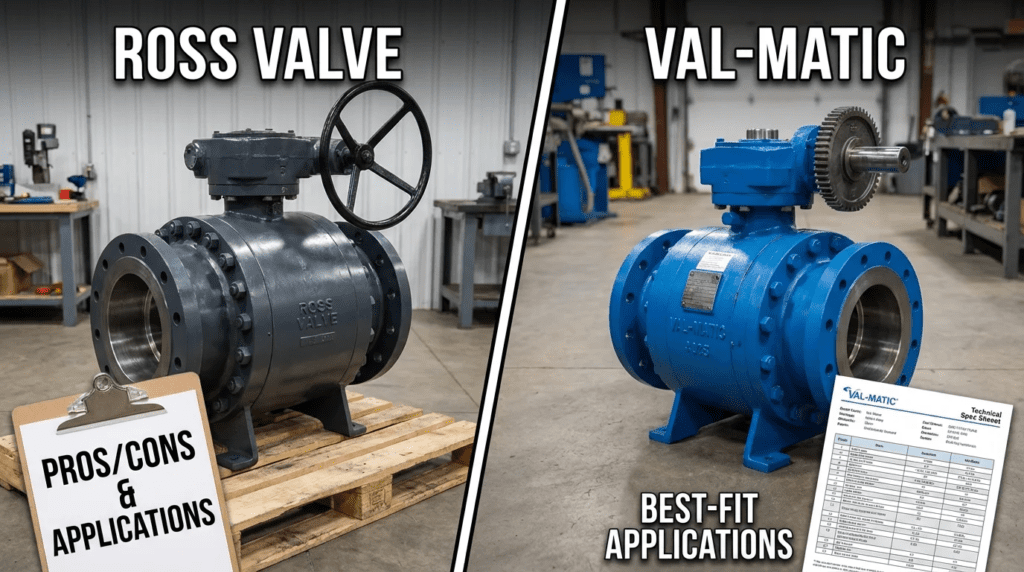
However, the marketplace offers divergent design philosophies. A common evaluation involves analyzing Ross Valve vs Val-Matic for Ball Valves: Pros/Cons & Best-Fit Applications. This comparison is not merely between two brands, but often between two engineering approaches: the highly customized, severe-service heritage of Ross Valve, and the standardized, energy-centric, AWWA C507 focus of Val-Matic. For municipal and industrial engineers, understanding the nuance between “custom engineered” and “application optimized” is critical.
These valves typically serve in raw water intakes, finished water pump stations, and wastewater force mains where velocities exceed 10 ft/s or where water hammer protection is paramount. A poor specification here can lead to slam conditions that rupture pipes or seal failures that require five-figure maintenance procedures. This article provides a technical, specification-safe breakdown to assist engineers in making data-driven decisions regarding these two industry heavyweights.
HOW TO SELECT / SPECIFY
When evaluating Ross Valve vs Val-Matic for Ball Valves: Pros/Cons & Best-Fit Applications, the engineer must move beyond catalog cut sheets and evaluate the equipment against the specific hydraulic and mechanical constraints of the project. The following criteria should form the basis of the technical specification.
Duty Conditions & Operating Envelope
The primary differentiator in valve selection is the energy inherent in the system. Ball valves are predominantly selected for their full-port flow characteristics, meaning the valve bore matches the pipe ID, resulting in a negligible K-factor (typically < 0.05). However, the operating envelope dictates the ruggedness required.
Engineers must define the Maximum Operating Pressure (MOP) and the potential Transient Pressures. Ross Valve designs often lean towards hydro-electric and extreme pressure applications where custom casting thicknesses and alloys are necessary. Val-Matic’s designs are typically optimized for standard AWWA pressure classes (150B, 250B, 300B) found in municipal water distribution. If the application involves high-frequency cycling or modulating service (throttling), the trunnion design and bearing load calculations become critical. Continuous throttling is generally not recommended for standard ball valves due to cavitation risk at intermediate positions, though both manufacturers offer specific trims to mitigate this.
Materials & Compatibility
Material selection drives the lifecycle of the valve, particularly in wastewater applications where hydrogen sulfide ($H_2S$) and grit are prevalent.
- Body Construction: Cast iron (ASTM A126) is fading in favor of Ductile Iron (ASTM A536) for its superior tensile strength and ductility during surge events. Both manufacturers utilize ductile iron, but specification engineers should verify the grade (e.g., 65-45-12).
- Seat Material: This is a major point of differentiation. Val-Matic typically utilizes a dual-seat design with resilient materials (like EPDM or Buna-N) on both upstream and downstream sides, allowing for bi-directional shutoff. Ross, depending on the specific vintage or custom build, may offer metal-to-metal seating or distinct stainless overlays for severe abrasion resistance.
- Shafts/Trunnions: In wastewater, 316 Stainless Steel or 17-4 PH Stainless Steel is mandatory to prevent corrosion at the seal interface.
Hydraulics & Process Performance
The hydraulic argument for ball valves is efficiency. In high-flow pump stations (e.g., >20 MGD), the pumping cost savings from using a ball valve (low head loss) versus a globe or plunger valve can amount to tens of thousands of dollars annually.
Engineers must analyze the Flow Coefficient ($C_v$). Both manufacturers offer full-port designs, but the specific contour of the waterway can affect turbulence. Process performance also relates to the valve’s ability to close against full reverse flow. In a pump failure scenario, the valve must actuate to close before the water column reverses significantly (to prevent slam) or close slowly enough to dissipate surge (if acting as a control valve). This requires precise matching of the valve torque requirements with the actuator’s capabilities.
Installation Environment & Constructability
Ball valves are heavy. A 36-inch AWWA ball valve can weigh upwards of 15,000 lbs. The structural design of the vault or pump station floor must account for this point load.
- Footprint: Double-check the laying length. While AWWA C507 standardizes dimensions, custom variations exist. Replacing a legacy Ross valve with a modern Val-Matic (or vice-versa) may require spool pieces or dismantling joints.
- Actuator Orientation: Hydraulic cylinders or electric motor actuators can protrude significantly. 3D modeling of the installation is recommended to ensure clearance for maintenance personnel and overhead cranes.
Reliability, Redundancy & Failure Modes
The most common failure mode for ball valves in wastewater is the accumulation of solids in the body cavity or behind the seats, leading to a “frozen” valve or an inability to seal. Val-Matic’s “Ener-G” design emphasizes a self-flushing action where the rotation of the ball shears debris. Ross’s heavy-duty designs often rely on sheer mechanical force to overcome obstructions.
Redundancy usually lies in the actuation system. For pump control ball valves, a dedicated Hydraulic Power Unit (HPU) with accumulator backup is standard. The specification must define the number of cycles the accumulator can perform without power. A common spec is “one open-close-open cycle” on stored energy.
Controls & Automation Interfaces
Integrating these valves into SCADA requires monitoring more than just Open/Closed limit switches. For critical pump control:
- Position Feedback: 4-20mA continuous position feedback is required to profile the closing speed.
- Pressure Switches: On hydraulic actuators, pressure switches indicate pump health or seal leaks.
- Solenoid Logic: The control logic must be fail-safe. If power is lost, does the valve fail open, fail closed, or hold last position? In pump discharge, “fail closed” (slowly) is usually required to prevent backflow.
Maintainability, Safety & Access
Maintenance on a large ball valve is not a trivial task. Engineers must specify:
- Trunnion Access: Can the bearings be lubricated without confined space entry behind the valve?
- Seat Replacement: Can the seats be adjusted or replaced without removing the valve from the line? Val-Matic promotes adjustable seats from the exterior on certain models, which reduces downtime. Ross designs are often fully rebuildable but may require more intensive disassembly due to their robust, heavy construction.
- Lockout/Tagout: Physical locking pins on the valve body are mandatory for safety during downstream maintenance.
Lifecycle Cost Drivers
The initial CAPEX for a ball valve is high—often 3x to 5x that of a butterfly valve. However, the Total Cost of Ownership (TCO) analysis favors ball valves in high-energy applications due to:
- Energy Savings: Reduced friction loss lowers pumping head.
- Longevity: A lifecycle of 30-50 years is typical, compared to 10-15 years for rubber-lined butterflies in high velocity.
- Maintenance: Periodic seal adjustment vs. frequent liner replacement.
COMPARISON TABLES
The following tables provide a direct technical comparison to assist in the evaluation of Ross Valve vs Val-Matic for Ball Valves: Pros/Cons & Best-Fit Applications. Table 1 focuses on the manufacturer characteristics and design philosophy, while Table 2 outlines the application suitability for different service conditions.
| Feature / Criteria | Ross Valve (General Characteristics) | Val-Matic (Ener-G Ball Valve) |
|---|---|---|
| Primary Design Philosophy | Custom-engineered, severe service, heavy-duty legacy replacement, hydro-focused. | Standardized AWWA C507, energy efficiency, municipal water/wastewater optimization. |
| Seat Design | Various (Metal-to-metal, resilient inserts). often custom to the pressure class. | Resilient seated (dual seat), typically adjustable, focused on drop-tight shutoff (AWWA). |
| Operating Mechanism | Heavy-duty trunnion, often custom lever systems or piston actuation integration. | Trunnion mounted with fused spherical coating, focused on low torque requirements. |
| Typical Size Range | Custom ranges, capability for extremely large diameters (60″+) and high pressures. | Standard ranges 6″ to 60″+ compliant with standard municipal pipe classes. |
| Primary Strengths | Extreme durability, customization for non-standard laying lengths, high-pressure handling. | Standardization, documentation, predictable head loss, widespread municipal parts support. |
| Limitations | Higher lead times for custom units; may be “over-engineered” for standard low-pressure distribution. | Standard designs may require modification for extreme industrial pressures (>500 psi) outside AWWA. |
| Application Scenario | Suitability: Ross Valve | Suitability: Val-Matic | Engineering Notes |
|---|---|---|---|
| Raw Water Intake (High Grit) | High | High | Both perform well; Val-Matic’s specific grit-guard seal designs are beneficial. |
| Pump Control (Check Valve Function) | High | High | Requires precise actuator pairing. Val-Matic Ener-G is specifically marketed for this energy-saving role. |
| High Pressure Transmission (>250 psi) | Excellent | Good | Ross excels in higher pressure classes often found in mountainous gravity feeds or hydro applications. |
| Wastewater Force Main Isolation | Good | Excellent | Val-Matic’s fused epoxy and full-port design minimize clogging and ragging. |
| Surge Relief / Anticipation | Excellent | Good | Ross is historically dominant in control valves; if the ball valve is part of a complex surge system, their integration is strong. |
| Retrofit / Replacement | Excellent | Moderate | Ross is known for fabricating valves to match existing (often obsolete) face-to-face dimensions. |
ENGINEER & OPERATOR FIELD NOTES
Successful implementation of these valves extends beyond the procurement phase. The following field notes address the practical realities of owning and operating large-diameter ball valves.
Commissioning & Acceptance Testing
The Site Acceptance Test (SAT) for a pump control ball valve is a critical milestone. It is not enough to simply open and close the valve.
- Timing Verification: The closing time must be verified against the surge analysis report. If the surge study calls for a 60-second closure to prevent water hammer, and the actuator is set to 10 seconds, the pipeline is at risk. Calibrate the flow control valves on the hydraulic actuator during SAT.
- Seat Leakage Test: Perform a hydrostatic test against the closed valve. AWWA C507 allows for some leakage, but modern resilient seated valves should be effectively drop-tight.
- Emergency Closure Simulation: Simulate a power failure. The valve should close using the accumulator or backup manual override. Verify that the closing speed during power loss matches the normal closing speed (or the “emergency” speed defined in the design).
Common Specification Mistakes
One of the most frequent errors in specifying Ross Valve vs Val-Matic for Ball Valves is failing to define the Actuator Safety Factor. Manufacturers will size actuators based on “clean water” torque requirements.
- The “Stuck Valve” Scenario: After a valve sits open for 6 months, the “breakaway torque” required to close it is significantly higher than the running torque. Engineers should specify a safety factor of 1.5 or 2.0 on the actuator sizing to account for seat set and debris accumulation.
- Ignoring Potable Water Certifications: Ensure the valve lining and grease (if exposed) meet NSF/ANSI 61 and 372 standards if used in finished water. While standard for Val-Matic, ensure custom Ross builds explicitly state this compliance.
O&M Burden & Strategy
Operators often prefer ball valves because they are “set and forget,” but this complacency leads to failure.
- Exercise Schedule: Ball valves must be full-cycled at least once per quarter. This prevents the trunnions from seizing and wipes the seat clean of buildup.
- Seal Adjustment: Val-Matic designs often allow for seat adjustment. If leakage is detected, operators should know the specific torque sequence for the seat retention bolts. Overtightening can crush the resilient seat, permanently damaging it.
- Grease Lines: Verify that trunnion grease lines are extended to a safe location. If an operator needs a ladder to grease a valve, it won’t get greased.
DESIGN DETAILS / CALCULATIONS
Sizing Logic & Methodology
Unlike control valves where sizing is based on pressure drop ($C_v$), isolation/pump control ball valves are typically “Line Size.” However, verification is required.
Velocity Check:
$$V = frac{0.4085 times Q}{D^2}$$
Where:
- $V$ = Velocity (ft/s)
- $Q$ = Flow (gpm)
- $D$ = Valve Diameter (inches)
While ball valves can handle velocities exceeding 35 ft/s, the economic velocity for pumping systems is usually 5-8 ft/s. If the calculated velocity is < 3 ft/s, the valve may be oversized, leading to unnecessary CAPEX. If > 15 ft/s, verify the potential for cavitation during the closing cycle.
Surge Control Integration
When using the ball valve as a pump check valve, the closure characteristic is vital. Ball valves have an “Equal Percentage” inherent flow characteristic. This means that during the first 20-30% of closure, the flow hardly changes. The effective flow reduction happens in the last 20% of travel.
Design Implication: Simple linear timing (e.g., 60 seconds total) may result in 45 seconds of no flow change, followed by 15 seconds of drastic throttling. This can induce surge. Advanced hydraulic actuators use “Dual Speed” logic: Fast close for the first 70% of travel (to reduce reverse velocity potential), then Slow close for the final 30% (to gently seat the valve without water hammer).
Specification Checklist
- Standard: AWWA C507 (latest revision).
- Flanges: ANSI B16.1 Class 125 or 250 (Match pipe spec).
- Actuation: Electric (AUMA/Rotork/Limitorque) or Hydraulic (Cylinder with HPU).
- Coating: Fusion Bonded Epoxy (interior/exterior) per AWWA C550.
- Testing: Proof of Design (POD) test data submission required.
FAQ SECTION
What is the primary difference between Ross Valve and Val-Matic ball valves?
The primary difference typically lies in design heritage and customization. Val-Matic focuses heavily on standardized, AWWA C507 compliant, energy-efficient ball valves optimized for municipal water and wastewater. Ross Valve is renowned for custom-engineered, severe-service solutions and legacy replacements, often utilized in high-pressure or unique dimensional applications where a standard off-the-shelf valve cannot fit or survive. Both produce high-quality equipment, but Val-Matic is often the default “spec” for standard plants, while Ross is the problem-solver for extreme conditions.
Why are ball valves preferred over butterfly valves for pump control?
Ball valves are preferred for pump control in high-head or high-velocity applications because they offer full-port flow with negligible head loss (K-factor < 0.05), whereas butterfly valves present an obstruction in the flow stream. Additionally, ball valves are more robust against water hammer and provide tighter shutoff capabilities at higher pressures. The initial cost is higher, but energy savings from reduced friction often pay back the difference within a few years.
What is the “Ener-G” feature in Val-Matic ball valves?
The “Ener-G” implies energy efficiency. It refers to Val-Matic’s specific design of the waterway and ball to ensure the flow path is completely unobstructed, matching the pipe diameter exactly. This minimizes turbulence and pumping head loss. It also incorporates a specific trunnion and seat design intended to reduce the torque required to operate the valve, allowing for smaller, more energy-efficient actuators.
Do I need a double-seated ball valve?
Yes, for most municipal isolation applications, a double-seated (bi-directional) ball valve is recommended. This allows the valve to shut off flow from either direction, which is critical if the valve is used for dividing a pipeline for maintenance. It allows the line to be dewatered on either side of the valve while maintaining a seal.
How often should an AWWA ball valve be serviced?
While the valve body is durable, the actuator and trunnion bearings require regular attention. It is best practice to cycle the valve (fully open to fully closed) every 3 months to prevent deposit buildup and bearing seizure. Hydraulic power units (HPUs) require fluid changes and filter replacements annually. Shaft seals should be inspected annually for leakage.
Can Ross Valve retrofit an existing ball valve installation?
Yes, this is a specific strength of Ross Valve. They frequently engineer drop-in replacements for obsolete valves (even from other manufacturers) that match non-standard face-to-face dimensions. This eliminates the need for expensive concrete work or pipe modifications in existing vaults.
CONCLUSION
KEY TAKEAWAYS
- Application Drives Brand: Choose Val-Matic for standard, high-efficiency municipal pump stations and AWWA C507 compliance. Choose Ross Valve for custom dimensions, extreme pressures, or replacing legacy heavy-industry equipment.
- Energy Matters: Ball valves are selected primarily for energy savings (low head loss). Ensure the $C_v$ provided leads to a calculable ROI against cheaper valve types.
- Actuation is Critical: The valve is only as good as its actuator. Specify dual-speed closing logic for pump control to prevent surge.
- Safety Factors: Always apply a safety factor (1.5x minimum) to actuator torque sizing to account for long-term debris buildup and “breakaway” friction.
- Maintenance Access: Verify trunnion lubrication points and seat adjustment bolts are accessible in the installed orientation.
Selecting between Ross Valve vs Val-Matic for Ball Valves: Pros/Cons & Best-Fit Applications ultimately comes down to the constraints of the facility. For new construction municipal wastewater treatment plants and water transmission mains, Val-Matic offers a highly standardized, supportable, and energy-efficient solution that fits seamlessly into modern specifications. Their focus on the AWWA municipal market makes them a safe, reliable choice for general high-performance duty.
Conversely, for rehabilitation projects involving non-standard piping, extreme pressure zones (hydro-electric or high-elevation drops), or applications requiring metallurgy beyond standard ductile iron, Ross Valve provides the engineering flexibility and ruggedness required. Engineers must weigh the operational efficiency against the need for customization. By strictly defining the hydraulic transients, dimensional constraints, and lifecycle maintenance capabilities, the correct choice will reveal itself not through brand loyalty, but through engineering necessity.