
Rotary Lobe Materials Selection: Cast Iron vs Stainless vs Duplex in Wastewater
Introduction
One of the costliest errors in municipal wastewater design is the mismatch between pump metallurgy and fluid characteristics. Engineers often default to 316 Stainless Steel for its “universal” corrosion resistance, only to witness premature failure due to abrasive scour in grit-heavy sludge applications. Conversely, specifying standard Grey Cast Iron for septic receiving stations can lead to rapid graphitic corrosion and seal failure due to high hydrogen sulfide (H2S) concentrations. The engineering challenge lies in balancing hardness against chemical inertness.
This article provides a comprehensive technical analysis of Rotary Lobe Materials Selection: Cast Iron vs Stainless vs Duplex in Wastewater applications. While rotary lobe pumps are favored for their ability to handle high-viscosity sludge, variable flows, and shear-sensitive polymers, their tight internal clearances make them exceptionally sensitive to material degradation. Unlike centrifugal pumps, where wear ring clearances can degrade slightly without catastrophic pressure loss, a rotary lobe pump relies on precise gaps between the rotors and the housing. If the housing material erodes or corrodes, volumetric efficiency (slip) increases, energy consumption spikes, and the pump eventually fails to prime.
We will examine the metallurgical trade-offs between standard Cast Iron (ASTM A48/A536), Austenitic Stainless Steel (304/316), and Duplex Stainless Steel (CD4MCu/2205) specifically for wastewater unit processes. From Thickened Waste Activated Sludge (TWAS) to polymer dosing, this guide aims to equip design engineers and plant superintendents with the data necessary to specify equipment that balances CAPEX constraints with long-term reliability.
How to Select / Specify
Proper specification requires moving beyond simple “corrosion resistance” checkboxes. The selection process must account for the tribological interaction between the fluid’s particulate matter and the pump housing’s surface hardness. Below are the critical engineering criteria for Rotary Lobe Materials Selection: Cast Iron vs Stainless vs Duplex in Wastewater.
Duty Conditions & Operating Envelope
The first step in material selection is characterizing the fluid’s “Aggression Profile,” which is a combination of chemical corrosivity and mechanical abrasivity.
- Abrasive Index: Wastewater sludges are rarely homogenous. Primary sludge and raw sewage contain grit, sand, and eggshells. Materials must possess sufficient Brinell Hardness (HB) to resist scouring. Cast Iron (typically 200-260 HB) offers decent abrasion resistance, while standard 316 Stainless Steel (approx. 150-170 HB) is significantly softer and prone to washout in grit applications.
- Chemical Aggression (pH & Chlorides): For lime-stabilized sludge (high pH) or septic sludge (low pH with organic acids), standard iron may degrade. However, the presence of chlorides (e.g., coastal wastewater plants or specific industrial influents) poses a threat of pitting and stress corrosion cracking (SCC) to 304/316 Stainless Steel, necessitating Duplex alloys.
- Operating Pressure: Higher discharge pressures increase “slip” (fluid backflow through clearances). High slip velocities accelerate erosive wear. If high pressure (>80 psi / 5.5 bar) is required in an abrasive application, a harder material (Duplex or Heat-Treated Iron) is mandatory to hold tolerances.
Materials & Compatibility
Understanding the microstructure of the housing materials is essential for predicting failure modes.
1. Cast Iron (Grey and Ductile):
Typically ASTM A48 Class 30 (Grey) or ASTM A536 (Ductile). This is the industry workhorse for benign municipal sludge.
- Pros: Excellent vibration dampening, low cost, good machinability, and reasonable hardness (better than 316SS).
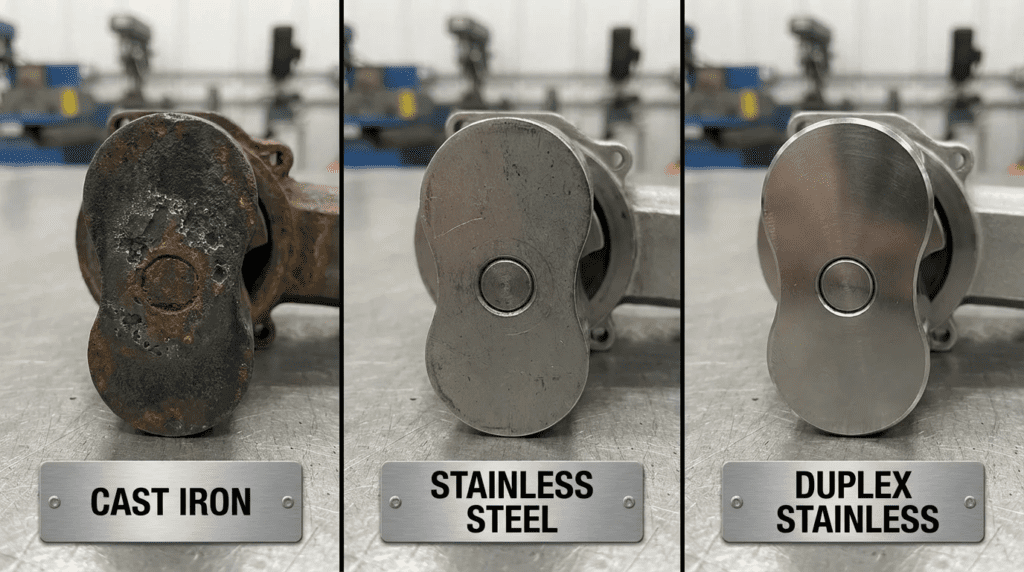
- Cons: Vulnerable to general rusting and specific wastewater corrosion mechanisms like graphitic corrosion, where the iron matrix leaches out, leaving a brittle graphite sponge.
2. Austenitic Stainless Steel (304/316/316L):
Typically ASTM A743 Grade CF8 (304) or CF8M (316).
- Pros: Excellent resistance to general oxidation and a wide range of chemicals (polymers, mild acids).
- Cons: Soft material. In rotary lobe pumps, 316SS housings can suffer from “galling” if metal-to-metal contact occurs with rotors. More critically, in grit-laden fluids, the soft matrix erodes rapidly, opening up clearances.
3. Duplex Stainless Steel (CD4MCu / 2205):
A dual-phase microstructure (ferrite + austenite).
- Pros: The “Goldilocks” material. It offers the corrosion resistance of 316SS (or better) with hardness levels exceeding Cast Iron (approx. 240-290 HB). It resists both pitting and abrasive scour.
- Cons: Higher material cost and more difficult to cast and machine, leading to higher CAPEX.
Critical Note: When specifying Rotary Lobe Materials Selection: Cast Iron vs Stainless vs Duplex in Wastewater, never assume the rotors and casing must be the same material. A common, cost-effective hybrid strategy involves Hardened Iron or Duplex Wear Plates installed within a standard Cast Iron housing.
Hydraulics & Process Performance
Material selection directly impacts hydraulic efficiency over the pump’s life. Rotary lobe pumps rely on tight clearances (often 0.003″ to 0.010″) to create a seal.
- Thermal Expansion: Stainless steel expands at a different rate than Cast Iron. If pumping hot sludge (e.g., thermal hydrolysis processes), clearances must be adjusted based on the housing material’s coefficient of thermal expansion to prevent seizure.
- Volumetric Efficiency Drop: An abrasive fluid in a soft 316SS housing will scour the casing bore. As the gap doubles, slip increases exponentially, not linearly. This forces the VFD to run faster to maintain flow, increasing wear further—a destructive feedback loop.
Installation Environment & Constructability
While material density differences between steel and iron are negligible for structural calculations, the environment dictates external protection.
- Corrosive Atmospheres: In headworks or dewatering rooms with high H2S, Cast Iron pumps require high-grade epoxy coating systems on the exterior to prevent corrosion. Stainless pumps eliminate this maintenance requirement.
- Piping Loads: Ductile Iron and Duplex Stainless pumps handle nozzle loading better than Grey Cast Iron, which is brittle and can crack under excessive pipe strain or thermal shock.
Reliability, Redundancy & Failure Modes
Engineers must match the material to the “Kill Mechanism” of the application:
- Failure Mode A: Seizure (Galling). Common in Stainless-on-Stainless designs. If a pressure spike deflects the shaft, 316SS rotors touching a 316SS case will friction-weld instantly. Prevention: Use non-galling alloys (Duplex casing) or rubber-coated rotors.
- Failure Mode B: Washout. Common in grit/primary sludge. Prevention: Minimum hardness >250 HB (Duplex or Hardened Iron).
- Failure Mode C: Chemical Attack. Common in polymer or septic waste. Prevention: 316SS or Duplex.
Lifecycle Cost Drivers
The Total Cost of Ownership (TCO) calculation often flips the initial price logic.
- Cast Iron: Low CAPEX. Moderate OPEX in standard sludge. High replacement cost in septic/acidic applications.
- 316 Stainless: Moderate/High CAPEX. High OPEX in abrasive applications due to rapid wear plate and housing replacement.
- Duplex: High CAPEX (approx. 1.5x – 2.0x Iron). Lowest OPEX for abrasive/corrosive hybrids. The ROI is typically realized within 2-3 years through reduced downtime and parts consumption in severe duty.
Comparison Tables
The following tables provide a direct comparison of metallurgical properties and application suitability. These are designed to assist engineers in making quick, defensible decisions during the preliminary design and submittal review phases of Rotary Lobe Materials Selection: Cast Iron vs Stainless vs Duplex in Wastewater projects.
Table 1: Metallurgical Performance Matrix
| Material Grade | Common Standard | Approx. Hardness (Brinell HB) | Pitting Resistance (PREN) | Relative Cost Factor | Primary Limitations |
|---|---|---|---|---|---|
| Grey Cast Iron | ASTM A48 Class 30/35 | 200 – 240 | N/A (Rusts) | 1.0 (Baseline) | Brittle; Poor corrosion resistance; Graphitic corrosion in acids. |
| Ductile Iron | ASTM A536 | 220 – 260 | N/A (Rusts) | 1.1 – 1.2 | Requires coating for corrosion; susceptible to H2S attack. |
| 316 Stainless Steel | ASTM A743 CF8M | 150 – 170 | 23 – 28 | 1.8 – 2.2 | Too soft for grit. Prone to galling; Low yield strength. |
| Duplex Stainless | ASTM A890 CD4MCu / 2205 | 240 – 290 | 32 – 36 | 2.2 – 2.8 | Higher initial cost; limited availability from some budget vendors. |
| Hardened Iron | Heat Treated Alloys | 400 – 600 | N/A | 1.5 – 2.0 | Excellent abrasion resistance but poor chemical resistance. |
Table 2: Application Fit Matrix for Wastewater Processes
| Application | Fluid Characteristics | Best Fit Material | Acceptable Alternative | Avoid |
|---|---|---|---|---|
| Primary Sludge | High grit, moderate viscosity, neutral pH. | Duplex SS (Life) or Ductile Iron (Cost) | Hardened Iron (with wear plates) | 316 SS (Wears too fast) |
| TWAS / RAS | Low grit, biological floc, low pressure. | Cast/Ductile Iron | 316 SS | Hardened Iron (Overkill) |
| Polymer / Chemical Dosing | Clean, viscous, potentially corrosive, shear sensitive. | 316 Stainless Steel | Duplex SS | Cast Iron (Contamination risk) |
| Septage / Imported Waste | High grit, debris, variable pH, High H2S. | Duplex SS | Cast Iron (If heavily coated & monitored) | 316 SS (Grit washout) |
| Digested Sludge | Moderate grit, higher temperature (if mesophilic/thermophilic). | Ductile Iron | Duplex SS | Grey Iron (Thermal shock risk) |
Engineer & Operator Field Notes
Real-world performance often diverges from catalog curves. The following notes are compiled from field observations regarding the interface of maintenance and material selection.
Commissioning & Acceptance Testing
When commissioning rotary lobe pumps, verify that the materials supplied match the submittals. A simple magnet test can distinguish between Austenitic Stainless (generally non-magnetic or very weakly magnetic) and Duplex/Cast Iron (magnetic).
- Clearance Verification: Verify the rotor-to-housing clearances. If you selected Duplex for high-pressure operation, clearances should be tighter than an equivalent standard iron pump due to the material’s stiffness.
- Hydrostatic Testing: Ensure water is used for testing. If the pump is Cast Iron, ensure it is drained and dried immediately after FAT (Factory Acceptance Test) to prevent flash rust on the machined sealing surfaces before it arrives at the job site.
Common Specification Mistakes
1. The “Stainless for Everything” Fallacy:
Engineers often upgrade to 316SS to “gold plate” a specification, assuming it is better. In primary sludge or grit chamber underflow, 316SS housings wear out 30-50% faster than Ductile Iron due to lower hardness. If you want an upgrade for sludge, specify Duplex, not 316SS.
2. Ignoring the Wear Plates:
Many rotary lobe pumps feature replaceable wear plates (axial liners). A savvy specification might allow a Cast Iron housing body but mandate Duplex Stainless Steel wear plates. This hybrid approach puts the expensive, hard material exactly where the abrasion occurs, optimizing cost and performance.
O&M Burden & Strategy
Material choice dictates the maintenance schedule:
- Iron Pumps: Monitor for external corrosion on the casing. If the paint system is breached by a dropped wrench or piping strain, H2S in the environment will attack the base metal.
- Stainless/Duplex Pumps: Require less external aesthetic maintenance. However, operators must monitor for “heat checking” or microscopic cracks if the pump runs dry. Duplex is more resistant to thermal shock than standard 316SS.
- Wear Measurement: Maintenance teams should track the rate of clearance opening. If an iron housing loses 0.005″ per year in a specific sludge application, switching to Duplex in the next replacement cycle could theoretically reduce that wear rate to 0.002″ per year, extending pump life significantly.
Troubleshooting Guide
Symptom: Rapid loss of flow performance (Slip).
Root Cause Analysis: Remove the front cover. Inspect the housing bore (the radial surface).
- If there are deep gouges (scoring) in the direction of flow, the material is too soft for the particulate size. Action: Upgrade liner/housing hardness.
- If the surface is pitted or spongy (Cast Iron), it is chemical attack. Action: Switch to Stainless or Duplex.
Design Details / Calculations
When conducting Rotary Lobe Materials Selection: Cast Iron vs Stainless vs Duplex in Wastewater, specific design parameters must be validated.
Sizing Logic & Methodology
Material hardness influences the allowable tip speed of the rotor. Soft materials require slower speeds to minimize abrasive wear rates.
Step 1: Determine Fluid Abrasivity.
If Sand Content > 500 ppm or Grit is present, classify as “Abrasive.”
Step 2: Select Speed Limit based on Material.
- Cast Iron / Duplex Housing: Max Tip Speed ~ 2.5 – 3.0 m/s.
- 316 SS Housing (in Abrasive fluid): Max Tip Speed ~ 1.5 – 2.0 m/s.
Note: Running a soft 316SS pump at high speed in sludge acts like a grinding wheel. You must oversize the pump (larger displacement) to run it slower if you are forced to use 316SS for chemical reasons.
Specification Checklist
To ensure you receive the correct configuration, include these specific lines in your Division 43 equipment specification:
- Casing Material: [Specify ASTM Standard, e.g., ASTM A890 Grade 1B (CD4MCu)].
- Minimum Hardness: Casing and Wear Plates shall have a minimum Brinell Hardness of [e.g., 220 HB for Ductile, 240 HB for Duplex].
- Wear Plates: Pump shall be equipped with replaceable radial and axial wear plates. (Note: Not all lobe pumps have radial liners; if not, the casing material is critical).
- Passivation: All Stainless Steel and Duplex wetted parts shall be passivated to remove iron contamination and restore the oxide layer.
Standards & Compliance
- ASTM A48: Standard Specification for Gray Iron Castings.
- ASTM A536: Standard Specification for Ductile Iron Castings.
- ASTM A743 / A744: Standard Specification for Castings, Iron-Chromium-Nickel, Corrosion Resistant.
- ASTM A890: Standard Specification for Castings, Iron-Chromium-Nickel-Molybdenum Corrosion-Resistant, Duplex (Austenitic/Ferritic) for General Application.
Frequently Asked Questions
What is the main advantage of Duplex Stainless Steel over 316SS in wastewater?
The primary advantage of Duplex Stainless Steel (e.g., CD4MCu or 2205) is its combination of superior corrosion resistance and significantly higher hardness. While 316SS provides excellent chemical resistance, it is relatively soft and wears quickly in grit-laden wastewater sludge. Duplex is approximately twice as strong and significantly harder than 316SS, resisting both chemical attack (pitting) and abrasive wear (scouring), making it the ideal choice for septic receiving and primary sludge applications.
Can I use Cast Iron pumps for polymer dosing applications?
While Cast Iron is chemically compatible with many polymers, it is generally not recommended for polymer dosing. Cast Iron can rust or shed particulate (graphite/iron oxide) which can contaminate the polymer or plug fine injection quills and check valves. Furthermore, polymer requires precise, repeatable metering; the corrosion inherent in Cast Iron can alter internal clearances over time, affecting dosing accuracy. 316 Stainless Steel is the industry standard for polymer dosing pumps.
How does hardness affect the lifespan of a rotary lobe pump?
Hardness (measured in Brinell HB or Rockwell HRC) is directly correlated to abrasive wear resistance. In rotary lobe pumps, the efficiency depends on maintaining tight gaps (0.005″-0.010″) between the rotor and housing. If the housing material is soft (like 304/316 SS), grit particles trapped in the slip path will gouge the metal, widening the gap. A harder material (Duplex or Heat-Treated Iron) resists this gouging, maintaining volumetric efficiency and extending the time between rebuilds.
What is the difference between CD4MCu and 2205 Duplex?
CD4MCu and 2205 are both Duplex Stainless Steels, but CD4MCu is a cast designation (common in pump housings), while 2205 is typically a wrought/bar stock designation (common in shafts). In modern specifications, they are often treated as functionally equivalent regarding corrosion and strength for wastewater applications. However, CD4MCu generally contains copper, which further enhances resistance to certain acids and abrasion.
Why are wear plates important in material selection?
Wear plates (liners) allow engineers to decouple the cost of the pump body from the performance of the wetted surface. Instead of casting an entire complex pump housing out of expensive Duplex Stainless Steel, manufacturers can use a standard Cast Iron body and bolt in Duplex wear plates. This reduces the initial capital cost while providing the necessary abrasion and corrosion resistance at the critical sealing interfaces. It also simplifies maintenance, as only the plates need replacement, not the entire housing.
Conclusion
Key Takeaways
- Avoid 316SS for Grit: Standard Stainless Steel is too soft for primary sludge or raw sewage; it will suffer from rapid abrasive scour.
- Duplex is the Hybrid Solution: For applications requiring both chemical resistance (low pH/H2S) and abrasion resistance, Duplex (CD4MCu) is the technically superior choice.
- Cast Iron is Standard for a Reason: For standard TWAS and RAS, Ductile Iron offers the best balance of cost, dampening, and durability.
- Check the Hardness: Always specify minimum hardness (HB) values in your bid documents to prevent the supply of inferior “soft” alloys.
- Utilize Wear Plates: Hybrid designs (Iron Body + Duplex Plates) often yield the best Lifecycle Cost (LCC).
Selecting the correct metallurgy for rotary lobe pumps is a balance of tribology, chemistry, and economics. While the initial capital cost of Duplex Stainless Steel may be 50-80% higher than Cast Iron, the Total Cost of Ownership in aggressive applications—such as septic receiving or primary sludge—is often lower due to extended service intervals and maintained volumetric efficiency.
Engineers must resist the urge to use a “one size fits all” specification. By segmenting the plant’s applications and applying Rotary Lobe Materials Selection: Cast Iron vs Stainless vs Duplex in Wastewater logic specifically to each unit process, utilities can achieve robust reliability without unnecessary expenditure. When in doubt regarding a specific sludge composition, prioritizing hardness (Duplex or hardened alloys) is generally the safer engineering bet over standard austenitic stainless steel.