
Rotating Biological Contactors (RBCs) in Wastewater Treatment
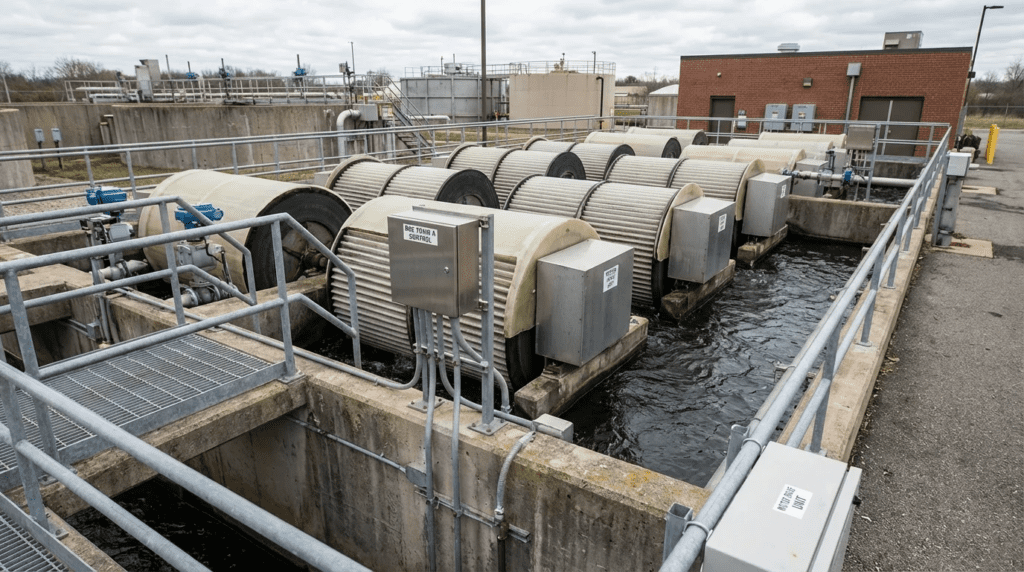
INTRODUCTION
A critical challenge in fixed-film wastewater engineering is balancing the biological treatment efficiency of attached-growth systems with the mechanical realities of supporting massive, wet biomass. Historically, early generations of Rotating Biological Contactors (RBCs) in Wastewater Treatment suffered from catastrophic shaft failures because structural engineers underestimated the immense sheer weight of overloaded biofilm. However, advancements in shaft design, media density profiling, and load monitoring have transformed RBCs into one of the most reliable, energy-efficient, and operator-friendly processes available for both municipal and industrial applications.
Rotating Biological Contactors (RBCs) in Wastewater Treatment represent a unique intersection of structural engineering, mechanical power transmission, and biological kinetics. Operating typically at a slow 1 to 2 RPM, these partially submerged media arrays rotate through wastewater and air, cultivating a robust biofilm that excels at carbonaceous BOD removal and nitrification while consuming a fraction of the energy required by conventional activated sludge (CAS) systems.
This pillar page serves as a comprehensive hub for engineers, plant directors, and operators navigating the modern RBC landscape. Because fixed-film technology is highly modular, the umbrella of RBCs covers a vast array of subtypes, mechanical configurations, specialized media arrays, and distinct operational methodologies. Understanding these interconnected subcategories is essential for proper specification, lifecycle cost analysis, and long-term operational success. Whether specifying a decentralized package plant, troubleshooting an imbalanced shaft, or retrofitting a multi-stage municipal train, this guide outlines the critical branches of RBC technology.
SUBCATEGORY LANDSCAPE — TYPES, TECHNOLOGIES & APPROACHES
The landscape of Rotating Biological Contactors (RBCs) in Wastewater Treatment is diverse, defined by variations in mechanical drive mechanisms, submergence levels, media density, and application contexts. Engineers must view these subcategories not as isolated products, but as configurable building blocks. For instance, an industrial application may require a standard-density media paired with a mechanical drive, while a tertiary municipal nitrification stage might utilize high-density media with an air-driven configuration. The following sections detail the major branches of RBC technology that require dedicated evaluation during the facility design or upgrade phase.
RBC Process Configurations & Types
Standard Rotating Biological Contactors
Standard Rotating Biological Contactors are the traditional configuration wherein a horizontal shaft is suspended over a contoured tank, with typically 40% of the media submerged in the wastewater. As the shaft rotates (usually between 1.0 and 1.6 RPM), the attached biomass alternates between absorbing organics from the water phase and absorbing oxygen from the atmospheric phase. This configuration is widely used in municipal plants ranging from 0.1 to 5.0 MGD because it requires zero supplemental aeration blowers, drastically reducing facility energy OPEX. Engineers must carefully specify tank baffling to prevent short-circuiting and ensure uniform hydraulic loading across the entire media face.
Submerged Rotating Biological Contactors (SRBCs)
Where standard units are 40% submerged, Submerged Rotating Biological Contactors (SRBCs) operate at 70% to 90% submergence. Because the media is largely underwater, atmospheric oxygen transfer is insufficient, necessitating the use of supplemental bottom-diffused aeration to sustain the biofilm. SRBCs are typically deployed when facility footprint is highly constrained, as the deeper tanks provide greater hydraulic retention time (HRT) within a smaller surface area. Additionally, the buoyant force of the deeper water significantly reduces the structural bending moment on the central shaft, allowing for longer media spans or the handling of heavier biomass loads without fatigue failure.
Mechanical Drive Rotating Biological Contactors
Mechanical Drive Rotating Biological Contactors utilize electric motors coupled to gear reducers and chain-and-sprocket or direct-drive assemblies to turn the shaft. This is the most common and deterministic method of RBC rotation, providing guaranteed RPM regardless of biomass weight fluctuations or basin hydraulics. They are typically specified for the first stages of carbonaceous treatment where heavy, unpredictable biofilm growth could stall a less robust drive mechanism. The limitation is mechanical wear; engineers must mandate high-service-factor gearboxes and auto-lubrication systems to mitigate the O&M burden of replacing sprockets and chains in highly corrosive environments.
Air-Driven Rotating Biological Contactors
As an alternative to mechanical motors, Air-Driven Rotating Biological Contactors utilize coarse-bubble diffusers mounted beneath the media on one side of the shaft. The rising air bubbles catch in specialized "air cups" molded into the media perimeter, creating a buoyant lifting force that turns the unit. This technology eliminates chains, sprockets, and local electrical motors, moving all active mechanical maintenance to a central blower building. Air-driven units also provide supplemental dissolved oxygen to the mixed liquor, making them ideal for high-strength wastes. However, rotation speed can become sluggish if the biomass becomes excessively heavy, requiring careful air-flow balancing by operators.
Multi-Stage Rotating Biological Contactors
To achieve strict effluent permits, RBCs are almost never deployed as single units; they are designed as Multi-Stage Rotating Biological Contactors. A stage is defined as a distinct section of media separated by baffles. Multi-staging prevents short-circuiting and establishes specialized biological zones: the first stages develop fast-growing heterotrophic bacteria for BOD removal, while later stages (starved of BOD) allow slow-growing autotrophic nitrifiers to establish for ammonia reduction. Engineers typically specify 3 to 4 stages for BOD removal and 4 to 6 stages for complete nitrification, often utilizing multiple shafts in a series-parallel train configuration.
Package RBC Plants
For small decentralized applications (typically under 100,000 GPD), Package RBC Plants bundle primary clarification, the RBC biological stage, and secondary clarification into a single prefabricated steel or fiberglass tank. These skid-mounted systems are heavily utilized in rural subdivisions, military outposts, and temporary workforce camps. Their primary advantage is "plug-and-play" installation with a very low center of gravity and minimal civil works required. Specification must focus heavily on the corrosion resistance of the fabricated tankage, often requiring multi-part epoxy coatings or 316L stainless steel wetted parts to ensure a 20+ year lifecycle.
Nitrifying Rotating Biological Contactors
While RBCs inherently remove BOD, Nitrifying Rotating Biological Contactors are specifically designed and sized for the tertiary oxidation of ammonia to nitrate. These units are typically installed downstream of secondary treatment processes (such as trickling filters or undersized activated sludge basins) to upgrade a plant for strict total nitrogen limits. Because the influent BOD is already low (< 15 mg/L), the biofilm is thin, dense, and uniformly autotrophic. Engineers can safely specify the highest-density media available (up to 150 sq ft/cu ft) for these units without fear of biomass bridging, maximizing the surface area available for the slow-growing nitrifiers.
Application-Specific Subcategories
Municipal Decentralized Wastewater RBCs
Municipal Decentralized Wastewater RBCs serve small communities, rural districts, and satellite treatment facilities where maintaining a complex activated sludge plant is economically or operationally unfeasible. The defining characteristic of these applications is the need for high tolerance to diurnal flow variations and very low operator intervention (often visited only 2-3 times per week). RBCs excel here because the attached growth biofilm is highly resilient to hydraulic washouts during storm events and recovers quickly from low-loading periods.
Industrial Roughing RBCs
In industrial applications such as food processing, dairy, or rendering, Industrial Roughing RBCs are utilized to shave peak biological loads before the effluent is discharged to a municipal sewer (pretreatment) or a sensitive downstream polishing process. These units handle extraordinarily high soluble BOD loadings (often > 10 lbs BOD/1,000 sq ft/day). To prevent rapid media clogging from extreme biomass growth, engineers must specify ultra-low-density media with wide spacing, and robust structural shafts designed to handle dynamic loads triple that of standard municipal applications.
Critical Equipment & Components
Standard-Density RBC Media
Standard-Density RBC Media provides approximately 35 to 50 square feet of surface area per cubic foot of volume. The media is typically manufactured from high-density polyethylene (HDPE) corrugated sheets welded or strapped together. Standard density is universally specified for the first and second stages of any RBC train, where influent BOD is highest and the resulting biofilm will be thick (up to 0.1 inches). If tighter media were used in these lead stages, the thick biomass would bridge the gaps, blocking wastewater flow and oxygen transfer, effectively rendering the internal surface area useless.
High-Density RBC Media
Offering 100 to 150 square feet of surface area per cubic foot, High-Density RBC Media features tightly packed, shallow corrugations. This media is strictly reserved for the middle and final stages of treatment where soluble BOD is sufficiently depleted (< 20 mg/L) and the resulting biofilm is naturally thin. By packing more surface area into the same physical footprint, engineers can dramatically increase the nitrification capacity of the plant. A critical design error is deploying high-density media too early in the treatment train, leading to catastrophic clogging, shaft overloading, and mechanical failure.
RBC Shafts and Central Supports
The structural backbone of the system, RBC Shafts and Central Supports, represent the single most critical point of failure in historical fixed-film systems. Modern shafts are heavily engineered components, frequently utilizing octagonal or heavily trussed tubular steel designs coated in thick polyurethane or epoxy. They must withstand millions of rotational cycles under immense cyclical bending moments caused by asymmetric biomass weight. Engineers must evaluate the structural fatigue limits of the shaft, looking for designs that offer continuous internal welding and rigorous non-destructive testing (NDT) during fabrication.
RBC Drive Systems
Whether mechanical or air-driven, RBC Drive Systems dictate the reliability of the rotational process. Mechanical drives typically consist of a high-efficiency NEMA motor, a helical-worm or planetary gear reducer, and a final chain-and-sprocket drive. Because these operate in corrosive, highly humid environments just inches above open wastewater, specification requires severe-duty enclosures (TEFC), space heaters in motors to prevent condensation, and automated grease lubricators for bearings. Variable Frequency Drives (VFDs) are occasionally used, though continuous slow RPM is generally preferred to maintain consistent oxygen transfer.
RBC Enclosures and Covers
RBCs cannot operate effectively if exposed to the elements; therefore, RBC Enclosures and Covers are a mandatory component. Typically constructed of segmented fiberglass reinforced plastic (FRP), these covers serve three vital purposes: they protect the HDPE media from UV degradation (which would cause the plastic to become brittle and shatter), they insulate the biological process to maintain favorable kinetics during winter months, and they contain odors and aerosols. Engineers must specify covers with hinged access hatches for easy inspection and adequate ventilation to ensure sufficient atmospheric oxygen is available for the biofilm.
RBC Bearing Assemblies
At both ends of the massive shaft sit the RBC Bearing Assemblies. These pillow-block spherical roller bearings must support total wet weights commonly exceeding 50,000 to 80,000 pounds per shaft. Due to the slow rotational speed, establishing an elasto-hydrodynamic lubrication film is difficult, making them susceptible to boundary lubrication wear. Premium specifications mandate split-housing bearings for ease of replacement without having to crane the entire shaft out of the basin, along with labyrinth seals to exclude moisture and automated continuous greasing systems.
Operations, Maintenance & Processes
RBC Biomass Control and Stripping
A unique operational requirement of this technology is RBC Biomass Control and Stripping. Under high organic loading, biofilm can grow excessively thick, leading to oxygen depletion at the media-biofilm interface. This causes the innermost layer of bacteria to die and slough off unpredictably, leading to "loping" (unbalanced rotation). Operators must have mechanisms to strip excess biomass. This is typically achieved by temporarily stopping rotation to let the biomass digest itself, adding chemical oxidants, or using mechanical air/water lances to sheer the heavy growth off the lead stages.
RBC Supplemental Aeration
Even in standard configurations, RBC Supplemental Aeration is sometimes required in lead stages facing unexpectedly high influent organic loads. By installing coarse-bubble diffusers beneath the media, operators can provide additional dissolved oxygen to prevent the onset of anaerobic conditions. This is particularly crucial for preventing the growth of Beggiatoa or Thiothrix—white, filamentous sulfur-reducing bacteria that thrive in oxygen-starved environments, causing noxious H2S odors and rapidly clogging the media.
RBC Shaft Repair and Replacement
Because many RBC installations are decades old, RBC Shaft Repair and Replacement is a major sub-discipline of fixed-film engineering. When a central shaft suffers fatigue cracking or a complete torsional shear, the entire unit must be removed via crane. Retrofitting involves upgrading the failed shaft with modern, high-yield-strength steel designs while salvaging or replacing the existing media pack. Specialized contractors provide "re-shafting" services, allowing municipalities to upgrade their process structural integrity without abandoning the existing concrete basins.
RBC Loping and Overload Troubleshooting
A critical operational challenge is RBC Loping and Overload Troubleshooting. "Loping" occurs when biomass sloughs off one side of the cylinder but remains attached to the other, creating an eccentric load. As the heavy side rotates upward, the motor strains; as it falls, the shaft surges forward, violently jerking the drive chain. Troubleshooting involves isolating the cause of the uneven growth—often toxic shock, hydraulic surges, or inadequate dissolved oxygen—and utilizing chemical or mechanical stripping to rebalance the media weight before catastrophic gear reducer failure occurs.
Major OEM Categories
(Note: The industry features several legacy and active manufacturers. Engineers must evaluate OEMs based on structural design philosophies and lifecycle support.)
Evoqua Water Technologies RBCs
Now part of Xylem, Evoqua Water Technologies RBCs represent a massive install base, historically acquiring legacy brands like Envirex. They are known for highly engineered, heavy-duty structural shafts and precise media welding techniques designed to prevent media migration. Their systems frequently utilize advanced mechanical drives and are dominant in large municipal installations requiring rigorous structural guarantees and extensive aftermarket support.
Walker Process Equipment RBCs
Walker Process Equipment RBCs are highly regarded for their robust mechanical and structural engineering. They are known for utilizing heavy-wall tubular steel shafts and prioritizing long-term fatigue resistance. Their designs often emphasize ease of maintenance, featuring easily accessible split pillow-block bearings and resilient drive mechanisms tailored for harsh, corrosive municipal and industrial environments.
Klargester RBC Systems
Primarily operating in the European and international markets (under Kingspan), Klargester RBC Systems dominate the decentralized and commercial package plant sector. These units are highly modular, integrating primary settlement, the RBC biological zone, and final clarification into compact, monolithic fiberglass or polyethylene tanks. They are the go-to specification for off-grid communities, resorts, and commercial complexes requiring minimal footprint and almost zero daily operator intervention.
SELECTION & SPECIFICATION FRAMEWORK
For engineers, navigating the subtypes of Rotating Biological Contactors (RBCs) in Wastewater Treatment requires a strict decision framework to prevent mechanical failures and ensure biological compliance. The most common specification error is choosing a media density or drive type incompatible with the plant’s organic loading rate.
Decision Framework & Logic:
- Determine the Primary Goal: Is the unit for roughing BOD, secondary BOD removal, or tertiary nitrification?
- Roughing / High BOD: Must use Industrial Roughing RBCs with very low-density media and heavy-duty mechanical drives.
- Lead Stages (BOD removal): Must use Standard-Density RBC Media to prevent bridging.
- Tail Stages (Nitrification): Can safely utilize High-Density RBC Media to maximize footprint efficiency.
- Evaluate Footprint and Power Constraints:
- If space is ample and power OPEX must be minimized, specify Standard Rotating Biological Contactors.
- If the footprint is heavily constrained, consider deeper Submerged Rotating Biological Contactors (SRBCs), accepting the tradeoff of increased blower OPEX.
- Select the Drive Mechanism:
- If heavy, unpredictable biofilm is expected (Stages 1 and 2), specify Mechanical Drive Rotating Biological Contactors for guaranteed torque.
- If the plant already utilizes a blower network and loads are predictable, Air-Driven Rotating Biological Contactors can consolidate maintenance away from the basins.
CAPEX vs. OPEX Tradeoffs:
RBCs inherently have a high initial CAPEX due to the extensive concrete basin work required for multi-stage trains, the cost of the structural shafts, and the massive volume of HDPE media. Furthermore, they require clarifiers for suspended solids removal. However, their OPEX is remarkably low. A 1 MGD RBC plant might require only 15 to 25 HP of total drive motor power, compared to 100+ HP for aeration blowers in an equivalent activated sludge plant. Over a 20-year lifecycle, standard mechanical RBCs frequently yield the lowest Total Cost of Ownership (TCO) among biological processes.
Plant Size and Operator Skill:
For applications under 0.1 MGD, Package RBC Plants are the standard because they require virtually no daily process control (no return activated sludge (RAS) rates to manage, no mixed liquor suspended solids (MLSS) to measure). For larger plants (up to 5 MGD), multi-stage RBC trains offer stability; however, beyond 5-10 MGD, the physical footprint required by the dozens of parallel RBC units usually renders them less economically viable than deep-tank fine-bubble aeration systems.
COMPARISON TABLES
The following tables synthesize the subcategories to assist engineers in rapidly matching RBC technologies and equipment with the appropriate application profiles.
Table 1: RBC Subcategory and Equipment Comparison
| Type / Component | Key Characteristics | Best-Fit Application | Primary Limitations | Maintenance Profile |
|---|---|---|---|---|
| Standard Rotating Biological Contactors | ~40% submergence, utilizes atmospheric oxygen transfer. | Municipal secondary treatment (0.1 – 5.0 MGD). | Requires larger surface area footprint. | Low; bearing grease and routine drive checks. |
| Submerged Rotating Biological Contactors (SRBCs) | 70-90% submergence, requires supplemental diffused air. | Footprint-constrained sites; deep tank retrofits. | Higher OPEX due to blower power requirements. | Moderate; requires diffuser maintenance. |
| Mechanical Drive Rotating Biological Contactors | Motor/gearbox/chain drive providing positive RPM. | Lead stages with heavy/fluctuating biomass loads. | Mechanical components exposed to corrosive gases. | Moderate; oil changes, chain tensioning. |
| Air-Driven Rotating Biological Contactors | Air diffusers and media cups drive rotation. | Later stages or plants with existing blower capacity. | Can stall if biomass becomes asymmetric or too heavy. | Low at basin; shifts maintenance to blower room. |
| Standard-Density RBC Media | 35-50 sq ft / cu ft; wide spacing. | Stages 1 & 2 for high BOD5 removal. | Lower overall treatment capacity per volume. | Minimal; highly resistant to bridging/clogging. |
| High-Density RBC Media | 100-150 sq ft / cu ft; tight spacing. | Stages 3+ and dedicated tertiary nitrification. | Catastrophic failure if subjected to high BOD. | Must monitor for solids accumulation. |
Table 2: Application Fit & Selection Matrix
| Application Scenario | Recommended Subcategory Fit | Operator Skill Impact | Design Constraints |
|---|---|---|---|
| Decentralized / Subdivision (< 100k GPD) | Package RBC Plants | Very Low; requires basic visual checks and greasing. | Must protect against extreme cold; relies on integral clarifiers. |
| Industrial Food Processing Pretreatment | Industrial Roughing RBCs + Mechanical Drive Rotating Biological Contactors | Moderate; requires active monitoring of biomass weight. | Mandatory low-density media; highest torque shafts. |
| Lagoon Upgrade for Strict Ammonia Limits | Nitrifying Rotating Biological Contactors w/ High-Density RBC Media | Low; stable kinetics due to pre-treated influent. | Alkalinity must be monitored; temperature drop in winter affects sizing. |
| Municipal Facility with Restricted Footprint | Submerged Rotating Biological Contactors (SRBCs) | Moderate; requires managing blower output and diffuser cleaning. | Deep concrete civil works required; higher power availability needed. |
ENGINEER & OPERATOR FIELD NOTES
While the biological principles of attached growth are consistent, practical operation and structural realities dictate plant success. The following field notes address cross-functional insights that apply uniquely across the different subtypes of Rotating Biological Contactors (RBCs) in Wastewater Treatment.
Commissioning Differences by Subtype
Proper commissioning prevents premature mechanical wear. When starting up Standard Rotating Biological Contactors, operators must allow 2 to 4 weeks for the biofilm to mature before establishing design flow. Lead stages will turn brown/gray rapidly, while tail stages will take much longer to develop the golden-brown nitrifying film. In contrast, commissioning Air-Driven Rotating Biological Contactors requires precise pneumatic balancing; operators must dial in header valves to ensure rotation speed is exactly 1.0 to 1.5 RPM—too much air wastes energy and strips the biofilm, while too little air causes stalling.
Specification Pitfalls: Mixing Up Media and Stages
The single most destructive specification error involves improper media density staging. Engineers sometimes specify High-Density RBC Media across an entire Multi-Stage Rotating Biological Contactors train to artificially lower the required basin footprint. This inevitably fails. High BOD in the first stage forces rapid heterotrophic growth that bridges the tightly packed high-density media. The bridged media traps water and dead solids, adding tens of thousands of pounds of eccentric load. This results in severe RBC Loping and Overload Troubleshooting issues and eventual fatigue failure of the central shaft. Always step down density: low-density in roughing, standard-density in stages 1-2, and high-density strictly in stages 3+.
A healthy BOD-removing biofilm on a lead stage should be thin, shaggy, and brownish-gray. If the media turns white and smells like rotten eggs, you are looking at Beggiatoa sulfur bacteria. This indicates the unit is organically overloaded and anaerobic. The immediate remedy is to implement RBC Supplemental Aeration or increase rotation speed slightly.
O&M Profiles and Troubleshooting
Because they rotate continuously, mechanical wear focuses on drives and bearings.
- Mechanical Wear: RBC Drive Systems utilizing chains require monthly tension checks and lubrication. Direct-drive gearboxes require semi-annual oil analysis to check for water ingress from the highly humid environment trapped beneath the RBC Enclosures and Covers.
- Bearing Failure: RBC Bearing Assemblies must be greased continuously. Because the shaft turns at only 1-2 RPM, the bearing rollers do not generate a protective hydrodynamic grease wedge. Utilizing automatic, spring-loaded or gas-driven grease pods is highly recommended to ensure continuous boundary lubrication.
- Loping: If severe eccentric loping occurs, operators must immediately initiate RBC Biomass Control and Stripping protocols. Allowing a loping unit to run will destroy the gear reducer and eventually cause cyclic fatigue failure of the main structural shaft.
Operators occasionally leave RBC Enclosures and Covers open or remove them entirely during summer to “cool the motors.” Direct UV sunlight will rapidly degrade the HDPE Standard-Density RBC Media, causing it to shatter and fall off the central support, requiring a complete, multi-hundred-thousand-dollar rebuild.
DESIGN DETAILS & STANDARDS
Sizing and specifying Rotating Biological Contactors (RBCs) in Wastewater Treatment requires adherence to both empirical kinetic data and strict structural standards.
Sizing Methodology Overview
RBCs are primarily sized based on hydraulic loading rate (GPD/sq ft) and organic loading rate (lbs BOD5 / 1,000 sq ft / day).
- For Municipal Decentralized Wastewater RBCs, typical design loading on the entire train is 2.5 to 4.0 lbs of soluble BOD5 per 1,000 sq ft of media surface area per day.
- The first stage (lead stage) must never exceed an organic loading of 4.0 to 6.0 lbs SBOD5 / 1,000 sq ft / day, depending on structural limits. Exceeding this triggers the growth of nuisance organisms and severe structural overloading.
- For Nitrifying Rotating Biological Contactors, ammonia loading rates are strictly temperature-dependent but generally range from 0.15 to 0.30 lbs NH3-N / 1,000 sq ft / day.
Differences in Loadings by Subcategory
Sizing changes drastically depending on the subcategory chosen. When specifying Submerged Rotating Biological Contactors (SRBCs), engineers can often push hydraulic loading rates slightly higher because the longer hydraulic retention time (HRT) within the deeper basin compensates for the reduced atmospheric contact. Conversely, when designing Industrial Roughing RBCs, engineers focus solely on organic loading, accepting poor effluent quality (often 50% BOD removal) simply to knock down the load to manageable levels for a downstream process, utilizing massively reinforced RBC Shafts and Central Supports.
Applicable Standards & Compliance
Engineers specifying RBCs must align with recognized regulatory guidelines and structural codes:
- Ten States Standards (GLUMRB): Chapter 70 (or fixed film equivalents) dictates minimum requirements for RBCs, stipulating that at least 4 stages be provided for municipal secondary treatment, and that enclosures be mandatory to protect against UV and temperature extremes.
- Structural Fatigue: Because RBC Shaft Repair and Replacement is a major historical issue, modern specifications must reference ASME/AWS D1.1 structural welding codes. Shaft designs must demonstrate an infinite fatigue life assuming an imbalanced live load (typically calculated at 25-40 lbs per cubic foot of media volume) to account for worst-case heavy biofilm scenarios.
- Electrical: NEMA 4X (corrosion-resistant/watertight) enclosures are standard for all local disconnects and motors within the RBC basin area.
Specification Checklist
When drafting the equipment specification, ensure the following are clearly defined:
- Total media surface area per stage AND total media volume.
- Maximum allowable organic loading on the first stage.
- Mandatory inclusion of load cells or torque monitors on Mechanical Drive Rotating Biological Contactors to alert operators of impending overload.
- Bearing L10 life > 100,000 hours under maximum eccentric load conditions.
- FRP RBC Enclosures and Covers with specified wind and snow load ratings.
FAQ SECTION
What are the different types of Rotating Biological Contactors (RBCs)?
The main types include Standard Rotating Biological Contactors (40% submerged), Submerged Rotating Biological Contactors (SRBCs) (up to 90% submerged), Multi-Stage Rotating Biological Contactors for sequential treatment, and Package RBC Plants for decentralized applications. They are further categorized by their drive mechanism into Mechanical Drive Rotating Biological Contactors and Air-Driven Rotating Biological Contactors.
How do you choose between standard-density and high-density media?
Standard-Density RBC Media (wider spacing) must be used in the first and second stages where organic loads are high, to prevent thick biofilm from clogging the media. High-Density RBC Media (tight spacing) should only be specified for later stages or dedicated Nitrifying Rotating Biological Contactors, where BOD is already depleted and the biofilm is thin.
Why do RBC shafts break and how can it be prevented?
Shafts fail due to fatigue caused by cyclical bending moments under extreme, unbalanced loads (loping). This typically occurs when the lead stages are organically overloaded, causing massive biofilm accumulation. Prevention involves keeping first-stage loading below 4.0 lbs BOD/1,000 sq ft/day, utilizing RBC Biomass Control and Stripping, and specifying heavy-duty RBC Shafts and Central Supports with infinite fatigue life designs.
What is the most cost-effective RBC setup for small communities?
For flows under 100,000 GPD, Package RBC Plants are the most cost-effective. These systems integrate clarification and the biological zone into a single transportable tank, offering low installation CAPEX and requiring extremely low daily operator intervention, making them ideal for rural communities.
How do you fix “loping” in an RBC unit?
Loping is the uneven rotation caused by asymmetrical biomass. To troubleshoot RBC Loping and Overload Troubleshooting, operators should temporarily halt the unit to allow the heavy biofilm to digest itself, utilize chemical stripping, or increase RPM. If the root cause is oxygen deprivation leading to sulfur bacteria, engaging RBC Supplemental Aeration beneath the media is necessary.
What maintenance is required for RBC drives and bearings?
Maintenance is mechanically focused. RBC Drive Systems require routine oil analysis for gearboxes and chain tensioning. The massive RBC Bearing Assemblies require continuous grease replenishment (preferably automated) to maintain boundary lubrication, as the slow rotation speed (1-2 RPM) prevents the formation of a standard hydrodynamic oil wedge.
CONCLUSION
- Drive Selection: Use Mechanical Drive Rotating Biological Contactors for guaranteed rotation in heavily loaded lead stages; consider Air-Driven Rotating Biological Contactors to consolidate maintenance.
- Media Staging is Critical: Never place High-Density RBC Media in lead stages. Always use Standard-Density RBC Media for roughing and early BOD removal to prevent bridging.
- Protect the Shaft: Overloading causes fatigue failure. Utilize load monitors and enforce RBC Biomass Control and Stripping to protect RBC Shafts and Central Supports.
- Scale of Application: Package RBC Plants excel in decentralized sites (<0.1 MGD), while Multi-Stage Rotating Biological Contactors scale efficiently for municipal plants up to 5.0 MGD.
- Environmental Protection: RBC Enclosures and Covers are absolutely mandatory to prevent UV degradation of media and to maintain kinetic efficiency in cold climates.
Navigating the landscape of Rotating Biological Contactors (RBCs) in Wastewater Treatment demands a holistic understanding of how biology interacts with heavy mechanical infrastructure. The technology’s unparalleled energy efficiency and ease of operation make it a highly desirable solution, particularly for decentralized facilities and strict tertiary nitrification upgrades. However, these benefits are only realized when the engineer correctly maps the specific subcategory to the plant’s duty conditions.
Success requires treating the RBC not as a simple paddlewheel, but as an engineered system where media density, rotational drive torque, and structural fatigue limits are perfectly balanced against anticipated organic and hydraulic loading rates. By carefully evaluating whether an application requires deep-tank Submerged Rotating Biological Contactors (SRBCs), massive Industrial Roughing RBCs, or precision Nitrifying Rotating Biological Contactors, engineers can specify systems that provide decades of reliable, low-OPEX compliance. Involving specialists during the preliminary sizing phase is critical to navigating OEM nuances, ensuring proper bearing selection, and guaranteeing the structural integrity of the central shafts.