
Sanitaire vs SSI Blowers Equipment: Comparison & Best Fit
Introduction
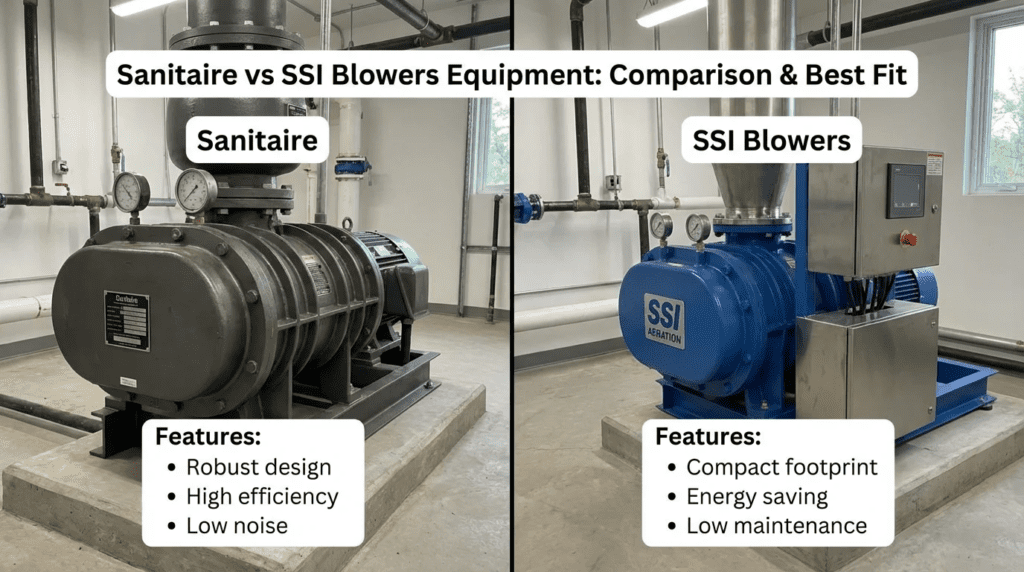
In the design and operation of activated sludge wastewater treatment plants, the aeration system represents the single largest consumer of energy, typically accounting for 50% to 70% of a facility’s total electrical demand. For consulting engineers and utility directors, selecting the correct aeration infrastructure is not merely a purchasing decision; it is a twenty-year commitment to specific hydraulic profiles, transfer efficiencies, and maintenance routines. A frequent point of debate in specification meetings revolves around the Sanitaire vs SSI Blowers Equipment: Comparison & Best Fit scenario.
Engineers often face a dichotomy when specifying this equipment: stick with the legacy “gold standard” widely written into existing municipal specifications, or pivot to challengers offering advanced material sciences and competitive lifecycle cost structures. The stakes are high; a poor selection can lead to premature membrane fouling, skyrocketing backpressure on blowers, and inability to meet discharge permits due to dissolved oxygen (DO) sag.
While both Sanitaire (a Xylem brand) and SSI Aeration are globally recognized for their air distribution systems and diffusers—which dictate the operating points for blower equipment—they approach the market with distinct engineering philosophies. Sanitaire is often synonymous with the invention of the modern fine bubble diffuser industry and offers integrated packages including their TurboMAX blowers. SSI Aeration has carved a significant market share through material innovation, specifically in PTFE-coated membranes and robust piping systems.
This article provides a technical, unbiased analysis for engineering professionals. It moves beyond marketing brochures to discuss Standard Oxygen Transfer Efficiency (SOTE), dynamic wet pressure (DWP), material compatibility, and the real-world operational realities of these systems. The goal is to assist decision-makers in determining which platform provides the optimal balance of CAPEX, OPEX, and reliability for their specific hydraulic and biological process conditions.
How to Select / Specify Aeration & Blower Systems
When evaluating a Sanitaire vs SSI Blowers Equipment: Comparison & Best Fit strategy, engineers must look beyond the initial purchase price of the diffusers or blower units. The selection process must involve a holistic review of the Air Distribution System (ADS) and its interaction with the air generation units (blowers). The following criteria should form the basis of the technical specification.
Duty Conditions & Operating Envelope
The first step in specification is defining the process envelope. Aeration equipment must be sized not just for average daily flow, but for peak hour oxygen demand and minimum mixing requirements.
- Flux Rate (scfm/diffuser): This is a critical design parameter. Operating diffusers at the low end of their flux range improves SOTE but increases capital cost (more diffusers required). Operating at the high end reduces CAPEX but increases head loss (DWP) and reduces transfer efficiency. Engineers must check the efficiency curves of both Sanitaire and SSI products at the specific flux rates calculated for the project.
- Turndown Capability: The system must handle diurnal load variations. If the blower system (e.g., Turbo or PD) has a 4:1 turndown, the aeration grid must utilize diffusers that maintain uniform air distribution without “weeping” (backflow of mixed liquor) at low flow rates.
- Alpha Factor (α): This correction factor accounts for the difference in oxygen transfer between clean water and process wastewater. Different diffuser materials and geometries handle surfactants and fouling differently, affecting the alpha factor over time.
Materials & Compatibility
The longevity of the system is dictated by material selection. This is a primary differentiator between manufacturers.
- Membrane Substrates: EPDM is the standard, but it degrades over time due to plasticizer leaching, leading to hardening and increased backpressure.
- Sanitaire: typically utilizes high-grade EPDM compounds and proprietary blends designed for long-term elasticity.
- SSI Aeration: strongly advocates for PTFE-coated EPDM or fEPDM. The PTFE coating creates a non-stick surface that reduces fouling and calcium scaling, potentially extending cleaning intervals.
- Piping Systems: The air headers and droppers are subject to thermal expansion and vibration. PVC is common for submerged laterals, but stainless steel offers higher durability. Engineers should specify wall thickness (SDR) and thermal expansion joints carefully, regardless of the manufacturer.
- Temperature Limits: In industrial applications (e.g., pulp and paper or food and beverage), wastewater temperatures can exceed 40°C. Standard EPDM may fail; specifications must call for high-temp polymers or silicone membranes.
Hydraulics & Process Performance
The interaction between the diffuser and the blower is governed by Dynamic Wet Pressure (DWP).
- DWP (Head Loss): This is the resistance the diffuser adds to the system. A system with lower DWP requires less blower horsepower. Engineers should request DWP curves for new and fouled conditions (e.g., 5 years in service).
- SOTE (Standard Oxygen Transfer Efficiency): This is the percentage of oxygen transferred to the water per foot of submergence. It is a function of bubble size, flux rate, and floor coverage. High floor coverage (dense grids) yields higher SOTE. Compare the certified SOTE curves for specific grid densities.
Installation Environment & Constructability
Retrofit projects often face severe constraints compared to greenfield sites.
- Leveling Requirements: Diffusers must be leveled within ±¼ inch to ensure uniform air distribution. Systems that offer adjustable saddle mounts or easy-leveling supports reduce contractor labor hours.
- Fixed vs. Retrievable: In basins that cannot be drained (e.g., single train lagoons), retrievable lift-out grids are necessary. Both manufacturers offer retrievable systems, but the ballast requirements and hoisting mechanisms differ.
- Structural Anchoring: Floor anchors must withstand the buoyant force of the air-filled pipes. Failure of anchors leads to catastrophic “floating headers.”
Reliability, Redundancy & Failure Modes
Understanding how the equipment fails is as important as how it runs.
- Membrane Failure: The most common failure is a slit rupture or clamp failure. Quality Assurance in the molding process is vital. Engineers should review the manufacturer’s QA/QC protocols for membrane casting.
- Backflow Prevention: When air is turned off, mixed liquor can enter the piping. Check valves (integrated into the diffuser or the header) are mandatory. Compare the design of the check valve—ball valves vs. flap valves vs. membrane sealing action.
- Piping Fractures: Vibration from blowers or water hammer can crack PVC laterals. Heavy-wall pipe (SDR 26 or thicker) and proper support spacing are critical specification points.
Lifecycle Cost Drivers
The lowest bid often results in the highest 20-year cost due to energy inefficiencies.
- Energy Intensity: A 1% difference in SOTE can translate to tens of thousands of dollars in electricity annually for large plants.
- Cleaning Costs: Systems that foul rapidly require frequent acid cleaning (liquid or gas) or “bumping” (airflow spikes). PTFE-coated systems typically demonstrate lower fouling rates, reducing O&M labor.
- Replacement Cycles: Assume membrane replacement every 5–7 years for standard EPDM, potentially 7–10 years for advanced materials. Factor the cost of draining basins and manual labor into the lifecycle analysis.
Comparison Tables
The following tables provide a side-by-side analysis to assist engineers in the Sanitaire vs SSI Blowers Equipment: Comparison & Best Fit evaluation. Table 1 focuses on the equipment attributes, while Table 2 outlines the best application fit based on facility constraints.
| Feature / Attribute | Sanitaire (Xylem) | SSI Aeration |
|---|---|---|
| Core Technology Focus | Fine Bubble (Ceramic Legacy, Membrane), Coarse Bubble, Integrated Blower Packages (TurboMAX). | Fine Bubble (PTFE Specialists), Coarse Bubble, MBBR Systems, Pod Systems. |
| Membrane Materials | High-quality proprietary EPDM blends (Silver/Gold series). Silicone and Polyurethane options available. | Known for PTFE-coated EPDM (patented), fEPDM, Silicone, and Viton for industrial apps. |
| Primary Strengths | System Integration: Massive install base, deep process guarantees, ability to package with TurboMAX blowers and OSCAR controls. | Material Science: PTFE coating technology reduces fouling and extends cleaning intervals. Innovative mounting (PODs) for rapid install. |
| Piping & Mounting | Robust, traditional fixed grid systems using PVC or Stainless. Highly standardized designs. | Flexible mounting options including Grommet, Saddle, and Quick-Connect systems. Strong focus on retrofit adaptability. |
| Blower Interface | Direct integration with Xylem blower portfolio (Turbo, etc.) for single-source responsibility. | Agnostic. Often partners with various blower OEMs. Provides precise process data for third-party sizing. |
| Limitations | Often carries a premium price point. Proprietary parts in some legacy systems can lock utilities into single-source replacement. | Brand recognition in some highly conservative municipalities may lag behind Sanitaire. Fewer direct “in-house” blower manufacturing capabilities. |
| Application Scenario | Best Fit Strategy | Engineering Rationale | Key Constraint |
|---|---|---|---|
| Large Municipal Plant (>10 MGD) | Competitive Spec (Base Bid + Alternates) | Both Sanitaire and SSI can handle large-scale hydraulics. The decision often comes down to the 20-year Present Worth Analysis including energy. | SOTE Guarantee |
| High-Fouling Industrial (Dairy/Food) | SSI Aeration (PTFE) or Sanitaire Coarse Bubble | PTFE coatings resist biological slime and calcium scaling better than standard EPDM. Alternatively, coarse bubble eliminates fouling risk entirely (at energy cost). | Maintenance Frequency |
| Single-Source Responsibility Required | Sanitaire (Xylem) | If the client wants one warranty for Blowers, Diffusers, and Control Logic (SCADA), Xylem’s integrated package minimizes finger-pointing. | Risk Aversion |
| Budget-Constrained Retrofit | SSI Aeration | SSI often provides cost-effective retrofit kits that can mount onto existing piping headers from other manufacturers, saving piping costs. | CAPEX |
| Deep Tanks (>25 ft side water depth) | Consult Engineering Support | Deep tanks require specialized high-pressure blowers and diffusers capable of withstanding higher external hydrostatic pressure. Sealing integrity is critical. | System Pressure |
Engineer & Operator Field Notes
Design on paper rarely matches reality in the field. The following notes are compiled from commissioning reports, operator logs, and forensic engineering analysis of aeration failures.
Commissioning & Acceptance Testing
The transition from construction to operation is the most critical phase for aeration equipment.
- Clean Water Testing: Ideally, performance should be verified via ASCE clean water oxygen transfer testing before the introduction of wastewater. This establishes the baseline SOTE. However, this is expensive and water-intensive.
- Leak Testing (The “Bubble Pattern” Check): Before the tanks are fully filled, flood the floor with 6-12 inches of water and run the blowers at minimum speed. Look for “volcanoes” (large boils) indicating a broken pipe, loose coupling, or missing diffuser. Uniform, small bubbles should be observed.
- Level Verification: Use a water level or laser level to ensure all diffusers are within the specified tolerance (usually ± 0.25 to 0.5 inches). Deviations cause airflow imbalance, where high spots get all the air and low spots get none.
O&M Burden & Strategy
Operators determine the actual lifespan of the equipment through their maintenance habits.
- The “Bump” Cycle: Operators should flex or “bump” the membranes regularly (e.g., daily or weekly) by ramping airflow to maximum for 5-10 minutes, then returning to setpoint. This expands the membrane pores to dislodge accumulated biofilm. Both Sanitaire and SSI membranes benefit from this, but automation is key—manual bumping is often neglected.
- Moisture Purging: Condensate accumulation in the air headers increases backpressure and causes airflow pulsation. Purge systems (airlifts) must be accessible. If an operator has to kayak into a lagoon to open a purge valve, it will never happen. Specify shore-mounted purge lines.
- Acid Cleaning: For scaling wastewater, in-situ acid cleaning (introducing formic or acetic acid gas into the airstream) is effective. Ensure the piping material (and blower discharge silencers) are compatible with the acid used.
Troubleshooting Guide
Symptom: Rising Blower Discharge Pressure
This typically indicates diffuser fouling. The pores are clogged, requiring higher pressure to force air through.
Action: Initiate bump cycle. If unsuccessful, consider acid cleaning or tank drainage for pressure washing.
Symptom: Dropping Blower Discharge Pressure + High DO in one zone
This indicates a leak. A pipe has fractured, or a diffuser has blown off. The system resistance has dropped because air is taking the path of least resistance.
Action: Inspect the tank surface for large boils. Isolate the dropleg immediately to prevent damage to the blower (some blowers cannot run against zero backpressure) and wash-out of solids.
Design Details & Calculations
Sizing Logic & Methodology
To accurately compare Sanitaire vs SSI Blowers Equipment, the engineer must perform independent sizing calculations rather than relying solely on vendor proposals.
- Determine AOR (Actual Oxygen Requirement): Based on BOD/COD loading, TKN (for nitrification), and endogenous respiration.
Typical range: 1.1 to 1.5 lbs O2/lb BOD removed. - Calculate SOR (Standard Oxygen Requirement): Convert AOR to standard conditions (20°C, sea level, clean water) using the Alpha factor (α), Beta factor (β), and Temperature correction (Theta).
Formula: SOR = AOR / [ (α * (SOTE_field / SOTE_std) * Theta^(T-20) ) ]
Note: Alpha factor is the most sensitive variable. For fine bubble, typical α is 0.45 – 0.65 depending on sludge age and wastewater characteristics. - Select Flux Rate: Choose a design flux rate (scfm/diffuser).
Low Flux (0.5 – 1.5 scfm): High efficiency, high capital cost.
High Flux (2.0 – 4.0 scfm): Lower efficiency, lower capital cost, higher mixing energy. - Calculate Airflow: Required scfm = SOR / (SOTE expressed as decimal * Oxygen weight in air).
Standards & Compliance
Ensure specifications reference the following to maintain quality control:
- ASCE 2-06: Measurement of Oxygen Transfer in Clean Water.
- ASTM D 412: Vulcanized Rubber and Thermoplastic Elastomers—Tension (Membrane material testing).
- ASTM D 1171: Ozone Resistance (Critical for EPDM exposure to air/sunlight).
Frequently Asked Questions
What is the difference between Sanitaire and SSI membrane materials?
Sanitaire primarily utilizes high-grade proprietary EPDM compounds known for long-term elasticity and resistance to plasticizer extraction. SSI Aeration offers standard EPDM but differentiates itself with PTFE-coated membranes. The PTFE coating provides a non-stick surface that improves resistance to fouling and calcium scaling, potentially maintaining the Alpha factor longer than uncoated EPDM in aggressive wastewaters.
How do I select the right flux rate for fine bubble diffusers?
Selection depends on the balance between CAPEX and OPEX. A lower flux rate (e.g., 0.8–1.2 scfm/diffuser) yields higher SOTE and lower energy costs but requires more diffusers and piping (higher CAPEX). A higher flux rate (e.g., 2.5–3.0 scfm/diffuser) reduces upfront costs but increases energy consumption over the life of the plant. Most municipal designs target 1.0–2.0 scfm/diffuser for an optimal lifecycle balance.
Can I mix Sanitaire diffusers with SSI piping (or vice versa)?
Physically, it is often possible, especially if standard connection types (like 3/4″ NPT nipple or saddle mounts) are used. However, mixing manufacturers voids process guarantees and warranties. For retrofits, SSI offers replacement diffusers designed to fit onto existing Sanitaire headers (and other brands), which is a common cost-saving strategy for membrane replacement projects.
How often should fine bubble diffusers be replaced?
In municipal wastewater, high-quality EPDM membranes typically last 5 to 7 years. With optimal maintenance (regular bumping and cleaning) and advanced materials (like PTFE or proprietary blends), lifespans can extend to 8–10 years. Indicators for replacement include significantly reduced SOTE, visible tearing, or excessive backpressure that endangers blower surge margins.
Why is the Alpha factor critical in the Sanitaire vs SSI comparison?
The Alpha factor (α) represents the ratio of oxygen transfer in wastewater versus clean water. It corrects for the interference of surfactants and contaminants. If a manufacturer claims an unrealistic Alpha factor (e.g., 0.85 for raw sewage), their system will appear more efficient on paper than it is in reality. Engineers should require justification for Alpha factors used in sizing or mandate a conservative value (e.g., 0.50–0.60) for all bidders.
Do these systems require pressure relief valves?
Yes. While the blowers themselves have relief valves, the aeration piping system is sensitive to over-pressurization and thermal expansion. However, the primary protection is at the blower discharge. The aeration design must ensure that the maximum fouled diffuser head loss plus hydrostatic head does not exceed the relief valve setting of the blowers.
Conclusion
KEY TAKEAWAYS
- Process Efficiency Drives Cost: The aeration system dictates blower power. A 10% gain in transfer efficiency (SOTE) outweighs diffuser CAPEX savings within 2-3 years.
- Material Matters: Consider PTFE-coated membranes (SSI strength) for high-fouling or scaling applications. Consider integrated packages (Sanitaire strength) for single-source accountability.
- Define the Boundary: Clarify if the “Blower Equipment” spec includes just the air movers or the entire Air Distribution System. The ADS design is the governing factor.
- Normalize the Alpha: When comparing bids, ensure all vendors use the same Alpha factor and site elevation data to prevent “specmanship.”
- Plan for Maintenance: Specify shore-mounted purge valves and easy-access bumping controls. If it’s hard to maintain, it will fail.
The choice in the Sanitaire vs SSI Blowers Equipment: Comparison & Best Fit analysis is rarely about one being objectively “better” than the other; it is about application alignment. Sanitaire (Xylem) remains the heavyweight choice for large-scale, integrated municipal projects where single-source responsibility for blowers, diffusers, and controls is a priority for risk mitigation. Their robust engineering support and massive install base provide a safety net for conservative designs.
SSI Aeration stands out as the agile, technically advanced option, particularly where material performance (PTFE coatings) and retrofit flexibility are paramount. For plants struggling with rapid fouling, calcium scaling, or tight budget constraints requiring the reuse of existing headers, SSI often provides a superior technical fit.
Ultimately, the consulting engineer must take ownership of the hydraulic and biological sizing. By defining the flux rates, mandating conservative Alpha factors, and rigidly specifying piping wall thicknesses and support intervals, the engineer creates a level playing field. This ensures that whether the plant utilizes Sanitaire’s integrated ecosystem or SSI’s advanced material platforms, the utility receives a system built for twenty years of reliable compliance.