
Screw Pump Clogging and Ragging: How to Reduce Blockages
Introduction
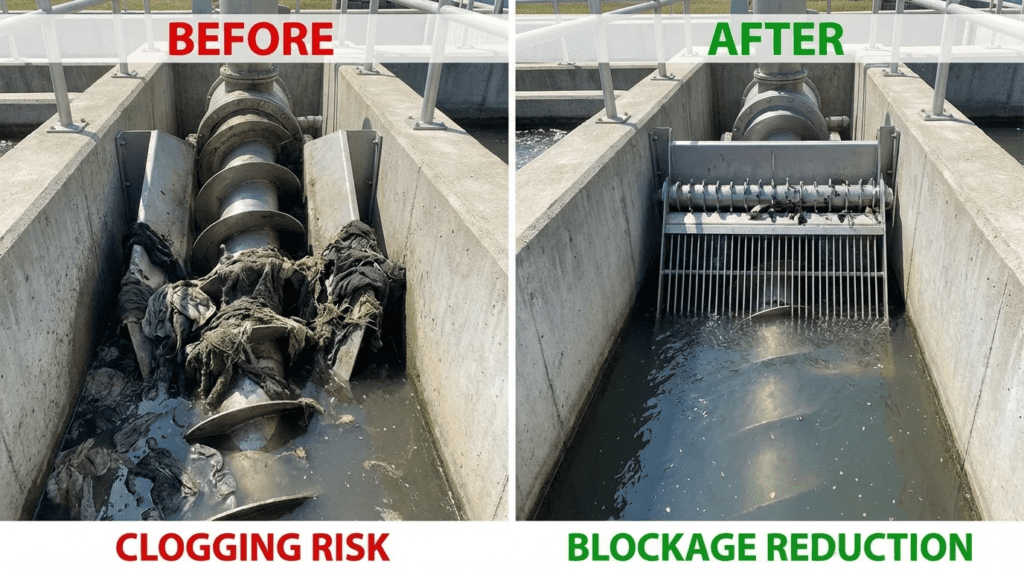
The rise of non-dispersible synthetic fabrics—commonly known as “wipes” or “rags”—in municipal wastewater streams has fundamentally altered the operational reliability of pumping systems. For decades, engineers relied on sphere-passing capability as the primary metric for solids handling. However, modern debris streams form long, tenacious ropes that defy traditional sphere-passing logic. One of the most critical challenges facing plant directors and design engineers today is managing Screw Pump Clogging and Ragging: How to Reduce Blockages to maintain compliance and control operational expenditures.
While “screw pumps” in wastewater generally refer to two distinct technologies—the open-flight Archimedes screw and the enclosed screw centrifugal (hybrid) pump—both face unique challenges regarding fibrous solids. The screw centrifugal pump, often selected for its high efficiency and gentle handling of sludge, is particularly susceptible to “stapling,” where rags catch on the leading edge of the impeller, accumulate into a “rag ball,” and eventually choke the suction eye.
The financial implications are severe. Utilities report spending thousands of man-hours annually on manual deragging—a hazardous task that exposes operators to raw sewage and confined spaces. Furthermore, a partially ragged pump often operates at 10-20% reduced efficiency for weeks before a complete trip occurs, resulting in hidden energy waste.
This article moves beyond basic product descriptions to provide engineers with a rigorous technical framework for selecting, specifying, and operating screw pump technologies. We will examine the physics of rag formation, the hydraulic nuances of impeller design, and the control strategies necessary to mitigate Screw Pump Clogging and Ragging: How to Reduce Blockages in municipal and industrial applications.
How to Select and Specify for Ragging Resistance
Proper selection begins with acknowledging that standard “non-clog” specifications are often insufficient for modern ragging loads. Engineers must evaluate the specific interaction between the fluid rheology, the debris character, and the pump geometry. The following criteria outline the engineering decisions required to address Screw Pump Clogging and Ragging: How to Reduce Blockages effectively.
Duty Conditions & Operating Envelope
The operating envelope dictates the likelihood of rag accumulation. Rags tend to drop out of suspension and bind together at low velocities, creating “ropes” in the suction piping before they even reach the pump.
- Minimum Velocity Requirements: Unlike clean water applications, wastewater lines containing high rag content should maintain velocities above 1.0–1.2 m/s (3.5–4 fps) to prevent sedimentation and rag ball formation in the suction line. Variable Frequency Drive (VFD) turndown ratios must be limited to maintain this scour velocity.
- Flow Regime: Intermittent operation (Stop/Start) can be beneficial for clearing minor accumulations if the pump ramps up quickly. However, prolonged operation at the far left of the curve (low flow) increases recirculation at the suction eye, which acts as a centrifuge for rags, promoting stapling.
- Solids Concentration: For sludge applications (RAS/WAS), the viscosity change impacts the drag forces on fibrous materials. Higher solids concentrations typically require greater torque margins to shear through initial blockages.
Materials & Compatibility

Material hardness plays a subtle but critical role in ragging mitigation. Soft materials (standard cast iron) erode quickly at the impeller’s leading edge. As the edge becomes jagged and pitted, it creates anchor points for fibers to staple.
- Hardened Leading Edges: Specifying High Chrome Iron (ASTM A532 Class III) or hardened tool steel for the impeller—or at least the suction liner/cone—preserves the smooth, sharp profile necessary to shed solids.
- Surface Finish: The interior surface roughness of the volute and suction cover impacts friction. A rough casting finish promotes the initial snagging of hair and fiber. Specifying a smoother finish or a ceramic epoxy coating can reduce the coefficient of friction, aiding in debris passage.
- Abrasion-Corrosion Synergy: In grit-heavy environments, abrasion wears down the impeller clearance. As the gap between the screw impeller and the suction liner increases (typically beyond 0.5-1.0mm), rags get trapped in the gap, rolling into tight wedges that stall the motor.
Hydraulics & Process Performance
The geometry of the screw centrifugal impeller is the primary defense against clogging. Unlike a standard radial centrifugal impeller, the screw centrifugal design features a single spiral vane that extends axially into the suction.
- Leading Edge Profile: The transition from the axial screw section to the radial centrifugal section must be smooth. Any abrupt change in angle provides a catch point. Engineers should request impeller profile drawings during the submittal phase.
- Suction Recirculation: Pumps operating significantly away from the Best Efficiency Point (BEP) generate suction recirculation vortices. These vortices spin rags into tight braids. Sizing the pump so that the primary duty point is slightly to the right of BEP can reduce this recirculation zone.
- NPSH Margin: Cavitation creates pitted surfaces which subsequently trap rags. Ensure an NPSH available (NPSHa) margin of at least 1.0 to 1.5 meters (3-5 ft) over NPSH required (NPSHr) to prevents surface degradation.
Installation Environment & Constructability
The physical layout of the station contributes significantly to clogging potential.
- Suction Piping Geometry: Elbows located immediately upstream of the pump suction induce pre-rotation. This swirling motion twists rags into ropes. An eccentrically reduced straight run of at least 5 pipe diameters is recommended to straighten flow.
- Wet Well Hydrodynamics: Stagnant zones in the wet well allow grease and rags to agglomerate into “mats.” When these mats eventually break loose, they overwhelm the pump regardless of its design. Bench and fillet design in the wet well is critical to ensure solids enter the pump continuously rather than in slugs.
Reliability, Redundancy & Failure Modes
Screw Pump Clogging and Ragging: How to Reduce Blockages strategies must account for failure modes. The most common failure mode in screw centrifugal pumps is the “soft clog,” where the pump continues to run but at drastically reduced flow, causing motor heating and vibration.
- Seal Protection: Ragging causes shaft deflection and high vibration. Cartridge mechanical seals with isolated springs are preferred, as rags can pack into exposed seal springs, locking them open or closed.
- Bearing Life: The radial loads caused by an unbalanced “rag ball” on the impeller can reduce L10 bearing life by 50% or more. Oversized shafts and bearings are a prudent specification for high-rag environments.
Controls & Automation Interfaces
Modern VFDs are the most effective active defense against ragging.
- Anti-Ragging Logic: Specifications should require VFDs capable of “pump cleaning cycles.” This logic detects a spike in torque or a drop in flow/power. The drive then stops the pump, reverses direction for a set number of rotations to unwind the rag, and restarts in forward motion to flush the debris.
- Instrumentation: Reliance on motor amps alone is often insufficient to detect partial clogging. Power monitors (kW) are more linear and accurate. Ideally, a flow meter on the discharge provides the definitive signal that a clog is forming.
Lifecycle Cost Drivers
When analyzing Total Cost of Ownership (TCO), the cost of manual deragging often dwarfs the initial CAPEX difference between a standard pump and a premium blockage-resistant pump.
- Energy Efficiency: A screw centrifugal pump might have a peak efficiency of 75-80%, slightly lower than a standard clean-water centrifugal pump. However, if the standard pump runs partially clogged at 40% efficiency for half its life, the screw pump is the superior energy choice.
- Maintenance Labor: Engineers should estimate the cost of two operators and a crane truck visiting the site weekly to derag pumps vs. a semi-annual inspection for a properly specified screw pump.
Technology Comparison and Application Fit
The following tables provide a structured comparison of pump technologies regarding their ability to handle fibrous solids. Use these tools to align equipment selection with process requirements, moving beyond manufacturer claims to underlying engineering principles.
| Technology Type | Primary Features | Ragging/Clogging Resistance Profile | Typical Efficiency | Limitations |
|---|---|---|---|---|
| Screw Centrifugal (Hybrid) | Single spiral vane, extended axial suction, steep H-Q curve. | High. Gentle handling prevents emulsification, but “stapling” on the leading edge is the primary failure mode. Requires tight clearance maintenance. | 70% – 85% | Clearance adjustment is critical. Sensitive to suction head (NPSH). |
| Archimedes Screw (Open Flight) | Positive displacement, open trough, low RPM. | Excellent. Virtually impossible to “rag” in the traditional sense. Rags pass through unless the trough gap is excessive. | 70% – 75% | Large physical footprint. Odor control issues (open). High civil construction costs. |
| Chopper / Cutter Pump | Serrated impeller edges, stationary cutter bar/plate. | High (Active). Actively cuts rags into smaller pieces. Prevents pump clogging but passes potential downstream issues (re-weaving). | 50% – 65% | Lower hydraulic efficiency. Cutter components require sharpening/replacement. Higher maintenance OPEX. |
| Vortex (Recessed Impeller) | Impeller recessed out of flow path. Pumping via fluid vortex. | Good. Solids do not pass through impeller vanes, reducing stapling. | 35% – 50% | Very low hydraulic efficiency. Not viable for high-flow/high-head continuous duty due to energy costs. |
| Application Scenario | Typical Debris Load | Best-Fit Technology | Key Decision Criteria |
|---|---|---|---|
| Raw Influent (Headworks) – Large Plant | High volume of wipes, grit, sanitary products, potential large objects. | Archimedes Screw | Unmatched reliability for variable coarse solids. Low shear preserves floc structures. High capital cost offset by extremely low maintenance. |
| Raw Sewage Lift Station (Remote) | High concentration of non-dispersible wipes from residential sources. | Screw Centrifugal with Cutter/Hardened Edge | Requires ability to pass rags without jamming. Auto-reversing VFD controls are mandatory here. |
| Return Activated Sludge (RAS) | Viscous, high solids, hair/fiber accumulation. | Screw Centrifugal | Gentle action preserves biological floc. High efficiency is critical for continuous duty. Large free passage handles hair balls. |
| Stormwater Station | Leaves, branches, trash, intermittent high flows. | Axial Flow or Screw Centrifugal | Ability to move massive volume. “Ragging” is less of an issue than large object blockage. |
| Digester Circulation | Thick sludge, potential struvite, re-woven rags. | Chopper Pump | Active cutting is often required to break down re-woven rags formed in the digester mixing process. |
Engineer and Operator Field Notes
Design theory often clashes with operational reality. The following insights are drawn from field experience in commissioning and maintaining systems prone to Screw Pump Clogging and Ragging: How to Reduce Blockages.
Commissioning & Acceptance Testing
Commissioning is the first line of defense. Do not accept a pump based solely on a clean-water curve test.
- Vibration Baselines: Establish strict vibration baselines (ISO 10816) across the full flow range. A pump that vibrates excessively at partial flow is signaling hydraulic instability that will invite ragging.
- Deragging Logic Verification: During the Site Acceptance Test (SAT), simulate a blockage (or use the VFD manual controls) to trigger the cleaning cycle. Verify the ramp-down, dwell time, reverse speed, and ramp-up rates. Aggressive reversals can loosen impeller bolts if not properly torqued or locked.
- Amp Draw Baselines: Record the “Clean Water Amps” at the design point. This number is the reference point for setting the “High Torque/Clog” alarm setpoints later.
While you cannot throw rags into a test loop, you can simulate the hydraulic effect. If a pump cannot handle a sudden 10% increase in head pressure or a minor speed reduction without entering an unstable vibration zone, it lacks the hydraulic stability to handle the “drag” created by a developing rag ball.
Common Specification Mistakes
Avoiding these errors in the Request for Proposal (RFP) can prevent years of maintenance headaches.
- Oversizing for Future Flows: Engineers often size pumps for “20-year build-out” flows. This forces the pump to operate at 30-40% capacity for the first decade. Low flow velocities in the volute allow rags to settle, staple, and weave. Always use VFDs and consider smaller “jockey” pumps for early-stage low flows.
- Ignoring Suction Liner Adjustment: Screw centrifugal pumps rely on a tight gap (0.25mm – 0.50mm) between the screw and the liner. If the spec does not call for an externally adjustable suction liner, operators must disassemble the piping to adjust clearance—meaning it will never happen.
- Vague Material Specs: Specifying “Cast Iron” allows vendors to supply soft gray iron. Specify “Ductile Iron (ASTM A536)” minimum for strength, and “High Chrome” or “Hardened” options for wear components in grit/rag applications.
O&M Burden & Strategy
Operational strategies must shift from reactive to proactive.
- Amperage Monitoring: A ragged pump often draws less power (lower amps) because the flow is choked off, effectively unloading the motor (similar to a closed valve). Conversely, a binding rag draws high amps. Operators must understand this dual signature.
- Preventive Reversals: Do not wait for a clog alarm. Program the VFD to perform a “preventive cleaning cycle” (reverse/flush) once every 24 hours, preferably during low-flow periods. This sheds minor accumulations before they densify into ropes.
- Clearance Checks: For screw centrifugal pumps, check the impeller-to-liner clearance quarterly. If the gap doubles, efficiency drops, and the probability of rags wedging in the gap increases exponentially.
Design Details and Sizing Logic
Reducing Screw Pump Clogging and Ragging: How to Reduce Blockages requires specific attention to sizing logic and hydraulic constraints.
Sizing Logic & Methodology
When sizing a screw centrifugal pump, the intersection of the system curve and pump curve is only part of the story.
- Determine Minimum Scour Velocity: Calculate the pipe diameter such that the velocity at minimum flow is > 1.0 m/s.
Calculation: V = Q / A. If the resulting V is too low, reduce pipe diameter or use a smaller pump for low-flow periods. - Select Free Passage: The “Free Passage” or “Sphere Size” should generally be at least 75mm (3 inches) for raw sewage. However, for screw pumps, look at the “Throughlet” size. Ensure the spiral geometry does not have a “choke point” smaller than the suction inlet.
- Check Specific Speed (Ns): Lower specific speed pumps (narrow impellers) are generally more prone to clogging than higher specific speed pumps (wider flow paths). Where possible, select a pump speed and geometry that yields a moderate Ns (typically Ns 1500-2500 in US units) to balance efficiency and solids handling.
Specification Checklist
Ensure the following items appear in your detailed technical specifications:
- Impeller Design: “Single-vane, screw-centrifugal type with positive displacement characteristics in the inducer section.”
- Cutting Features: “Impeller leading edge shall be hardened (min 450 BHN) or equipped with a replaceable cutting groove/serration.”
- Drive System: “Motors shall be rated for inverter duty (MG1 Part 31) and capable of continuous operation at 30% speed and full reverse torque.”
- Testing: “Witnessed performance test shall include minimum stable flow determination and vibration recording at 50%, 75%, 100%, and 110% of BEP.”
Do not assume a pump that passes a 3-inch sphere will pass a rag. A sphere is a rigid solid; a rag is a flexible tensile web. Rags wrap; spheres roll. Prioritize leading edge geometry and lack of protrusions over sphere size when evaluating ragging resistance.
Frequently Asked Questions
What is the difference between clogging and ragging?
While often used interchangeably, they are distinct. Clogging refers to a blockage caused by a large hard object (wood, stone, tennis shoe) getting stuck in the volute or impeller vane. Ragging is the accumulation of fibrous materials (wipes, hair, string) that staple onto the leading edge of the impeller or wrap around the shaft. Ragging typically builds up over time, gradually reducing performance, whereas clogging is often an instant trip event.
How effective are grinder pumps compared to screw pumps for preventing blockages?
Grinder pumps are effective at low flows (residential lift stations) but are hydraulically inefficient and maintenance-intensive for larger flows. Grinders reduce solids to a slurry, which prevents pump clogging but can cause downstream issues at the headworks (passing through screens). Screw pumps (centrifugal type) are preferred for larger municipal flows because they pass solids intact (better for screening) and offer significantly higher hydraulic efficiency and lifecycle savings.
Why does my screw centrifugal pump clog even though it has a large free passage?
This is likely due to “stapling” or excessive clearance. Even with a large free passage, if the leading edge of the screw is rough or pitted, rags will catch (staple) on the imperfection. Additionally, if the clearance between the rotating screw and the stationary liner exceeds 1.0mm, rags will wedge into the gap, creating a braking effect. Check the liner clearance and the condition of the impeller leading edge.
Can Variable Frequency Drives (VFDs) eliminate the need for manual deragging?
VFDs with advanced “pump cleaning” algorithms can reduce manual deragging by 70-90%, but they rarely eliminate it entirely. These algorithms detect torque spikes and reverse the pump to unspool the rag. However, if a “rag ball” has become extremely dense or is wrapped tightly around the shaft behind the impeller, hydraulic reversal may not generate enough force to dislodge it. VFDs are a mitigation tool, not a cure-all.
What is the recommended interval for screw pump clearance adjustment?
For screw centrifugal pumps in raw sewage applications, clearance should be checked every 3 to 6 months. In high-grit environments, wear occurs faster. Most modern designs allow for external adjustment without disassembling the piping. Maintaining a tight clearance (typically 0.25mm – 0.50mm) is the single most effective maintenance task to prevent Screw Pump Clogging and Ragging: How to Reduce Blockages.
How does the wet well design impact ragging?
Poor wet well design creates stagnant zones where grease and rags combine to form “mats.” When the water level drops, these mats break off and enter the pump en masse, overwhelming even the best non-clog pumps. A self-cleaning trench-style wet well or steeper benching directs solids into the pump continuously in manageable amounts, rather than allowing them to accumulate and slug the system.
Conclusion
Key Takeaways
- Differentiate Technologies: Understand the difference between Archimedes screws (clog-proof, large footprint) and Screw Centrifugal pumps (efficient, requires specific specs for ragging).
- Velocity Matters: Maintain suction line velocities >1.0 m/s to prevent rags from roping before they reach the pump. Avoid massive oversizing.
- Tight Clearances: Screw centrifugal pumps require tight impeller-to-liner clearances (0.25-0.50mm) to shear solids. Large gaps promote wedging.
- Hardened Materials: Specify High Chrome Iron or hardened edges to maintain the sharp cutting profile necessary to shed rags.
- Active Controls: Mandate VFDs with auto-reverse/cleaning logic in the specification. It is the most cost-effective retrofit for ragging issues.
Successfully managing Screw Pump Clogging and Ragging: How to Reduce Blockages requires a holistic engineering approach that transcends simple pump selection. It involves analyzing the entire hydraulic system—from the wet well geometry and suction piping to the material hardness and control logic.
For municipal and industrial engineers, the goal is to balance hydraulic efficiency with operational reliability. While no pump is immune to the extreme challenges posed by modern non-dispersible wipes, a correctly specified screw centrifugal pump, paired with intelligent controls and disciplined maintenance of clearances, remains one of the most effective tools in the wastewater arsenal. By focusing on the “systems” approach detailed in this article, utilities can significantly reduce the lifecycle costs associated with blockages and improve the safety and efficiency of their treatment operations.