
Sedimentation in Wastewater Treatment: How to Size and Improve Clarifiers
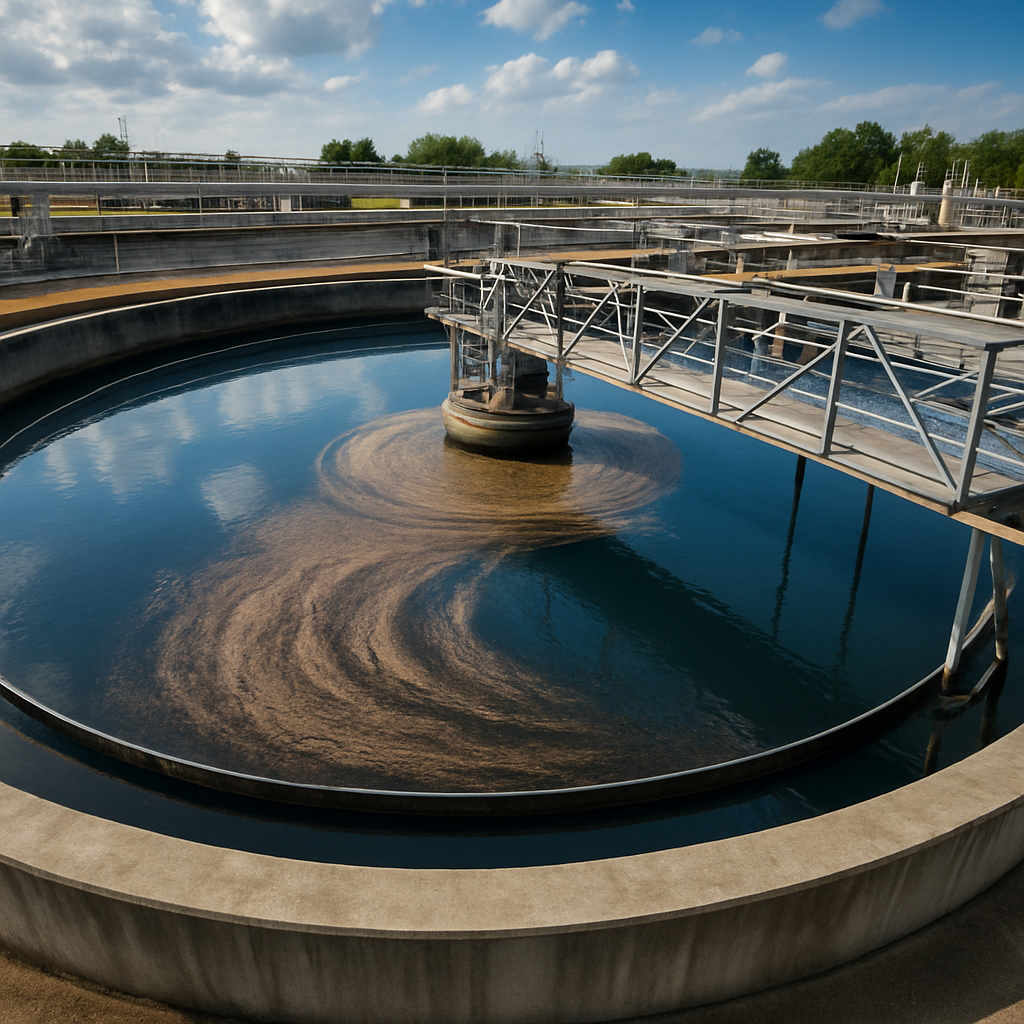
Sedimentation in Wastewater Treatment: How to Size and Improve Clarifiers
Sedimentation remains the dominant physical process that controls solids removal, effluent quality, and clarifier footprint in municipal and industrial wastewater treatment. This guide gives the exact sizing equations you need, practical hydraulic and mechanical fixes to stop short-circuiting and solids carryover, and a decision framework for choosing conventional clarifiers or compact options such as lamella settlers. You will also find worked calculations, retrofit strategies, and monitoring protocols to translate theory into measurable improvements on-site.
Sedimentation fundamentals relevant to clarifier performance
Key point: Clarifier performance is driven by the relationship between particle settling velocity and the local upward hydraulic velocity. Area sets the available quiescent surface where particles can fall out; poor hydraulics or high solids concentration remove effective area and defeat even correctly sized tanks.
Particle settling regimes and practical consequences
Discrete, flocculent, and hindered settling: Discrete settling applies when particles settle independently. Flocculent settling dominates in secondary and many industrial streams where particles form loose aggregates. Hindered settling occurs at higher solids concentrations when particles interact and form a rising sludge blanket. Each regime changes how you predict removal and what interventions work.
Stokes law is a starting point, not the answer. Use the Stokes equation v = g (rho_p – rho) d^2 / 18 mu to estimate settling velocity for small, rigid spheres. In real wastewater particles are non-spherical, porous, low density flocs and experience shear, breakup, and consolidation. Rely on Stokes only to order magnitude checks and always validate with jar tests or in-plant settling data.
Concrete Example: A 100 micrometer rigid sphere with particle density 2600 kg m-3 in water (viscosity 0.001 Pa s) has a Stokes settling velocity of roughly 0.009 m s-1 or 0.9 cm s-1. In activated sludge this same nominal size will often settle far slower because flocs are lower density and fragile. Designing to the Stokes number here would overestimate removal and risk carryover.
Metrics that matter on-site: Surface overflow rate SOR = Q/A remains the most predictive design metric for clarifiers handling discrete and flocculent particles but be aware that local upflow pockets, short-circuiting, and feedwell mixing reduce effective area. Detention time, sludge blanket depth, solids loading rate, and weir loading also affect performance and maintenance demands.
- Surface overflow rate: Primary control for particle separation and clarifier sizing
- Settling velocity: Use bench tests to derive an effective v that represents the wastewater stream
- Solids loading rate: Predicts hopper performance and need for more frequent sludge removal
- Weir loading: Controls hydraulic uniformity at effluent; spikes concentrate flow and increase carryover
Tradeoff to accept: Chemical coagulation and intensive flocculation will reduce fine solids in the effluent but substantially increase sludge mass and change downstream dewatering needs. Compact solutions such as lamella packs reduce footprint but demand near perfect flow distribution and higher maintenance discipline.
Practical next step: If you are diagnosing poor performance, measure effluent turbidity, run quick settling jars, and inspect feedwell energy dissipation. For design questions, pair SOR calculations with on-site settlability data and review the mechanical feed distribution details in Clarifiers and hydraulics guidance from EPA.
Design parameters and equations every engineer must use
Start with surface loading, not tank depth. For practical clarifier sizing the controlling relationship is between the upward hydraulic velocity and the particle settling velocity; area is what you choose to control that hydraulic velocity. Ignore marketing claims about deep tanks rescuing poor hydraulics – they rarely do in practice.
Core sizing equations and unit notes
- Clarifier surface area:
A = Q / SOR— use Q in m3/day and SOR in m3/m2/day to get A in m2. If you prefer US units,A(ft2) = Q(gpd) / SOR(gpd/ft2). - Volume / detention time:
V = Q * t— choose t in days (or convert hours to days) so V and Q share the same time base. For hydraulics use seconds and m3/s when computing velocities. - Local upflow (required settling velocity):
vup = Q / A— this is the cut-off settling velocity (m/s). Particles with vs > v_up tend to be removed; those slower will remain in suspension. - Weir loading:
WL = Q / L_w— express WL as m3/day per metre of weir (or gpd/ft). Keep WL uniform; concentrate weir flow and you concentrate carryover. - Solids loading rate (mass flux):
SLR = (Q * SS) / A— compute Q in m3/day, SS in g/m3 (mg/L = g/m3), then SLR in kg/m2/day after dividing by 1000.
Conversion guardrails: Always convert MGD to gpd or m3/day before dividing by SOR. 1 MGD = 1,000,000 gpd = 3,785.41 m3/day; 1 ft2 = 0.092903 m2. Small arithmetic mistakes here produce undersized designs.
Design ranges (practice-based): Typical working surface overflow rates used by designers fall in broad bands depending on clarifier function and influent character; consult WEF or Tchobanoglous for final selection and apply a safety margin if feed is flocculent or variable. Use on-site jar tests to choose where in the band you should sit.
Practical trade-off: Lowering SOR (bigger area) improves removal of fine and slow-settling particles but raises capital cost and footprint. Adding coagulation reduces required area but shifts cost and operational burden into chemical use and larger, wetter sludge handling.
Concrete Example: For a 10 MGD plant, pick SOR = 800 gpd/ft2 as a working value. Area = 10,000,000 gpd / 800 gpd/ft2 = 12,500 ft2 (≈ 1,161 m2). Q = 10 MGD = 37,854 m3/day, so v_up = Q/A = 37,854 / 1,161 ≈ 0.00038 m/s (≈ 0.38 mm/s). If your jar tests show a practical settling velocity distribution with a large fraction below 0.4 mm/s, expect carryover or need for chemical aid.
Interpretation of the example: That 0.38 mm/s number is the cut-size for removal. In real activated-sludge or industrial streams many particles are flocculent and fragile; design to a margin below the median settlability (for example target vup at 60-70 percent of the median measured vs) to allow for shear and day-to-day variability.
Common mistake and judgement: Relying on Stokes law or default SOR numbers without plant-specific settling tests is the root cause of undersized clarifiers. In practice, prioritize a small suite of site measurements — jar tests, short tracer runs, and a day of effluent turbidity monitoring — and use those to select SOR and sludge handling rates rather than textbook defaults alone. For design details on feedwell and launder integration see Clarifiers and WEF guidance.
Next consideration: after you set area and volume with these equations, validate hydraulics with tracer tests and check feedwell energy dissipation — correct area plus poor flow distribution still gives bad effluent.
Selecting clarifier type and configuration
Start with the material you need to remove, not the tank shape. Particle size distribution, fraction of colloidal versus flocculent solids, grit/rag content, and sludge mass flux drive the decision more than aesthetic preferences. Choose a configuration that matches solids characteristics, required footprint, and downstream sludge handling capacity.
A practical decision framework
- Define the performance target: pick an effluent SS or turbidity target and translate that into a required cut-size settling velocity using site jar tests or historical settlability data.
- Screen for nuisances: if grit, rags, or heavy inorganic loads are present, eliminate compact internals that will clog and prefer conventional tanks with grit removal upstream.
- Match mass flux to hopper design: compute solids loading rate (SLR) at peak flow and select hopper geometry and withdrawal capacity capable of the calculated kg/m2/day.
- Decide on footprint versus OPEX tradeoff: if land is constrained, consider inclined-plate packs or lamella, but budget for stricter flow control and more frequent access/cleaning.
- Piloting and verification: use a bench lamella or a temporary tube-settler trial and a brief tracer test to confirm hydraulics before committing to costly retrofits.
| Clarifier Type | Best fit | Key limitations | Maintenance focus |
|---|---|---|---|
| Rectangular (channelized) | Plants with predictable flow profiles and straightforward desludging | Requires more site area; poor inlet design causes short-circuiting | Feedwell integrity, scraper torque, hopper draw-off scheduling |
| Circular (mechanical bridge) | Variable flows and heavy solids where central collection is advantageous | Higher capital per unit area; mechanical pivot requires robust drives | Bridge bearings, centre feedwell, sludge pump reliability |
| Inclined-plate / lamella | Sites with limited footprint and fine, well-conditioned flocs | Sensitive to uneven feed, clogging with fibrous material, access constraints | Periodic plate cleaning, careful flow distribution, monitoring for localized bypass |
| Thickening/clarifying hybrids | When sludge volume reduction and clarification must be combined | Higher solids concentration complicates scraper and hopper design | Polymer dosing control, hopper cone angles, sludge withdrawal reliability |
Practical insight: Inclined-plate modules succeed only when the inlet flow is distributed uniformly across the bank and upstream screening removes coarse debris. In practice, I have seen lamella packs underperform when operators left bypass culverts open or when inconsistent polymer dosing created sticky sludge that bridged between plates.
Trade-off to accept: Compact designs buy area but transfer complexity. You trade lower capital and land cost for higher sensitivity to hydraulic disturbances and a higher maintenance discipline. If operations are thin-staffed or influent quality varies seasonally, a conventional tank is often the safer long-term choice.
Concrete example: At a 5 MGD plant constrained by an expansion site, engineers installed inclined plates into two existing rectangular tanks. The retrofit halved the plan view occupied by clarifiers and achieved the plant's effluent SS goal only after installing a new uniforming baffle and scheduled weekly plate inspections. The lesson: the hardware change was necessary but not sufficient without correcting inlet hydraulics and maintenance routines.
Critical: never select a compact clarifier without verifying feed distribution and cleaning access; those two failures account for most underperforming retrofits.
Next consideration: After picking type and layout, lock down the hydraulic details: inlet energy dissipation, launder distribution, and hopper withdrawal logic are where most selected designs either succeed or fail — plan those before ordering plates or drives.
Hydraulic and mechanical design details to avoid short-circuiting and carryover
Direct point: Most solids carryover is a hydraulic problem, not a solids problem. You can size area perfectly and still get suspended solids in the effluent if the inlet jet punches through the settling zone or the launder concentrates flow into a few spots.
Inlet quiescing (feedwell) rules that work in the field: Design the inlet chamber so turbulent momentum is dissipated before flow reaches the settling plane. Practically, that means creating a stilling volume with short residence time (order of seconds at peak flow), using flow-diffusing perforated plates or chevron baffles, and keeping inlet jets away from the effluent launder. Avoid hard elbows that generate high local shear near the settling surface.
Weir and launder details that reduce localized overloading
Weir uniformity matters more than total length. Make the launder feed uniform along the bank by providing equalizing troughs or submerged spreaders and avoid point discharges directly onto the weir. Small variations in weir elevation or blocked scum troughs create concentrated upflow zones that defeat the surface loading you calculated.
- Practical check: Inspect weir elevations with a string line during commissioning; adjust shims or clips to keep deviations within a few millimetres.
- Launder protection: Add perforated toe plates or adjustable weir dams to prevent local high-velocity washout during short, high flows.
- Bypass control: Ensure any bypass or flashboards have positive locking and visual indicators so field crews do not leave them open after storms.
Mechanical elements that actually affect clarity: Scraper operation, hopper withdrawal strategy, and drive sizing determine whether settled solids stay put. Specify drives with torque margin, use variable speed control to tune scraper travel without resuspension, and prefer multiple withdrawal points or automated intermittent drawdown to avoid building a high sludge blanket.
Trade-off and limitation: Tight hydraulic control increases capital and operational complexity. Devices like lamella packs or elaborate feedwells dramatically reduce footprint, but they require stricter flow-control hardware and disciplined maintenance. If operations are lean, simpler hydraulic fixes (baffles, launder equalizers, controlled withdrawal) often deliver better net performance than an expensive compact retrofit.
Concrete example: At a 12 MGD secondary clarifier retrofit, operators installed a perforated stilling ring and extended the feedwell so incoming jets were dissipated across a 3–4 m zone. Within weeks effluent turbidity dropped and the sludge blanket stabilised; the retrofit cost less than a third of a lamella installation and avoided increasing sludge mass with chemicals.
Judgment: Do a cheap hydraulic check before buying hardware. A 24-hour tracer run and a dye visualization will reveal short circuits far faster and cheaper than a CFD study and will point to simple mechanical fixes that often restore the designed effective area.
Next consideration: After making hydraulic and mechanical corrections, lock in routine verification: periodic tracer runs, effluent turbidity trending, and torque monitoring on scrapers. Those checks expose creeping failures (clogged plates, misaligned weirs, seized drives) before they produce visible carryover.
Solids handling and integration with downstream processes
Direct point: Solids handling is the operational choke point for clarifiers. It is the part of the system that determines how often crews intervene, how resilient the plant is to hydraulic spikes, and whether any improvements to the sedimentation process actually translate into better downstream performance.
Hopper geometry and withdrawal mechanics matter more than extra depth. Use cone angles appropriate to the sludge rheology (at least 45 degrees for raw primary sludge; 60 degrees for sticky, polymer-conditioned sludges) and provide multiple withdrawal points or a center sump with staged pumps to avoid bridging. Size hopper volume to store the solids produced between planned withdrawals at peak load rather than average load — a single missed draw should not force solids back into suspension.
Withdrawal strategy is a trade-off between resuspension risk and operational simplicity. Continuous low-rate extraction reduces the chance of a rising sludge blanket but increases wear on pumps and piping; intermittent batch drawdowns are simple but require larger hopper storage and disciplined scheduling. In practice, a combined approach works: continuous low-rate bleed with periodic higher-rate flushing to ensure conveyance to downstream thickening or dewatering.
Chemicals change the sludge you have to handle, not just the clarity of the effluent. Coagulants (ferric, alum) and cationic polymers improve flocculation and turbidity reduction but increase total solids mass, alter rheology, and frequently change dewatering characteristics. That means thicker sludge going to thickeners or digesters, different polymer types and doses at the belt press, and sometimes reduced digester gas yield if the inorganic fraction rises.
Integration with downstream processes needs explicit checks before changing clarifier operation. Run bench dewatering tests, measure polymer demand per tonne of dry solids, and simulate the impact on thickener load and digester organic loading rate. If a planned coagulant will boost sludge volume by even 10 to 30 percent, you must confirm thickener capacity, reserve belt-press throughput, and update OPEX for polymers and sludge disposal.
Example from the field: At an 8 MGD municipal plant tackling seasonal fines, operators added a cationic polymer feed and switched to continuous hopper draw. Effluent turbidity dropped noticeably within a week, but sludge mass to the dewatering train increased by about one quarter. The team mitigated the impact by installing a second duty pump on the hopper and retuning polymer dosing at the belt press, avoiding a capital expansion of the thickener.
- Sizing check: calculate peak solids mass (kg/day) and size hopper for at least 24–48 hours of storage at peak; include volume for grit and scum accumulation.
- Withdrawal design: prefer multiple draw points or center suction with staged pumps; avoid single large-diameter gravity outlets that promote bridging.
- Chemical pilot: run side-by-side jar and dewatering tests before full-scale coagulation; measure cake solids, polymer dose, and filtrate quality.
- Monitoring: install sludge-blanket probes and turbidity meters upstream of downstream thickeners and trend solids inventory weekly to detect creeping SLR increases.
Takeaway: Treat any change that improves sedimentation (chemical dosing, lamella packs, increased area) as a change to the sludge stream; validate downstream capacity, adjust hopper and withdrawal design first, and pilot chemical regimes to avoid moving the problem from the effluent to sludge handling and disposal.
Retrofit and optimization strategies with expected performance gains
Prioritise interventions that increase effective settling area per dollar. Throwing chemicals or buying a compact unit is tempting, but the most durable gains come from restoring the clarifier to the area and hydraulic conditions the design assumed. Treat retrofit choices as capacity reallocation problems: where can you recover quiescent area, eliminate high-velocity pockets, or add controlled packing without ballooning OPEX?
Real-world judgement: fixing inlet hydraulics and launder distribution usually returns larger, more reliable improvements than an equivalent capital spent on polymer dosing. Chemical fixes work fast, but they convert a hydraulic problem into an operational burden – more sludge, more polymer, higher dewatering cost.
Prioritised retrofit actions and what to expect
| Action | Typical effluent SS impact | Main downside or constraint |
|---|---|---|
| Feedwell redesign and stilling elements (perforated rings, chevrons, diffusers) | Large reduction in short-circuiting; often rapid turbidity fall | Requires temporary bypass and careful commissioning |
| Add tube settlers or lamella modules to recover area | Moderate to strong SS reduction if flow distribution is uniform | Sensitive to debris and fibrous material – cleaning access required |
| Install in-line static flocculator plus targeted coagulant | Quick improvement for fine colloids and turbidity | Increases sludge mass and dewatering duty |
| Optimize sludge withdrawal – staged pumps or intermittent flushing | Stabilises sludge blanket and prevents re-suspension | May need extra pumping and controls |
| Local launder equalizers and adjustable weirs | Smooths surface loading and prevents concentrated carryover | Low capex but requires precise setup and leveling |
Practical limitation to accept: compact internals amplify the consequences of imperfect flow distribution. If you lack reliable screening, consistent influent quality, or maintenance bandwidth, a lamella retrofit can underperform a well-executed hydraulic correction.
- How to sequence a retrofit: run a 24-hour tracer or dye mapping to identify bypass paths, implement the cheapest effective hydraulic fixes first, pilot any chemical dosing for two weeks, then add pack media only if needed.
- Monitoring to validate outcomes: baseline effluent turbidity, then track 15-minute turbidity trends and daily sludge-blanket depth for four weeks after each change to isolate effects.
- Budgeting tradeoffs: estimate OPEX change from added polymer and sludge handling before approving capital – often the recurring cost over 5 years exceeds the retrofit capex if polymer dosing is heavy.
Concrete example: At a 4 MGD municipal clarifier suffering seasonal fines, the team first corrected a bent launder and installed a perforated stilling ring. Effluent suspended solids fell from about 40 mg/L to roughly 18 mg/L within ten days. They then piloted a short lamella bank and an in-line flocculator; final effluent averaged below 12 mg/L but sludge production rose, forcing a re-evaluation of thickener throughput.
Small hydraulic fixes often deliver the best ROI. Do a cheap tracer test before buying internals or committing to continuous chemical dosing.
Next consideration: after selecting a retrofit, lock in a verification plan that uses both short-term performance (turbidity and SS) and medium-term operational metrics (sludge mass, polymer use, dewatering performance). For design sketches and feedwell examples see Clarifiers and consult WEF guidance when drafting mechanical changes.
Worked sizing example and step-by-step calculation
Practical starting point: perform the arithmetic in both unit systems, pick a defensible SOR and detention time from site data, then check solids flux and hopper needs. The math below uses a 10 MGD design flow to show the exact conversions and the consequences of small SOR choices.
Stepwise calculation (metric and US units)
- Step 1 convert flow: Q = 10 MGD =
10,000,000 gpd=37,854 m3/day(divide by 86,400 to get0.4385 m3/s). - Step 2 pick a surface overflow rate: choose a working SOR =
600 gpd/ft2(conservative for mixed flocculent feed). - Step 3 compute surface area: A = Q / SOR =
10,000,000 gpd / 600 gpd/ft2 = 16,667 ft2≈1,548 m2. - Step 4 compute hydraulic upflow (cut size): v_up = Q / A =
0.4385 m3/s / 1,548 m2 = 0.000283 m/s(~0.283 mm/s). Particles with settling velocity faster than this are the first removed. - Step 5 choose detention time and volume: pick t =
1.5 hoursfor a primary clarifier. V = Q t =37,854 m3/day0.0625 day = 2,366 m3. Check depth: if active depth =3.5 m, plan area matches V/depth and you can split into multiple tanks. - Step 6 estimate solids loading rate: assume influent TSS =
200 mg/L→ mass =37,854 m3/day * 0.200 kg/m3 = 7,571 kg/day. SLR = mass / A =7,571 / 1,548 = 4.9 kg/m2/day. - Step 7 size hopper volume for 24 hours: if sludge arrives at 2% solids (typical raw primary slurry), slurry volume =
7,571 kg / (0.02 * 1,000 kg/m3) ≈ 379 m3. Add 20 to 30 percent freeboard and access allowance. - Step 8 check weir length and launder layout: pick an acceptable weir loading WL and compute total weir length Lw = Q / WL. Then allocate Lw across banks and tanks so launder flows are uniform.
Practical insight and tradeoff: choosing SOR is a capital versus OPEX decision. Reducing SOR (larger area) lowers the cut-size and reduces the need for coagulant. Adding chemicals shrinks area but raises sludge mass and polymer cost and may force thickener upgrades.
Sensitivity note: if SOR increases 20 percent to 720 gpd/ft2, area drops to about 13,889 ft2 and v_up rises to roughly 0.34 mm/s. That shift eliminates removal of many slow settling flocs and commonly doubles fines in the effluent unless coagulation or better hydraulics are added.
Concrete use case: a municipal plant designing a new primary clarifier used the steps above to size two rectangular tanks. After calculating SLR and hopper volume they discovered their existing thickener lacked capacity for the extra sludge that full coagulation would create, so they increased area instead of specifying a continuous polymer regime. That decision avoided a downstream capital spend.
Key takeaway: do the arithmetic in both unit systems, document every assumption, and verify the chosen SOR against short jar tests and a tracer run before committing to internals or chemical strategies.
Commissioning, monitoring, and troubleshooting checklist
Start decisive: Commissioning is where theoretical sizing meets reality. Validate flows, hydraulics, and sludge handling in sequence so you do not mask a hydraulic defect with chemicals or a temporary operational workaround.
Commissioning sequence (minimum viable checklist)
- Confirm hydraulic baseline: Measure plant flow profile for a full day at 5 to 15 minute intervals, verify that splitters and bypasses are closed, and run a short dye or tracer pass to locate any short circuits.
- Verify feedwell behaviour: With design flow or a scaled fraction, observe jet impingement and verify stilling devices are dissipating momentum; adjust diffuser perforations or baffle positions until no visible jet reaches the launder.
- Set mechanical parameters: Calibrate scraper speed and torque limits, confirm bridge alignment and bearing clearances, and program staged sludge withdrawal sequences based on calculated SLR rather than operator intuition.
- Baseline effluent and sludge metrics: Record turbidity, influent and effluent TSS, sludge blanket depth, and launder elevations for at least one week of normal operation to create a comparison baseline.
- Instrument calibration and alarms: Calibrate turbidity probes, sludge-blanket sensors, and flow meters. Configure alarm setpoints and automated responses – for example, high turbidity triggers a temporary diversion to a polishing train or ramped polymer feed.
- Operational run-in: Operate the clarifier under typical daily variation for 2 to 7 days, inspect internals daily, and lock in procedures only after metrics stabilise.
Practical tradeoff: Spending 10 to 20 percent of retrofit capex on proper flow distribution and commissioning usually yields a larger drop in effluent suspended solids than spending the same amount on extra plate area or chemicals. Fix hydraulics first; chemicals second.
Monitoring cadence and trigger thresholds
- Continuous: effluent turbidity (15 minute average) with high alarm at a chosen setpoint tied to immediate investigation.
- Daily: sludge blanket depth and launder visual check; log any deviations from baseline.
- Weekly: grab samples for influent and effluent TSS, plus a quick jar test if turbidity has trended up.
- Monthly: torque and motor amp trending for scraper drives; compare to baseline to detect seizing or increased friction.
- Event-driven: run a tracer test after any significant plant layout change, seasonal influent shift, or if effluent SS increases by more than 25 percent.
Common troubleshooting response list: When you see a symptom, act with a short, decisive response rather than layering fixes. Symptoms and immediate actions below reflect what works in real plants.
- Symptom: sudden turbidity spike across all launders. Isolate upstream splitters and run tracer; check for a stuck bypass or opened flashboards, then inspect weir elevations for debris or flotation that concentrates flow.
- Symptom: rising sludge blanket over several hours. Increase intermittent hopper draw, confirm scraper torque did not change, and inspect for inflow of grit or sticky organic material causing bridging.
- Symptom: uneven launder discharge with pockets of clear water and concentrated jets. Check launder weir heights with a string, clear scum/debris, and install temporary spreader plates while scheduling permanent adjustments.
- Symptom: repeated plate clogging in lamella packs. Reduce inlet solids peaks with a screening or grit step, schedule plate cleanings, and evaluate converting a fraction of flow to bypass for maintenance periods.
Concrete Example: During commissioning at a retrofit site I observed intermittent turbidity spikes at peak hour. A 6 hour tracer run showed the influent jet punching across the tank to the launder. Repositioning the diffuser ring and adding a perforated stilling plate eliminated the spike within two days and avoided a planned lamella purchase.
Action to prioritise: verify feed distribution and launder uniformity first. Most persistent clarifier problems trace back to poor flow distribution, not the absence of coagulant.