
Seepex vs Ebara Double Disc Pump Equipment: Comparison & Best Fit
Introduction
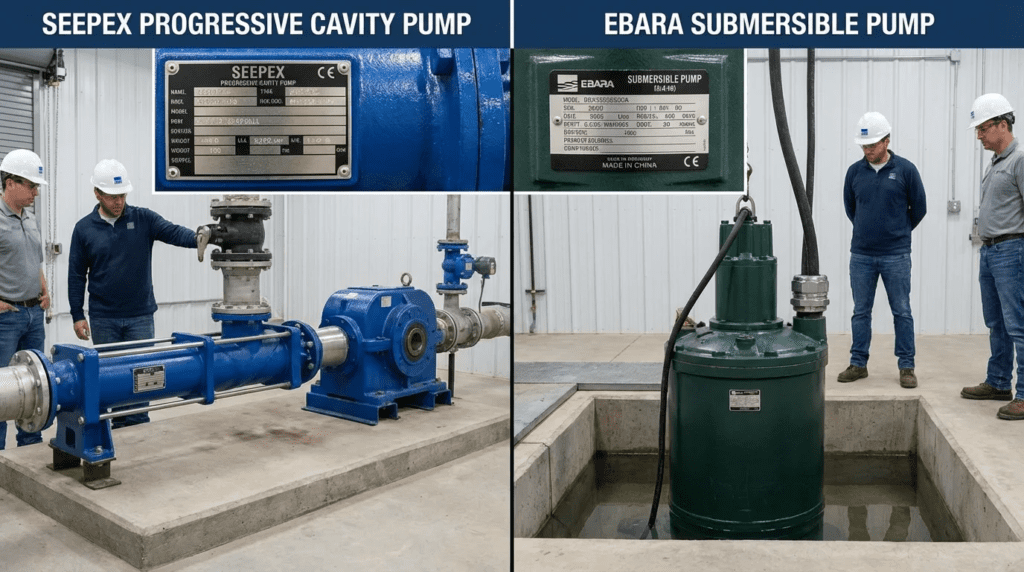
In the complex ecosystem of wastewater treatment, the movement of sludge and slurries represents one of the highest operational expenditures and maintenance burdens for utilities. Engineers are frequently tasked with selecting the optimal prime mover for these difficult fluids, often leading to a specific evaluation of Seepex vs Ebara Double Disc Pump Equipment: Comparison & Best Fit. This comparison is effectively a choice between three distinct hydraulic philosophies: the Progressive Cavity (PC) pump (typified by market leader Seepex), the Heavy-Duty Centrifugal or Submersible pump (typified by global giant Ebara), and the Double Disc pump (a distinct positive displacement technology).
A surprising statistic from municipal asset management studies suggests that while pumps account for less than 10% of a treatment plant’s capital cost, they can account for up to 40% of the maintenance budget and 20-50% of the energy usage. The decision between these technologies is not merely about brand preference; it is a fundamental engineering decision regarding fluid rheology, shear sensitivity, and solids handling capability.
Most engineers overlook the nuanced interaction between thixotropic sludge behavior and pump internal velocities. While a centrifugal unit might offer the lowest CAPEX, its inability to handle high-viscosity sludge without massive efficiency losses can cripple a process. Conversely, applying a precision PC pump to a grit-heavy application without adequate protection can lead to catastrophic stator failure in weeks. This article provides a rigorous, unbiased analysis to help engineers navigate the specification of Seepex vs Ebara Double Disc Pump Equipment: Comparison & Best Fit for municipal and industrial applications.
How to Select / Specify
Selecting the correct pump requires a departure from standard water pump logic. Sludge is a non-Newtonian fluid, meaning its viscosity changes with shear rate. The selection criteria below provide a structured approach to evaluating these competing technologies.
Duty Conditions & Operating Envelope
The primary differentiator between Seepex (PC), Ebara (Centrifugal), and Double Disc technology is the operating envelope regarding flow, pressure, and viscosity.
- Viscosity and % Solids: Progressive Cavity (PC) pumps excel as viscosity increases. Above 4-5% solids, centrifugal efficiency plummets, and friction losses skyrocket. PC pumps maintain volumetric efficiency regardless of pressure. Double Disc pumps handle mid-to-high viscosity well but are generally limited to lower flow rates compared to large centrifugals.
- Head/Pressure Requirements:
- Seepex (PC): Modular staging allows for very high discharge pressures (over 48 bar/700 psi). Ideal for long force mains or filter press feed.
- Ebara (Centrifugal): Limited by the impeller curve. High head requires large motors and high speeds, which increases wear in abrasive service.
- Double Disc: Typically limited to 100-120 psi (approx. 7-8 bar). Excellent for transfer but may struggle with high-head filter press applications compared to multi-stage PC pumps.
- Flow Control: PC and Double Disc pumps offer linear flow control proportional to speed, making them ideal for dosing or precise RAS/WAS wasting. Centrifugal flow varies non-linearly with head changes, making them less accurate for metering.
Materials & Compatibility
The aggressive nature of wastewater sludge—often septic, abrasive, and chemically variable—dictates material selection.
Seepex (PC) Approach: Reliance on the interference fit between a metal rotor and an elastomeric stator.
Engineering Consideration: Stator elastomer selection (Buna-N, Viton, EPDM) is critical. Chemical incompatibility leads to swelling, which locks the pump. Abrasives (grit) can gouge the rotor and wear the stator.
Ebara (Centrifugal) Approach: Reliance on Hard Iron (High Chrome) or Stainless Steel.
Engineering Consideration: Hardened materials (Rockwell C 60+) are essential for grit survivability. Unlike PC pumps, there is no rubber to swell, but corrosion-abrasion synergy can rapidly degrade impeller vanes.
Double Disc Approach: Elastomeric trunnions/discs and metal housings.
Engineering Consideration: Similar to PC pumps, elastomer compatibility is key. However, the discs operate via reciprocation rather than rotary friction, often tolerating abrasives better than a PC stator.
Hydraulics & Process Performance
When analyzing Seepex vs Ebara Double Disc Pump Equipment: Comparison & Best Fit, the hydraulic impact on the fluid is paramount for process stability.
Shear Sensitivity:
Flocculated sludge (e.g., feeding a belt press or centrifuge) is highly shear-sensitive.
- PC Pumps: Low shear. Ideally suited for preserving floc structure.
- Double Disc: Low shear. Good for thickener feed.
- Centrifugal: High shear. The high-speed impeller creates turbulence that destroys floc, requiring significantly higher polymer dosing to compensate.
Suction Performance (NPSH):
PC and Double Disc pumps generally have better suction lift capabilities than centrifugals, which often require flooded suction or self-priming assist mechanisms (vacuum pumps/venturis). Double disc pumps can pull high vacuums (up to 25” Hg), making them forgiving in challenging suction piping geometries.
Installation Environment & Constructability
Space Constraints:
Seepex PC pumps have a long footprint due to the rotor/stator geometry and bearing frame. They require significant clearance for stator removal (often equal to the pump length).
Ebara submersibles (wet pit) take up zero floor space. Dry pit submersibles are compact.
Double Disc pumps are compact but wider than PC pumps; however, they require less axial clearance for maintenance.
Constructability:
Submersible centrifugal installations simplify piping layouts but complicate valve access. PC pumps require robust baseplates and grouting to handle the torque and vibration.
Reliability, Redundancy & Failure Modes
Ragging and Clogging:
This is the “killer” variable in modern wastewater.
- PC (Seepex): Susceptible to ragging at the rotor inlet or wrapping around the coupling rod. Often requires an upstream grinder (macerator), adding CAPEX and O&M.
- Centrifugal (Ebara): Standard impellers clog. Vortex or Cutter/Grinder impellers are required for raw sewage. Vortex impellers sacrifice efficiency for solids passage.
- Double Disc: Extremely rag-tolerant due to the valvular action and lack of rotating components in the fluid stream. Often specified where ragging causes chronic failure in other pump types.
Run-Dry Failure:
PC pumps cannot run dry for even seconds; the stator will burn. Thermal protection is mandatory. Double Disc pumps can run dry indefinitely without damage. Centrifugals can tolerate short periods of dry running (depending on seal design) but will eventually overheat.
Lifecycle Cost Drivers
The total cost of ownership (TCO) analysis shifts dramatically based on the application.
- Energy: PC pumps are generally more efficient hydraulically than sludge centrifugals or double disc pumps, especially at higher pressures.
- Spares: PC pumps require regular stator and seal replacements (expensive parts, high labor). Double disc pumps require trunnion/disc replacements (moderate cost, low labor). Centrifugals have low routine maintenance but catastrophic failures (seals, bearings) are expensive to repair.
Comparison Tables
The following tables provide a direct side-by-side analysis to assist in the specification process. These tables break down the “Big Three” technologies represented by Seepex, Ebara, and Double Disc manufacturers, focusing on objective engineering metrics.
Table 1: Technology & Manufacturer Archetype Comparison
| Feature/Metric | Progressive Cavity (e.g., Seepex) | Centrifugal/Submersible (e.g., Ebara) | Double Disc (e.g., Penn Valley/Others) |
|---|---|---|---|
| Primary Operating Principle | Positive Displacement (Rotary) | Rotodynamic (Kinetic Energy) | Positive Displacement (Reciprocating) |
| Best Fit Application | Polymer dosing, Dewatering feed, High-pressure transfer | Raw influent, Recirculation, Stormwater, Effluent | Thickened sludge, Scum, Septage, Rag-heavy fluids |
| Solids Handling | Good, but requires grinding for rags | Good with Vortex/Cutter; Poor with closed impellers | Excellent; passes rags and stringy solids easily |
| Viscosity Limit | High (up to 1,000,000 cP) | Low (Efficiency drops rapidly >500 cP) | Medium-High (up to 50,000 cP) |
| Maintenance Profile | High: Stator wear is continuous; rotor replacement periodic. | Low: Infrequent, but seal/bearing failures are major events. | Medium: Discs/Trunnions are wear parts but quick to change. |
| Run Dry Capability | Zero: Immediate damage to stator. | Limited: Dependent on seal cooling method. | Excellent: Can run dry indefinitely. |
| Shear Characteristics | Low Shear (Laminar flow) | High Shear (Turbulent flow) | Low to Moderate Shear |
Table 2: Application Fit Matrix
| Application Scenario | Seepex (PC) Suitability | Ebara (Centrifugal) Suitability | Double Disc Suitability | Critical Decision Factor |
|---|---|---|---|---|
| Raw Sewage Lift Station | Rare (Grinder req’d) | Best Fit (Submersible Non-Clog) | Limited by flow capacity | Flow rate and capital cost favor centrifugal. |
| Primary Sludge (High Rags) | Fair (Requires Grinder) | Fair (Clogging risk) | Best Fit | Rag handling capability is paramount. |
| WAS / RAS (Return/Waste Sludge) | Good (Flow Control) | Good (High Volume) | Good (Moderate Volume) | Flow accuracy vs. volume. PC for precision, Centrifugal for bulk. |
| Centrifuge/Press Feed | Best Fit | Poor (High Shear) | Fair (Pulse dampener req’d) | Non-pulsating, low-shear flow is critical for dewatering. |
| Scum Pumping | Poor (Runs dry, rags) | Fair (Vortex impeller) | Best Fit | Ability to run dry and handle floating debris. |
| Lime/Chemical Slurry | Good (Metering) | Good (Hard Iron) | Fair (Check valve wear) | Abrasion resistance and metering accuracy. |
Engineer & Operator Field Notes
Real-world experience often diverges from the datasheet. The following insights are derived from field troubleshooting and long-term asset management of Seepex vs Ebara Double Disc Pump Equipment: Comparison & Best Fit applications.
Commissioning & Acceptance Testing
For PC Pumps (Seepex):
The most critical “Do Not” is running the pump dry during rotational checks. Even a few rotations can burn the stator elastomer.
Pro Tip: Always apply lubricant (soap solution or compatible grease) to the stator during installation and ensure the suction line is flooded before the first “bump.” Verify the Variable Frequency Drive (VFD) ramps are set to avoid high torque snaps that can shear coupling pins.
For Centrifugals (Ebara):
Check for air binding. Submersible pumps in dry-pit applications often trap air in the volute if the air release valve is undersized or clogged. Verify the amperage draw against the curve—low amps usually indicate air entrainment or closed valves.
For Double Disc Pumps:
Verify the trunnion (check valve) seating. Listen for “slapping” sounds which may indicate cavitation or insufficient Net Positive Suction Head Available (NPSHa). Ensure pulsation dampeners are charged to the correct percentage of discharge pressure (typically 80-90%).
Common Specification Mistakes
Engineers often apply large safety factors to motor horsepower to account for sludge viscosity. For PC pumps, this torque is necessary (start-up torque). However, for centrifugals, oversizing the motor does not solve the hydraulic efficiency loss caused by viscosity; it merely wastes energy and forces the pump to operate far to the left of its Best Efficiency Point (BEP), leading to shaft deflection and seal failure.
- Ignoring Pipe Friction: Sludge friction loss can be 4-10 times that of water. Specifying a pump based on water curves for 5% sludge guarantees underperformance.
- Missing Seal Water Plans: Centrifugal sludge pumps often require external flush water (API Plan 53/54 or simple seal water). Failing to specify the seal water system (flow/pressure switches) is a common omission that leads to seal burnout in week one.
O&M Burden & Strategy
Maintenance Intervals:
Seepex (PC): Expect stator replacement every 6-24 months depending on abrasives. Rotor replacement every 2nd or 3rd stator change.
Labor Impact: Changing a large PC stator is physically demanding, often requiring chain falls, strap wrenches, and significant clearance space.
Double Disc: Trunnions and discs typically last 12-36 months.
Labor Impact: Replacement can often be done without removing the pump from the piping, taking 1-2 hours for a two-person crew.
Ebara (Centrifugal): Oil checks every 6 months (submersible). Seal replacement every 3-5 years.
Labor Impact: Submersibles require lifting equipment (hoists/cranes) to pull the pump from the wet well. Dry pit maintenance is easier but seal changes still require pump disassembly.
Troubleshooting Guide
Symptom: No Flow / Low Flow
- PC Pump: Check for dry running protection trip. If running, stator may be worn (blow-by). Tighten tensioning bolts if equipped, otherwise replace stator.
- Centrifugal: Check for air lock. Check for clogged impeller (high amps or uneven sound). Check rotation direction (reverse rotation produces ~30% flow).
- Double Disc: Check for debris lodged in the trunnion (check valve) preventing it from sealing. Listen for internal bypassing.
Design Details / Calculations
Proper sizing for Seepex vs Ebara Double Disc Pump Equipment: Comparison & Best Fit requires specific calculations regarding shear stress and friction loss.
Sizing Logic & Methodology
Step 1: Define Rheology
Do not guess viscosity. For Primary Sludge, typical values might range from 500 cP to 3000 cP depending on concentration.
Rule of Thumb: For every 1% increase in solids above 2%, multiply friction loss by a factor of 1.5 to 2.0 (highly variable).
Step 2: TDH Calculation (Total Dynamic Head)
$$ TDH = H_{static} + H_{friction} + H_{minor} $$
For PC and Double Disc pumps (PD pumps), you calculate the maximum system pressure to size the motor torque and pressure class.
For Centrifugal pumps, you must overlay the System Curve on the Pump Curve. Note that viscosity “derates” the pump curve—lowering head, flow, and efficiency.
Specification Checklist
When writing the CSI specifications (Division 43), ensure the following are mandated:
- For PC Pumps:
- Run-dry protection (thermistor in stator or current sensing).
- Stator removal clearance diagram in submittals.
- Hardened rotor coating (chrome or ceramic) specifications.
- For Double Disc Pumps:
- Pulsation dampeners (suction and discharge).
- Leak detection system (vacuum or probe) in the pump housing.
- For Centrifugals:
- Derated curves for specified viscosity (ANSI/HI 9.6.7 method).
- Minimum solids passage size (typically 3″ for municipal raw sewage).
- Premium efficiency motors (IE3/IE4) rated for inverter duty.
Standards & Compliance
Designers should reference:
- ANSI/HI 9.6.7: Effects of Liquid Viscosity on Rotodynamic Pump Performance.
- AWWA E103: Horizontal and Vertical Line-Shaft Pumps (applicable sections).
- ISO 21049 / API 682: Pumps—Shaft Sealing Systems (for severe industrial applications).
Frequently Asked Questions
How does the initial cost compare between Seepex, Ebara, and Double Disc pumps?
Typically, Ebara centrifugal pumps have the lowest initial capital cost (CAPEX), especially for high-flow applications. Double Disc pumps usually sit in the middle price bracket. Seepex Progressive Cavity pumps often have a higher CAPEX, particularly when ancillary protection systems (grinders, run-dry protection) and complex baseplates are included. However, the decision should be based on Total Cost of Ownership (TCO), where maintenance costs often outweigh initial purchase price.
When should I choose Seepex vs Ebara Double Disc Pump Equipment for thickened sludge?
For thickened sludge (4-6% solids or higher), Seepex (PC) or Double Disc pumps are superior to Ebara (centrifugal). Centrifugals lose significant efficiency and head generation capabilities at these viscosities. If the sludge is to be fed to a dewatering device (press/centrifuge), the Seepex PC pump is generally the standard due to its non-pulsating flow. If it is for transfer only, the Double Disc is a strong contender due to lower maintenance costs.
Do Seepex or Ebara manufacture double disc pumps?
No. This is a common confusion. Seepex specializes in Progressive Cavity technology. Ebara specializes in Centrifugal and Submersible technology. “Double Disc” is a specific technology type manufactured by companies like Penn Valley and others. When engineers evaluate “Seepex vs Ebara Double Disc,” they are comparing the technologies offered by these major players against the Double Disc technology.
Why do Double Disc pumps handle rags better than PC pumps?
Double Disc pumps utilize a reciprocating action with large ball or trunnion check valves and have no rotating internal components in the fluid stream that rags can wrap around. PC pumps have a rotating rotor inside a stationary stator; rags tend to wrap around the coupling rod or accumulate at the stator inlet, eventually choking the flow. To handle rags, PC pumps usually require an upstream grinder.
What is the typical lifespan of a PC pump stator vs. a Double Disc?
A PC pump stator typically lasts between 6 to 24 months in abrasive sludge service before requiring replacement. A Double Disc pump’s discs and trunnions typically last 18 to 36 months in similar service. While the PC stator replacement is a complex maintenance task often requiring pump removal or significant disassembly, Double Disc components can usually be replaced in-line in under two hours.
Can I use VFDs with all three pump types?
Yes, but the effect differs. VFDs work perfectly with Seepex PC and Double Disc pumps because flow is linearly proportional to speed (Positive Displacement). VFDs on Ebara centrifugal pumps must be carefully controlled; if speed drops too low, the pump may fail to overcome static head (check valve pressure), resulting in zero flow and rapid overheating (dead-heading).
Conclusion
KEY TAKEAWAYS
- Viscosity Rules: For fluids >2-3% solids, default to Seepex (PC) or Double Disc. Use Ebara (Centrifugal) for dilute slurries and raw water.
- Shear Sensitivity: If feeding a dewatering press, PC pumps are the industry standard to preserve floc structure.
- Ragging: If the fluid contains heavy rags and no grinder is present, Double Disc technology offers the highest reliability.
- Run-Dry: PC pumps fail immediately if run dry. Double Disc pumps are immune. Centrifugals are tolerant for short periods.
- Maintenance Strategy: Choose Double Disc for ease of repair (low skill requirement). Choose PC for performance precision (higher maintenance skill required). Choose Centrifugal for “install and forget” in clean water applications.
The analysis of Seepex vs Ebara Double Disc Pump Equipment: Comparison & Best Fit is ultimately an exercise in matching hydraulic characteristics to fluid behavior. There is no single “best” pump; there is only the best pump for the specific rheology and constraint set of the facility.
Engineers should specify Seepex (Progressive Cavity) when process precision, high pressure, and laminar flow are non-negotiable, such as in polymer dosing or centrifuge feed. Ebara (Centrifugal) remains the undisputed king of high-volume, low-viscosity lifting, such as in headworks and effluent pumping. The Double Disc pump fills the crucial “tough application” niche—handling scum, thickened sludge transfer, and rag-heavy fluids where PC pumps experience high wear and centrifugals clog.
By accurately defining the duty point, understanding the viscous losses, and realistically assessing the plant’s maintenance capabilities, engineers can select the equipment that delivers the lowest lifecycle cost and highest operational reliability.