
Seepex vs Xylem (Flygt) Diaphragm Equipment: Comparison & Best Fit
Introduction
In the municipal and industrial water treatment sectors, the selection of positive displacement (PD) pumping technology is often the determining factor between a reliable, low-maintenance process and a chronic operational headache. Engineers frequently default to familiar technologies without fully analyzing the rheological impacts of the fluid on the equipment lifecycle. A common, yet critical, decision point arises when specifying equipment for viscous sludge, chemical metering, or shear-sensitive polymer handling: the choice between progressive cavity (PC) technology and diaphragm-based or centrifugal alternatives.
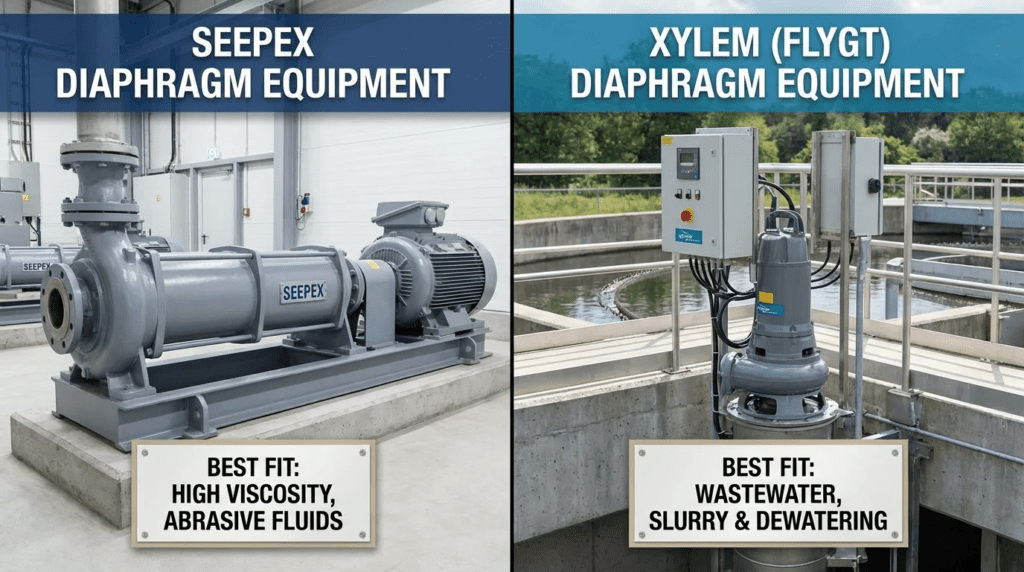
This article specifically addresses the engineering considerations surrounding Seepex vs Xylem (Flygt) Diaphragm Equipment: Comparison & Best Fit. While “Flygt” is synonymous with submersible centrifugal technology, the parent company, Xylem, encompasses a broad portfolio including Wilden (AODD) and Jabsco (Diaphragm) technologies. Consequently, the comparison is often between Seepex’s progressive cavity solutions and Xylem’s diverse range of diaphragm and specialized centrifugal offerings.
The stakes in this selection are high. Data suggests that misapplication of pump technology in sludge lines can increase maintenance hours by up to 40% and energy consumption by 20-50%. This guide moves beyond manufacturer marketing to provide consulting engineers, plant directors, and maintenance supervisors with the technical criteria necessary to specify the correct equipment for difficult fluid handling applications.
By the end of this article, you will be able to distinguish the critical hydraulic and mechanical differences between these technologies, calculate lifecycle implications, and generate robust specifications that protect the utility’s long-term interests.
How to Select / Specify
When evaluating Seepex vs Xylem (Flygt) Diaphragm Equipment: Comparison & Best Fit, engineers must look beyond the initial capital cost and focus on the interaction between the pump mechanics and the fluid’s physical properties. The selection process should follow a rigorous hierarchy of constraints.
Duty Conditions & Operating Envelope
The primary differentiator between these technologies is their response to variable duty points. Seepex progressive cavity pumps are inherently volumetric; flow is directly proportional to speed and largely independent of discharge pressure (until slip becomes a factor). This makes them ideal for applications requiring constant flow against variable head, such as feeding filter presses where pressure rises as the cake builds.
Conversely, Xylem’s diaphragm equipment (specifically air-operated double diaphragm or AODD) operates on a 1:1 ratio between air inlet pressure and discharge pressure. As discharge head increases, flow inherently decreases unless air pressure is adjusted. Flygt centrifugal options operate on a distinct system curve intersection. Engineers must specify:
- Viscosity Range: PC pumps handle viscosities exceeding 1,000,000 cP with minimal efficiency loss. Diaphragm pumps can handle high viscosity but require significant derating and slower cycle times to allow the ball checks to seat properly.
- Flow Control Accuracy: For metering applications (polymer, hypochlorite), PC pumps offer linear accuracy (+/- 1%). Diaphragm pumps produce pulsating flow that requires pulsation dampeners and is generally less accurate for strict process control without complex feedback loops.
- Solids Content: While both can pass solids, the mechanism differs. PC pumps encapsulate solids in the cavity; diaphragm pumps rely on the clearance of the check valves.

Materials & Compatibility
Material science is the backbone of reliability in aggressive wastewater environments. Both Seepex and Xylem offer extensive material options, but the wear components differ significantly.
- Elastomer Selection: In PC pumps, the stator is the sacrificial element. The chemical compatibility of the elastomer (NBR, EPDM, Viton, etc.) with the process fluid is critical. In diaphragm pumps, the diaphragms themselves are the flex points. PTFE diaphragms offer superior chemical resistance but reduced flex life compared to Neoprene or Santoprene.
- Abrasion Resistance: For grit-heavy primary sludge, PC pumps require specific rotor coatings (hard chrome plating or ceramic) and elastomers tailored for abrasion. Diaphragm pumps generally handle abrasion well due to low internal velocities, but check valve balls and seats are prone to scour.
- Temperature Limits: Standard stator elastomers have temperature limits (typically around 160°F/71°C for NBR). Xylem’s metal centrifugal pumps or PTFE-fitted diaphragm pumps can often handle higher temperature ranges without component degradation.
Hydraulics & Process Performance
The hydraulic profile determines the impact on the pumped fluid. This is particularly relevant for shear-sensitive fluids like flocculated sludge or polymer solutions.
Seepex PC pumps are low-shear devices. The fluid moves axially with minimal turbulence, preserving floc structures. This results in better dewatering performance downstream. Xylem Flygt pumps (centrifugal) impart high shear forces, which can destroy floc. Diaphragm pumps fall in the middle; the pumping action is gentle, but the high velocity through the check valves can cause localized shear.
Installation Environment & Constructability
Space and infrastructure often dictate the choice. Xylem Flygt pumps are dominant in submersible wet-well applications. They require minimal superstructure and no dry pit floor space. This is a massive advantage for lift stations.
Seepex PC pumps and Xylem (Wilden) diaphragm pumps typically require dry installation. PC pumps have a long footprint (stator + rotor + bearing housing + motor) which can be a constraint in retrofits. However, Seepex has developed vertical variants and “maintain-in-place” designs to mitigate space issues. Diaphragm pumps are compact and portable but require a compressed air infrastructure, which is a significant hidden capital and operational cost.
Reliability, Redundancy & Failure Modes
Understanding failure modes is essential for system resilience design.
- Dry Run: This is the Achilles’ heel of PC pumps. Running a Seepex pump dry for even a few minutes can destroy the stator due to friction heat. Protection sensors (TSE) are mandatory specifications. Diaphragm pumps (Xylem/Wilden) can run dry indefinitely without damage, making them superior for intermittent sump dewatering where level control is unreliable.
- Blockage: Flygt N-technology (chopper/grinder) is designed specifically to handle rags and wipes in lift stations. PC pumps can handle solids but are susceptible to “ragging” on the rotor if not equipped with a macerator upstream.
- MTBF: In steady-state sludge service, a properly sized PC pump often exceeds the MTBF of a diaphragm pump, whose diaphragms are cycle-limited fatigue components.
Controls & Automation Interfaces
Integration with SCADA systems varies by technology. Electronic drives (VFDs) are native to Seepex PC pumps and Flygt centrifugals, allowing for seamless 4-20mA speed control and flow pacing. Diaphragm pumps (pneumatic) require solenoid valves, stroke counters, or expensive electronic air distribution systems to achieve comparable automation integration.
Maintainability, Safety & Access
Maintenance ergonomics are a major concern for operators. Changing a stator on a large PC pump traditionally required significant clearance and heavy lifting. Seepex’s “SCT” (Smart Conveying Technology) allows for split stators, significantly reducing maintenance time. Xylem Flygt pumps require lifting gear to pull from the wet well, which is a safety hazard but keeps the dry well clean. Diaphragm pumps are generally easy to service but can be messy, as the pump must be disassembled to reach the wet side.
Lifecycle Cost Drivers
The Total Cost of Ownership (TCO) equation shifts based on energy source. Pneumatic diaphragm pumps are notoriously inefficient; compressing air is expensive (approx. 10-15% overall efficiency wire-to-water). Electric PC pumps and Centrifugal pumps operate at much higher efficiencies (50-80%). For continuous duty applications, electric-driven equipment (Seepex or Flygt) will always have a lower OPEX than air-operated diaphragm pumps.
Comparison Tables
The following tables provide a direct comparison to assist engineers in determining the Seepex vs Xylem (Flygt) Diaphragm Equipment: Comparison & Best Fit for specific project constraints. Table 1 focuses on technology characteristics, while Table 2 provides an application fit matrix.
| Feature | Seepex (Progressive Cavity) | Xylem/Wilden (AODD/Diaphragm) | Xylem/Flygt (Centrifugal/Submersible) |
|---|---|---|---|
| Primary Flow Characteristic | Non-pulsating, Low Shear, Volumetric | Pulsating, Medium Shear, Variable | Continuous, High Shear, Pressure Dependent |
| Dry Run Capability | Poor (Requires protection devices) | Excellent (Can run dry indefinitely) | Limited (Depends on cooling jacket/motor type) |
| Pressure Capability | High (up to 48 bar standard) | Limited by air supply (typ. 8-9 bar max) | Depends on impeller/staging (High head available) |
| Metering Accuracy | High (+/- 1%) | Low (unless specialized metering type) | N/A (Not for metering) |
| Energy Efficiency | High (Electric drive) | Very Low (Compressed air) | High (at Best Efficiency Point) |
| Typical Maintenance | Stator/Rotor wear, Joint kits | Diaphragms, Balls, Seats, Air valve | Wear rings, Mechanical seals, Impeller |
| Application | Best Fit Technology | Reasoning | Key Constraint |
|---|---|---|---|
| Thickened Sludge Transfer (>4% solids) | Seepex (PC) | Handles high viscosity efficiently; maintains flow at pressure. | Footprint for pump; Stator protection. |
| Raw Sewage Lift Station | Xylem/Flygt (Centrifugal) | Non-clog capability; submersible installation; handles rags. | Not suitable for metering or low-shear needs. |
| Polymer Dosing | Seepex (PC) | Low shear preserves polymer chains; high accuracy. | Requires VFD for control. |
| Sump / Utility Pump | Xylem/Wilden (Diaphragm) | Self-priming; run-dry capable; portable. | High noise levels; Air consumption. |
| Filter Press Feed | Seepex (PC) or High-Pressure Piston/Diaphragm | Can handle pressure ramp-up better than standard centrifugals. | Control logic needed to reduce speed as pressure builds. |
Engineer & Operator Field Notes
Commissioning & Acceptance Testing
When commissioning these systems, the acceptance criteria differ markedly. For Seepex equipment, the focus of the Factory Acceptance Test (FAT) and Site Acceptance Test (SAT) must be on starting torque and alignment. PC pumps often have high break-away torque requirements, especially after sitting idle. Verification of VFD torque boost settings is critical.
For Xylem/Flygt submersible units, insulation resistance (megger) testing and phase rotation verification are paramount. For diaphragm equipment, commissioning is simpler but must verify air supply volume (SCFM), not just pressure (PSI). A common failure during startup is air starvation causing the pump to stall under load.
Common Specification Mistakes
Another frequent error involves suction piping for sludge. Specifying small diameter suction lines for diaphragm pumps leads to cavitation and poor ball valve seating. Even though diaphragm pumps are “self-priming,” high-viscosity sludge requires flooded suction or net positive suction head available (NPSHa) calculations that account for significant friction losses.
O&M Burden & Strategy
Seepex PC Strategy: Implement a predictive maintenance schedule based on run hours and flow degradation. As the stator wears, the VFD speed will need to increase to maintain flow (compensating for slip). When speed increases by 15-20% over baseline to achieve the same flow, it is time to plan for a stator change.
Xylem/Flygt Strategy: Monitoring motor current and vibration is key. A rise in vibration often indicates a ragged impeller or bearing wear. Moisture sensors in the seal chamber provide early warning of seal failure.
Diaphragm Pump Strategy: These are often run-to-failure items in smaller sizes, but for critical process pumps, preventive diaphragm replacement every 6-12 months (depending on duty) prevents catastrophic sludge spills.
Troubleshooting Guide
- Symptom: PC Pump No Flow. Check: Is the pump running in reverse? (Common after electrical work). Is the stator run dry/burnt? Is the suction line clogged?
- Symptom: Diaphragm Pump Stalls. Check: Is the exhaust muffler iced up? (Common with wet air supply). Is the discharge head higher than air inlet pressure?
- Symptom: Centrifugal Pump Low Flow. Check: Is the impeller clogged? Is the wear ring gap excessive? Is the check valve stuck closed?
Design Details / Calculations
Sizing Logic & Methodology
Correct sizing requires accurate characterization of the fluid. For non-Newtonian fluids (sludge), viscosity changes with shear rate.
Step 1: Determine Effective Viscosity
Do not use a single viscosity number. Calculate the shear rate inside the pump.
Shear Rate (approx) = (V * D) / gap
For PC pumps, the internal shear rate is low, meaning the apparent viscosity remains high. Ensure the motor HP is sized for this higher viscosity.
Step 2: TDH Calculation
Calculate Total Dynamic Head. For PC and Diaphragm pumps, friction loss is the dominant factor.
TDH = Static Head + Friction Head + Pressure Head
Note: For sludge, use Hazen-Williams C-factors of 100 or less (or Darcy-Weisbach with appropriate roughness) to be conservative.
Step 3: Speed Selection
Rule of Thumb: For abrasive sludge, limit PC pump speed to 200-300 RPM. Higher speeds drastically reduce stator life (wear is proportional to speed squared). For diaphragm pumps, limit cycle rate to 30-40 strokes per minute to allow full cavity filling.
Specification Checklist
To ensure a robust procurement for Seepex vs Xylem (Flygt) Diaphragm Equipment: Comparison & Best Fit, your specification typically must include:
- Performance Test Code: Reference ISO 9906 for centrifugals or appropriate HI (Hydraulic Institute) standards for PD pumps.
- Dry Run Protection: Mandatory for PC pumps (Thermistors in stator).
- Materials Certifications: Request material trace/certs for wetted elastomers if the chemical is aggressive (e.g., polymer, lime).
- Serviceability: Specify “Maintain in Place” features if space is limited. (e.g., Seepex SCT or Flygt maintenance sleds).
FAQ Section
What is the main difference between Seepex and Flygt pumps for sludge?
The main difference is the technology. Seepex primarily uses Progressive Cavity (PC) technology, which moves fluid via a rotating screw (rotor) inside a stationary elastomer (stator), providing constant flow and handling high viscosity well. Flygt primarily uses centrifugal technology (submersible), which uses a spinning impeller. PC pumps are better for thick sludge and metering; Flygt pumps are better for high-volume transport and lift stations.
Can a Seepex pump replace a diaphragm pump?
Yes, and often with benefits. A Seepex PC pump can replace a diaphragm pump in applications requiring non-pulsating flow, higher energy efficiency, or quieter operation. However, the system must be checked to ensure it can handle a pump that cannot run dry (unless protected) and may require a larger installation footprint compared to a compact AODD pump.
How do maintenance costs compare between PC and Diaphragm pumps?
In high-wear applications, PC pumps typically have lower day-to-day maintenance but higher periodic overhaul costs (stators/rotors are expensive). Diaphragm pumps have lower individual part costs (diaphragms/balls) but may require more frequent replacement cycles. Crucially, the energy cost of air-operated diaphragm pumps is 5-10 times higher than electric PC pumps, often making PC pumps cheaper over a 10-year lifecycle.
Why would I choose a Flygt pump over a Seepex pump for thick sludge?
You typically wouldn’t choose a standard Flygt centrifugal pump for thick sludge (>4-6% solids) due to efficiency losses and potential air binding. However, for primary sludge (1-3% solids), a Flygt pump is often preferred because it is submersible, requires no floor space, and handles trash/debris better than a standard PC pump without an upstream grinder.
What is the typical lifespan of a Seepex stator vs. a generic diaphragm?
In municipal sludge service, a Seepex stator typically lasts 1 to 5 years depending on grit content and speed. A diaphragm in an AODD pump in similar service might last 6 to 18 months. Stator life is heavily dependent on operating speed—running a PC pump at half speed can quadruple the stator life.
Does Xylem make progressive cavity pumps?
Xylem implies a broad portfolio. While Xylem owns brands like Mono (in certain markets) or has PC offerings under specific subdivisions depending on region, Seepex is a dedicated PC specialist. Typically, when engineers compare “Seepex vs Xylem,” they are comparing Seepex PC against Xylem’s centrifugal (Flygt) or diaphragm (Wilden/Jabsco) portfolio.
Conclusion
KEY TAKEAWAYS
- Viscosity Rules: Use Seepex (PC) for fluids >2,000 cP or where flow accuracy is critical. Use Flygt (Centrifugal) for dilute fluids and general transport.
- Energy Penalty: Avoid air-operated diaphragm pumps for continuous duty; the energy cost is prohibitive compared to electric PC or centrifugal options.
- Shear Sensitivity: Select PC pumps for polymer and flocculated sludge to improve downstream dewatering performance.
- Installation: Flygt wins on footprint (submersible); Seepex requires floor space but offers better maintenance access for dry-installed equipment.
- Protection: Never specify a PC pump without run-dry protection (TSE/TSD). Never specify a diaphragm pump without checking air supply volume (SCFM) availability.
The decision regarding Seepex vs Xylem (Flygt) Diaphragm Equipment: Comparison & Best Fit is rarely a question of “good vs. bad” equipment, but rather “fit vs. mismatch” for the application. For engineers and operators, the path to a reliable system involves acknowledging the physical limitations of the fluid.
If the application demands high suction lift, portability, or indefinite run-dry capability, Xylem’s diaphragm (Wilden) or submersible (Flygt) solutions are the engineering standard. However, for process-critical applications involving thickened sludge, chemical metering, or scenarios where energy efficiency and flow linearity are paramount, Seepex progressive cavity technology offers a superior lifecycle return.
When writing specifications, avoid copy-pasting previous boilerplates. Evaluate the shear rates, calculate the true friction losses, and consider the operator’s ability to maintain the equipment. By aligning the mechanical attributes of the pump with the rheological reality of the fluid, you ensure long-term process stability and fiscal responsibility.