
Tertiary Treatment of Wastewater: Filtration Membranes & Advanced Purification
INTRODUCTION
Historically, municipal and industrial wastewater facilities were designed with a single goal: meet baseline discharge permits to protect receiving waters. Today, the engineering paradigm has shifted from basic disposal to active resource recovery. Driven by water scarcity, stringent regulatory limits on emerging contaminants (PFAS, endocrine disruptors), and the rise of indirect and direct potable reuse (IPR/DPR), conventional sand filtration and basic chlorination are no longer sufficient. This is where Tertiary Treatment of Wastewater: Filtration Membranes & Advanced Purification becomes the critical design frontier.
Engineers specifying these systems face a common, high-stakes challenge: underestimating the fouling potential of secondary effluent and miscalculating the total lifecycle cost of high-pressure membranes. A seemingly minor mischaracterization in feed water organics or biological scaling potential can lead to crippling operating expenses, excessive chemical consumption, and premature membrane failure. The capital expenditure (CAPEX) of an advanced water treatment facility is massive, but the operating expenditure (OPEX) driven by membrane replacement and energy consumption can easily eclipse it if the system is improperly designed.
These technologies are predominantly utilized downstream of secondary biological processes (like activated sludge, MBBR, or oxidation ditches). Applications range from industrial zero-liquid-discharge (ZLD) plants and cooling tower blowdown recovery, to municipal aquifer recharge and potable reuse facilities. Strict adherence to proper pretreatment sizing, flux rate selection, and chemical compatibility is paramount.
This article provides an unbiased, technical deep-dive into Tertiary Treatment of Wastewater: Filtration Membranes & Advanced Purification. It is written strictly for design engineers, utility managers, and operators. By detailing membrane hydrodynamics, advanced oxidation integration, sizing methodologies, and real-world failure modes, this guide will equip decision-makers to specify systems that balance reliability, regulatory compliance, and long-term cost of ownership.
CORE TECHNICAL CONTENT: TERTIARY TREATMENT OF WASTEWATER: FILTRATION MEMBRANES & ADVANCED PURIFICATION
How It Works / Process Fundamentals
In the context of advanced wastewater treatment, the tertiary phase relies on physical separation and chemical oxidation rather than biological metabolism. The core principle of membrane filtration is the application of a pressure differential across a semi-permeable barrier. As wastewater is forced against the membrane, water molecules permeate through the pores, while suspended solids, colloids, bacteria, and eventually dissolved ions (depending on the pore size) are rejected and concentrated.
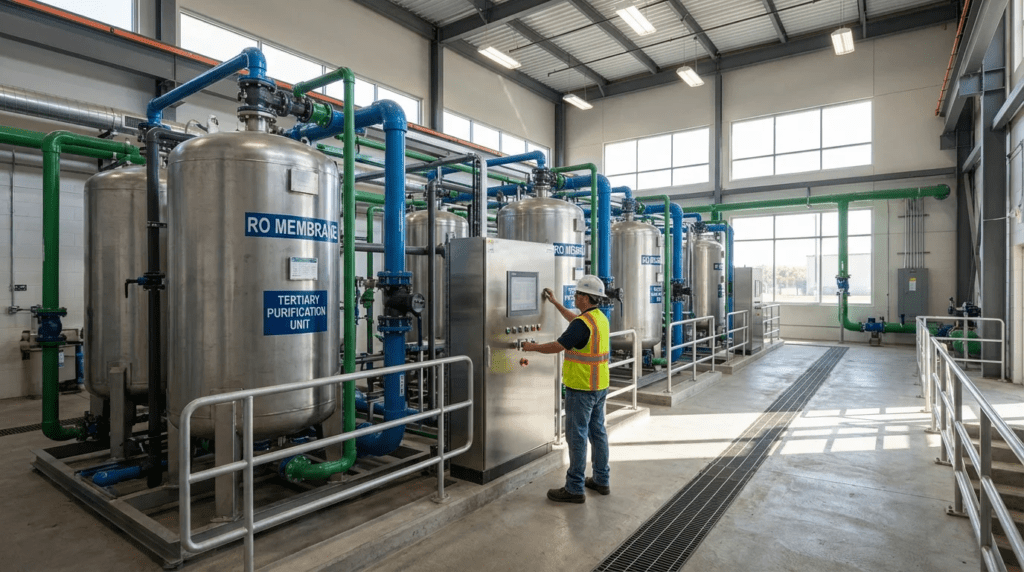
Advanced Purification typically refers to the sequential combination of processes designed to achieve complete pathogen sterilization and the destruction of recalcitrant trace organic compounds (TOrCs). The industry-standard “Full Advanced Treatment” (FAT) train consists of Microfiltration or Ultrafiltration (MF/UF), followed by Reverse Osmosis (RO), and culminating in an Advanced Oxidation Process (AOP), usually Ultraviolet light paired with Hydrogen Peroxide (UV/H2O2) or Sodium Hypochlorite.
While biological secondary treatment addresses bulk biochemical oxygen demand (BOD) and total suspended solids (TSS), the tertiary membrane train is engineered based on Molecular Weight Cut-Off (MWCO) and Log Removal Values (LRV). The primary objective is to drive effluent quality to near-distilled purity levels, ensuring absolute physical barriers against viruses and the chemical oxidation of micropollutants.
Types, Configurations & Technologies
The landscape of Tertiary Treatment of Wastewater: Filtration Membranes & Advanced Purification encompasses several distinct pressure-driven boundaries and oxidation strategies:
- Low-Pressure Membranes (MF/UF): Microfiltration (typically 0.1 to 0.2 µm pore size) and Ultrafiltration (typically 0.01 to 0.05 µm) serve as the primary physical barrier. They remove residual TSS, colloidal matter, and pathogens, serving as critical pretreatment to protect downstream RO elements. Configurations include hollow-fiber (most common in municipal), tubular, and flat-sheet. Flow regimes are typically either inside-out or outside-in.
- High-Pressure Membranes (NF/RO): Nanofiltration and Reverse Osmosis operate on the principle of solution-diffusion rather than pure physical sieving. RO elements reject dissolved salts, heavy metals, and low-molecular-weight organics. They are almost exclusively spiral-wound thin-film composite (TFC) membranes. NF offers lower operating pressures and allows monovalent ions (like sodium and chloride) to pass while rejecting multivalent ions (like calcium and sulfate) and larger organics.
- Advanced Oxidation Processes (AOP): AOP relies on the generation of highly reactive hydroxyl radicals (•OH), which non-selectively attack and mineralize organic pollutants. Common configurations include UV/H2O2, UV/Free Chlorine, and Ozone coupled with Biologically Active Filtration (O3/BAF). The latter is gaining traction in non-RO-based advanced purification trains (carbon-based advanced treatment).
- Adsorption & Ion Exchange: Often used as polishing steps or in lieu of RO for specific contaminant targeting, Granular Activated Carbon (GAC) provides physical adsorption of organics, while Ion Exchange (IX) selectively removes specific dissolved constituents like nitrate, perchlorate, or PFAS.
Operating Conditions & Duty Requirements
Membrane system design is fundamentally dictated by the feed water quality and the required production rate. The most critical operating parameter is Flux (J), measured in liters per square meter per hour (LMH) or gallons per square foot per day (GFD). Typical conservative tertiary MF/UF flux rates on secondary effluent range from 35 to 60 LMH (20 to 35 GFD), highly dependent on upstream organic loading.
Trans-membrane Pressure (TMP) is the driving force required to push water through the membrane. As membranes foul, TMP increases to maintain a constant flux. Low-pressure membranes typically operate between 0.1 to 0.8 bar (1.5 to 12 psi), while RO systems treating wastewater effluent generally operate between 10 to 25 bar (150 to 360 psi).
Recovery rate—the percentage of feed water converted to clean permeate—is another vital duty requirement. UF systems typically run at 90–95% recovery, generating a low volume of backwash waste. RO systems on wastewater typically operate at 75–85% recovery, producing a highly concentrated brine stream that presents significant disposal challenges. Engineers must account for the ultimate disposal or treatment of these reject streams during the preliminary design phase.
Materials & Compatibility
The selection of membrane material heavily influences chemical resilience, mechanical strength, and lifespan. In modern Tertiary Treatment of Wastewater: Filtration Membranes & Advanced Purification, options generally fall into polymeric and ceramic categories.
- Polyvinylidene Fluoride (PVDF): The industry standard for municipal UF hollow fibers. PVDF is prized for its high mechanical strength and excellent tolerance to oxidizing chemicals, allowing for aggressive cleaning regimes using sodium hypochlorite (up to 5,000 ppm-hrs tolerance typical).
- Polyethersulfone (PES): Highly hydrophilic, which inherently reduces organic fouling. However, PES has lower mechanical strength and lower chlorine tolerance compared to PVDF, making it less ideal for aggressive chemical recovery but excellent for lower-fouling tertiary applications.
- Polyamide (PA) Thin-Film Composite: The dominant material for RO membranes. PA offers exceptional salt rejection but has effectively zero tolerance for free chlorine. Dechlorination (via sodium bisulfite or UV) upstream of RO is strictly mandatory to prevent irreversible membrane degradation.
- Ceramic Membranes (Silicon Carbide or Aluminum Oxide): While commanding a high CAPEX, ceramics offer extreme durability, tolerating vast pH ranges (0-14), high temperatures, and abrasive solids. They are increasingly specified in aggressive industrial wastewater tertiary reuse where polymeric membranes would fail rapidly.
Hydraulic & Process Performance
Performance in membrane systems is characterized by specific permeability—the flux divided by the TMP, usually expressed as LMH/bar. In secondary effluent applications, specific permeability declines over time due to concentration polarization and fouling. Fouling occurs via four primary mechanisms: pore blocking, pore constriction, cake formation, and gel layer formation.
Extracellular Polymeric Substances (EPS) and Soluble Microbial Products (SMP) originating from the upstream biological process are the most notorious foulants in tertiary systems. These complex organic compounds bind to membrane surfaces, creating a sticky gel layer that rapidly increases TMP. High-performance process design requires continuous monitoring of permeability trends and automated adjustment of backwash frequencies to manage this fouling before it becomes irreversible.
Reliability, Redundancy & Common Failure Modes
Reliability in advanced purification is legally mandated, especially in IPR/DPR applications where public health is directly impacted. Redundancy is typically modeled on an “N+1” or “N+2” basis, ensuring design flow can be met with one or two membrane trains offline for cleaning or repair.
Common failure modes include:
- Fiber Breakage (MF/UF): Mechanical stress from aggressive aeration, high backwash pressures, or debris bypassing fine screens can snap hollow fibers, compromising pathogen rejection. Integrity is monitored via daily automated pressure decay tests (PDT).
- Irreversible Fouling: Occurs when organics or scaling (calcium phosphate, silica) embed deep within pore structures or on RO spacers, failing to respond to chemical cleaning. This dramatically shortens the typical 7-10 year membrane lifespan.
- Oxidation Damage (RO): As mentioned, upstream dechlorination failure allows free chlorine to reach polyamide RO elements, literally dissolving the rejection layer and causing an immediate spike in permeate conductivity.
Lifecycle Cost Drivers
The total cost of ownership (TCO) for Tertiary Treatment of Wastewater: Filtration Membranes & Advanced Purification is heavily weighted toward OPEX. CAPEX typically accounts for only 30-40% of the 20-year lifecycle cost.
Energy consumption is the primary OPEX driver. The high-pressure feed pumps required for RO easily consume 0.8 to 1.5 kWh/m³ of treated water. Using energy recovery devices (ERDs), though standard in seawater desalination, is becoming more common in brackish/wastewater RO to offset these costs.
Chemical consumption is the secondary OPEX driver. Continuous dosing of antiscalants, sulfuric acid (for pH suppression), sodium bisulfite, and periodic use of citric acid and sodium hypochlorite for clean-in-place (CIP) operations represent a major ongoing expense. Finally, membrane replacement sinking funds must be modeled. MF/UF elements typically last 7-10 years, while wastewater RO elements generally require replacement every 5-7 years, assuming optimal pretreatment.
COMPARISON TABLES
The following tables provide an objective comparison of technologies and their application fit within Tertiary Treatment of Wastewater: Filtration Membranes & Advanced Purification. Use Table 1 to evaluate the technical merits and limitations of specific approaches, and Table 2 to align system selection with specific plant scenarios and effluent requirements.
Table 1: Technology & Process Approach Comparison
| Technology Type | Primary Mechanism | Best-Fit Applications | Limitations / Considerations | Typical Maintenance Profile |
|---|---|---|---|---|
| Microfiltration / Ultrafiltration (MF/UF) | Physical Sieving (0.01 – 0.2 µm) | RO pretreatment, strict TSS/pathogen removal, aquifer recharge prep. | Does not remove dissolved salts or small trace organics. Highly susceptible to EPS/SMP fouling. | Frequent automatic backwashing (every 20-60 mins); CEB weekly; CIP monthly. High mechanical wear on valves. |
| Reverse Osmosis (RO) | Solution-Diffusion / Osmotic pressure | IPR/DPR, Industrial ZLD, specific ion/salt rejection, high-purity reuse. | Generates concentrated brine stream requiring disposal. High energy demand. Zero chlorine tolerance. | Continuous antiscalant dosing; periodic CIP (every 3-6 months). Cartridge filter replacement monthly. |
| Nanofiltration (NF) | Solution-Diffusion (loose RO) | Hardness removal, large molecular weight organic removal with lower energy than RO. | Partial salt passage (monovalent ions). Still generates a brine stream. Less standardized than RO. | Similar to RO, but potentially less frequent CIP depending on hardness scaling potential. |
| Advanced Oxidation (UV/H2O2) | Hydroxyl Radical generation (•OH) | Destruction of trace organics, NDMA, 1,4-dioxane; final pathogen sterilization. | High power consumption. Requires upstream quenching of remaining H2O2 to prevent pipeline corrosion. | UV lamp replacement (approx. 10,000 hrs); quartz sleeve wiping/cleaning; H2O2 chemical handling. |
| Ozone / BAF (Carbon-based advanced) | Direct oxidation & biological degradation | Non-RO potable reuse trains. High organic destruction without brine generation. | Bromate formation risk if bromide is present. Complex process control required. | Ozone generator maintenance (dielectrics); BAF media backwashing; liquid oxygen (LOX) supply logistics. |
Table 2: Application Fit Matrix
| Application Scenario | Primary Constraint | Recommended Tech Train | Operator Skill Requirement | Relative Lifecycle Cost |
|---|---|---|---|---|
| Title 22 Irrigation / Parks Reuse | Pathogen / TSS removal limits | Coagulation → Cloth Media or MF/UF → UV Disinfection | Low to Moderate | Low to Medium ($) |
| Cooling Tower Make-Up Water | Scaling potential (Silica, Hardness) | MF/UF → NF or RO | Moderate to High | Medium ($$) |
| Indirect Potable Reuse (Groundwater) | Trace organics, Salinity, Pathogens | MF/UF → RO → UV/H2O2 (Full Advanced Treatment) | Very High (Advanced SCADA) | High ($$$) |
| Direct Potable Reuse (No RO allowed/desired) | Brine disposal constraints, NDMA | Ozone → BAF → GAC → UV/Chlorine | Very High (Complex Biology/Chem) | High ($$$) |
| Harsh Industrial / Solvent Recovery | Extreme pH, temperature, or abrasives | Ceramic UF → Specialized IX or High-Temp RO | High | Very High CAPEX ($$$$) |
ENGINEER & OPERATOR FIELD NOTES
Commissioning & Acceptance Testing
The transition from construction to operation is the highest-risk phase for advanced purification systems. Factory Acceptance Testing (FAT) should focus on control panel integration, verifying that programmable logic controllers (PLCs) appropriately execute automated backwash and CIP sequencing. Site Acceptance Testing (SAT) requires rigorous hydrodynamic verification.
For MF/UF systems, the critical checkpoint is the Clean Water Flux (CWF) test. Baseline permeability must be established using potable water before secondary effluent is introduced. This baseline is the standard against which all future fouling and chemical cleaning efficacy will be measured. Additionally, strict Pressure Decay Testing (PDT) must be witnessed to verify unbroken membrane integrity, ensuring zero fiber breaches occurred during transport or installation.
Common Specification Mistakes
A frequent error in specifying Tertiary Treatment of Wastewater: Filtration Membranes & Advanced Purification is the over-reliance on “average” influent water quality data. Membrane flux and recovery limitations are dictated by extreme events, not averages. Spikes in cold-weather viscosity, seasonal biological upsets (yielding high biopolymer/EPS shedding), or industrial shock loads will rapidly overwhelm a system sized purely on average daily flow and average organic loading.
Another common mistake is under-specifying the fine screening upstream of polymeric hollow-fiber UF. Relying on primary/secondary screens is insufficient. Dedicated 1mm to 3mm auto-backwashing strainers are strictly required immediately upstream of the UF feed pumps to protect fibers from hair, fibrous debris, and biological snails that accumulate in secondary clarifiers.
O&M Burden & Strategy
Maintaining advanced membrane trains requires shifting from a “repair when broken” mindset to a highly proactive, predictive maintenance strategy. The O&M burden centers heavily around chemical cleaning regimes:
- Backwash (BW): Hydraulic reversal of flow, typically every 20-60 minutes, using permeate and air scouring.
- Maintenance Wash / Chemically Enhanced Backwash (CEB): Performed daily or weekly. Involves injecting moderate concentrations of chemicals (e.g., 200-500 ppm NaOCl or low-concentration acid) during a backwash and allowing a brief soak (15-30 mins).
- Clean-In-Place (CIP): A rigorous, offline process performed monthly or quarterly. Uses heated water, high chemical concentrations (e.g., 1000-2000 ppm NaOCl, pH 2 citric acid), and extended soaking periods (4-12 hours) to fully recover permeability.
Operators must carefully log temperature-corrected specific permeability. CIPs should be triggered based on permeability decline (typically a 15-20% drop from baseline), not merely based on time intervals. Waiting too long allows foulants to compact, rendering the CIP ineffective.
Troubleshooting Guide
When TMP rises faster than designed, operators must diagnose the root cause quickly to apply the correct chemical countermeasure. Troubleshooting generally breaks down by the nature of the foulant:
- Symptom: Rapid TMP increase; slimy, dark residue on pre-filters.
Root Cause: Biological or organic fouling (EPS/SMP).
Fix: High-pH (alkaline) CIP using sodium hydroxide and sodium hypochlorite. Investigate upstream secondary biological treatment for low dissolved oxygen or excessive sludge age. - Symptom: Gradual TMP increase; white/chalky scale on RO concentrate piping.
Root Cause: Inorganic scaling (calcium carbonate, calcium sulfate).
Fix: Low-pH (acidic) CIP using citric or hydrochloric acid. Verify antiscalant dosing rates and feed water hardness. - Symptom: Sudden increase in RO permeate conductivity.
Root Cause: Membrane oxidation or physical O-ring failure.
Fix: Profile individual pressure vessels to isolate the failing element. Check bisulfite dosing and ORP meters. Replace damaged elements or rolled O-rings.
DESIGN DETAILS & CALCULATIONS
Sizing Logic & Methodology
Properly sizing Tertiary Treatment of Wastewater: Filtration Membranes & Advanced Purification systems begins with the basic flux equation, heavily modified by empirical safety factors and temperature corrections. The required membrane area ($A$) is a function of the design flow rate ($Q$) and the design flux ($J$):
$A = Q / J$
However, pure water viscosity changes significantly with temperature, directly impacting flux. Membrane manufacturers normalize flux at 20°C (68°F). Engineers must apply a Temperature Correction Factor (TCF) to ensure the system can meet capacity during the coldest anticipated water conditions. As water cools, viscosity increases, requiring more pressure (higher TMP) or more membrane area to pass the same flow.
Rule of Thumb: For every 1°C drop below 20°C, viscosity increases by approximately 2-3%, effectively reducing permeability by an equal margin. Always size the total membrane area based on the winter design minimum temperature, not the annual average.
Specification Checklist
To ensure a specification-safe and highly reliable procurement package, engineers should explicitly detail the following in their bidding documents:
- Maximum Allowable Flux: Specify the maximum instantaneous operating flux (LMH or GFD) at the lowest design temperature. Do not allow vendors to stretch flux to reduce capital costs.
- Pre-treatment Requirements: Dictate exact micron ratings for pre-strainers (e.g., “Basket strainers with 2mm slotted screens, maximum velocity 1.5 m/s”).
- Chemical Compatibility: Require submittal data proving membrane tolerance to continuous and shock dosing of specific oxidizing agents. Define the maximum cumulative chlorine exposure (ppm-hours).
- Energy Guarantee: Require bidders to submit a guaranteed maximum specific energy consumption (kWh/1000 gallons produced) and include a liquidated damages clause for underperformance.
- Instrumentation: Mandate redundant high-resolution pressure transmitters across all membrane stages to accurately calculate TMP and specific permeability via the PLC.
Standards & Compliance
Municipal wastewater reuse projects involving membranes and advanced oxidation are subject to strict regulatory frameworks. In the United States, California Title 22 sets the gold standard for wastewater reuse, explicitly defining the log removal requirements and required turbidity limits (typically < 0.2 NTU for membrane filtration) for disinfected tertiary recycled water.
Components in contact with water intended for eventual potable reuse must often comply with NSF/ANSI Standard 61 (Drinking Water System Components – Health Effects). Furthermore, RO and UF system designs should align with AWWA B110 (Membrane Systems) guidance, ensuring standard practices for integrity testing, cleaning, and performance monitoring are structurally embedded into the facility.
FAQ SECTION
What is Tertiary Treatment of Wastewater: Filtration Membranes & Advanced Purification?
It is an advanced stage of wastewater treatment that occurs after secondary biological processes. It utilizes physical barriers (like microfiltration, ultrafiltration, and reverse osmosis) and chemical processes (like advanced oxidation) to remove residual suspended solids, dissolved salts, pathogens, and trace organic contaminants. It is heavily used to prepare wastewater for industrial reuse or potable aquifer recharge.
What is the difference between Ultrafiltration (UF) and Reverse Osmosis (RO) in wastewater?
UF is a low-pressure physical sieving process that removes suspended solids, bacteria, and large macromolecules (typical pore size 0.01-0.05 µm). It does not remove dissolved salts. RO is a high-pressure solution-diffusion process that rejects dissolved ions, minerals, and trace organics. In advanced treatment trains, UF is typically deployed as the mandatory pretreatment step to protect the RO membranes from solid fouling.
How do you select the proper membrane flux rate?
Flux rate selection depends heavily on the secondary effluent quality (specifically organics/EPS) and water temperature. Typical design fluxes for tertiary UF range from 35 to 60 LMH (20 to 35 GFD). Selection must be based on pilot testing or empirical data from similar wastewater plants, always sizing the final membrane area based on the coldest anticipated water temperature to account for increased viscosity.
How much energy do these advanced systems consume?
Energy consumption is largely driven by the high-pressure feed pumps required for reverse osmosis. While UF systems generally consume less than 0.2 kWh/m³, an RO system treating wastewater will typically consume between 0.8 and 1.5 kWh/m³. Advanced oxidation processes (UV/H2O2) add another significant electrical load, depending on the required log removal targets.
How often should RO or UF membrane elements be replaced?
Under optimal operating conditions with excellent pretreatment and proactive chemical cleaning, polymeric hollow-fiber UF membranes typically last 7 to 10 years. Spiral-wound RO elements in wastewater applications usually require replacement every 5 to 7 years. Premature failure is almost always due to biological fouling, improper chemical cleaning, or accidental chlorine exposure.
Why do tertiary membrane systems fail or underperform?
The most common cause of underperformance is irreversible organic or biological fouling caused by upsets in the upstream secondary treatment process. If the biological process sheds high amounts of extracellular polymeric substances (EPS), the tertiary membranes will quickly lose permeability. Other failures include inadequate pretreatment screening (causing fiber breakage) and scaling from unmanaged water hardness.
What are the best practices for integrating Advanced Oxidation Processes (AOP)?
AOP (such as UV paired with hydrogen peroxide) should always be placed downstream of RO in full advanced treatment trains. The RO step removes the bulk organics and turbidity that would otherwise scavenge the hydroxyl radicals or block UV light transmission. Best practices include precise peroxide dosing control and mandatory downstream quenching to prevent unreacted peroxide from oxidizing distribution piping.
CONCLUSION
KEY TAKEAWAYS
- Pretreatment is Paramount: The longevity and performance of Tertiary Treatment of Wastewater: Filtration Membranes & Advanced Purification relies entirely on protecting the membranes from macroscopic debris and bulk biological organics. Auto-strainers and optimized secondary clarifier effluent are non-negotiable.
- Temperature Dictates Sizing: Never size membrane area on average annual temperatures. Always use the coldest winter design conditions to calculate viscosity-adjusted flux requirements.
- Beware of Chlorine: Polyamide RO membranes have zero tolerance for free chlorine. Redundant dechlorination monitoring is essential to prevent catastrophic, irreversible oxidation damage.
- OPEX Outweighs CAPEX: Energy for high-pressure pumps and chemical costs for continuous antiscalants and frequent CIPs form the bulk of the lifecycle cost. Invest in energy recovery devices and highly efficient PLC automation.
- Predictive Maintenance: Do not wait for hard alarms to initiate chemical cleaning. Track temperature-corrected specific permeability and initiate CIPs when permeability drops 15-20% from baseline.
Engineers and utility operators navigating Tertiary Treatment of Wastewater: Filtration Membranes & Advanced Purification must approach design holistically, recognizing that tertiary systems are unforgiving of upstream biological process upsets. The specification of microfiltration, ultrafiltration, reverse osmosis, and advanced oxidation technologies requires a rigorous understanding of feed water chemistry, seasonal temperature variations, and strict regulatory pathogen removal mandates.
A robust decision framework for real-world projects begins with extensive water characterization and pilot testing, ensuring the selected flux rates, antiscalants, and clean-in-place protocols are empirically validated for the specific wastewater matrix. Balancing the competing requirements of capital budgets, space constraints, and high long-term operational costs demands that engineers specify durable materials, mandate comprehensive automated controls, and build in sufficient N+1 redundancy. When specifying complex direct or indirect potable reuse trains, engaging specialized process consultants to optimize the RO-to-AOP interface is highly recommended to ensure public health compliance and operational resilience.
By focusing heavily on pretreatment integrity, acknowledging the viscosity impacts of cold-weather flows, and implementing predictive, data-driven chemical cleaning regimes, utilities can successfully deploy these advanced purification systems. Done correctly, these facilities transform municipal wastewater from a localized disposal liability into a high-purity, drought-resistant water resource.