
Top 10 Piping Accessories Manufacturers for Water and Wastewater
Introduction
One of the most persistent challenges in municipal and industrial water engineering is not the pipe itself, but the integrity of the connections, adaptations, and restraints. Industry statistics suggest that over 60% of pipeline failures occur at joints or fittings rather than along the pipe barrel. For consulting engineers and plant directors, overlooking the specification of couplings, restraints, and expansion joints often leads to catastrophic blowouts, costly non-revenue water loss, and unplanned plant shutdowns. The Top 10 Piping Accessories Manufacturers for Water and Wastewater offer distinct engineering approaches to these critical interface points, ranging from wide-range coupling technology to specialized seismic expansion joints.
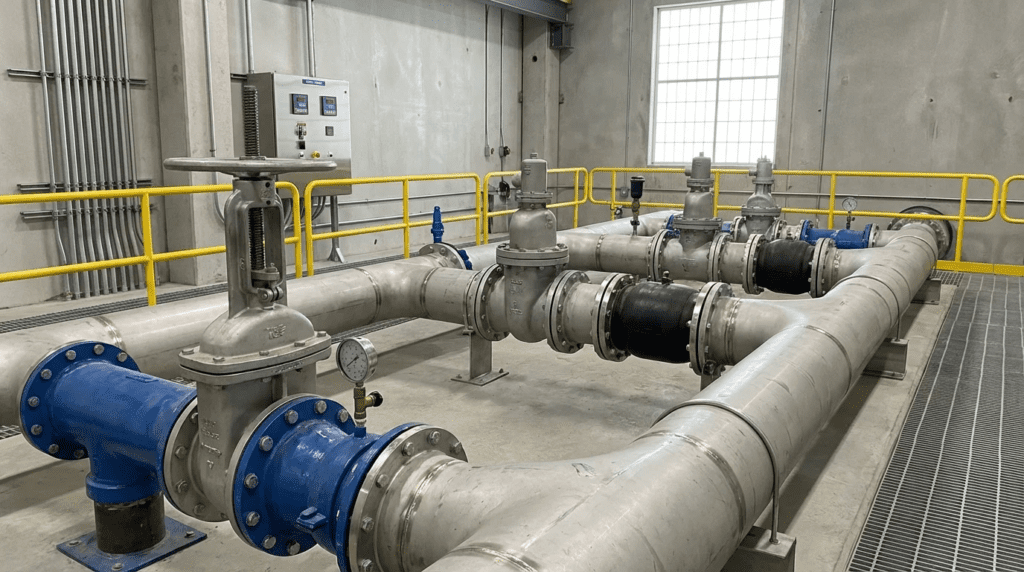
This equipment category encompasses the “connective tissue” of treatment plants and distribution networks: mechanical joint restraints, wide-range couplings, flange adaptors, tapping sleeves, repair clamps, and expansion joints. These components are utilized in every environment from submerged raw water intakes to high-pressure reverse osmosis skids and sludge dewatering galleries. The operational environment in water and wastewater (W/WW) is notoriously harsh, featuring variable pH, abrasive grit, water hammer (surge), and corrosive soil conditions.
Proper specification matters because the cost of an accessory failure far exceeds the component cost. A failed $500 restraint on a 24-inch force main can cause hundreds of thousands of dollars in environmental cleanup, road repair, and regulatory fines. This article helps engineers navigate the complex landscape of the Top 10 Piping Accessories Manufacturers for Water and Wastewater, focusing on technical selection, material compatibility, and long-term asset reliability rather than brand marketing.
How to Select / Specify
When evaluating the Top 10 Piping Accessories Manufacturers for Water and Wastewater, engineers must move beyond simple catalog selection. The specification process requires a rigorous analysis of hydraulic forces, soil mechanics, and chemical compatibility. The following criteria provide a framework for creating robust specifications.
Duty Conditions & Operating Envelope
The operating envelope defines the mechanical stress limits of the accessory. Unlike continuous pipe, accessories are often discontinuous points of rigidity or flexibility.
- Pressure Ratings: Specifications must distinguish between working pressure and test pressure. Many accessories are rated for 250 psi or 350 psi (Ductile Iron standard), but surge pressures in force mains can momentarily exceed these limits. Engineers should require a minimum safety factor of 1.5x or 2x depending on the surge analysis.
- Vacuum Conditions: Often overlooked, vacuum conditions can occur during rapid draining or pump shut-off. Gaskets on certain couplings may draw in contaminants or unseat if not designed for negative pressure.
- Flow Rates and Turbulence: High velocities (typically >15 ft/s) through intrusive fittings or poorly aligned joints can cause cavitation and erosion.
- Movement Capability: For couplings and expansion joints, the specification must define the required axial expansion/contraction, angular deflection, and lateral offset capabilities.
Materials & Compatibility
Material selection is the primary driver of longevity in wastewater environments where hydrogen sulfide (H2S) and sulfuric acid generation are risks.
- Metals: Ductile iron (ASTM A536) is standard, but the coating is critical. Fusion Bonded Epoxy (FBE) compliant with AWWA C213 is the baseline. For highly corrosive soils or aggressive sludge, Type 304 or 316 Stainless Steel hardware is mandatory.
- Elastomers (Gaskets): This is the most common failure point. EPDM (Ethylene Propylene Diene Monomer) is standard for water and general wastewater with excellent resistance to ozone and oxidation. However, if hydrocarbons (oil/grease) are present in industrial wastewater, Nitrile (Buna-N) must be specified to prevent swelling and degradation.
- Coatings: In addition to FBE, engineers should evaluate the need for electrophoretic deposition (e-coat) on smaller components or zinc-rich primers for exposed steel accessories.
Hydraulics & Process Performance
While often considered passive, accessories impact system hydraulics. Poorly designed fittings introduce minor losses that accumulate.
- Internal Diameter Matching: “Wide range” couplings are versatile but may have a larger internal cavity than the pipe ID. This transition creates turbulence. In sludge lines, these cavities can become accumulation points for rags and struvite.
- Thrust Restraint: For pressurized systems, the hydraulic thrust force at bends and tees must be countered. If using mechanical joint restraints instead of concrete thrust blocks, the restraint mechanism (wedge vs. friction) must be capable of holding the full hydraulic force plus a safety margin.
Installation Environment & Constructability
The “constructability” of an accessory dictates the quality of the final installation. If a device is too difficult to install in a muddy trench, it will likely be installed incorrectly.
- OD Tolerance: Water systems often feature mixed materials (Ductile Iron, PVC, HDPE, Asbestos Cement). Accessories must accommodate variations in Outer Diameter (OD). Engineers should specify the required range (e.g., 0.40 to 0.80 inches of range).
- Bolt Access: In tight galleries or trench boxes, access to tighten bolts is limited. Designs featuring top-facing bolts or single-bolt tightening mechanisms (common in repair clamps) reduce installation errors.
- Deflection: Buried pipes settle. Couplings that allow for 3-5 degrees of dynamic deflection prevent stress fractures during soil settling.
Reliability, Redundancy & Failure Modes
Understanding how a component fails allows for better risk mitigation.
- Restraint Mechanism: Wedge-action restraints generally offer higher reliability than friction-based restraints, which can slip if the pipe diameter fluctuates or if the coating is too slick.
- Corrosion of Hardware: The most common failure mode is the corrosion of the bolts (T-bolts). Specifying fluoropolymer-coated stainless steel bolts significantly extends MTBF (Mean Time Between Failures).
- Gasket Relaxation: Over decades, rubber loses elasticity (compression set). Accessories that maintain constant compression via spring washers or specific geometric designs are preferred for critical buried infrastructure.
Maintainability, Safety & Access
For plant applications, accessibility determines the speed of repair.
- Disassembly: Some restraint systems “bite” into the pipe and are destructive to remove. Others are non-destructive. For piping that requires frequent cleaning or dismantling (e.g., sludge lines), non-destructive couplings are essential.
- Lockout/Tagout: While accessories don’t use power, they store hydraulic energy. Bleed valves or test ports integrated into the accessory can improve safety during isolation.
Lifecycle Cost Drivers
Initial purchase price (CAPEX) is often dwarfed by installation labor and replacement costs (OPEX).
- Labor Efficiency: A coupling that installs with two bolts instead of twelve saves significant labor hours.
- Inventory Reduction: “Universal” or wide-range couplings allow utilities to stock fewer SKUs to cover multiple pipe materials and diameters, reducing inventory carrying costs.
- Cathodic Protection: Metallic accessories on plastic pipes do not need CP, but metallic accessories on metallic pipes must be electrically bonded or isolated depending on the corrosion control strategy.
Comparison Tables
The following tables provide an engineering-level comparison of the Top 10 Piping Accessories Manufacturers for Water and Wastewater. Table 1 focuses on the specific manufacturers, their primary technologies, and application strengths. Table 2 provides a matrix to help engineers match specific accessories to difficult application scenarios.
| Manufacturer | Primary Strengths & Technologies | Best-Fit Applications | Engineering Considerations/Limitations | Typical Maintenance/Install Profile |
|---|---|---|---|---|
| Victaulic | Grooved mechanical couplings; rigid and flexible systems; high vibration attenuation. | Wastewater treatment plants, pump stations, exposed piping, air lines. | Requires pipe preparation (grooving); rarely used for buried distribution mains. | Low maintenance; visual verification of joint closure (pad-to-pad). |
| Krausz (Mueller/Hymax) | HYMAX wide-range couplings; hydraulic pressure-assisted gaskets; minimal bolts. | Pipe repair, joining dissimilar materials, unstable soil conditions. | Dynamic deflection capabilities are high; ensure vacuum rating is checked for specific models. | Fastest install (top-facing bolts); non-destructive removal. |
| EBAA Iron | MEGALUG joint restraints; ductile iron restraint specialist. | Buried PVC and Ductile Iron restraints; thrust restraint without concrete blocks. | Primary focus is restraint, not repair; heavy iron components require corrosion protection. | Torque-off nuts ensure proper installation torque automatically. |
| Smith-Blair | Repair clamps, tapping sleeves, flexible couplings. | Emergency leak repair, hot tapping, joining plain-end pipes. | Broad catalog; specification must carefully match OD ranges to avoid sealing issues. | Standard multi-bolt installation; requires proper bolt tightening sequence. |
| Romac Industries | Alpha wide-range couplings; stainless steel repair clamps; tapping sleeves. | Distribution system repairs, service saddles, connection of HDPE. | Alpha series offers wide range but confirm pressure ratings for large diameters. | Single-bolt designs available for quick trench installation. |
| Ford Meter Box | Service line fittings, restraints (Uni-Flange), meter setters. | Service laterals (small diameter), meter pits, flange adapters. | Dominant in small diameter (<4"); specific product lines for large mains. | High variety of brass and iron alloys; specific to potable water distribution. |
| Dresser | Legacy bolted couplings; pipeline repair products. | Steel pipelines, gas/water crossovers, long-transmission mains. | Traditional designs; requires precise pipe cleaning and preparation. | Proven longevity but labor-intensive multi-bolt assembly. |
| Tyler Union / McWane | Ductile iron fittings, restraints, and accessories. | New construction of water mains; standard AWWA C110/C153 fittings. | Focus is on fittings/hardware rather than specialty repair clamps. | Standard utility maintenance; requires wax tape or polywrap in corrosive soils. |
| Proco Products | Rubber and metal expansion joints; check valves. | Pump suction/discharge; vibration isolation; seismic joints. | Rubber elastomers have temperature/chemical limits; not for structural pipe support. | Periodic inspection for rubber cracking/hardening required. |
| Viking Johnson | Large diameter couplings; dedicated flange adaptors; maxi-fit. | Large transmission mains; desalination; export pipelines. | Specialized for large bore; longer lead times for custom fabrication. | Robust design for high-pressure/large-diameter applications. |
| Scenario | Primary Constraint | Recommended Tech Type | Key Specification Parameter | Critical Risk Factor |
|---|---|---|---|---|
| Pump Station Discharge | Vibration & Misalignment | Grooved Coupling or Rubber Expansion Joint | Vibration attenuation & angular deflection | Fatigue failure of rigid flanges |
| Buried Force Main Repair | Unknown Pipe OD & Muddy Conditions | Wide-Range Coupling (e.g., Hymax/Alpha) | OD Range (>1.0 inch) & Deflection | Improper bolt torque due to difficult access |
| New PVC Distribution Line | Thrust Forces (No Concrete Blocks) | Mechanical Joint Restraint (Wedge Action) | Restraint rating = Pipe Pressure Class | Point-loading the PVC pipe wall |
| Sludge Recirculation | Frequent Disassembly & clogging | Grooved Coupling (Flush seal) | Ease of disassembly (2 bolts) | Gasket chemical compatibility (H2S/Grease) |
| Seismic Zone Crossing | Ground Movement / Shear | Double-Ball Expansion Joint | Axial and Lateral offset capability | Shearing of standard rigid couplings |
Engineer & Operator Field Notes
The gap between a catalog specification and a successful installation is often bridged by field experience. The following notes address common issues encountered with products from the Top 10 Piping Accessories Manufacturers for Water and Wastewater.
Commissioning & Acceptance Testing
Commissioning piping accessories requires more than just watching a pressure gauge.
- Torque Verification: Do not rely on “hand tight.” Use calibrated torque wrenches during SAT (Site Acceptance Testing). For restraints with “torque-off” nuts, verify all heads have snapped off cleanly.
- Visual Gasket Check: For grooved couplings and certain flange adapters, ensure the gasket is seated uniformly. Bulging gaskets indicate pinching, which will lead to delayed failure.
- Restraint Engagement: For wedge-action restraints, ensure the wedges are in contact with the pipe surface before pressurization. If wedges are loose, the joint will move before the restraint engages, potentially pulling the spigot out of the bell.
Common Specification Mistakes
Engineering errors often stem from ambiguity in the bid documents.
- “Or Equal” Traps: Specifying a high-performance wide-range coupling but allowing a generic “or equal” often results in the contractor supplying a basic bolted coupling with zero deflection capability. Specifications must list critical performance metrics (e.g., “Must accommodate 0.8 inches of OD variation”).
- Ignoring Pipe Ovality: Large diameter pipes (especially steel and older ductile iron) are rarely perfectly round. Repair clamps specified with tight tolerances may not seal on oval pipes. Specify clamps with heavy, thick gaskets capable of conforming to irregularities.
- Galvanic Corrosion Oversight: Connecting a stainless steel repair clamp to a ductile iron pipe in hot soil creates a battery. If the specification does not call for a dielectric barrier or heavy coating, the iron pipe will corrode rapidly at the connection point.
O&M Burden & Strategy
Operations teams bear the long-term burden of accessory selection.
- Re-Torquing: Most manufacturers recommend checking bolt torque after the initial pressurization cycle. In reality, buried assets are never checked again. Design for “install and forget” by using double-nutting or specialized locking washers if vibration is present.
- Spare Parts Inventory: Instead of stocking a specific coupling for every pipe material (Asbestos Cement, Iron, PVC), utilities should standardize on wide-range couplings for emergency stock. This reduces inventory value while increasing response capability.
Troubleshooting Guide
Symptom: Leakage immediately after installation.
- Root Cause: Dirt/grit under the gasket or improper torque sequence (tightening one side fully before the other).
- Solution: Disassemble, clean pipe surface to bare metal, lubricate gasket heavily with NSF-61 soap, and tighten in a star pattern.
Symptom: Restraint movement/slippage.
- Root Cause: Pipe OD is undersized for the restraint range, or the pipe coating is too hard/slick for the wedges to bite.
- Solution: Verify pipe OD matches restraint range. If pipe is HDPE, ensure internal stiffeners are installed to prevent pipe collapse under restraint load.
Design Details / Calculations
To properly utilize products from the Top 10 Piping Accessories Manufacturers for Water and Wastewater, engineers must perform basic verifications.
Sizing Logic & Methodology
The most critical calculation is the determination of the Pipe OD. “12-inch pipe” is a nominal term, not a dimension.
- Identify Material Standards:
- Ductile Iron (AWWA C151): Fixed OD based on casting.
- PVC (AWWA C900): Typically matches Ductile Iron OD (CIOD).
- PVC (ASTM D2241): Often Steel Pipe OD (IPS), which is smaller than CIOD.
- Steel: Can be IPS or custom.
- Check the Delta: Calculate the difference between the pipe ODs being joined. If the delta exceeds 0.05-0.10 inches, a standard coupling may fail. A stepped coupling or wide-range coupling is required.
- Thrust Calculation: Formula: $T = P times A$
- $T$ = Thrust Force (lbs)
- $P$ = Design Pressure (psi) (Include Surge!)
- $A$ = Cross sectional area of pipe (sq. inches)
Example: A 12-inch cap at 150 psi generates approx. 17,000 lbs of thrust. The restraint selected must be rated for this load with a safety factor (typically 1.5).
Specification Checklist
Ensure your MasterSpec includes:
- compliance: NSF-61 (Health effects), NSF-372 (Lead-free).
- Standards: AWWA C219 (Bolted Couplings), AWWA C111 (Rubber Gasket Joints).
- Coating: Minimum 10-12 mil Fusion Bonded Epoxy.
- Hardware: 304 or 316 Stainless Steel with anti-galling coating (molybdenum disulfide).
- Origin: Domestic vs. Import requirements (AIS – American Iron and Steel) if federal funding is involved.
Standards & Compliance
Adherence to AWWA standards is non-negotiable for municipal projects.
- AWWA C219: Covers bolted sleeve-type couplings.
- AWWA C110/C153: Covers ductile iron fittings (Full body vs. Compact).
- AWWA M11/M41: Manuals of practice for steel and ductile iron pipe, respectively, detailing restraint lengths.
FAQ Section
What is the difference between a restrained and unrestrained coupling?
An unrestrained coupling (like a standard Dresser coupling) provides a seal but does not prevent the pipes from pulling apart under pressure. It requires external thrust blocks. A restrained coupling includes a mechanical mechanism (gripping wedges or tie-rods) that locks the pipes together, transferring the thrust force across the joint, eliminating the need for concrete thrust blocks.
How do I select the right gasket material for piping accessories?
For potable water and general municipal wastewater, EPDM is the industry standard due to its resistance to chloramines and oxidation. Temperature range is typically -30°F to 230°F. For wastewater containing oils, fats, grease, or hydrocarbons (common in industrial effluent or restaurant districts), Nitrile (Buna-N) must be used to prevent gasket swelling and failure. Fluoroelastomers (FKM/Viton) are reserved for high-temperature or aggressive chemical applications.
Why is “wide-range” technology important for the Top 10 Piping Accessories Manufacturers?
Wide-range technology allows a single coupling or repair clamp to fit a broad spectrum of pipe outer diameters (e.g., fitting both Ductile Iron and Steel pipe sizes with one unit). This reduces inventory requirements for utilities and reduces the risk of contractors arriving at a job site with the wrong size fitting, especially when repairing older infrastructure where record drawings may be inaccurate.
When should I use a flange adapter versus a mechanical joint adapter?
A flange adapter is used to connect a plain end pipe to a flanged piece of equipment (like a valve or flow meter). A Mechanical Joint (MJ) adapter is typically used to connect a plain end pipe to a standard MJ fitting (like a tee or elbow). MJ connections allow for more deflection (angular movement) than flanged connections, making them better suited for buried applications where soil settling occurs.
What is the typical lifespan of a bolted coupling in soil?
The lifespan is dictated by the corrosion protection. A bare steel coupling in aggressive soil may fail in 5-10 years. A coupling with Fusion Bonded Epoxy (FBE) coating and Stainless Steel hardware can last 50+ years. In extremely corrosive soils, polyethylene encasement (polywrap) or cathodic protection is required to achieve the full 50-100 year design life expected of municipal infrastructure.
How does surge pressure impact accessory selection?
Standard pressure ratings (e.g., 250 psi) often refer to working pressure. Water hammer (surge) can create transient spikes 2-3 times the working pressure. Engineers must verify that the accessory’s maximum transient rating exceeds the worst-case surge scenario modeled in the hydraulic analysis. Failure to account for surge is a leading cause of gasket blowout.
Conclusion
Key Takeaways
- System Weak Points: 60% of pipeline failures occur at joints/accessories. Specification quality here is critical.
- Material Matters: Specify EPDM for water/general sewer, but Nitrile for hydrocarbon-rich wastewater.
- Restraint Logic: Move toward wedge-action mechanical restraints to reduce labor and concrete work (thrust blocks).
- Corrosion Control: 304/316 Stainless Steel hardware and Fusion Bonded Epoxy are mandatory for longevity.
- Know Your OD: Never guess pipe diameters. The difference between Ductile Iron OD and Steel OD determines coupling success.
- Installation Quality: Design for easy installation (top bolts, wide tolerance) to minimize contractor error.
Selecting from the Top 10 Piping Accessories Manufacturers for Water and Wastewater is not about brand loyalty, but about matching specific technologies to unique hydraulic and environmental challenges. Whether specifying Victaulic for an accessible treatment plant gallery, EBAA Iron for a buried restraint system, or Hymax for a critical emergency repair, the engineer’s goal is to maintain the hydraulic integrity of the system under all load conditions.
Successful projects result from specifications that acknowledge the realities of the field: pipes are rarely perfectly round, soils are corrosive, and surge events happen. By focusing on robust materials, appropriate safety factors for pressure and deflection, and constructability, engineers can ensure that the “connective tissue” of their water infrastructure lasts as long as the pipes themselves. When in doubt, consult the manufacturer’s engineering data for specific chemical compatibility and pressure de-rating curves to ensure the selected accessory meets the specific demands of the application.