
Top OEMs for Progressive Cavity Pumps in Water & Wastewater Applications
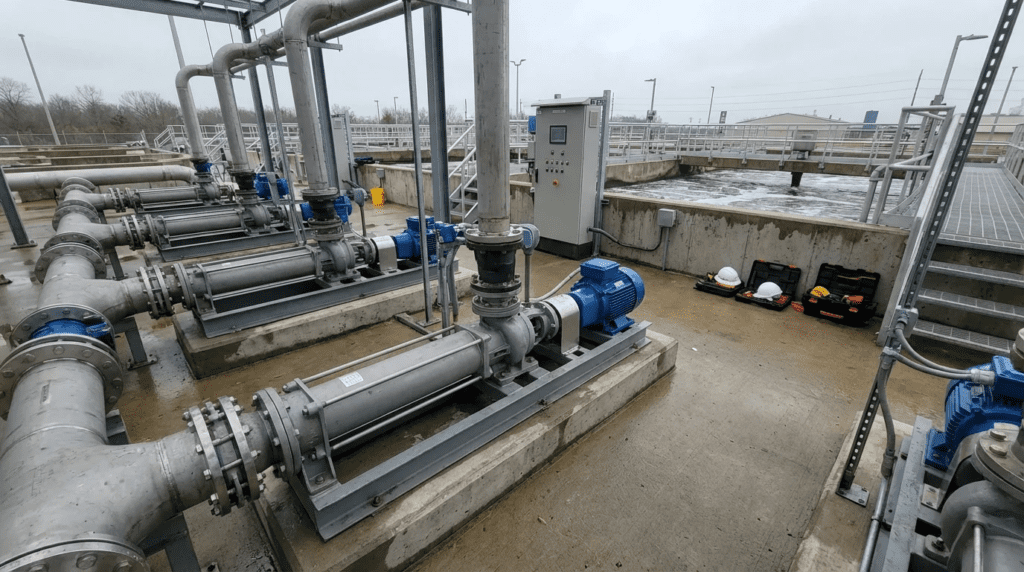
1. Introduction: The Role of Progressive Cavity Pumps in Water & Wastewater
In the complex hydraulic architecture of municipal and industrial water treatment facilities, the Progressive Cavity (PC) pump—often referred to as a helical rotor pump or eccentric screw pump—occupies a critical operational niche. Unlike centrifugal pumps, which rely on kinetic energy to move fluid and are susceptible to rapid efficiency losses when handling viscous materials, PC pumps are positive displacement machines. They generate flow by trapping a fixed volume of fluid in cavities formed between a rotating screw (rotor) and a stationary flexible liner (stator), pushing the fluid axially from suction to discharge.
This fundamental operating principle makes PC pumps the industry standard for handling fluids that are too thick, viscous, shear-sensitive, or solids-laden for rotodynamic pumps. In a typical wastewater treatment plant (WWTP), PC pumps are the primary movers for thickened sludge, dewatered sludge cake, polymer dosing, and scum removal. Their ability to maintain a relatively constant flow rate despite varying discharge pressures allows for precise process control, which is essential for feeding centrifuges, belt filter presses, and digesters.
However, the selection of a PC pump OEM (Original Equipment Manufacturer) is not a commodity decision. The specific geometry of the rotor/stator, the proprietary elastomer formulations, the design of the universal joints, and the maintainability of the housing significantly impact the lifecycle cost. PC pumps are wear-intensive machines; the stator is a sacrificial component designed to degrade over time. Consequently, the “initial bid price” is often a fraction of the total cost of ownership (TCO) over a 20-year horizon. Engineers must evaluate OEMs based on mechanical robustness, parts availability, and ease of service.
This article provides a detailed, non-commercial engineering analysis of the leading OEMs in the progressive cavity market, focusing specifically on their application within the water and wastewater sectors. The analysis prioritizes technical specification data, maintenance realities, and historical reliability over marketing claims.
2. How to Select This Pump Type: Engineering Criteria
Specifying a progressive cavity pump requires a deep understanding of non-Newtonian fluid mechanics and mechanical design. Unlike water pumps where the Best Efficiency Point (BEP) is the primary driver, PC pump selection centers on wear rates, shear sensitivity, and pressure handling. The following criteria should form the basis of any technical specification.
Hydraulic Performance and Geometry
The core of a PC pump is the interference fit between the metal rotor and the elastomeric stator.
- Stage Count and Pressure: PC pumps are staged machines. Typically, one stage can handle approximately 75 to 90 PSI (5 to 6 bar) of differential pressure. Engineers must calculate the Total Dynamic Head (TDH) accurately, accounting for friction losses in sludge lines (which are significantly higher than water), and specify the appropriate number of stages (1-stage, 2-stage, 4-stage, etc.) to prevent “blow-by” or slip, which accelerates wear.
- Flow Geometry (1:2 vs. 2:3): The geometry refers to the number of lobes on the rotor versus the stator. A conventional 1:2 geometry (single helix rotor) offers larger cavities and is better for large solids. A 2:3 geometry (two-lobe rotor) allows for shorter pitch lengths and higher flow rates at lower rotational speeds, but with slightly reduced solids handling capability.
- Shear Sensitivity: For applications like polymer dosing or feeding flocculated sludge to a dewatering device, low shear is paramount. The pump must operate at low RPM to prevent breaking the floc structure, which would ruin dewatering efficiency.
Solids Handling and Abrasion Resistance
Wastewater sludge contains grit, sand, and ragging material.
- Particle Size: The specification must define the maximum spherical solid size the pump must pass. This is dictated by the cavity size and the pitch of the stator.
- Rotational Speed (RPM): This is the single most critical factor in pump life. As solids content and abrasiveness increase, operating speed must decrease. For abrasive primary sludge, specifications should often cap speeds at 200-300 RPM to minimize stator wear. Running a small pump fast to save capital cost is a false economy that results in rapid stator failure.
- Rotor Coating: Rotors are typically tool steel or stainless steel with a hard chrome plating for abrasion resistance. In extremely abrasive applications (like lime slurry or grit), engineers should specify ceramic coatings or proprietary hardening processes.
Materials of Construction
The chemical compatibility of the stator elastomer is the most common failure point after dry running.
- Elastomers: NBR (Nitrile Butadiene Rubber) is standard for municipal sludge. However, if the stream contains industrial solvents, hydrocarbons, or high temperatures, EPDM or Viton (FKM) may be required. The consulting engineer must review the full chemical makeup of the influent.
- Housing: Cast iron is standard for most wastewater housings. 304 or 316 Stainless Steel is required for corrosive environments, polymer dosing, or potable water applications.
Maintenance and Serviceability
PC pumps are notoriously difficult to service because of the heavy rotor and the tight interference fit of the stator.
- Maintain-in-Place (MIP): Modern designs feature split stators or removable housing segments that allow the stator to be replaced without disconnecting the suction/discharge piping. This feature drastically reduces mean time to repair (MTTR).
- Rotor Removal Space: The mechanical room layout must account for the space required to pull the rotor. This is roughly equal to the length of the pump itself. Failure to provide this space results in the need to hoist the entire pump out for service.
- Joint Design: The connecting rod between the drive shaft and the eccentric rotor utilizes universal joints. These joints endure complex compound motion and torque. Pin joints are common but wear out. Gear joints offer longer life. Flex shafts (titanium or composite) eliminate moving parts in the joint entirely but have length/pressure limitations.
Reliability and Failure Modes
Reliability engineering for PC pumps focuses on protecting the stator.
- Dry Run Protection: The friction between the rotor and stator generates immense heat. Without fluid to lubricate and cool the interface, the elastomer will burn and seize within minutes. Thermal sensors (thermistors) embedded in the stator are a mandatory specification requirement to trip the motor upon temperature rise.
- Overpressure Protection: A blockage in the discharge line of a positive displacement pump will cause pressure to rise until pipes burst or the pump fails. Discharge pressure switches or rupture disks are mandatory safety devices.
3. Comparison Table: Top Progressive Cavity OEMs
The following table compares the locked list of manufacturers based on general market positioning, technological strengths, and typical application fits within the water and wastewater sector. Note that “limitations” often refer to trade-offs (e.g., higher cost for premium features).
| OEM Manufacturer | Core Strength / Proprietary Tech | Primary WWTP Applications | Best-Fit Scenarios | Maintenance Considerations |
|---|---|---|---|---|
| Seepex | SCT (Smart Conveying Technology): Split stator design and adjustable stator tensioning. Excellent digital monitoring ecosystem. | Thickened sludge transfer, Cake pumps, Polymer dosing, Digester feed. | Facilities prioritizing low MTTR (Mean Time To Repair) and “Smart Water” digital integration. High-end municipal specs. | SCT allows stator change without dismantling piping. Adjustable tension can extend stator life before replacement is needed. |
| Netzsch | FSIP (Full Service in Place): “Zipper” style housing access. xLC Unit: Stator adjustment system. Robust Tornado lobe knowledge crossover. | Primary sludge, WAS/RAS, High-solids cake, Industrial effluent. | Sites requiring extreme robustness and those valuing the ability to adjust stator compression to counteract wear. | The xLC unit allows operators to re-tighten the stator rubber to restore efficiency, prolonging intervals between full parts replacement. |
| Moyno (NOV) | EZstrip Technology: Split suction housing allowing rag removal and joint access without teardown. “The Original” PC pump. | Raw sewage, Rag-heavy sludge, Scum, Municipal wastewater transfer. | Utilities with heavy ragging issues (EZstrip excels here) and legacy installations requiring drop-in replacements. | EZstrip significantly reduces time to clear clogs. Proprietary parts network is vast in North America. Traditional pin joint designs are field-proven. |
| PCM | EcoMoineau: Floating stator design. Heritage of René Moineau (inventor). Strong chemical dosing precision. | Chemical metering (Polymer, Ferric), Complex industrial sludges, Food-waste-to-energy. | Applications requiring high dosing accuracy or handling of shear-sensitive emulsions. Compact footprint installations. | Simpler joint designs in smaller models reduce part count. Floating stator design reduces footprint and simplifies alignment. |
| Bornemann (ITT) | Twin Screw Heritage: Brings heavy-duty, multi-phase expertise to their PC lines. Suction lift capabilities. | Heavy industrial wastewater, Oil/Water separation, Large volume transfer. | Hybrid industrial/municipal applications where suction conditions are difficult or fluid properties vary wildly. | Heavy-duty construction often results in a higher initial weight/footprint but offers extreme durability in harsh environments. |
4. Top OEM Manufacturers: Detailed Analysis
This section provides a technical deep dive into the specific product philosophies and engineering merits of the permitted OEMs. These manufacturers represent the top tier of the market; all are capable of meeting rigorous Hydraulic Institute standards.
Seepex
Seepex has aggressively positioned itself as a technology leader, particularly regarding maintenance efficiency and digital integration. Their hallmark innovation is the SCT (Smart Conveying Technology). In traditional PC pumps, replacing a stator requires decoupling the piping and physically pulling the heavy stator off the rotor—a labor-intensive process often requiring chain falls.
Seepex’s SCT utilizes a split stator design held together by tensioning segments. This allows maintenance teams to remove the stator halves laterally without disturbing the pipework. Furthermore, as the elastomer wears and efficiency drops (slip increases), the tensioning segments can be tightened to restore the interference fit, effectively giving the stator a “second life.”
Engineering Verdict: Seepex is often the “Engineer’s Choice” for plants with limited maintenance staff or strict uptime requirements. Their digital solutions (pump monitoring for dry run and wear) are among the most advanced in the sector.
Netzsch
Netzsch is a global powerhouse in positive displacement pumps. Their NEMO® line of progressive cavity pumps is ubiquitous in the industry. Netzsch differentiates itself with versatility in joint designs, offering standard pin joints, V-joints, and wear-free flex shafts depending on the torque and service factor requirements.
Their answer to the maintenance challenge is the FSIP (Full Service In Place) design and the xLC unit. Similar to Seepex, the xLC allows for the compression of the stator elastomer to compensate for wear. However, Netzsch maintains a strong focus on the “whole pump” robustness, including very heavy-duty bearing housings and gear reducers. They are particularly strong in high-solids “cake” pumping applications where the sludge has been dewatered to 20-30% dry solids.
Engineering Verdict: Netzsch is a top-tier contender for heavy-duty sludge applications. Their ability to handle extremely high pressures and abrasive media makes them a favorite for feeding thermal dryers or incinerators.
Moyno (NOV)
Now part of NOV (National Oilwell Varco), Moyno is a brand with immense historical weight, tracing its lineage back to the invention of the progressive cavity principle by René Moineau. In the North American market, “Moyno” is often used generically to refer to PC pumps, much like “Kleenex” for tissues.
Moyno’s defining modern innovation is the EZstrip technology. While others focused on the stator, Moyno revolutionized the suction housing. The EZstrip design allows the suction chamber to be split open. This is a game-changer for “ragging”—the accumulation of fibrous wipes and debris on the connecting rod. In a standard pump, clearing a rag ball requires dismantling the pump. With EZstrip, it can be cleared in minutes. They have extended this split technology to the stator as well.
Engineering Verdict: Moyno remains the standard-bearer for municipal wastewater, particularly in headworks or primary sludge applications where ragging is a constant threat. Their installed base is massive, ensuring parts availability is rarely an issue.
PCM
PCM was founded by the inventor of the PC pump, René Moineau. While they have a significant industrial and food/beverage presence, their application in water treatment is characterized by precision and efficiency. PCM pumps often feature the EcoMoineau technology, which utilizes a floating stator design. By allowing the stator to float, the pump eliminates the need for a long, complex connecting rod with universal joints in some sizes, replacing it with a simpler flexible rod.
This design results in a significantly shorter pump footprint, which is a major advantage in retrofits where mechanical room space is constrained. PCM excels in the chemical side of water treatment—metering lime, polymer, and ferric chloride—where flow stability and chemical resistance are more critical than passing large rocks.
Engineering Verdict: PCM is an excellent specification for chemical dosing skids and tight spaces. Their designs are often simpler (fewer moving parts) for low-flow, high-precision applications.
Bornemann (ITT)
Bornemann, acquired by ITT, is globally renowned for twin-screw multiphase pumps. However, their progressive cavity portfolio benefits from this heavy industrial DNA. Bornemann PC pumps are often over-engineered for standard municipal duties, which translates to exceptional longevity.
They are particularly adept at suction lift applications. While PC pumps generally have good Net Positive Suction Head (NPSH) characteristics, Bornemann’s designs often allow for superior priming capabilities. Their pumps are frequently found in industrial wastewater treatment (refineries, petrochemical plants) where the influent is a complex mixture of water, hydrocarbons, and solids.
Engineering Verdict: Bornemann is the “Heavy Industry” choice. If the application involves industrial effluent, high temperatures, or variable suction conditions that might cavitate other pumps, Bornemann is a strong fit.
5. Application Fit Guidance
While all five OEMs can supply pumps for any PC application, subtle design differences make them preferable for specific operational zones within a plant.
Municipal Sludge Transfer (TWAS/RAS/WAS)
This is the “bread and butter” application. The fluid is viscous (1-6% solids) and abrasive.
- Preferred Approach: Seepex and Netzsch are currently leading here due to their maintain-in-place features (SCT and FSIP). In this application, wear is inevitable. The speed at which a maintenance crew can change a stator defines the success of the installation.
- Key Spec: Limit speed to < 300 RPM. Specify run-dry protection.
Headworks and Primary Sludge (Ragging Prone)
Primary sludge contains raw solids, grit, and specifically, “flushable” wipes that create rag balls.
- Preferred Approach: Moyno (NOV) with EZstrip technology is the standout here. The ability to open the suction housing to remove rags without tools or hoist capability is a massive operational advantage.
- Key Spec: 1:2 geometry (larger cavities for solids passage).
Dewatered Sludge Cake
Moving cake (20-35% solids) from a centrifuge or press requires a pump with an auger feed screw and a bridge breaker to force the non-flowable material into the rotor/stator elements.
- Preferred Approach: Netzsch and Seepex both offer highly sophisticated open-hopper pumps with boundary layer injection (injecting polymer or water to lubricate the pipe walls). Netzsch’s robust gearing is often favored for the extreme torque requirements of cake pumping.
- Key Spec: Open hopper with oversized auger feed. Friction loss calculations are critical here; pipe runs must be kept short.
Chemical Dosing (Polymer/Lime)
These applications require low flow, high pressure, and non-pulsating accuracy.
- Preferred Approach: PCM and Seepex (dosing line). PCM’s compact, floating stator designs are ideal for skids.
- Key Spec: 316SS or exotic alloy housings. Tungsten carbide mechanical seals.
6. Engineer & Operator Considerations
When designing a system or inheriting one, professionals must look beyond the nameplate. The long-term success of a PC pump installation relies on environmental factors and maintenance protocols.
Maintenance Access and Facility Layout
A common engineering error in CAD design is failing to model the rotor removal path.
- The Rule of Thumb: You need a clearance zone behind the pump equal to the length of the stator + rotor. If the pump is placed against a wall, the operator cannot remove the rotor without disconnecting the piping and moving the pump base.
- Vertical Installs: While PC pumps can be installed vertically to save floor space, this complicates maintenance significantly. Seal leaks drip directly into the motor or gear reducer unless a specific standoff lantern is used. Avoid vertical installs for high-solids applications if possible.
Spare Parts and Proprietary Lock-in
The PC pump business model relies heavily on aftermarket parts (rotors and stators).
- OEM vs. Replicators: There is a large market of “will-fit” generic stators. While cheaper, replicator parts often lack the specific elastomer compounding of the OEM, leading to faster failure. However, OEMs charge a premium.
- Strategy: For critical path pumps (digester feed), stick to OEM parts to guarantee performance curves. For non-critical transfer, generics may be cost-effective, but warranties will be voided.
Common Mistakes in Specifying
- Oversizing the Pump but Running it Fast: Engineers sometimes pick a smaller pump frame running at high RPM to meet the flow requirement at a lower bid price. This is fatal for the stator. Always specify the maximum RPM based on abrasiveness.
- Ignoring Starting Torque: PC pumps have high breakaway torque, especially after sitting idle when the elastomer has “set” around the rotor. Motors should be sized with a safety factor (often 1.5x) and VFDs must be programmed for constant torque or “kick start” modes.
- Inadequate Seal Water: If using mechanical seals with a flush plan, the water supply must be reliable. If plant water pressure fluctuates, the seal will fail. In many sludge applications, a double mechanical seal with a thermosiphon pot (Plan 52/53) is safer than relying on an external flush (Plan 54).
7. Conclusion
The selection of a Progressive Cavity pump OEM for water and wastewater applications is a balance between capital expenditure and operational reality. For applications involving high-solids sludge and cake, the Progressive Cavity pump remains the superior technological choice over rotary lobe or centrifugal alternatives due to its pressure stability and non-pulsating flow.
Among the top OEMs, Moyno (NOV) excels in applications where ragging is the primary concern, offering superior access to the suction housing. Seepex and Netzsch have established themselves as leaders in lifecycle cost reduction through their respective split-stator and adjustable-stator technologies (SCT and FSIP/xLC), making them ideal for facilities focused on reducing wrench-time. PCM offers distinct advantages in footprint and chemical dosing precision, while Bornemann provides heavy-duty solutions for complex industrial crossovers.
Engineers are advised to write specifications that prioritize low rotational speeds, dry-run protection, and maintain-in-place features. By focusing on the total cost of ownership rather than the lowest initial bid, municipalities and plants can ensure decades of reliable service from these workhorse machines.