
Top OEMs for Variable Frequency Drives (VFDs)
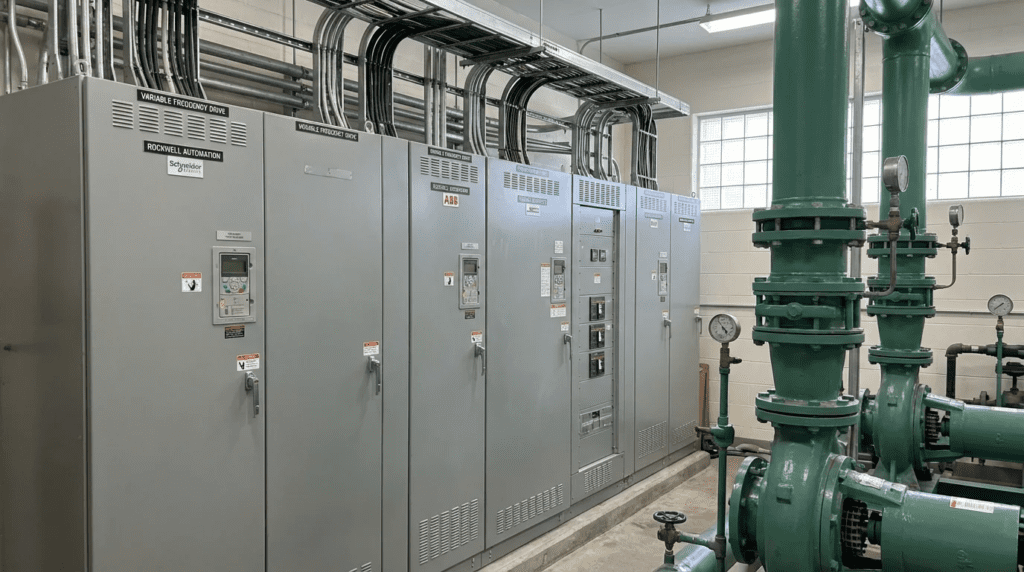
1. Introduction
In the context of municipal water and wastewater treatment, energy consumption represents one of the largest operational expenditures (OPEX) for utilities. Within these facilities, rotating equipment—specifically pumps, blowers, compressors, and mixers—accounts for the vast majority of this energy usage. The primary mechanism for controlling this equipment, optimizing energy efficiency, and managing process variables is the Variable Frequency Drive (VFD), also known as a Variable Speed Drive (VSD) or Adjustable Frequency Drive (AFD).
The application of VFDs in water and wastewater infrastructure extends beyond simple speed control. In modern treatment processes, VFDs are critical control nodes that influence hydraulic stability, biological process integrity, and mechanical longevity. For consulting engineers and plant operations staff, the specification of VFDs is not merely an electrical decision; it is a process-critical decision that impacts the facility’s ability to meet NPDES permit limits, maintain distribution pressure, and prevent catastrophic mechanical failures such as water hammer or pump cavitation.
The operating environment in these facilities is notoriously aggressive. VFDs installed in headworks, lift stations, or solids handling buildings are frequently exposed to high humidity, varying ambient temperatures, and corrosive gases such as Hydrogen Sulfide (H2S) and Chlorine. Consequently, the selection of an Original Equipment Manufacturer (OEM) for VFD technology must weigh factors far beyond initial capital cost. Reliability, ruggedness (specifically circuit board conformal coating), thermal management, and harmonic mitigation are paramount.
Furthermore, the integration of VFDs into the wider SCADA and automation ecosystem dictates the level of observability and control operators have over the plant. As the industry moves toward Industry 4.0 and data-driven asset management, the VFD’s ability to provide diagnostic data—predictive maintenance alerts, energy monitoring, and detailed fault history—distinguishes utility-grade hardware from general-purpose industrial drives. This article provides a comprehensive engineering analysis of the leading OEMs in the VFD market relevant to the water sector, focusing on technical differentiation, application suitability, and lifecycle engineering considerations.
2. How to Select This System or Equipment
Selecting a Variable Frequency Drive for municipal applications requires a multidimensional engineering approach. The “black box” mentality—treating the drive simply as a device that converts fixed frequency/voltage to variable frequency/voltage—is insufficient for critical infrastructure. Engineers must evaluate the drive based on its interaction with the power grid (line side), the motor (load side), and the process environment.
Functional Role and Load Characteristics
The first step in selection is defining the load profile. Water and wastewater applications generally fall into two categories:
- Variable Torque (VT) Loads: Centrifugal pumps and aeration blowers follow the affinity laws, where power required varies with the cube of the speed. VFDs for these applications offer significant energy savings. Engineers should specify “Normal Duty” or VT-rated drives, which typically allow for 110% overload for one minute. Special firmware features like sleep/wake functionality, pipe fill mode, and cavitation detection are critical here.
- Constant Torque (CT) Loads: Positive displacement pumps (dosing, sludge), conveyors, and centrifuges require constant torque across the speed range. These applications necessitate “Heavy Duty” or CT-rated drives capable of handling 150% overload for 60 seconds to manage high breakaway torques and potential jamming scenarios.
Harmonic Mitigation and Power Quality
Non-linear loads like VFDs introduce harmonic distortion to the facility’s power distribution system. Excessive harmonics can cause overheating in transformers, nuisance tripping of breakers, and interference with sensitive instrumentation.
- 6-Pulse Drives: The standard topology. Without mitigation, these produce high Total Harmonic Distortion (THD). Acceptable only for small motors or where the VFD load is a negligible fraction of the total plant load.
- Passive Filters / Line Reactors: Adding 3% or 5% line reactors or DC link chokes is a minimum requirement for municipal specifications to provide impedance and reduce harmonics.
- Multi-Pulse Drives (12 or 18-Pulse): For larger horsepower applications (typically >50 HP), engineers often specify 18-pulse drives which use phase-shifting transformers to cancel out lower-order harmonics, typically achieving <5% THDi (Current Total Harmonic Distortion) at the drive terminals.
- Active Front End (AFE) / Low Harmonic Drives: These use active switching (IGBTs) on the input side to shape the current waveform to be nearly sinusoidal. They provide the best harmonic performance and unity power factor but come at a higher cost and complexity.
Environmental Hardening and Thermal Management
The failure of VFDs in wastewater plants is frequently due to environmental corrosion. Hydrogen Sulfide attacks copper traces on printed circuit boards (PCBs), leading to “black wire” corrosion and premature failure.
- Conformal Coating: Engineers must specify IEC 60721-3-3 Class 3C2 or preferably 3C3 coating for all PCBs within the drive. This ensures resistance to chemical corrosion.
- Enclosure Ratings: While NEMA 1 is standard for clean electrical rooms, NEMA 12 (dust-tight) is recommended for most plant floors. For outdoor or highly corrosive areas, NEMA 3R or NEMA 4X (Stainless Steel) enclosures are required, though these often require active cooling systems (AC units) which introduce their own maintenance liabilities.
- Cooling Design: “Back-channel cooling” is a design feature where the drive’s heatsink projects into a separate cooling duct, keeping the majority of the heat load out of the electrical enclosure and reducing the demand on control room HVAC systems.
Motor Protection and Cable Length
The fast switching frequency of the drive’s IGBTs (Carrier Frequency) creates high voltage rise times (dV/dt) which can damage motor insulation and cause bearing fluting via common-mode currents.
- Output Reactors: Required for medium cable lengths to reduce dV/dt.
- dV/dt Filters: Required for longer cable runs (typically >100-150 feet) to protect motor insulation.
- Sine Wave Filters: Required for very long runs (typically >500 feet) or when retrofitting older motors with non-inverter-duty insulation.
Integration and Control
The VFD must integrate seamlessly with the plant’s PLC/SCADA architecture.
- Protocols: EtherNet/IP, PROFINET, and Modbus TCP/IP are standard. The drive should support the native protocol of the PLC without requiring third-party gateways.
- Bypass Logic: In critical lift stations, a 3-contactor bypass allows the motor to run across the line (DOL) if the VFD fails. Engineers must decide between “soft starter bypass” or “across-the-line bypass” based on the mechanical stress the system can endure.
- Intelligence: Modern drives act as sensors, monitoring torque, power, and motor temperature. Specifying drives that expose these parameters allows for predictive maintenance algorithms (e.g., detecting a ragged impeller via torque signature analysis).
3. Comparison Table
The following table compares the five leading OEMs utilized in the North American municipal water and wastewater market. Engineers should interpret this data based on their specific project constraints: “Integration Focus” indicates how well the drive couples with specific PLC platforms, while “Harmonic Strategy” outlines the primary method the OEM uses to meet IEEE 519 compliance for that product family.
| OEM | Core Strength | Primary Water/Wastewater Series | Harmonic Mitigation Approach | Integration Focus | Best-Fit Scenario |
|---|---|---|---|---|---|
| ABB | Dedicated Water Firmware & Ultra-Low Harmonics | ACQ580 / ACQ800 | Active Front End (ULH Series) & Multi-pulse | Agnostic (supports all major protocols) | Projects prioritizing harmonic performance and dedicated pump control logic independent of the PLC. |
| Danfoss | Thermal Management & Drive Specialization | VLT AQUA Drive (FC 202) | Back-channel cooling, Passive Filters, AFE | Agnostic (highly flexible comms cards) | Retrofits, confined electrical rooms needing heat diversion, and users preferring a drive specialist over a full-line automation vendor. |
| Rockwell Automation | Premier Integration with Logix Platform | PowerFlex 750 Series / PowerFlex 6000 (MV) | Active Front End (755T) & 18-Pulse | Native EtherNet/IP (Studio 5000) | Facilities standardized on Allen-Bradley PLCs requiring deep integration, automatic device configuration (ADC), and unified support. |
| Siemens | Modular Design & Process Automation Integration | SINAMICS G120X / G150 | Clean Power (AFE) & Low Harmonic modules | Native PROFINET (TIA Portal) | Complex process control environments using Siemens PLCs/DCS, requiring high modularity and safety integration. |
| Schneider Electric | Services Oriented & Asset Management | Altivar Process ATV600 / ATV900 | Low Harmonic solutions & 3-level topology | Native Modbus/EtherNet (EcoStruxure) | Digital transformation projects focusing on embedded energy monitoring, QR-code diagnostics, and fluid asset management. |
4. Top OEMs / System Integrators
ABB
ABB is a global leader in power and automation technologies and holds a significant market share in the global water and wastewater drives market. Their approach to the sector is characterized by product lines specifically engineered for water applications, rather than generic industrial drives adapted for pumps.
Technical Overview
The flagship product for this sector is the ACQ580 series. Unlike general-purpose drives, the ACQ580 comes pre-loaded with application macros tailored for water processes. This includes built-in logic for multi-pump control, sensorless flow calculation, level control, and pipe cleaning (anti-ragging). From an electrical engineering standpoint, ABB is renowned for its Direct Torque Control (DTC) technology (available in high-end models), which provides precise motor control without encoder feedback, offering superior torque response during load transients compared to standard Volts/Hertz control.
Harmonic Mitigation
ABB strongly advocates for “Ultra-Low Harmonic” (ULH) drives. The ACQ580 ULH version features an active supply unit and a line filter integrated into the drive package. This design results in a low harmonic content (typically <3% THDi) even under partial loads. For engineers, this simplifies the single-line diagram by eliminating the need for external harmonic filters, multi-pulse transformers, or oversized generators.
Maintenance and Usability
A key strength of ABB is the Hand-Off-Auto (HOA) control panel. It is intuitive, supports graphical trending, and speaks “pump language” (e.g., displaying flow in GPM rather than frequency in Hz). For maintenance, the drive modules in higher horsepower frames are often mounted on rails, allowing for easy extraction and replacement. The electronics are coated to class 3C3 standards, providing resilience against H2S environments common in lift stations.
Danfoss
Danfoss distinguishes itself by being a dedicated drive manufacturer (VLT and Vacon brands) rather than a broad-spectrum automation conglomerate. This focus results in a product that is highly optimized for mechanical integration and efficiency, often viewed as “motor independent” and “PLC independent.”
Technical Overview
The VLT AQUA Drive FC 202 is the industry standard for Danfoss in this sector. A critical differentiator is the thermal management design. Danfoss pioneered back-channel cooling, where the heatsink is isolated from the electronics and positioned in a dedicated air channel. This allows 85-90% of the drive’s heat loss to be vented directly outside the enclosure or control room. For consulting engineers designing electrical rooms, this can significantly reduce the size and CAPEX of the HVAC system required to cool the room.
Process Features
The VLT AQUA Drive includes a “Cascade Controller” as a standard feature, capable of controlling multiple pumps without an external PLC. This makes it an excellent choice for booster stations and remote sites where minimizing control hardware is desirable. The drive also features “Deragging,” “Dry Run Detection,” and “Flow Compensation” (reducing pressure setpoint at low flows to save energy).
Lifecycle Considerations
Danfoss drives are known for their compact footprint, often being narrower than competitors, which is advantageous in MCC (Motor Control Center) retrofit projects. They maintain a strong philosophy of backward compatibility, ensuring that newer control cards work with older power sections where possible, extending the usable life of the installation.
Rockwell Automation
In the North American municipal market, Rockwell Automation (Allen-Bradley) is the dominant player, largely driven by the ubiquity of their ControlLogix and CompactLogix PLC platforms. The primary value proposition for Rockwell drives is “Premier Integration.”
Technical Overview
The PowerFlex 750 Series (specifically the 753 and 755) serves the water industry. The PowerFlex 755 offers an integrated motion instruction set and advanced safety features. When paired with a Logix controller, the drive configuration is stored within the PLC project file. If a drive fails, maintenance personnel can replace the hardware, and the PLC will automatically download the firmware and configuration to the new unit (Automatic Device Configuration – ADC). This feature significantly reduces Mean Time To Repair (MTTR) and reduces the skill gap required for night-shift operators.
Power and Harmonics
Rockwell offers the PowerFlex 755T (TotalFORCE technology) which utilizes an Active Front End for harmonic mitigation and power factor correction. For high-horsepower applications, they provide 18-pulse solutions packaged in their Centerline MCCs. The TotalFORCE technology provides active damping of system resonance, which can be critical in systems with long leads and complex filter networks.
Application Fit
While the standalone drive features are robust, Rockwell drives are most justifiable in facilities already committed to the Rockwell ecosystem. The ease of mapping tags to SCADA and the availability of Add-On Profiles (AOPs) streamline the System Integrator’s workload, often offsetting the potentially higher hardware cost compared to standalone drive specialists.
Siemens
Siemens is a powerhouse in global industrial automation, offering drives that are deeply integrated into their TIA (Totally Integrated Automation) Portal environment. Their portfolio is vast, but the SINAMICS G120X is the series specifically optimized for water/wastewater infrastructure applications.
Technical Overview
The SINAMICS G120X is built on a modular platform consisting of a Power Module (PM) and a Control Unit (CU). This modularity allows engineers to mix and match power capacities with intelligence levels. The drive is designed for seamless integration with PROFINET networks, offering extensive diagnostics and safety integration (SIL 3 / PL e) directly over the network cable.
Efficiency and Reliability
Siemens emphasizes energy efficiency and grid stability. The G120X series includes a DC link reactor as standard to mitigate harmonics. For more stringent requirements, Siemens offers Active Interface Modules. The drives feature a “Keep Running” mode, designed to maintain operation during unstable grid conditions (voltage dips), which is vital for storm pumps during severe weather events.
Digitalization
Siemens leads in the “Digital Twin” concept. Engineers can simulate the drive and motor performance within the design phase using Siemens software tools. Furthermore, the drives are ready for edge computing, capable of sending high-frequency data to cloud platforms (MindSphere) for advanced analytics without overloading the plant SCADA network.
Schneider Electric
Schneider Electric positions its Altivar Process (ATV600 and ATV900) drives as “Services Oriented Drives.” The focus here is on embedded intelligence that assists with asset management and process optimization directly from the drive, reducing reliance on external sensors and heavy SCADA coding.
Technical Overview
The Altivar Process drives feature built-in web servers and Ethernet connectivity as standard. A unique feature is the embedded power measurement capability, which boasts an accuracy of <5%, allowing the drive to function as a sub-meter for energy audits. The drive can store and display pump curves; by monitoring the operating point relative to the Best Efficiency Point (BEP), the drive can alert operators if a pump is running inefficiently or suffering from mechanical wear (e.g., worn wear rings).
User Interface and Support
Schneider has integrated dynamic QR codes on the drive display. When a fault occurs, the operator scans the code with a mobile device, which links directly to a troubleshooting guide specific to that error and drive model. This reduces downtime by providing immediate, contextualized support information.
Ruggedness
The ATV600 series is designed for harsh environments, with 3C3 coating standard on printed circuit boards. They also offer robust enclosure options suitable for the corrosive atmosphere of wastewater treatment plants.
5. Application Fit Guidance
While all five OEMs produce high-quality VFDs capable of spinning a motor, the optimal choice often depends on the specific constraints and goals of the municipal project.
Municipal Water (Clean Water)
In clean water distribution and booster stations, reliability and constant pressure control are key.
- Preferred Approach: Danfoss and ABB are frequently selected here for their robust standalone multi-pump control logic. If the booster station is remote and lacks a complex PLC, the internal cascading logic of the VLT Aqua or ACQ580 is superior.
- High Service/Distribution Pumps: For large horsepower distribution pumps (>200HP), Rockwell and Siemens are often favored if the utility wants deep integration into a central SCADA for precise dispatch control and energy grid load shedding coordination.
Municipal Wastewater (Headworks & Lift Stations)
This is the most challenging environment due to rags (clogging) and H2S (corrosion).
- Anti-Ragging: All OEMs offer this, but ABB and Danfoss have particularly mature algorithms that detect the early onset of jamming via torque monitoring and execute cleaning cycles without operator intervention.
- Corrosion Resistance: Engineers should strictly enforce 3C3 conformal coating specifications. Schneider Electric and Danfoss have strong reputations for enclosure integrity in these zones.
Retrofit vs. Greenfield
- Retrofits: Danfoss is often the “contractor’s choice” for retrofits due to compact dimensions and versatile mounting options. The ability to use back-channel cooling can save a project from needing expensive HVAC upgrades in existing electrical rooms.
- Greenfield: In new plants, the decision is usually driven by the Master Spec and the System Integrator. If the plant is an “Allen-Bradley shop,” Rockwell PowerFlex drives in a smart MCC are the logical engineering choice to minimize integration risk.
Remote and Unmanned Sites
For remote wells or lift stations with limited telemetry:
- Schneider Electric offers significant advantages with its embedded web server and QR code troubleshooting, allowing a roving technician to diagnose issues with a smartphone even if the SCADA link is down.
6. Engineer & Operator Considerations
Beyond selecting the manufacturer, the long-term success of a VFD installation hinges on detailed engineering and operational planning.
Installation Best Practices
Cabling and Grounding: The most common cause of VFD-related issues is improper cabling. Engineers must specify VFD-grade shielded cable (e.g., 3-conductor plus 3-symmetrical grounds with foil and braid shield) between the drive and the motor. This contains the high-frequency noise generated by the IGBT switching. Equally critical is the grounding plane; the motor chassis, cable shield, and drive chassis must be bonded to a low-impedance ground grid to prevent common-mode voltage issues.
Cable Length Management: Engineers must calculate the cable distance from the VFD to the motor during the design phase. If the distance exceeds the OEM’s recommendation (often 150-300 ft depending on carrier frequency), a dV/dt filter must be installed at the drive output. Failure to do so will result in reflective wave phenomena that can punch through motor insulation voltage ratings (1600V or higher).
Integration and Commissioning
Auto-Tuning: A VFD cannot control a motor optimally without knowing its electrical characteristics. “Rotational Auto-tune” should be a mandatory step in the commissioning checklist. This allows the drive to measure stator resistance and leakage inductance, optimizing torque accuracy and efficiency.
Parameter Management: Operators often face the “replaced drive nightmare,” where a failed unit is swapped, but the new unit has factory default settings. Engineers should mandate that VFD parameters be backed up in three places: the drive keypad (HMI), the facility server/laptop, and ideally, the PLC (via ADC features like those in Rockwell or Siemens systems).
Maintenance and Lifecycle
Fan Replacement: Cooling fans are the only moving part in a VFD and have a finite life (typically 3-5 years). Select drives where the main heatsink fans can be replaced without removing the drive from the wall or the MCC bucket.
Capacitor Reforming: If a VFD is kept as a spare on a shelf for more than a year, the DC bus capacitors can degrade. Applying full voltage immediately can cause them to explode. Maintenance supervisors must have a procedure for “reforming” capacitors (gradually increasing voltage) for spare drives stored long-term.
Obsolescence Strategy: VFD product lifecycles are shorter than pumps (10-15 years vs. 20-30 years). Engineers should select OEMs with a proven track record of long support windows and clear migration paths (e.g., mounting adapter plates that allow a new generation drive to fit the bolt pattern of the old generation).
7. Conclusion
For municipal water and wastewater engineers, the selection of a VFD OEM is a balance between process performance, electrical compatibility, and long-term supportability. There is no single “best” drive; rather, there is a best drive for a specific facility context.
ABB and Danfoss excel in applications requiring deep hydraulic expertise, standalone control capability, and superior harmonic performance without complex external filtering. They are the go-to choices for engineers prioritizing the VFD as a dedicated process controller.
Rockwell Automation and Siemens are the clear leaders when the VFD is viewed as a node in a tightly integrated automation architecture. Their value is maximized in greenfield plants or major upgrades where the speed of integration, centralized configuration, and unified diagnostic data streams outweigh hardware modularity.
Schneider Electric bridges the gap with a strong focus on digital services and asset management, making them ideal for utilities pushing for data-driven operations and remote accessibility.
Ultimately, a robust specification must go beyond the brand name. It must detail the harmonic limits, the conformal coating class, the integration protocol, and the thermal management strategy. By doing so, engineers ensure that the selected VFD provides decades of reliable service in the demanding environment of municipal water and wastewater treatment.