
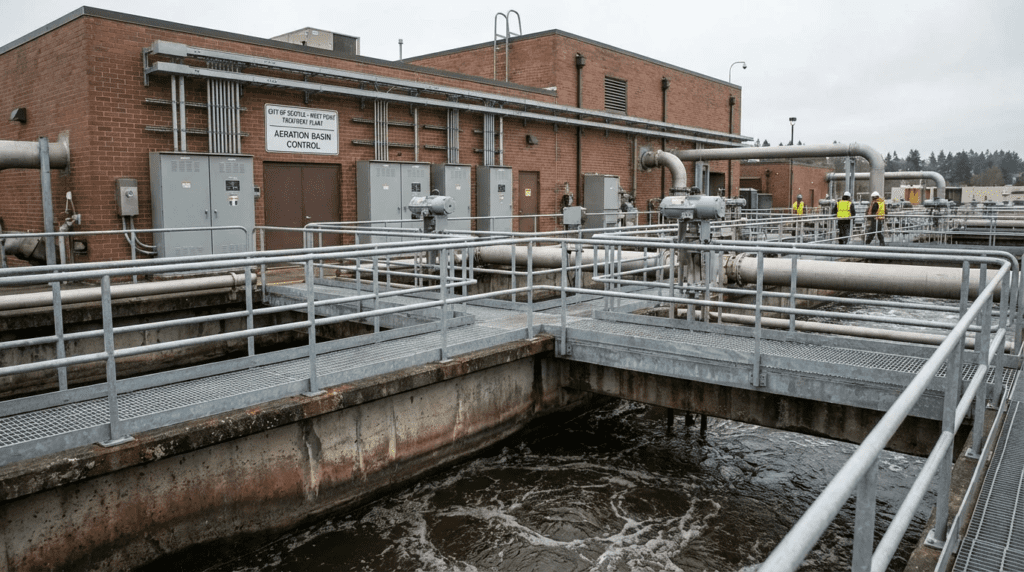
Introduction: The State of Washington’s Wastewater Infrastructure
Washington State operates one of the most environmentally scrutinized wastewater sectors in the United States, largely driven by the delicate ecosystem of the Puget Sound and the Columbia River basin. The state manages approximately 300 public wastewater treatment plants, serving a population of nearly 8 million. The infrastructure landscape is currently defined by a massive pivot toward advanced nutrient removal, driven by the Washington State Department of Ecology’s stringent water quality standards.
For consulting engineers and utility managers, Washington represents a high-activity market. The sector is currently grappling with the Puget Sound Nutrient General Permit (PSNGP), which mandates significant reductions in nitrogen discharges for nearly 60 facilities discharging into the Sound. This regulatory pressure, combined with ambitious Combined Sewer Overflow (CSO) control programs in the Seattle metropolitan area, has triggered billions in capital improvement planning.
Currently, the state treats approximately 600+ MGD (Million Gallons per Day) of wastewater. The transition from conventional secondary treatment to tertiary treatment and Membrane Bioreactor (MBR) technologies is accelerating, supported by robust state revolving funds and federal IIJA allocations.
Recent Developments & Market Trends
The engineering landscape in Washington is dominated by two primary factors: Nutrient Optimization and Wet Weather Management.
- The Nitrogen Shift: Following the issuance of the PSNGP, facilities facing the Puget Sound are currently in the optimization phase, with many moving into design for major process upgrades to achieve lower Total Inorganic Nitrogen (TIN) limits. This presents significant opportunities for process engineers specializing in BNR (Biological Nutrient Removal).
- Mega-Projects in CSO Control: King County and Seattle Public Utilities are nearing the completion of several massive underground storage tunnel projects designed to mitigate combined sewer overflows during heavy Pacific Northwest rains.
- Resource Recovery: Washington is a leader in “waste-to-resource” philosophy. Tacoma and King County are pioneering co-digestion of high-strength organic waste to boost biogas production for Renewable Natural Gas (RNG) injection.
- Water Reuse: The LOTT Clean Water Alliance and King County’s Brightwater facility continue to expand reclaimed water distribution networks (Class A water) for irrigation and industrial use, reducing strain on potable water supplies.
Top 20 Largest Wastewater Treatment Plants in Washington
The following list ranks Washington’s treatment facilities by Design Average Wet Weather Flow (DAWWF) or Maximum Month Design Flow capacity. Data is compiled from the WA Department of Ecology, King County WTD reports, and municipal comprehensive plans.

| Rank | Plant Name | Location | Design Capacity (MGD) | Pop. Served | Operating Authority |
|---|---|---|---|---|---|
| 1 | West Point Treatment Plant | Seattle | 215 (440 Peak) | 1.7M* | King County WTD |
| 2 | South Treatment Plant | Renton | 144 | ~800k | King County WTD |
| 3 | Central Treatment Plant | Tacoma | 60 | 250,000 | City of Tacoma |
| 4 | Riverside Park Water Reclamation | Spokane | 50 | 230,000 | City of Spokane |
| 5 | Chambers Creek Regional WWTP | University Place | 44 | 316,000 | Pierce County |
| 6 | Brightwater Treatment Plant | Woodinville | 36 | 205,000 | King County WTD |
| 7 | Everett Water Pollution Control | Everett | 34.8 | 150,000 | City of Everett |
| 8 | LOTT Budd Inlet Treatment Plant | Olympia | 28 | 118,000 | LOTT Clean Water Alliance |
| 9 | Westside Water Reclamation | Vancouver | 28.3 | ~150k | City of Vancouver |
| 10 | Marine Park Treatment Plant | Vancouver | 24.8 | ~100k | City of Vancouver |
| 11 | Salmon Creek Treatment Plant | Vancouver | 14.9 | ~100k | Discovery Clean Water |
| 12 | Bellingham Post Point WWTP | Bellingham | 20 (Max Mo) | 90,000 | City of Bellingham |
| 13 | Lakewood/Walton WWTP | Sewage District | 15 | 80,000 | Pierce County |
| 14 | Lynnwood WWTP | Lynnwood | 11.6 | 40,000 | City of Lynnwood |
| 15 | Bremerton Westside WWTP | Bremerton | 11 | 42,000 | City of Bremerton |
| 16 | Yakima Regional WWTP | Yakima | 10.5 | 95,000 | City of Yakima |
| 17 | Kennewick WWTP | Kennewick | 10.3 | 84,000 | City of Kennewick |
| 18 | Richland WWTP | Richland | 10.1 | 60,000 | City of Richland |
| 19 | Pasco WWTP | Pasco | 9.8 | 77,000 | City of Pasco |
| 20 | Midway Sewer District Plant | Des Moines | 9.0 | 30,000 | Midway Sewer District |

*Note: King County WTD population figures are aggregate; West Point serves the largest portion of the Seattle metro area.
Detailed Profiles: Top 5 Largest Facilities
1. West Point Treatment Plant
- Location: Seattle, King County
- Design Capacity: 215 MGD (Average Wet Weather), 440 MGD (Peak Hydraulic)
- Operating Authority: King County Wastewater Treatment Division (WTD)
- Receiving Water: Puget Sound
- Treatment Process: Preliminary screening, primary sedimentation, high-purity oxygen (HPO) activated sludge secondary treatment, chlorine disinfection.
- Infrastructure Highlights:
- Biosolids: Anaerobic digestion producing “Loop” biosolids for forestry/agriculture application.
- Energy: Co-generation engines utilize digester gas to produce electricity and heat for plant processes.
- Recent Upgrades: Major raw sewage pump restoration following 2017 flooding event; ongoing power quality improvements to prevent bypasses.
- Compliance Status: Operating under NPDES permit WA0029181. Strict adherence to CSO control limits.
2. South Treatment Plant
- Location: Renton, King County
- Design Capacity: 144 MGD
- Operating Authority: King County WTD
- Receiving Water: Puget Sound (via 12-mile outfall from Renton to Elliott Bay)
- Treatment Process: Conventional activated sludge, producing Class A reclaimed water for local irrigation and industrial use.
- Notable Innovation: The plant is a hub for the “WaterWorks” program and features extensive scrubbing systems to inject Renewable Natural Gas (RNG) into the commercial pipeline, generating revenue for the utility.
3. Tacoma Central Treatment Plant
- Location: Tacoma, Pierce County
- Design Capacity: 60 MGD (Peak hydraulic flow >150 MGD)
- Operating Authority: City of Tacoma Environmental Services
- Receiving Water: Commencement Bay (Puget Sound)
- Treatment Process: High Purity Oxygen (HPO) activated sludge with peak flow treatment capabilities.
- Infrastructure Highlights: Recognized as a “Plant of the Future” for its co-digestion program. The plant accepts high-strength organic waste (FOG) to boost biogas production, fueling boiler operations and selling excess energy.
4. Riverside Park Water Reclamation Facility
- Location: Spokane, Spokane County
- Design Capacity: 50 MGD
- Operating Authority: City of Spokane
- Receiving Water: Spokane River
- Treatment Process: Advanced Tertiary Treatment. The plant recently integrated membrane filtration technology (Next Level of Treatment) to remove phosphorus, essential for protecting the Spokane River ecosystem.
- Compliance: Operates under one of the strictest phosphorus discharge limits in the nation.
5. Chambers Creek Regional WWTP
- Location: University Place, Pierce County
- Design Capacity: 44 MGD
- Operating Authority: Pierce County Planning & Public Works
- Receiving Water: Puget Sound
- Treatment Process: Secondary treatment utilizing activated sludge; currently undergoing expansion planning to accommodate rapid regional growth.
- Recent Projects: A $353M expansion project completed in recent years to increase capacity and upgrade solids handling facilities.
Plants with Approved Budgets & Expansion Projects
A. Major Projects Under Construction (2024-2026)
Ship Canal Water Quality Project (Storage Tunnel)
- Location: Seattle (Ballard/Wallingford)
- Project Scope: Construction of a 2.7-mile, 18-foot 10-inch diameter underground storage tunnel to capture 29 million gallons of stormwater/sewage. While not a “plant” expansion, this is the critical conveyance upgrade for West Point WWTP.
- Total Budget: ~$570 Million
- Funding: SRF Loans ($180M+), WIFIA Loan ($192M), Revenue Bonds.
- Timeline: Tunneling complete 2023; Facilities completion 2025; Commissioning 2026.
- Key Contractors: Lane Construction (Tunnel), Jacobs (Design/CM).
- Drivers: Consent Decree compliance to reduce CSOs into Lake Washington Ship Canal.
LOTT Biological Process Improvements
- Location: Olympia, WA
- Project Scope: Upgrades to biological nutrient removal capabilities to meet new Puget Sound Nitrogen limits. Includes aeration basin modifications and blower replacements.
- Total Budget: ~$32 Million
- Timeline: Construction 2023-2025.
- Drivers: Regulatory compliance (Nutrient General Permit).
B. Projects in Design/Planning Phase (2025-2027)
Bellingham Post Point Resource Recovery Phase 1
- Location: Bellingham, WA
- Estimated Budget: $200+ Million (Project scope currently under re-evaluation)
- Scope: Replacement of aging incineration system with anaerobic digestion and Class A biosolids production.
- Status: Design paused for re-evaluation of costs/technologies; expected restart 2025.
King County West Point Power Quality Improvements
- Location: Seattle, WA
- Estimated Budget: $68 Million
- Scope: Installation of battery energy storage systems (BESS) and power conditioning to prevent plant trips during voltage sags.
- Timeline: Design 2024; Construction 2025-2027.
Summary Statistics: WA Infrastructure Investment
- Total Active Capital Investment: >$1.8 Billion currently programmed.
- Primary Drivers: Nutrient Removal (40%), CSO Control (35%), Asset Replacement (25%).
- Largest Active Initiative: King County Combined Sewer Overflow Control Program.
- Funding Breakdown: WA State SRF serves as a primary lever, heavily supplemented by WIFIA loans for mega-projects in King County and Seattle.
Regulatory & Compliance Landscape
Washington operates under the delegated authority of the EPA, managed by the Washington State Department of Ecology. The regulatory environment is currently one of the most dynamic in the country due to the Puget Sound Nutrient General Permit (PSNGP).
- Nutrient General Permit: Issued to limit total inorganic nitrogen discharges. It creates a tiered system where larger plants (“dominant loaders”) must optimize current processes immediately and plan for major BNR upgrades.
- PFAS “Safer Products for WA”: Washington is aggressively monitoring PFAS. While drinking water limits are set, wastewater biosolids land application is under increasing scrutiny regarding PFAS content.
- CSO Consent Decrees: Seattle, King County, and Spokane operate under federal consent decrees requiring the reduction of untreated overflows to an average of no more than one event per outfall per year.
Technology Trends in Washington
- Tertiary Membrane Filtration: As seen in Spokane’s Riverside Park, tertiary membranes are becoming the standard for meeting strict phosphorus limits in river discharge scenarios.
- Side-Stream Treatment: To meet nitrogen limits without massive footprint expansion, plants are exploring side-stream treatment (e.g., Anammox) to treat nitrogen-rich centrate from dewatering processes.
- Co-Digestion: With legislation favoring renewable energy, facilities like Tacoma Central are leaders in co-digesting FOG (Fats, Oils, Grease) and food waste to maximize biogas production.
- Electrical Resiliency: Following the West Point flooding incident (caused by power failure), there is a trend toward installing high-capacity Battery Energy Storage Systems (BESS) and microgrids at major plants.
Resources for Engineers & Operators
- Pacific Northwest Clean Water Association (PNCWA) – The primary WEF member association for the region.
- Washington State Department of Ecology – Water Quality Program – Permitting and funding information.
- Evergreen Rural Water of Washington – Training and certification for smaller utility operators.
- Washington Wastewater Operator Certification – Link to DOE certification portal.
Frequently Asked Questions
- What is the largest wastewater treatment plant in Washington?
- The West Point Treatment Plant in Seattle, operated by King County, is the largest with a design capacity of 215 MGD and peak wet weather capacity of 440 MGD.
- What is the Puget Sound Nutrient General Permit?
- It is a regulatory permit issued by the Dept of Ecology requiring 58 wastewater treatment plants discharging to Puget Sound to cap and eventually reduce nitrogen discharges to prevent low oxygen levels (hypoxia) in the water.
- Which engineering firms are active in Washington wastewater projects?
- Major firms with significant market share in WA include Jacobs, HDR, Brown and Caldwell, Carollo Engineers, Parametrix, and Kennedy Jenks.
- How are wastewater projects funded in Washington?
- Funding primarily comes from the Water Quality Combined Funding Program (managed by Ecology), which blends EPA State Revolving Funds (SRF), state Centennial Clean Water grants, and Stormwater Financial Assistance.
- Are there opportunities for water reuse in Washington?
- Yes, particularly for Class A Reclaimed Water. LOTT in Olympia and King County’s Brightwater plant are the state’s flagship examples of large-scale water reclamation for irrigation and industrial processes.