
YSI (Xylem) vs SCADATA for Instrumentation: Pros/Cons & Best-Fit Applications
Introduction
One of the most persistent challenges in water and wastewater engineering is bridging the gap between high-fidelity process data and actionable remote visibility. Engineers face a bifurcation in the market: robust analytical sensor networks designed for in-plant process control, and cloud-centric telemetry platforms designed for distributed remote monitoring. This dichotomy is what the comparison of YSI (Xylem) vs SCADATA for Instrumentation: Pros/Cons & Best-Fit Applications is really about.
A great deal of installed analytical capability in the sector is never used, because integration into the plant SCADA or telemetry system proves too complex, incompatible, or is value-engineered out of the project. The result is stranded data — expensive sensors acting as local displays rather than drivers of automation. For municipal design engineers and utility directors, choosing between a comprehensive sensor ecosystem and a telemetry-focused platform is not just a brand choice; it is a decision about the facility’s data architecture.
A clarification on naming before going further. YSI is a Xylem brand with a long history in water quality measurement, particularly dissolved oxygen, ammonium, and pH. The IQ SensorNet platform frequently discussed alongside it is a WTW product line, also under Xylem Analytics — the two brands are related but distinct, and a quotation should state which platform it is based on. On the other side of the comparison, SCADATA stands in for the telemetry and remote terminal unit (RTU) as-a-service category: cellular-backhauled RTUs with cloud hosting, sold on a subscription rather than as plant hardware. Verify the specific supplier and its product scope before naming either in a specification.
This article provides a specification-grade analysis to help engineers navigate these two distinct approaches to water quality and process monitoring. Both sit within the broader field of water treatment equipment manufacturers, where the instrumentation and controls scope is frequently the last thing resolved and the first thing cut.
How to Select and Specify
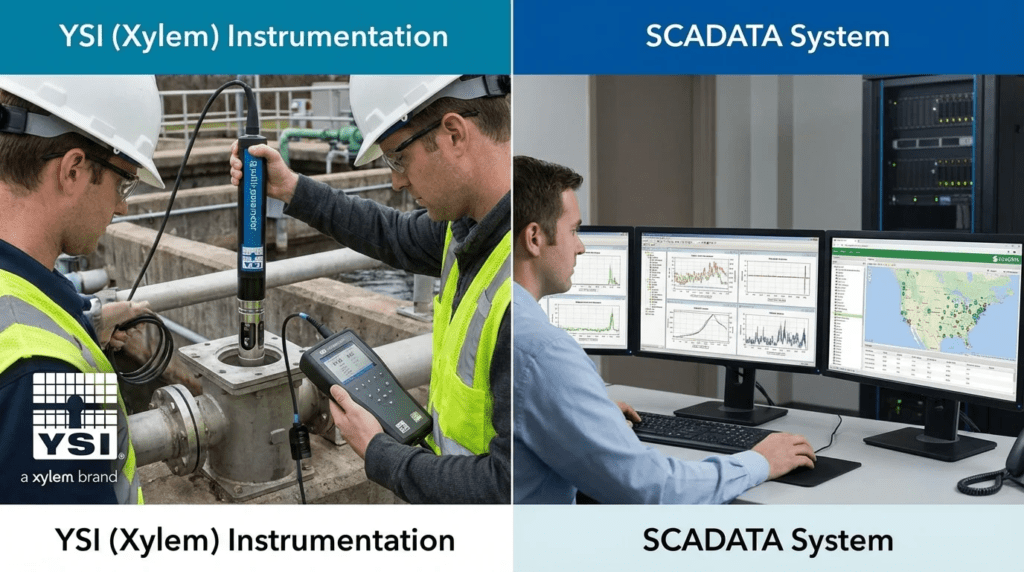
When evaluating YSI (Xylem) vs SCADATA for Instrumentation: Pros/Cons & Best-Fit Applications, engineers must recognize that these technologies sit at different layers of the automation stack. YSI is an instrumentation and sensor network provider; a telemetry platform is a data transport and presentation layer. The selection process hinges on duty conditions and data requirements.
Duty Conditions & Operating Envelope
The primary differentiator is the criticality of the process control loop. If the instrumentation is intended to drive a variable frequency drive for blower aeration control in real time, latency and reliability requirements favor hard-wired, dedicated sensor networks.
- Continuous Process Control: For applications requiring fast update rates and direct PLC integration, such as ammonia-based aeration control, sensor network platforms are designed to reside on the plant’s local industrial network (EtherNet/IP, Modbus TCP, Profibus). They offer the data throughput essential for PID loops.
- Remote Monitoring & Compliance: If the duty is compliance reporting or asset health monitoring, such as lift station levels, a telemetry architecture excels. These applications typically tolerate data latency measured in minutes, which aligns with cellular power-saving cycles.
- Capacity Planning: Engineers must consider future expansion. Sensor network systems are modular regarding sensor count. Telemetry systems are modular regarding site count.
Materials & Compatibility
The physical construction of the equipment dictates its survival in harsh wastewater environments.
- Wetted Materials: YSI specializes in wetted components. Probes use stainless steel, titanium, and specialized polymers designed for submersion in mixed liquor suspended solids. Engineers must specify automatic cleaning mechanisms for high-fouling environments.
- Enclosure Ratings: Telemetry hardware typically resides outside the process fluid, often in NEMA 4X (IP66) enclosures. The critical compatibility check is the environmental rating of the enclosure against UV exposure, heat load, and corrosive gases if mounted near wet wells.
- Temperature Limits: Process sensors are generally rated for process temperatures. Telemetry electronics, often containing batteries or cellular radios, may require sun shields or active cooling in hot climates where internal panel temperatures rise well above ambient.
Hydraulics & Process Performance
While instrumentation does not pump fluid, it must interact with the hydraulic profile of the plant.
- Flow Velocity Requirements: Electrochemical and optical sensors often require minimum flow velocities across the membrane or lens to prevent bio-fouling and ensure representative sampling. Specifications must detail mounting locations where velocity is sufficient.
- Level Sensing Hydraulics: When using telemetry for level monitoring, the choice of the primary element (ultrasonic vs. hydrostatic) affects performance. In turbulent wet wells, the algorithm must filter out surface foam and turbulence.
Installation Environment & Constructability
The cost to install is often a hidden differentiator between these systems.
- Sensor Network Installation: Requires conduit runs, local power, and mounting hardware. Complexity increases with the distance from the basin to the transmitter. In retrofit applications, the cost of trenching for conduit can exceed the cost of the sensor itself.
- Telemetry Installation: Designed for drop-in deployment. Solar-powered options eliminate line power, and cellular backhaul eliminates communication conduit. This suits sites with difficult access or where trenching is cost-prohibitive.
- Structural: Probes in aeration basins require swing-arm mounts to allow operators to retrieve sensors without entering the tank. Engineers must detail these structural supports in the drawings.
Never specify “SCADA compatibility” generically. For a sensor network, specify the exact protocol and the register map. For a telemetry platform, specify the API or data export format so the utility owns and can retrieve its own data.
Reliability, Redundancy & Failure Modes
Sensor networks: The failure mode is typically sensor drift or fouling. The architecture is centralized; if the main terminal fails, connected sensors may lose visibility unless redundant modules are specified. Mean time between failures for the digital controllers is generally high.
Telemetry platforms: The primary failure mode is communication loss. The system must be specified with store-and-forward capability, ensuring that data collected during a network outage is buffered locally and transmitted once the connection is restored. This prevents data gaps in compliance reports.
Controls & Automation Interfaces
This is the most distinct boundary between the two.
- Closed-Loop Control: Hard-wired sensor networks are the standard for closed-loop control. The sensor feeds data to the PLC, which adjusts blower speed. Latency is negligible.
- Supervisory Control: Telemetry is supervisory. It allows an operator to change a setpoint remotely, but local logic must handle immediate process safety. Relying on cloud-based telemetry for critical real-time pump protection is not acceptable practice.
Lifecycle Cost Drivers
- CAPEX: Sensor networks carry high initial hardware costs (terminals, probes, mounting hardware). Telemetry hardware costs less.
- OPEX (Consumables): Process sensors require regular replacement of sensor caps, electrolytes, and reagents. These costs are significant and predictable.
- OPEX (Service): Telemetry carries a recurring subscription for cellular data and cloud hosting. Over a 10-year horizon this operational expense can approach the initial capital cost.
Remote Monitoring Is Now a Cybersecurity Decision
The moment a utility puts a cellular RTU on a lift station, it has added an internet-connected device to a water system, and that carries obligations that did not exist when the same station was monitored by a dedicated radio link.
Under America’s Water Infrastructure Act of 2018, community water systems above the applicable population thresholds must conduct risk and resilience assessments that explicitly cover electronic, computer, and automated systems, and must certify emergency response plans addressing them. A fleet of subscription telemetry units is squarely within that scope, and the assessment has to account for them whether or not the vendor mentions it.
Practically, four requirements belong in the specification. Require an asset inventory at handover — every unit, its firmware version, its SIM identity, and its cloud account — because a fleet nobody has catalogued cannot be patched. Require multi-factor authentication on all administrative access to the hosted platform, with logging, and prohibit shared accounts. Require that default credentials be changed before acceptance and that the changed credentials be delivered to the utility, not retained solely by the integrator. And require a documented firmware update path with a stated support horizon, since a cellular RTU that cannot be patched becomes a liability the day a vulnerability is published.
Two further items are specific to this architecture. Cellular network generations are retired on the carrier’s schedule, not the utility’s, and a fleet built on a sunsetting radio becomes scrap; specify hardware supporting current and next-generation bands, and prefer dual-SIM or eSIM so carriers can be changed without touching hardware. And settle data ownership contractually: require an export mechanism and a defined retention period, so that ending the subscription does not end access to records the utility may need for compliance purposes.
Comparison Tables
The following tables provide a direct comparison to assist in the specification process. Table 1 contrasts the technological architecture and maintenance profiles, while Table 2 outlines the best-fit scenarios for different plant applications.
| Feature | YSI / WTW (Xylem) process sensor network | Cloud telemetry / RTU platform |
|---|---|---|
| Primary Function | High-fidelity analytical sensing and process control integration. | Remote telemetry, data logging, and cloud visualization. |
| Data Connectivity | Local industrial protocols (Modbus, Profibus, EtherNet/IP) to plant PLC. | Cellular, satellite, or radio to cloud or web server. |
| Power Requirements | Typically line power or 24VDC from panel. | Optimized for solar, battery, or line power. |
| Sensor Types | Specialized process: DO, pH, ORP, TSS, ammonium, nitrate, organics. | Universal inputs: 4-20mA, pulse, digital inputs; accepts third-party sensors. |
| Update Rate | Real-time (seconds) — suitable for PID control. | Interval (minutes to hours) — suitable for monitoring and alarms. |
| Maintenance Profile | High: regular calibration, cap changes, cleaning verification. | Low to medium: battery checks, signal verification, firmware patching. |
| Data Ownership | On-premise; utility owns the database. | Cloud-hosted under subscription; ownership and export rights must be contractual. |
| Cybersecurity Exposure | Inside the plant network boundary; governed by the plant’s existing controls. | Internet-connected assets requiring inventory, MFA, credential management, and a patch path under AWIA 2018 assessments. |
| Application Scenario | Best Fit | Why? | Engineer’s Note |
|---|---|---|---|
| Aeration Basin Control | YSI (Xylem) | Requires real-time DO and ammonia readings to adjust blower VFDs. | Specifying cellular telemetry here introduces unacceptable latency for blower control. |
| Remote Lift Station Monitoring | Telemetry platform | Dispersed geography; requires cellular backhaul; simple I/O. | Process analytics are unnecessary unless wastewater chemistry is being monitored at the station. |
| Effluent Compliance (Turbidity/pH) | Hybrid / YSI | Accuracy is paramount for regulatory reporting. | Use the process sensor for accuracy, hardwired to plant SCADA or an RTU for reporting. Confirm the method is permit-acceptable. |
| CSO/SSO Level Monitoring | Telemetry platform | Locations usually lack power; event-based data needed. | Verify area classification for manhole installations and specify equipment rated accordingly. |
| River/Source Water Monitoring | YSI sonde + telemetry | Requires multiparameter quality data in remote locations. | Typically a YSI sonde connected to a third-party RTU. Confirm which party owns the data path. |
Engineer & Operator Field Notes
Successful deployment of either system relies on practical field implementation. The following notes are derived from commissioning experiences and operational feedback.
Commissioning & Acceptance Testing
When commissioning process sensor networks, the site acceptance test must verify the digital handshake between the sensor controller and the plant PLC. A common failure point is data scaling — the controller sends one range and the PLC expects another. Engineers should require a loop check sheet that verifies values at 0%, 50%, and 100% of range using the controller’s simulation mode.
For telemetry systems, the critical acceptance step is signal strength verification. A marginal cellular signal on a sunny commissioning day may fail during a storm event. Acceptance criteria should specify a minimum received signal strength and the successful transmission of alarms to the designated operator list within a defined timeframe. Add the cybersecurity acceptance items: inventory delivered, default credentials changed and handed over, MFA enabled, and a firmware update demonstrated.
Common Specification Mistakes
Engineers often specify telemetry systems assuming they include the primary sensors. The platform provides the interface, but the specification must clearly define who supplies the level transducer or pressure transmitter. Conversely, specifying a sensor network without defining the communication module leaves the unit isolated from the plant SCADA.
Another frequent error is under-specifying cable lengths. Digital process sensors come with standard cable lengths. If the handrail-to-transmitter distance exceeds it, a junction box or extension cable is required. Splicing proprietary digital sensor cables in the field is a major reliability risk and should be prohibited in the specification.
O&M Burden & Strategy
Process sensor maintenance:
Operators must commit to a cleaning schedule. Even with air-blast or ultrasonic cleaning, biological slime accumulates. A typical preventive maintenance schedule involves:
- Weekly: Visual inspection and manual wipe-down.
- Monthly: Calibration verification against a handheld unit.
- Quarterly to semi-annually: Replacement of membrane caps or reagents.
Telemetry maintenance:
The burden here is administrative, electrical, and now also security-related.
- Quarterly: Clean solar panels if equipped.
- Annually: Check backup battery health; review the asset inventory against what is actually deployed.
- Ongoing: Manage SIM subscriptions, apply firmware updates, and review user accounts and access logs.
Troubleshooting Guide
When process sensor readings become erratic, the root cause is often ground loops or moisture ingress in the sensor connector. Use the manufacturer-supplied grounding kits when mounting in stainless steel tanks to prevent galvanic interference.
When telemetry units go offline, do not assume hardware failure immediately. Check the local cellular carrier status. Network generation retirements or local tower maintenance are common culprits. A power cycle resolves a large share of RTU lockups.
Design Details & Specifications
Integrating these systems requires specific design inputs. Below are the methodologies for sizing and specifying these components correctly.
Sizing Logic & Methodology
1. Power Budget Calculation (for solar RTU applications):
Calculate the daily amp-hour consumption as the active current draw multiplied by the hours spent transmitting, plus the standby current multiplied by the remaining hours.
Example: a cellular modem drawing 0.5 A while transmitting for 10 minutes each hour spends 4 hours per day active, giving 2.0 Ah; at 0.01 A standby for the remaining 20 hours, a further 0.2 Ah; total 2.2 Ah/day.
Size the solar panel and battery for 5-7 days of autonomy against this load.
2. Sensor Range Sizing:
Select sensor ranges that place the normal operating point at 40-60% of full scale for maximum accuracy. For an aeration basin normally at 2.0 mg/L dissolved oxygen, a 0-20 mg/L sensor is standard, but accuracy is best in the lower portion of the range. Avoid using wide-range turbidity sensors for low-range potable applications.
Specification Checklist
For process analytics:
- Controller Capacity: Specify the number of available channels to allow future expansion without replacing the terminal.
- Surge Protection: Require surge protection modules on the sensor network backbone for outdoor installations.
- Digital Communication: Specify that the exact register map be submitted during the shop drawing phase.
For remote telemetry:
- Carrier Independence: Specify hardware supporting multiple carriers via dual SIM or eSIM to allow network changes without hardware replacement.
- Data Hosting: Define the retention period and require an export mechanism in a documented open format.
- Cybersecurity: Require TLS 1.2 or higher for all transmissions, multi-factor authentication with logging for all administrative access, changed default credentials at handover, an asset inventory, and a documented firmware update path with a stated support horizon.
Standards & Compliance
- AWIA 2018: Requires covered community water systems to assess risk and resilience including electronic and automated systems, and to maintain emergency response plans addressing them.
- NEMA/IEC: Electrical enclosures must meet NEMA 4X (IP66) for corrosion resistance.
- NIST Cybersecurity Framework: The common reference for critical infrastructure control system security; useful for structuring the utility’s requirements.
- Permit methods: For any instrument feeding a reported compliance value, confirm the measurement method is acceptable under the discharge or drinking water permit.
Frequently Asked Questions
What is the difference between a digital sensor network and a standard 4-20mA sensor?
A digital bus-based network such as IQ SensorNet transmits the measured value together with sensor health, calibration history, and error codes over a single cable, and allows multiple sensors to be daisy-chained. A standard 4-20mA sensor sends only an analog signal proportional to the value, with no diagnostic content, and requires its own copper pair.
Can I use YSI sensors with a telemetry RTU?
Yes, this is a common hybrid application. YSI sensors, or the network terminal, can output data via Modbus or 4-20mA. An RTU reads these outputs and transmits to the cloud, combining analytical precision with remote connectivity. This is well suited to remote river monitoring stations or unmanned facilities. Define clearly which party owns the data path and the export rights.
How often does a dissolved oxygen sensor need calibration?
Modern optical dissolved oxygen sensors are stable. Unlike older electrochemical probes requiring frequent calibration, optical sensors typically require verification every 3-6 months. The sensor cap usually requires replacement every 12-24 months depending on the abrasiveness of the wastewater.
Is a subscription telemetry platform cheaper than a traditional SCADA system?
Initially, yes. Subscription platforms have lower upfront capital cost because they eliminate on-site servers, software licensing, and custom integration labor. Over a 20-year horizon the recurring hosting and data fees must be counted. For small utilities with a handful of sites the subscription model is usually more cost-effective; for large utilities with many sites, an owned SCADA system may have a lower total cost of ownership.
Why does a cellular telemetry system lose connection during storms?
Usually signal attenuation or tower infrastructure issues rather than the unit itself. If the installation uses a directional antenna, wind may have shifted alignment. Specifying high-gain omni-directional antennas and weather-rated cabling connections mitigates most weather-related outages.
What are the cybersecurity risks of cloud-based telemetry?
Cloud platforms rely on the public internet, introducing attack surface a dedicated radio link does not have. Reputable providers often employ stronger platform security than a small utility could manage locally, so the practical risk concentrates in credential hygiene, unpatched field firmware, and undocumented assets. Mandating MFA, changed default credentials, an asset inventory, and a firmware support horizon addresses most of it — and doing so is part of the AWIA assessment, not an optional extra.
Where do the control panel and automation packages fit relative to instrumentation?
They are adjacent scopes that must be coordinated with this one, and they raise the same components-versus-package question. That decision is worked through in comparisons such as ABB vs PRIMEX for automation and controls and ABB vs Emerson instrumentation equipment, while process-specific analyzer selection is covered in evaluations such as Krohne vs Hach.
Conclusion
Key Takeaways
- Define the Duty: Use process sensor networks for internal plant control (aeration, nutrient removal). Use telemetry for distributed asset monitoring (lift stations, remote reservoirs).
- Latency Matters: Never use cellular telemetry for critical, fast-acting closed-loop control.
- Integration is Key: Ensure sensor networks are specified with the correct communication modules and a submitted register map.
- Security Is Not Optional: A cellular RTU fleet is an internet-connected asset set within the scope of AWIA risk and resilience assessments. Specify inventory, MFA, credential handover, and a patch path.
- Calculate TCO: Balance high hardware and consumable costs against ongoing subscription and data costs.
- Hybrid Approaches Work: The best solution is often accurate sensors feeding a local PLC, which then reports summary data to a hosted platform for management visibility.
When deciding between YSI (Xylem) vs SCADATA for Instrumentation: Pros/Cons & Best-Fit Applications, the engineering decision should not be viewed as a binary choice between competitors, but as a selection between two architectural philosophies.
YSI, and the WTW sensor network platforms alongside it, represent process fidelity. This is the tool of choice when the chemical and biological reality of the water must be known with precision to drive treatment processes. It is a hardware-heavy, capital-intensive investment that pays dividends in process optimization and energy savings.
Telemetry platforms represent operational visibility. They solve the logistics problem of gathering data from geographically dispersed assets without maintaining IT infrastructure. They are service-heavy, agile solutions that pay dividends in reduced travel time and simpler compliance record-keeping — and they bring a security obligation with them.
For the municipal engineer, the most robust design often uses both: trusted instruments providing the data foundation within the fence line, and telemetry bridging the gap to the operator’s mobile device. By rigorously applying the selection criteria regarding latency, materials, lifecycle costs, and cybersecurity outlined in this article, engineers can deliver systems that are not only specification-compliant but operationally sustainable for decades.