
Top OEMs for Aeration Equipment
1. INTRODUCTION
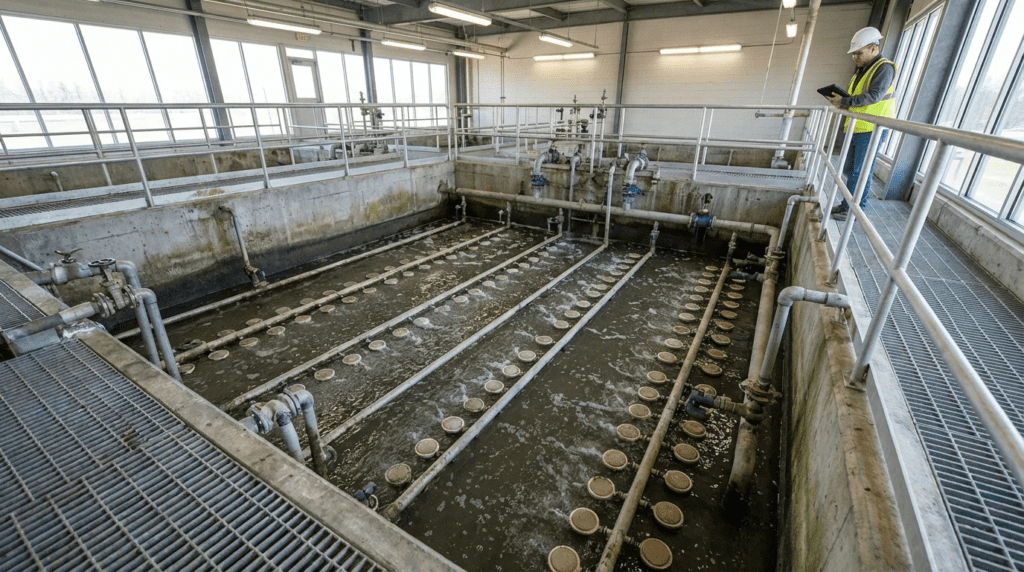
In the context of biological wastewater treatment, “Aeration Equipment” encompasses a broad spectrum of machinery designed to facilitate oxygen transfer and maintain solids suspension within bioreactors. While diffused air systems are common, mechanical aeration and large-scale process mixing—driven by Propeller and Axial Flow technologies—remain critical for oxidation ditches, surface aeration applications, and internal recirculation loops (IMLR). The selection of Original Equipment Manufacturers (OEMs) for these propeller-based systems is a pivotal decision for municipal consulting engineers and utility directors, as these units often represent the highest energy consumers and the most mechanically stressed assets in a treatment plant.
Propeller and axial flow pumps/aerators serve two distinct but related functions in the aeration process. First, as surface mechanical aerators, they induce atmospheric oxygen entrainment through high-velocity surface agitation. Second, as submersible mixers or wall-mounted recirculation pumps, they provide the necessary thrust to prevent mixed liquor suspended solids (MLSS) from settling, particularly in anoxic and anaerobic zones where diffused air is absent. In oxidation ditches, these units (often referred to as flow boosters or banana-blade mixers) are the primary movers, generating the horizontal velocity required to maintain channel flow.
The engineering challenge lies in the nature of the fluid and the duty cycle. These units operate 24/7/365 in abrasive, viscous fluids containing ragging material. An OEM’s ability to provide hydraulically efficient blade geometries, robust sealing systems, and motors capable of withstanding high axial thrust loads determines the lifecycle cost (LCC) of the asset. Unlike standard water pumps, axial flow equipment in aeration basins must contend with variable submergence (in surface applications), vortexing, and the critical requirement of maintaining non-scouring yet non-settling velocities (typically 0.3 to 0.5 m/s in ditches).
Furthermore, the shift toward nutrient removal—requiring internal recirculation rates of 200% to 400% of the influent flow (Q)—has elevated the importance of large-diameter axial flow pumps. These low-head, high-flow devices function essentially as ducted propellers, moving vast quantities of nitrate-rich mixed liquor from aerobic to anoxic zones. Failure in this equipment compromises the denitrification process, leading to permit violations for Total Nitrogen. Therefore, evaluating OEMs based on their specific expertise in propeller hydrodynamics, material science, and mechanical reliability is not merely a procurement exercise but a process guarantee strategy.
This analysis evaluates the leading OEMs for Propeller and Axial Flow Pumps utilized in mechanical aeration and biological process mixing. It focuses on the technical differentiators, reliability metrics, and application suitability for municipal and industrial wastewater treatment facilities.
2. HOW TO SELECT THIS PUMP TYPE
Selecting propeller and axial flow equipment for aeration and process mixing requires a deviation from standard centrifugal pump selection logic. Engineers must prioritize thrust generation, flow pattern development, and oxygen transfer efficiency (in surface applications) over simple pressure generation. The following criteria form the basis of a robust engineering specification.
Hydraulic Performance and Thrust
For mixing and flow boosting applications, the primary performance metric is not Head (H) but Thrust (measured in Newtons) and Hydraulic Efficiency (thrust per unit of power). Engineers must evaluate the OEM’s ability to generate sufficient thrust to overcome channel friction and hydraulic losses without inducing excessive turbulence that wastes energy. For recirculation pumps, the performance curve is steep; a slight deviation in static head calculation can result in significant flow reduction.
Key Specification Point: Require ISO 21630 testing standards for mixers to verify thrust ratings. For recirculation pumps, ensure the best efficiency point (BEP) aligns with the system curve at the maximum expected viscosity of the MLSS.
Solids Handling and Blade Geometry
Ragging is the primary operational failure mode for aeration zone propellers. Fibrous materials accumulate on the leading edges of blades, destroying hydraulic efficiency and increasing shaft torque, which leads to motor overload or seal failure.
Self-Cleaning Designs: Specify swept-back blade geometries (backswept leading edges) that shed solids naturally.
Propeller Diameter: Larger diameters running at lower rotational speeds generally offer higher efficiency and better solids handling than small, high-speed propellers. Large-scale mixers often utilize gearboxes to achieve these low speeds, introducing a maintenance trade-off that must be evaluated.
Materials of Construction
Aeration basins are corrosive environments. While cast iron is standard for volutes, the propellers themselves are subject to cavitation and abrasion.
Standard: ASTM A48 Class 30 Cast Iron (often coated).
Preferred: 316 Stainless Steel or Hard-Iron/High-Chrome alloys for propellers to resist abrasion from grit.
Surface Aerators: Floating units or bridge-mounted units require robust epoxy coatings or full stainless steel construction to resist the highly oxygenated, corrosive spray zone.
Efficiency and Lifecycle Cost (LCC)
Because aeration and mixing consume 50-60% of a plant’s total energy, efficiency is paramount.
Standard Aeration Efficiency (SAE): For surface aerators, measured in lbs O2/hp-hr. Top-tier OEMs should demonstrate SAE values of 3.0 to 3.5 or higher in standard conditions.
Wire-to-Water Efficiency: For recirculation pumps, premium efficiency motors (IE3 or IE4) combined with optimized hydraulics are essential. A 2% efficiency gain on a 100HP pump running continuously yields massive ROI over 20 years.
Installation and Maintenance Access
Retrieval Systems: Submersible units must be installable and removable without tank drainage. Guide rail systems must be robust (typically dual-rail or square rail) to prevent vibration-induced fatigue.
Cable Entry: The cable entry point is a frequent source of moisture intrusion. Specify a separate terminal chamber that is isolated from the motor stator to prevent capillary action of water down the cable.
Surface Aerators: Evaluate the ease of gearbox access. Bridge-mounted units allow for easier maintenance than floating units, which require a boat or crane for access.
Reliability and Redundancy
Bearing Life: Specify an L10 bearing life of minimum 50,000 hours, with 100,000 hours preferred for critical internal recycle pumps.
Seal Protection: Double mechanical seals in a tandem arrangement (SiC/SiC) are mandatory. Look for OEMs that offer active seal monitoring (moisture sensors in the oil chamber and stator housing).
3. COMPARISON TABLE
The following table contrasts the five specified OEMs regarding their Propeller and Axial Flow offerings. Engineers should use this to identify which manufacturer aligns best with the specific process requirement—whether it be surface aeration, oxidation ditch flow propulsion, or high-volume nitrate recirculation.
| OEM | Primary Aeration/Mixing Technologies | Typical Applications | Key Strengths | Limitations & Considerations |
|---|---|---|---|---|
| Fairbanks Nijhuis (Pentair) | Large Axial Flow Pumps, Vertical Propeller Pumps | High-volume internal recycle, flood control, raw water intake | Exceptional custom engineering for massive flow rates; robust construction suited for low-head/high-flow duties typical of nitrate recycle. | Focus is primarily on pumping rather than mixing; less specialized in small-scale submersible mixers compared to others. |
| Flygt (Xylem) | Submersible Mixers (Banana Blade), Adaptive N-Propellers, Recirculation Pumps | Oxidation ditches, Anoxic zones, SBRs, RAS/WAS pumping | Industry-leading R&D in fluid dynamics; “N-Technology” provides superior rag handling; massive installed base and service network. | Proprietary parts and monitoring systems (MiniCAS) can lock users into the ecosystem; premium pricing for premium technology. |
| KSB | Amaprop (Mixers), Amacan (Axial Pumps) | Activated sludge tanks, Biogas mixing, Denitrification loops | Highly efficient blade designs; robust cable entry sealing; Amacan series specifically designed for tube-installation in recirculation loops. | Lead times for large, specialized German-engineered units can be long; parts availability varies by region compared to domestic brands. |
| Sulzer | Submersible Flow Boosters, High-Speed Mixers, Recirculation Pumps | Carrousel systems, Selector zones, Bardenpho processes | Excellent motor efficiency (IE3/IE4 equivalents); strong history in oxidation ditch propulsion (ABS heritage); wide range of materials. | Documentation and sizing software can be complex; heavily reliant on proper installation alignment to prevent vibration. |
| Smith & Loveless | Surface Mechanical Aerators, Engineered Fluid Systems | Aerated lagoons, Oxidation ditches, Grit systems | Specialists in surface aeration reliability; robust above-water maintenance access; known for long service life in harsh environments. | Portfolio is less focused on submersible axial flow pumps than European competitors; primarily focused on packaged systems and surface units. |
4. TOP OEM MANUFACTURERS
The following section provides a detailed engineering evaluation of the locked list of OEMs for the Propeller / Axial Flow category. These manufacturers represent the global standard for fluid movement in biological treatment processes.
Fairbanks Nijhuis (Pentair)
Engineering Profile:
Fairbanks Nijhuis is a heavyweight in the realm of hydraulic engineering, specifically renowned for moving large volumes of water at low heads. Their expertise lies in the design of axial flow and mixed flow propeller pumps. In the context of aeration and biological treatment, Fairbanks Nijhuis is frequently specified for large-scale Internal Mixed Liquor Recycle (IMLR) pumps and influent/effluent pumping where propeller technology is advantageous.
Technical Differentiators:
Their propeller pumps are characterized by customizable pitch and bowl configurations. Unlike commoditized submersible mixers, Fairbanks units are often engineered-to-order, allowing the consulting engineer to hit a precise operating point on the system curve. This is critical in nitrate recycle loops where the friction head is extremely low (often less than 5 feet) but flow requirements are massive. Over-pumping in these applications wastes significant energy, while under-pumping fails the process. Fairbanks’ ability to tune the hydraulic end minimizes this risk.
Maintenance & Reliability:
These units are typically built with heavy cast components and robust shafting designed for infinite fatigue life. Their vertical turbine style configurations allow the motor to be mounted above the flood plane (dry motor), which simplifies maintenance access compared to fully submersible units, although they do offer submersible configurations as well.
Flygt (Xylem)
Engineering Profile:
Flygt is arguably the most recognizable name in submersible wastewater technology. For aeration zones and oxidation ditches, their contribution is defined by the development of the submersible mixer and the “banana blade” flow booster. Flygt’s engineering focus is heavily centered on hydrodynamics and clogging resistance.
Technical Differentiators:
The standout technology for Flygt is the N-Technology hydraulics applied to their recirculation pumps and mixers. This design features a backswept leading edge on the propeller and a relief groove in the wear ring area, which allows fibrous rags to slide off the blade rather than accumulating. For low-speed mixers (Oxidation Ditches), Flygt utilizes high-efficiency gearboxes and composite or stainless steel blades optimized for thrust-to-power ratios. They also offer integrated intelligence (Flygt Concertor) in some pumping lines, which allows for clog detection and automatic de-ragging cycles.
Maintenance & Reliability:
Flygt units are designed with the “Active Seal” system, which pumps leaking liquid back into the oil housing to prevent it from reaching the motor. Their installation accessories—specifically the mast and davit systems—are engineered to withstand the harmonic vibrations caused by hydraulic thrust, a common failure point in competitor installations. The sheer size of Xylem’s service network ensures parts availability, though the ecosystem is proprietary.
KSB
Engineering Profile:
KSB is a German engineering giant with a deep portfolio in slurry and wastewater transport. In the aeration sector, their Amacan (submersible pump in discharge tube) and Amaprop (mixer) lines are industry benchmarks for efficiency and mechanical integrity. KSB focuses heavily on material quality and the longevity of the mechanical seal environment.
Technical Differentiators:
The Amacan submersible axial flow pump is specifically designed for installation in discharge tubes, making it ideal for recirculation barriers between anoxic and aerobic zones. KSB’s propellers are often designed with a specific focus on mitigating the effects of gas content in the media—a critical factor in aeration tanks where entrained air can cause cavitation or air-binding in standard pumps. The Amaprop mixers feature streamlined hubs and break-resistant blades made from composite materials or stainless steel, designed to maintain hydraulic profile even after years of wear.
Maintenance & Reliability:
KSB distinguishes itself with a resin-embedded cable entry system that provides a hermetic seal, virtually eliminating capillary water ingress, which is the leading cause of stator burnout. Their mechanical seals are typically enclosed in an oil chamber with monitoring sensors accessible via standard control relays. KSB equipment is often viewed as “over-engineered,” resulting in high reliability but sometimes higher initial capital cost and longer lead times for spares.
Sulzer
Engineering Profile:
Sulzer’s presence in the aeration market is strengthened by its acquisition of ABS, a brand historically synonymous with submersible mixing. Sulzer offers a comprehensive range of low-speed flow boosters and high-speed submersible mixers. Their approach emphasizes energy efficiency, leveraging permanent magnet motor technologies in their premium lines.
Technical Differentiators:
Sulzer’s XRW series of submersible mixers represents a significant leap in efficiency, utilizing IE3 equivalent motors and optimized propeller shapes to deliver high thrust with low power consumption. For oxidation ditches, their flow boosters utilize distinct 2- or 3-blade composite propellers that are highly resistant to corrosion and fatigue. Sulzer also excels in the “agitator” segment, providing vertical agitators for deep tanks where bottom-mounted mixers might be insufficient.
Maintenance & Reliability:
Sulzer pays close attention to the mounting dynamics. Their vibration damping systems on guide rails extend the life of the unit by isolating the thrust forces from the civil structure. Maintenance access is standard, but the use of high-efficiency motors reduces the thermal stress on the windings, theoretically extending insulation life. Their “Contrablock” hydraulic systems in associated pump lines are also effective at handling the stringy solids found in raw sewage mixing applications.
Smith & Loveless
Engineering Profile:
Smith & Loveless (S&L) occupies a unique niche. While the other OEMs listed are dominant in submersible technology, S&L is the authority on wet-well mounted and surface-based equipment. In the context of aeration, S&L is known for robust surface mechanical aerators and packaged systems that integrate fluid movement with process treatment.
Technical Differentiators:
S&L’s approach to propeller and axial flow technology is often seen in their surface aerators, which utilize a propeller/impeller to draw liquid upward and spray it outward for oxygen transfer. This design eliminates submerged electrical components, which is a significant maintenance advantage. The motors and gearboxes are located above the waterline on floating platforms or fixed bridges. Their blade designs are focused on maximizing the spray pattern radius for oxygenation while maintaining vigorous mixing in the basin below.
Maintenance & Reliability:
The primary value proposition of S&L is ease of access. Operators do not need hoists or cranes to retrieve a submerged pump; they can access the motor and drive train directly from the surface (bridge-mounted units). This “operator-safe” design philosophy permeates their equipment line. While they may not compete directly with Flygt or KSB for submerged wall-mounted recycle pumps, they are a top-tier choice for lagoons and oxidation ditches utilizing surface mechanical aeration.
5. APPLICATION FIT GUIDANCE
Understanding where each OEM excels allows engineers to write tighter specifications that align equipment strengths with process needs.
Oxidation Ditches (Carrousel / Orbital)
Preferred OEMs: Flygt, Sulzer, KSB.
Reasoning: This application requires low-speed, large-diameter submersible flow boosters (banana blades). These OEMs have the most extensive hydrodynamic data verifying their ability to maintain the critical 1 ft/s channel velocity without scouring. Flygt and Sulzer, in particular, have vast installed bases here.
Internal Mixed Liquor Recycle (IMLR)
Preferred OEMs: Fairbanks Nijhuis, KSB, Flygt.
Reasoning: This demands high-flow, ultra-low-head axial flow pumping. Fairbanks Nijhuis excels if the design calls for a vertical column pump (dry motor). KSB’s Amacan is the standard for submerged tube-mounted applications. Flygt’s large P-pumps are also a staple here.
Aerated Lagoons and Surface Aeration
Preferred OEMs: Smith & Loveless.
Reasoning: When the process design relies on surface agitation rather than diffused air, S&L’s surface aerators provide a robust, maintenance-friendly solution that keeps electrical components out of the water.
Anoxic and Anaerobic Selectors
Preferred OEMs: Flygt, Sulzer, KSB.
Reasoning: These zones require compact submersible mixers to keep solids in suspension without introducing oxygen. The “compact mixer” lines from these OEMs are designed specifically for the chaotic flow regimes and smaller volumes of selector tanks.
6. ENGINEER & OPERATOR CONSIDERATIONS
Beyond the nameplate data, several practical factors influence the long-term success of propeller and axial flow installations.
Vibration and Civil Structure
Axial flow pumps and mixers generate significant thrust. A common design failure is under-designing the mounting mast or the concrete wall thickness. Engineers must specify that the OEM provides load calculations for the mast and that the mast is Schedule 40 or 80 stainless steel, not standard pipe. Harmonic vibration can crack concrete and loosen anchors.
Cable Management
For submersible units, the power cable is the Achilles’ heel. In mixing applications, the turbulent flow can cause cables to whip, leading to jacket abrasion and eventual short circuits.
Best Practice: Specify stainless steel cable strain relief grips (Kellerman grips) and dedicated cable hooks on the guiderail system to keep cables taut and out of the propeller wash.
Spare Parts Strategy
Propeller equipment utilizes proprietary seals and often proprietary bearings or sleeves. Unlike standard centrifugal pumps where a generic mechanical seal might suffice in an emergency, these units require OEM parts.
Operator Tip: Standardize on one OEM for all mixing/recirculation duties within the plant to minimize the inventory of spare mechanical seals and cable entry grommets.
CFD Modeling
For complex basins, blindly placing mixers often results in “dead zones” where solids settle and become septic.
Engineering Requirement: For basins larger than standard sizes, require the OEM to perform Computational Fluid Dynamics (CFD) modeling. This validates that the selected thrust and placement will achieve a complete mix and prevent short-circuiting.
7. CONCLUSION
The selection of OEMs for aeration and mixing duties—specifically utilizing Propeller and Axial Flow technologies—is a balance between hydraulic efficiency and mechanical robustness. Fairbanks Nijhuis stands out for massive water movement and custom axial flow designs. Flygt (Xylem) and Sulzer remain the leaders in submersible mixing technology with advanced hydraulics and efficiency. KSB offers German-engineered reliability specifically for tube-mounted recirculation, and Smith & Loveless provides the premier solution for surface-based mechanical aeration.
Engineers should avoid treating these units as commodities. The cost of energy over a 20-year lifecycle dwarfs the initial capital cost. Therefore, specifications should heavily weight wire-to-water efficiency (or thrust-to-power ratios), verified solids handling capabilities, and the robustness of the sealing systems. By aligning the specific process application—be it an oxidation ditch, a denitrification loop, or a lagoon—with the OEM’s specific technological strengths, utilities can ensure process stability and minimized operational expenditure.