
Wilo vs Grundfos Dry Pit Submersible Equipment: Comparison & Best Fit
Introduction
One of the most persistent vulnerabilities in municipal wastewater infrastructure is the susceptibility of dry well lift stations to flooding. Traditional configurations utilizing standard TEFC (Totally Enclosed Fan Cooled) motors coupled to pumps via long drive shafts offer excellent maintenance access but catastrophic failure modes during flood events. When a dry well floods due to pipe failure or system surcharge, standard motors fail immediately, rendering the station inoperable exactly when it is needed most.
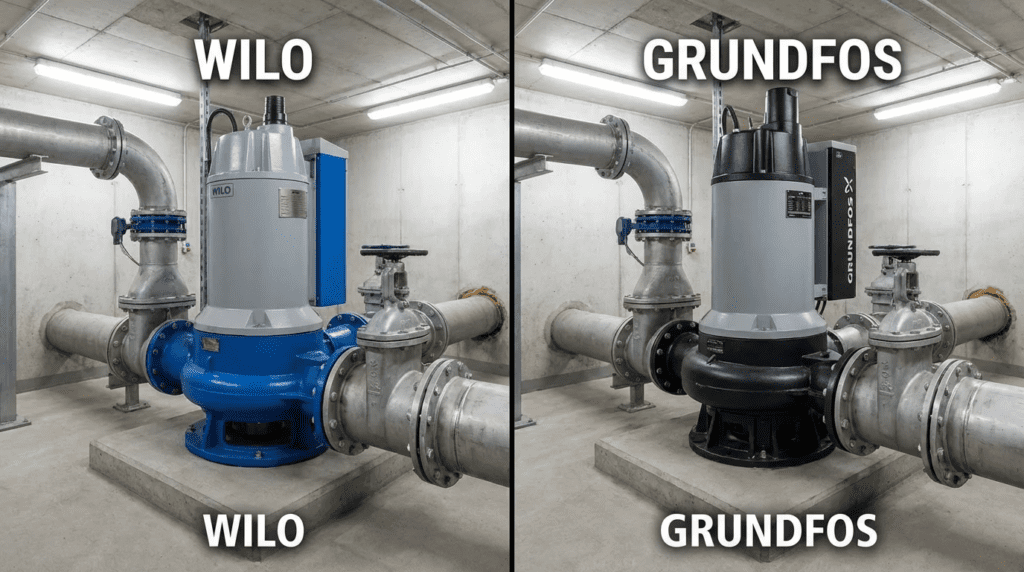
This operational risk has driven a massive industry shift toward dry pit submersible technology—pumps equipped with IP68-rated motors capable of continuous operation in air, yet fully submersible in the event of a flood. When specifying these systems, the engineering decision often narrows down to two European powerhouses with significant North American footprints. This article provides a technical analysis of Wilo vs Grundfos Dry Pit Submersible Equipment: Comparison & Best Fit to assist consulting engineers and utility directors in making data-driven selection decisions.
For municipal and industrial engineers, the choice between these manufacturers is rarely about “good vs. bad.” Both offer premium, specification-grade equipment. The distinction lies in the engineering philosophy: internal cooling strategies, impeller geometries for solids handling, ease of impeller clearance adjustment, and proprietary vs. open control architectures. A poor selection often stems not from hardware failure, but from misapplying a specific pump technology to a sludge profile or duty cycle it wasn’t optimized for.
This guide moves beyond catalog data to explore the real-world operational differences, maintainability implications, and hydraulic nuances between Wilo’s EMU/Rexa lines and Grundfos’s SE/SL ranges. We will examine the consequences of specification choices on lifecycle costs (LCC) and operational resilience in critical wastewater conveyance.
How to Select and Specify Dry Pit Submersible Systems
Selecting the correct dry pit submersible requires a rigorous evaluation of the operating envelope and the physical constraints of the dry well. Unlike wet well installations where the surrounding liquid provides cooling, dry pit applications place extreme thermal demands on the motor stator. Engineers must rigorously evaluate the following criteria to determine the Wilo vs Grundfos Dry Pit Submersible Equipment: Comparison & Best Fit for their specific facility.
Duty Conditions & Operating Envelope
The first step in specification is defining the hydraulic and thermal operating envelope. Dry pit submersibles must be rated for continuous duty in air (S1 duty cycle) without derating the motor. This capability relies heavily on the manufacturer’s cooling technology.
- Variable Frequency Drive (VFD) Operation: Both manufacturers offer VFD-rated insulation systems (Class H or F), but engineers must verify the minimum flow requirements. Running a dry pit pump too slow on a VFD may reduce the velocity of the coolant (glycol or pumped media) in the cooling jacket, leading to thermal shutdowns.
- Operating Points: Analyze the system curve against the pump curve at multiple speeds. Wilo’s heavy-duty EMU pumps often favor high-head, large-flow applications typical of master lift stations, while Grundfos offers exceptional coverage in the low-to-medium flow ranges common in subdivision and collection system lift stations.
- NPSH Margin: In dry pit configurations, the pump is often located near the wet well with positive suction head, but not always. If suction lift is required (even minimal), the Net Positive Suction Head Required (NPSH3) becomes critical. Cavitation in a dry pit pump causes vibration that is not dampened by surrounding water, accelerating bearing failure.
Materials & Compatibility
Wastewater composition varies drastically between municipal sewage, combined sewer overflow (CSO), and industrial effluent. The material selection must align with the abrasiveness and corrosivity of the fluid.
Corrosion Resistance: Standard construction for both is typically ASTM A48 Class 30 or 35B cast iron. However, for aggressive environments (high H2S), coating specifications are critical.
- Wilo: Is renowned for its “Ceram” coatings—a solvent-free, polymer-ceramic composite that provides exceptional resistance to abrasion and corrosion. It is often cited as a benchmark for longevity in grit-heavy influent.
- Grundfos: Typically utilizes high-grade two-component epoxy coatings. For extreme corrosion, they offer extensive stainless steel (Duplex) options in their range, which may be more cost-effective than custom-coating cast iron in smaller frame sizes.
Hydraulics & Process Performance
The “heart” of the comparison often comes down to impeller technology. Modern wastewater contains fibrous materials (wipes, rags) that challenge traditional enclosed impellers.
- Grundfos S-Tube: Grundfos utilizes the S-Tube impeller, a semi-open or closed channel design optimized for solids passage without compromising hydraulic efficiency. It is designed to balance non-clogging performance with high wire-to-water efficiency.
- Wilo Solids Handling: Wilo offers a variety of hydraulics, including vortex, single-channel, and multi-channel impellers. Their SOLID impeller technology focuses on minimizing leading edges where rags catch. In larger EMU pumps, their enclosed impellers are designed for massive solids throughput.
Installation Environment & Constructability
Retrofitting dry pits often involves tight spatial constraints. The physical footprint of the pump and the orientation of the discharge flange are critical.
Cooling System Integration: This is a major differentiator.
Grundfos: Many SE/SL pumps feature an integral closed-loop cooling jacket. The heat is transferred from the motor to a coolant (glycol/water mix), which is then cooled by the pumped media through a heat exchanger built into the pump housing. This eliminates external water piping.
Wilo: While offering internal cooling, Wilo also specializes in high-mass motor designs that can sometimes operate without cooling jackets in certain duty cycles, or use active circulation. The specific cooling method must be checked against the ambient air temperature of the dry well (often reaching 40°C/104°F in summer).
Reliability, Redundancy & Failure Modes
Reliability in dry pit submersibles is defined by seal integrity and bearing life.
- Seal Protection: Both manufacturers use dual mechanical seals. Engineers should look for “active” seal protection features. For instance, is there a moisture sensor in the oil chamber (between seals) or only in the stator housing? Early warning of the lower seal failure allows for planned maintenance before the motor is compromised.
- Bearing Life: Specify L10 bearing life of at least 50,000 hours (preferably 100,000 hours) at the Best Efficiency Point (BEP). Dry pit pumps experience different radial loads than wet well pumps due to the lack of fluid dampening and the rigidity of hard-piped connections.
Maintainability, Safety & Access
The “Best Fit” is often determined by who has to fix it.
Impeller Clearance Adjustment: As impellers wear, efficiency drops. Restoring the gap between the impeller and the suction liner is essential.
Grundfos: Features the “SmartTrim” system on many models, allowing operators to adjust the impeller clearance axially using adjustment screws on the exterior of the volute, without dismantling the pump.
Wilo: Generally requires the suction plate to be adjusted or shims to be managed. While robust, it can be more labor-intensive to restore factory tolerances in the field compared to the SmartTrim system.
Lifecycle Cost Drivers
When analyzing Wilo vs Grundfos Dry Pit Submersible Equipment: Comparison & Best Fit, the Total Cost of Ownership (TCO) calculation must include:
- Energy Costs: Compare the wire-to-water efficiency, not just hydraulic efficiency. Both brands offer IE3 and IE4 equivalent motors.
- Maintenance Labor: Factor in the time required for seal changes and clearance adjustments.
- Spare Parts: Analyze the cost and availability of seal kits and bearings. Proprietary cartridges can be expensive but save labor time.
Comparison Tables: Wilo vs Grundfos
The following tables provide a side-by-side analysis of the technical attributes and application suitability for both manufacturers. These tables are designed to help engineers identify the correct technology platform for their specific project constraints.
| Feature/Attribute | Grundfos (SE/SL Series) | Wilo (EMU FA / Rexa Series) |
|---|---|---|
| Primary Cooling Method | Internal closed-loop cooling jacket (glycol/water) or pumped media jacket. High thermal efficiency in compact frames. | Internal cooling loops or oil-filled motors (depending on size). High thermal mass designs available for passive cooling in intermittent duty. |
| Impeller Technology | S-Tube: Tube impeller design balancing large free passage with high efficiency. Excellent rag handling. | SOLID / Vortex / Channel: Wide variety of geometries. Known for heavy-duty multi-channel impellers in large sizes. |
| Wear Adjustment | SmartTrim: External axial adjustment capability. Allows clearance reset without pump disassembly. | Typically requires wear ring replacement or internal shim/suction plate adjustment. More traditional maintenance procedure. |
| Motor Efficiency | High focus on IE3/IE4 equivalents. Integrated drives (CUE) available for system optimization. | Strong focus on IE3/IE4. Large motors (EMU) are renowned for electrical robustness and service factors. |
| Solids Handling Philosophy | Hydraulic design focuses on passing solids through smooth channels (S-Tube). | Hydraulic design focuses on robust torque and blockage resistance; coatings (Ceram) used to mitigate abrasion. |
| Typical Size Range (Dry Pit) | Dominant in 5 HP to 800 HP range. Very strong in municipal lift stations. | Ranges from small to massive (>1000 HP). Exceptionally strong in large influent pumping and storm water. |
| Application Scenario | Best Fit Analysis | Key Decision Factor |
|---|---|---|
| High Grit / Abrasive Influent | Wilo (with Ceram) | If the grit load is extreme, Wilo’s proprietary Ceram coating and heavy wall castings often provide superior longevity against abrasion. |
| High Ragging / Wipes Content | Grundfos (S-Tube) | The S-Tube hydraulic design is specifically engineered to pass fibrous materials without catching on leading edges, reducing de-ragging callouts. |
| Limited Maintenance Staff | Grundfos | SmartTrim technology allows operators to restore pump efficiency easily without skilled millwright labor to disassemble the volute. |
| Massive Flows (Master Lift Stations) | Wilo (EMU) | For very large infrastructure (>20 MGD per pump), Wilo’s legacy EMU large-frame pumps have a proven track record of durability. |
| Integrated Intelligence | Grundfos | If the utility desires “smart” pumping with integrated sensors and dedicated pump controllers (MP204), Grundfos offers a highly cohesive ecosystem. |
Engineer & Operator Field Notes
Successful deployment of dry pit submersibles depends on more than just the catalog selection. The following field notes cover commissioning, specification errors, and operation strategies specifically for Wilo and Grundfos equipment.
Commissioning & Acceptance Testing
The Site Acceptance Test (SAT) for dry pit submersibles differs significantly from wet well pumps. Because the unit is accessible, vibration analysis is easier and more critical.
- Vibration Baselines: Establish a vibration baseline (velocity in in/s or mm/s) at the upper and lower bearing housing immediately upon startup. Dry pit installations are “stiffer” than guide-rail installations. High vibration often indicates pipe strain—where the piping is pushing on the pump flange—rather than pump imbalance. Both Wilo and Grundfos units are sensitive to nozzle loading.
- Cooling Loop Venting: For Grundfos units with internal cooling jackets, ensuring the jacket is fully vented of air is critical. Air pockets create hot spots on the stator. Verify the venting procedure in the O&M manual has been followed during filling.
- Seal Leak Monitoring: Test the logic of the seal leak relay. Unlike a wet well pump where you might tolerate a small warning indication, a seal failure in a dry pit pump must trigger an alarm immediately to prevent oil/water mixture from damaging the lower bearing.
Common Specification Mistakes
Engineers frequently make errors in the “boilerplate” sections of specifications that conflict with modern dry pit submersible designs.
- Specifying External Flushing Water: Older dry pit pumps required external water seal flushing. Modern Wilo and Grundfos dry pit submersibles utilize self-contained cooling and lubrication. Specifying external water lines adds unnecessary complexity, plumbing costs, and failure points (solenoids).
- Ignoring Ambient Temperature: Specifications often assume a 25°C ambient. Dry wells in summer can exceed 40°C. If the VFD is also located in the dry well (not recommended, but happens), the thermal load is massive. Ensure the motor insulation class (Class H is preferred) and cooling system are rated for the actual worst-case room temperature.
- Over-sizing: Selecting a pump that operates too far to the left of the Best Efficiency Point (BEP) causes recirculation cavitation. In a dry pit, this noise is audible and the vibration is destructive. Variable flow requirements should be managed via VFD turndown, not by sizing the pump for a peak flow that happens once a decade.
O&M Burden & Strategy
Maintenance strategies differ slightly between the two manufacturers.
Wilo Maintenance: Focus generally shifts to oil checks and coating inspections. If Ceram coatings are used, visual inspection through the suction port (during lockout/tagout) is recommended annually to check for chip/wear. Oil changes are standard, typically every 2,000-4,000 hours depending on the model.
Grundfos Maintenance: The primary O&M advantage is the SmartTrim. Maintenance schedules should include an annual “gap check” and adjustment. This takes 15 minutes per pump but can save thousands of dollars in energy. Additionally, if the unit uses an internal glycol loop, the coolant quality and level must be checked annually.
Troubleshooting Guide
- Overheating (Winding Temp Trip):
Cause: Clogged cooling jacket (if media cooled) or air lock in glycol loop.
Action: Back-flush the jacket or vent the loop. Check VFD minimum speed settings (ensure sufficient coolant velocity). - High Vibration:
Cause: Clogged impeller or pipe strain.
Action: Check for ragging. If clean, loosen flange bolts to see if piping springs away (pipe strain). Re-align piping supports.
Design Details and Calculations
Sizing Logic & Methodology
When sizing dry pit submersibles, the interaction between the Net Positive Suction Head Available (NPSHa) and the pump’s required NPSH (NPSH3) is often tighter than in wet wells. In a wet well, the pump is submerged. In a dry pit, the pump may be installed above the wet well water level (suction lift) or adjacent with a flooded suction.
Calculation Pre-requisite:
NPSHa = Hatm + Hs – Hvp – Hf
Where:
Hatm: Atmospheric pressure
Hs: Static suction head (positive if water level is above eye, negative if below)
Hvp: Vapor pressure of the liquid
Hf: Friction losses in the suction piping
Design Rule: Maintain a safety margin of at least 1.5 to 2.0 meters (5-7 feet) between NPSHa and NPSHr, especially if using a VFD. VFDs allow pumps to run at speeds where NPSHr might change, or where system resonance occurs.
Specification Checklist
To ensure a fair comparison in a bid situation involving Wilo vs Grundfos Dry Pit Submersible Equipment: Comparison & Best Fit, ensure the specification includes:
- Cooling: “The cooling system shall be a self-contained, closed-loop system utilizing a glycol/water mixture or oil, circulated by an integral impeller or thermal siphon. Systems requiring external water sources are not acceptable.”
- Mounting: “Pump shall be capable of vertical or horizontal installation in a dry environment without derating.”
- Protection: “Motor shall include thermal switches in each phase and moisture detection sensors in the oil chamber and stator housing.”
- Efficiency: “Motor shall meet IE3 efficiency standards equivalent at full load.”
Standards & Compliance
Ensure compliance with:
- Hydraulic Institute (HI) 11.6: For submersible pump tests.
- Class I, Division 1 or 2, Group C & D: Hazardous location rating is mandatory if the dry pit is classified (which it often is due to potential gas accumulation).
- IP68 Rating: The motor must be dust-tight and capable of continuous submersion in water (usually 20 meters depth for a specific time).
Frequently Asked Questions
What is the main difference between Wilo and Grundfos dry pit pumps?
While both are high-quality European manufacturers, Grundfos (SE/SL series) typically emphasizes integrated intelligence, ease of maintenance via SmartTrim, and compact internal cooling loops. Wilo (EMU/Rexa series) emphasizes rugged heavy-duty construction, specialized coatings (Ceram) for abrasion resistance, and dominance in very large, high-flow applications.
Do dry pit submersible pumps require external cooling water?
Generally, no. Modern dry pit submersibles from both Wilo and Grundfos are designed with internal cooling systems (jackets with glycol or oil, or media circulation). This eliminates the need for external flush water lines, reducing installation complexity and water consumption.
Can a dry pit submersible run continuously in air?
Yes. This is the defining feature of the technology. Unlike standard submersibles that rely on submersion for cooling, dry pit submersibles are rated for S1 (continuous) duty in air, provided the ambient temperature and pumped media temperature remain within the manufacturer’s limits (typically up to 40°C).
Why is impeller clearance adjustment important?
As an impeller and suction liner wear, the gap between them increases, causing internal recirculation and a drop in pump efficiency and flow. Adjusting this clearance restores the pump’s performance. Grundfos SmartTrim allows this adjustment externally, while other designs may require internal shims or wear ring replacement.
How does the cost compare between standard TEFC dry pit pumps and submersibles?
Dry pit submersibles typically have a higher initial capital cost than standard TEFC motor pumps due to the IP68 rating, specialized seals, and cooling jackets. However, the lifecycle cost often favors submersibles due to flood resilience (avoiding catastrophic replacement costs) and the elimination of long drive shafts and guards.
What happens if a dry pit submersible floods?
Nothing adverse should happen. The motors are rated IP68, meaning they are designed to operate submerged. If the dry well floods, the pump continues to operate, protecting the station from total failure. This flood resilience is the primary driver for their specification.
Conclusion
KEY TAKEAWAYS
- Flood Resilience is Standard: Both Wilo and Grundfos units provide IP68 protection, eliminating the risk of motor failure during dry well flooding events.
- Cooling Matters: Verify the cooling methodology. Grundfos generally utilizes closed-loop glycol jackets in SE/SL ranges, while Wilo uses a mix of oil-filled, convection, or active cooling depending on the series.
- Maintenance Philosophy: Choose Grundfos if your priority is easy, external impeller adjustment (SmartTrim) for maintenance teams with limited time. Choose Wilo if you prioritize heavy-duty castings and abrasion-resistant coatings (Ceram) for grit-heavy environments.
- Application Scale: Grundfos is extremely strong in the low-to-medium municipal flow range (lift stations). Wilo excels in large-scale infrastructure (master lift stations, treatment plant influent).
- No “Wrong” Choice: Both manufacturers meet high engineering standards. The failure usually comes from incorrect sizing or ignoring system curve interactions, not the hardware itself.
When finalizing the Wilo vs Grundfos Dry Pit Submersible Equipment: Comparison & Best Fit decision, engineers must look beyond the initial purchase price. The decision framework should weigh the specific “pain points” of the utility. If the utility struggles with fibrous clogging, the Grundfos S-Tube hydraulic design and SmartTrim adjustment offer a compelling operational advantage. If the application involves abrasive grit or massive flow rates where pump longevity and casting thickness are paramount, Wilo’s EMU heritage and Ceram coatings provide a robust solution.
Ultimately, the best specification provides a complete system: a pump selected at the correct operating point, protected by intelligent monitoring, and installed with a clear understanding of the thermal and hydraulic constraints of the dry well environment. By focusing on these engineering fundamentals, utilities can ensure decades of reliable service regardless of the brand on the nameplate.