
VAG
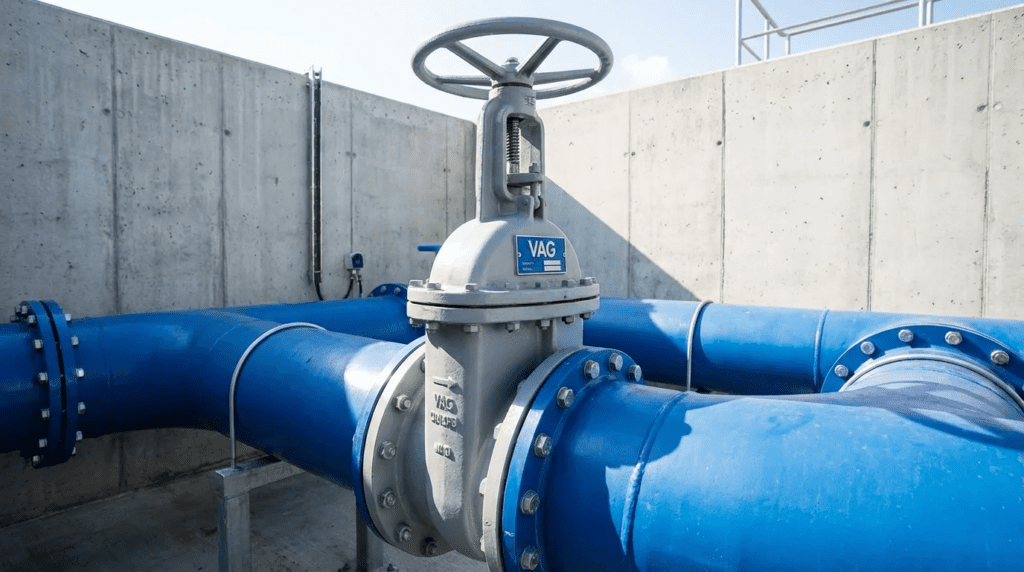
Introduction to VAG Flow Control Technologies
One of the most persistent challenges in municipal and industrial water infrastructure is the management of high-energy water streams without inducing catastrophic mechanical failure. Engineers frequently underestimate the destructive power of cavitation and water hammer, leading to premature valve degradation and pipeline ruptures. Within the global water sector, VAG has established itself as a standard-bearer for heavy-duty flow control and isolation solutions, particularly in high-pressure applications such as dams, transmission mains, and power plants. However, the effectiveness of any valve—whether a VAG plunger valve or a resilient seated gate valve—relies entirely on precise specification and hydraulic alignment.
VAG equipment is ubiquitous in critical infrastructure, from the bottom outlets of hydroelectric dams to the distribution networks of major metropolitan areas. Yet, a common oversight in the design phase is treating these complex hydraulic machines as simple commodities. The distinction between a standard shut-off valve and a control valve engineered for continuous throttling is significant, often measured in hundreds of thousands of dollars in lifecycle costs. For consulting engineers and utility directors, understanding the specific engineering principles behind VAG valves and similar high-performance equipment is essential for preventing operational bottlenecks.
This article provides a rigorous, specification-safe analysis of VAG flow control technologies. It is designed to help engineers navigate the complexities of sizing, material selection, and integration, ensuring that the installed equipment meets the rigorous demands of modern water and wastewater systems without succumbing to early failure.
How to Select and Specify VAG Valves
Selecting the correct valve requires a departure from simple line-size matching. Engineers must evaluate the full hydraulic profile and mechanical constraints of the application. The following criteria outline the necessary engineering diligence for specifying VAG flow control and isolation equipment.
Duty Conditions & Operating Envelope
The primary driver for selection is the specific duty cycle. For isolation applications, the valve is expected to be either fully open or fully closed. However, for control applications, the operating envelope is dynamic. Engineers must define:
- Differential Pressure (ΔP): The pressure drop across the valve in modulated positions. High ΔP values at low flow rates are the primary cause of cavitation.
- Flow Velocity: Exceeding 4-5 m/s in isolation valves can lead to vibration and seat damage. Control valves, such as VAG plunger valves, are designed to handle significantly higher velocities (often >20 m/s at the seat area) without damage.
- Frequency of Operation: A valve modulated continuously by a PID loop requires a different actuation and bearing design than a valve cycled once annually.
“Specification Error: Using a butterfly valve for high-pressure drop throttling often results in cavitation damage within months. For high ΔP applications, a plunger or needle valve is the hydraulically correct choice.”
Materials & Compatibility
The longevity of VAG valves in wastewater or raw water applications depends heavily on material science. Standard ductile iron (GGG-40/50) is sufficient for the body, but the internal wetted parts and coatings require scrutiny.
- Coatings: In potable water, heavy-duty epoxy powder coating (often GSK certified) with a minimum thickness of 250 microns is the baseline. For wastewater with high H2S concentrations, internal linings may need to be ceramic-filled epoxy or glass-lined.
- Seating Surfaces: For VAG gate valves, EPDM rubber encapsulation is standard. However, in industrial wastewater containing hydrocarbons, NBR (Nitrile) is required to prevent swelling.
- Shafts and Stems: Duplex stainless steel (1.4462) is recommended for critical shafts to resist stress corrosion cracking, particularly in chloride-rich environments.
Hydraulics & Process Performance
Hydraulic performance is quantified by the valve’s Kv (or Cv) value and its inherent flow characteristic curve. When specifying control valves, engineers must analyze the system curve against the valve curve.
- Linear vs. Equal Percentage: VAG plunger valves typically offer linear control characteristics, meaning flow changes linearly with stroke. This is ideal for discharging to atmosphere. Butterfly valves typically exhibit equal percentage characteristics, where flow changes exponentially, making them sensitive near the closed position.
- Cavitation Index (σ): Engineers must calculate the sigma value for the worst-case operating point. If σ < σc (critical cavitation index of the valve), anti-cavitation trim (such as slotted cages) must be specified.
Installation Environment & Constructability
Physical constraints often dictate valve selection. Large diameter VAG butterfly valves save significant space compared to gate valves, but they require specific upstream and downstream straight pipe runs (typically 3D to 5D) to ensure a uniform velocity profile and prevent flutter.
- Orientation: While many valves can be installed vertically or horizontally, large gate valves often require horizontal installation with the stem horizontal to prevent debris accumulation in the bottom track.
- Support: Heavy plunger valves and large gate valves impose significant dead loads. Concrete plinths or dedicated pipe supports must be detailed in the civil drawings to prevent stress transfer to the pipe flanges.
Reliability, Redundancy & Failure Modes
In critical transmission mains, the failure mode of the valve is a safety parameter. VAG combined air valves, for instance, play a critical role in preventing pipeline collapse during vacuum conditions.
- MTBF (Mean Time Between Failures): High-quality valves should operate for 25-50 years. The weakest links are typically the actuator and the resilient seals.
- Safety Factors: Actuators should be sized with a safety factor of 1.25 to 1.5 times the maximum seating torque to account for “break-away” torque after long periods of inactivity.
Controls & Automation Interfaces
Modern VAG valves are rarely manually operated in large plants. Integration with SCADA is standard.
- Actuation: Multi-turn electric actuators are common for gate and plunger valves; quarter-turn for butterfly valves. Specifications must define the interface (e.g., Modbus, Profibus, or hardwired 4-20mA).
- Position Feedback: Accurate position transmitters are vital for control loops. Non-contact encoders are preferred over potentiometers for durability.
Maintainability, Safety & Access
The design must account for the operator’s physical interaction with the equipment. Large VAG valves often require gearboxes that place handwheels at significant heights.
- Access Platforms: If the handwheel or actuator controls are more than 1.5 meters above grade, permanent OSHA-compliant platforms should be included in the design.
- Confined Space: For valves in vaults, ensure the vault hatch is sized to allow the removal of the entire valve assembly, or at least the internal mechanism, without demolition.
Lifecycle Cost Drivers
While premium VAG valves carry a higher CAPEX, the OPEX analysis often favors them due to hydraulic efficiency.
- Head Loss: A full-bore ball or gate valve has negligible head loss. A butterfly valve disc obstruction creates permanent pressure loss, increasing pumping energy costs over the lifecycle.
- Maintenance Labor: Valves that allow in-situ seal replacement (without removing the body from the line) significantly reduce maintenance costs.
Valve Technology Comparison Guide
The following tables assist engineers in distinguishing between different valve technologies commonly manufactured by companies like VAG. Proper application mapping is critical to avoid premature failure.
Table 1: Flow Control & Isolation Technology Comparison
| Valve Type | Primary Strengths | Best-Fit Applications | Limitations & Engineering Considerations | Typical Maintenance |
|---|---|---|---|---|
| Plunger / Needle Valves | Precise linear flow control; High cavitation resistance; Anti-cavitation trim options. | Dam bottom outlets; High-pressure reduction; Reservoir inlet control; Turbine bypass. | High CAPEX; Heavy weight; Requires substantial installation space; Complex mechanism compared to gates. | Seal replacement; Cranking mechanism lubrication; intervals: 5-7 years. |
| Resilient Seated Gate Valves | Full bore (zero head loss); Bidirectional sealing; Robust design; Debris tolerant. | Wastewater isolation; Water distribution networks; Buried service; Pump isolation. | Poor throttling capability (vibration/wear); Large number of turns to close; Heavy footprint in large diameters. | Stem seal replacement; Exercising to prevent seizure; intervals: 1-3 years. |
| Butterfly Valves (Double Eccentric) | Compact; Lightweight; Quick operation (90°); Cost-effective in large diameters (>DN600). | Transmission mains; Water treatment plant galleries; Filter isolation; Low-head control. | Disc obstructs flow (head loss); Susceptible to cavitation in high ΔP; Requires straight pipe run upstream. | Seat adjustment/replacement; Actuator maintenance; intervals: 3-5 years. |
| Air Release / Vacuum Valves | High venting capacity; Triple-function (release, vacuum break, micro-venting). | High points in pipelines; Pump discharge; Long transmission lines; Deep well applications. | Must be sized correctly to prevent water hammer (switching pressure); Float mechanisms can foul in wastewater. | Cleaning of float and orifice; Seal inspection; intervals: 6-12 months (wastewater). |
Table 2: Application Fit Matrix
| Application Scenario | Plunger Valve | Gate Valve | Butterfly Valve | Knife Gate Valve | Key Constraint |
|---|---|---|---|---|---|
| Raw Sewage Isolation | Not Recommended | Excellent (NGA) | Poor (Clogging risk) | Good | Solids Handling |
| Potable Water Transmission (High Pressure) | Good (Control) | Good (Isolation) | Excellent (Isolation) | Not Recommended | Pressure Rating / Size |
| Pressure Regulation / Throttling | Best Fit | Do Not Use | Conditional (Low ΔP) | Do Not Use | Cavitation / Linear Control |
| Dam Bottom Outlet | Best Fit | Conditional (Guard valve only) | Conditional (Guard valve only) | Not Recommended | Extreme Velocity / Energy Dissipation |
Engineer and Operator Field Notes
Successful deployment of VAG equipment extends beyond the datasheet. The following insights are drawn from field experience regarding installation, commissioning, and operations.
Commissioning & Acceptance Testing
Commissioning is the phase where most long-term issues can be identified and rectified. For heavy valves:
- End Stop Settings: Ensure the actuator limit switches are set correctly. For seating valves (like gate valves), the “closed” position should often be torque-seated, while the “open” position is position-seated.
- Stroke Timing: Adjust the opening/closing time to prevent water hammer. A VAG plunger valve might need 60-120 seconds to close to safely dissipate energy in a long pipeline.
- Dry vs. Wet Testing: Never fully stroke a high-performance control valve dry if it relies on the fluid for lubrication or cooling of the dynamic seals, unless approved by the manufacturer.
Over-torquing is a leading cause of valve stem damage. Always request the “Maximum Allowable Stem Torque” (MAST) from the manufacturer and ensure the actuator’s stall torque does not exceed this value.
Common Specification Mistakes
Engineers often copy-paste specifications, leading to incongruences:
- Ignoring the Gearbox: Specifying a high-grade stainless steel valve body but failing to specify the IP rating or coating of the gearbox often leads to the gearbox failing before the valve.
- Incomplete Coating Specs: Simply stating “Epoxy Coated” is insufficient. Specify “Fusion Bonded Epoxy to GSK/RAL-GZ 662 standards, minimum 250 microns, holiday free.”
- Undersizing Air Valves: Failing to account for the vacuum collapse pressure of the pipe. The air valve intake capacity is often more critical than its exhaust capacity.
O&M Burden & Strategy
Maintenance strategies for VAG valves should be proactive:
- Exercise Program: Isolation valves that sit in one position for years will eventually seize. Implement a semi-annual exercising program (partial stroke) to keep the screw and nut free of calcification.
- Gearbox Lubrication: Check oil levels in gearboxes annually. Water ingress into gearboxes is common in flooded vaults; consider IP68 rated gearboxes for these environments.
- Spares Inventory: For critical VAG plunger valves, keep a set of primary seals and a seat ring on the shelf. Lead times for these custom components can be 12-20 weeks.
Troubleshooting Guide
Symptom: Vibration / Noise during throttling.
Root Cause: Cavitation or operation below minimum opening percentage.
Fix: Check the Sigma value. If cavitation is present, air admission might be required, or the valve is oversized (operating too close to the seat).
Symptom: Valve fails to seal tight (Passing).
Root Cause: Debris trapped in the seat (Gate/Butterfly) or worn seal ring.
Fix: Flush the valve by cycling open/close (flushing velocity). If persistent, verify torque switch settings aren’t tripping prematurely.
Design Details and Calculations
Proper sizing separates a functional system from an efficient one. When designing with VAG valves, the following methodologies apply.
Sizing Logic & Methodology
For control valves, do not size based on line diameter. Size based on the required Kv (flow coefficient).
- Determine Flow Conditions: Define Qmin, Qnorm, and Qmax along with the associated upstream (P1) and downstream (P2) pressures.
- Calculate Kv Required: Use the standard formula: ( Kv = Q / sqrt{Delta P} ) (ensure units are consistent, typically m³/h and bar).
- Select Valve Size: Choose a valve where the calculated Kvmax is approximately 80-90% of the valve’s Kvs (fully open rating). This ensures control authority.
- Check Velocity: Ensure the velocity at the inlet flange does not exceed the manufacturer’s limit (often 4-5 m/s for butterfly, higher for plunger).
Specification Checklist
A robust specification for VAG-type equipment should include:
- Design Standard: EN 1074, AWWA C504 (Butterfly), AWWA C509/C515 (Gate), or specific manufacturer standards for plunger valves.
- Flange Drilling: Explicitly state ISO PN10/16/25 or ANSI Class 150/300. Mismatched flanges are a common site issue.
- Testing: Require Hydrostatic Shell Test (1.5x PN) and Seat Leakage Test (1.1x PN) per EN 12266-1 or API 598.
- Documentation: Require 3.1 Material Certificates (EN 10204) for body and shaft.
Cavitation Analysis (Sigma Index)
For high-pressure drops, calculate the Cavitation Index (σ):
[ sigma = frac{P_{downstream} – P_{vapor}}{P_{upstream} – P_{downstream}} ]
Compare the calculated σ against the valve’s tested σc (critical) and σmv (incipient damage). If the calculated σ is lower than the valve’s limit, cavitation will occur. In these cases, a VAG plunger valve with a slotted cylinder (anti-cavitation cage) is required to stage the pressure drop.
Frequently Asked Questions
What is the primary advantage of a VAG plunger valve over a butterfly valve?
The primary advantage is the linear control characteristic and resistance to cavitation. A VAG plunger valve controls flow via an axially moving piston that changes the annular cross-section. This design allows for high pressure drops without the cavitation damage that would destroy a butterfly valve disc or seat. Furthermore, the flow remains symmetrical, preventing vibration.
How often should VAG resilient seated gate valves be maintained?
Resilient seated gate valves are generally maintenance-free regarding internal parts. However, they should be “exercised” (cycled) at least once every 6 to 12 months to prevent the wedge nut from seizing on the stem and to clear any sediment build-up in the seat area. Stem seals should be inspected annually for leakage.
What is the difference between a kinetic air valve and an automatic air valve?
A kinetic air valve (large orifice) is designed to exhaust or admit large volumes of air during the filling or draining of a pipeline. An automatic air valve (small orifice) is designed to release small pockets of accumulated air while the pipeline is pressurized and operating. VAG combination air valves typically integrate both functions into a single unit.
Why is the GSK coating standard important for VAG valves?
GSK (Quality Association for Heavy Duty Corrosion Protection) is a rigorous standard for epoxy powder coating in the water industry. It ensures a minimum thickness of 250 microns, zero porosity, and high adhesion. Specifying GSK certification ensures the valve body is protected against corrosion and minimizes biofilm formation, which is critical for a 50-year design life.
Can VAG valves be installed in vertical pipelines?
Yes, most VAG valves can be installed vertically. However, for large gate valves and check valves, gravity affects the internal components. It is crucial to specify the flow direction (upward or downward) and the installation orientation during the ordering process so the manufacturer can adjust counterweights or internal guides accordingly.
How do I prevent water hammer when closing a VAG valve?
Water hammer is prevented by controlling the closing speed. The effective closure time—the time it takes to close the “effective” hydraulic part of the stroke (usually the last 20-30%)—is critical. Engineers should perform a transient analysis (surge analysis) to determine the minimum safe closure time and program the actuator or install a dual-speed gearbox to slow the closure near the seat.
Conclusion
Key Takeaways for Engineers
- Selection is Math, Not Guesswork: Use Kv values and Sigma (σ) calculations to size control valves; do not rely on line size.
- Right Tool for the Job: Use plunger valves for high ΔP throttling, gate valves for isolation, and butterfly valves for low-head space-constrained isolation.
- Material Integrity: Insist on GSK-certified epoxy coatings and proper stainless steel grades for shafts to ensure longevity.
- Actuation Safety: Size actuators with a safety factor of 1.25-1.5x above MAST to handle “break-away” torque requirements.
- Verify Interfaces: Confirm flange drilling standards and SCADA communication protocols early in the design phase.
The specification of VAG valves and similar heavy-duty flow control equipment represents a critical decision point in water infrastructure design. While the initial capital cost of high-performance plunger or gate valves may be higher than standard commercial alternatives, the return on investment is realized through operational reliability, reduced leakage, and minimized energy losses.
For municipal and industrial engineers, the goal is to create a system where the valve is the strongest link, not the failure point. By adhering to rigorous hydraulic modeling, selecting materials appropriate for the specific fluid chemistry, and implementing a disciplined maintenance strategy, utilities can ensure their flow control assets deliver performance for decades. When in doubt regarding critical applications—such as dam bottom outlets or high-pressure pump discharge—engineers should engage directly with application specialists to validate hydraulic calculations and prevent costly cavitation or surge issues.