
Bray vs Rotork Altitude Valves Equipment: Comparison & Best Fit
INTRODUCTION
One of the most persistent challenges in municipal water distribution design is the control of storage tank levels—specifically, balancing the simplicity of mechanical hydraulic valves with the data-rich requirements of modern SCADA systems. For decades, the industry standard was the pilot-operated hydraulic globe valve. However, a significant shift is occurring toward electrically actuated quarter-turn valves (typically butterfly or plug valves) for altitude service. This transition brings consulting engineers to a critical decision point: selecting the right actuation package to ensure reliability, precision, and longevity.
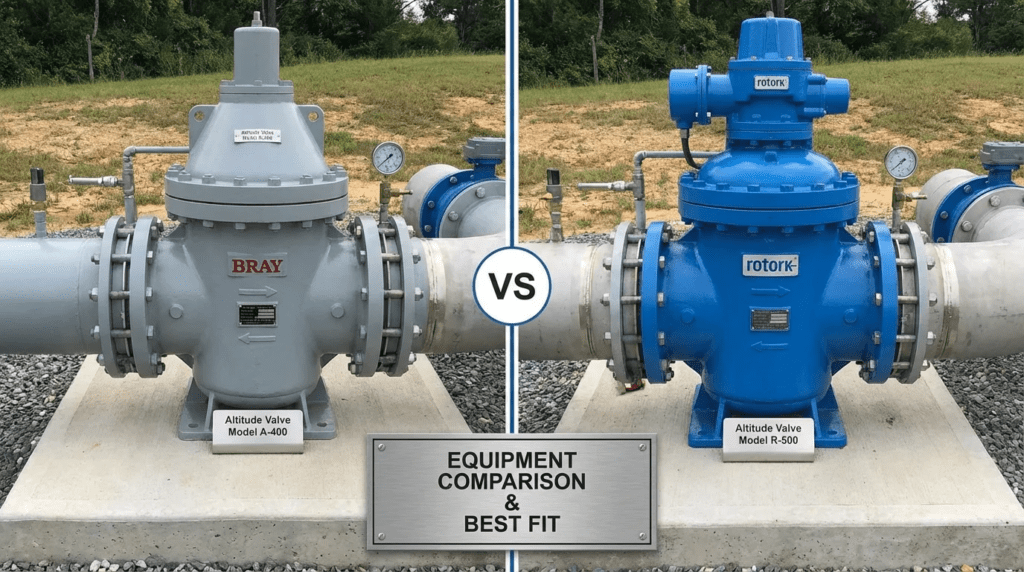
When evaluating Bray vs Rotork Altitude Valves Equipment: Comparison & Best Fit, engineers are often choosing between two distinct philosophies of automation. Bray generally represents a commercially efficient, modular approach often rooted in industrial flow control, while Rotork is frequently viewed through the lens of heavy-duty, intelligent municipal actuation. Misapplying these technologies can lead to catastrophic tank overflows, debilitating water hammer, or premature gearbox failure due to high-frequency modulation.
This article addresses the engineering criteria required to specify these systems correctly. It is not a marketing comparison but a technical analysis of how these equipment lines function in altitude applications—where a valve must open to fill a tank based on telemetry and close tightly against static head pressure. We will explore duty cycles, environmental sealing, torque safety factors, and integration with plant control systems to help utility decision-makers determine the optimal configuration for their specific hydraulic conditions.
HOW TO SELECT / SPECIFY
Selecting the correct equipment for altitude service differs significantly from standard isolation applications. The valve is not merely Open/Close; it often modulates to maintain system pressure or follows a specific filling curve to prevent pressure surges. The following criteria outline the engineering logic required when assessing Bray vs Rotork Altitude Valves Equipment: Comparison & Best Fit.
Duty Conditions & Operating Envelope
The first step in specification is defining the duty cycle. Altitude valves in water towers may cycle only a few times a day, whereas valves controlling ground storage tanks fed by variable speed pumps may modulate continuously.
- Modulation Class: For simple tank filling (Open/Close), standard duty actuators (S2-15 min rating) are often sufficient. However, if the valve modulates to maintain backpressure while filling, an actuator rated for continuous modulation (S4-1200 starts/hour) is mandatory.
- Differential Pressure (dP): The actuator must be sized not just for the static head, but for the maximum dynamic dP that occurs as the valve nears the closed position. This is where torque requirements peak.
- Flow Velocities: High velocities (>15 ft/s) through a butterfly valve can cause dynamic torque reversals, where the flow tends to close the valve. The actuator’s gear train must be self-locking to prevent “back-driving.”
Materials & Compatibility
The physical environment of an altitude valve vault is notoriously harsh. It is often a confined space with high humidity, potential for flooding, and condensation.
- Corrosion Protection: Standard epoxy coatings may fail in submerged vault conditions. Specifications should call for C5-M marine-grade painting systems or equivalent for the actuator housing.
- Enclosure Ratings: For vault-installed altitude valves, NEMA 4X (watertight/corrosion-resistant) is the minimum. However, NEMA 6P (IP68) temporary submersibility is strongly recommended. Both Bray and Rotork offer IP68 options, but the depth and duration ratings differ between models.
- Valve Body Materials: While the focus is often on the actuator, the valve itself (typically a butterfly valve in this comparison) should feature a Ductile Iron body with a 316 Stainless Steel disc edge and a bonded EPDM seat to prevent delamination during high-velocity throttling.
Hydraulics & Process Performance
Replacing a globe-style hydraulic altitude valve with a butterfly valve alters the system head curve. Engineers must analyze the inherent flow characteristics.
- Linearity: Butterfly valves are generally linear between 20% and 70% open. Outside this range, flow control is coarse. The actuator must be capable of multi-point characterization (customizing the position vs. signal curve) to linearize the flow output.
- Cavitation: As the tank nears full and the valve throttles, high pressure drop can induce cavitation. Selecting a “High Performance” butterfly valve (double or triple offset) or a plug valve may be necessary over a standard resilient-seated concentric butterfly valve.
Installation Environment & Constructability
Physical constraints in existing vaults often dictate equipment selection.
- Orientation: Electric actuators are heavy. If installed on a horizontal pipe, the valve shaft should ideally be horizontal to keep the actuator weight from side-loading the stem seals, though vertical mounting is common.
- Clearance: Rotork IQ series and Bray Series 70/98 have different removal envelopes. Engineers must verify that the cover can be removed for maintenance without hitting the vault ceiling.
- Power Availability: Unlike hydraulic valves which run on line pressure, these systems require reliable 3-phase or single-phase power. Voltage drop calculations are critical for remote tanks with long cable runs.
Reliability, Redundancy & Failure Modes
The most critical distinction between hydraulic and electric altitude valves is the failure mode. A hydraulic valve can be spring-loaded to fail closed. An electric valve fails in its last position upon power loss unless specific provisions are made.
- Fail-Safe Requirements: If a power loss occurs while filling, the tank will overflow. Specifications must require either a battery backup system (BBS), a supercapacitor system, or a mechanical spring-return actuator.
- Handwheel Operation: In the event of motor failure, a declutchable manual override is essential. The mechanical advantage (turns to close) must be manageable for a single operator (maximum 80 lbs rim pull).
Controls & Automation Interfaces
This is the primary driver for switching to electric actuation. The ability to integrate the “Bray vs Rotork Altitude Valves Equipment: Comparison & Best Fit” analysis into the broader SCADA architecture is paramount.
- Telemetry: Modern actuators should communicate directly via Modbus, Profibus, or Ethernet/IP, providing real-time data on valve position, torque profiles, and alarm history.
- Datalogging: High-end actuators (like the Rotork IQ3) store historical data logs locally. This allows operators to diagnose when a valve started sticking or if torque requirements have increased over time, predicting maintenance needs.
- Local Interface: A non-intrusive setup (configuring via Bluetooth or Infrared without removing the cover) is critical for preserving the seal integrity of the electronics compartment in damp vaults.
Lifecycle Cost Drivers
While the initial CAPEX of an electric butterfly valve package is often lower than a large automated globe valve, the OPEX equation is complex.
- Energy: Electric actuators only consume power when moving. Hydraulic pilots continuously vent small amounts of water or require strainer cleaning.
- Maintenance: Electronic components have a finite lifespan (typically 10-15 years for capacitors/boards). Mechanical gearboxes require grease analysis.
- Retrofit Costs: If power is not already at the tank site, the cost of running conduit and pulling wire can exceed the cost of the valve itself.
COMPARISON TABLES
The following tables provide a structured comparison to assist engineers in the selection process. Table 1 compares the typical manufacturing philosophies and product lines relevant to altitude service. Table 2 provides an application fit matrix to guide specification based on project constraints.
| Manufacturer / Series | Primary Strengths | Typical Altitude Applications | Limitations / Considerations | Maintenance Profile |
|---|---|---|---|---|
| Rotork (IQ3 / IQT Series) |
– “Intelligent” actuation with deep data logging – Double-sealed enclosure (water cannot reach electronics even with terminal cover removed) – Robust non-intrusive setup tool |
– Critical municipal distribution – Remote towers requiring detailed diagnostics – High-modulation pressure sustaining |
– Higher initial capital cost – Over-featured for simple Open/Close remote tanks – Proprietary software required for deep analysis |
– Minimal mechanical maintenance – internal battery replacement (for display/logging) every 5 years – “Set and forget” reliability |
| Bray (Series 70 / Series 98) |
– Cost-effective, compact design – Modular construction – Wide commercial availability and distributor network – Lighter weight reduces piping stress |
– Standard municipal tank fill – Indoor booster stations – Space-constrained valve vaults |
– Enclosure sealing on some legacy models requires careful installation (cable glands) – Fewer onboard diagnostic tools compared to IQ3 – Lower duty cycle ratings on base models |
– Standard grease intervals – Simpler electronics are easier for general electricians to troubleshoot – Potentially higher frequency of seal inspection |
| Traditional Hydraulic Pilot (Cla-Val/Singer) |
– No electricity required (mechanical energy) – Infinite modulation resolution – Failsafe capabilities inherent to design |
– Sites with no power availability – Systems requiring ultra-fast surge relief – Simple “float valve” logic |
– High head loss (high K-factor) – Pilot lines clog with debris/mineral buildup – Limited SCADA feedback without add-ons |
– High maintenance: diaphragm replacement, pilot cleaning, strainer clearing – Requires skilled mechanical technician |
| Application Scenario | Recommended Technology | Key Decision Factor | Relative CAPEX | Operator Skill Impact |
|---|---|---|---|---|
| Remote Water Tower (Solar/No Grid Power) | Hydraulic Pilot w/ Latching Solenoid | Power Availability | $$ | High (Mechanical) |
| Central Distribution Hub (Grid Power + SCADA) | Rotork IQ / Intelligent Actuation | Data/Diagnostics Requirement | $$$$ | High (Software/Electrical) |
| Small Rural Standpipe (Grid Power Available) | Bray Series 70 Electric | Cost Efficiency | $$ | Medium (General Electrician) |
| High Pressure Differential / Throttling Fill | Severe Service Butterfly w/ Heavy Duty Actuator | Torque & Cavitation Resistance | $$$$$ | Medium |
| Emergency Overflow Prevention (Redundant) | Electric Actuator w/ Battery Backup (BBS) | Fail-Safe Requirement | $$$ | Medium |
ENGINEER & OPERATOR FIELD NOTES
Successful implementation of altitude valves goes beyond the datasheet. The following field notes are derived from commissioning experiences and long-term operations of automated tank fill valves.
Commissioning & Acceptance Testing
When commissioning Bray vs Rotork Altitude Valves Equipment: Comparison & Best Fit systems, the Site Acceptance Test (SAT) is the moment of truth.
- Torque Seating vs. Position Seating: For butterfly valves, manufacturers often recommend position seating to avoid over-torquing the seat. However, intelligent actuators (Rotork) allow torque profiles. Ensure the “Close” limit is set to Position with a Torque backup protection.
- Stroke Time Verification: A common error is leaving the actuator at factory default speed. For a 12-inch altitude valve, a 10-second closure may cause massive water hammer. The closing time must be adjusted (often slowing down the last 10% of travel) to match the surge analysis report.
- Loss of Signal Behavior: Simulate a SCADA wire break. Does the valve hold last position, close, or open? This must match the risk assessment for the specific tank (overflow vs. system depressurization).
Common Specification Mistakes
If you simply write “Altitude Valve” in a spec, contractors will bid a hydraulic pilot globe valve (like a Cla-Val 210 Series). If you want a Bray or Rotork actuated butterfly valve, the specification must be in Division 40 (Instrumentation/Actuation) or explicitly detailed in the valve schedule.
- Ignoring Cable Entry Sealing: The #1 killer of electric actuators in vaults is moisture ingress through the conduit entries. Specification must require certified cable glands or potting of the conduit entry. Do not rely on the contractor’s standard PVC conduit glue.
- Undersizing for Breakout Torque: Valves that sit static (open or closed) for weeks develop “stiction.” The actuator must be sized with a safety factor of 1.5x the valve’s breakout torque, not its running torque.
O&M Burden & Strategy
- Desiccant Maintenance: Many actuators rely on internal desiccant packs to control condensation. These must be checked during annual PMs. Rotork’s double-sealed design minimizes this, but proper installation is prerequisite.
- Battery Management: Intelligent actuators use batteries to maintain position sensing during power outages. These typically have a 5-year life. A proactive PM schedule should replace these before the “Low Battery” alarm appears on SCADA.
- Handwheel Exercise: Every 6 months, operators should manually cycle the valve using the handwheel. This prevents the declutch mechanism from seizing and redistributes grease in the stem bearings.
DESIGN DETAILS / CALCULATIONS
Engineering the correct actuation solution involves specific calculations to ensure the equipment can handle the hydraulic forces.
Sizing Logic & Methodology
To properly size the actuator for an altitude application, follow this logic:
- Calculate Maximum Differential Pressure (dP):
dP = Max System Pressure (Pump Shutoff Head) – Minimum Tank Head
Note: Do not use static pressure; use dynamic conditions. - Determine Valve Torque Characteristics:
Consult the valve manufacturer for Seating Torque ($T_s$), Bearing Friction Torque ($T_b$), and Dynamic Torque ($T_d$).
Total Required Torque = $T_s$ + ($T_d$ at max velocity) - Apply Safety Factor:
For municipal water, a safety factor of 1.5 is recommended to account for seat swelling, debris, and scale buildup over time. - Select Actuator:
The actuator’s rated torque must exceed the calculated Total Required Torque x 1.5 across the entire voltage range (allow for 10% voltage dip).
Specification Checklist
When writing the RFP, ensure these elements are present to ensure a fair comparison between Bray and Rotork options:
- AWWA C504: Standard for Rubber-Seated Butterfly Valves (verifies body construction).
- AWWA C542: Standard for Electric Motor Actuators for Valves and Slide Gates.
- Enclosure Rating: NEMA 4X / IP68 (specify depth and time, e.g., 7 meters for 72 hours).
- Duty Rating: IEC 60034-1 duty cycle (S2 for isolation, S4 for modulating).
- Bus Protocol: Clearly state Modbus TCP, Ethernet/IP, or Hardwired I/O.
Standards & Compliance
Compliance with AWWA C542 is critical. This standard dictates the minimum design life (cycles), testing procedures, and safety factors for electric actuators in water service. Industrial-grade actuators typically meet NEMA or ISO standards, but AWWA C542 ensures the equipment is ruggedized for the specific hammering and surge conditions found in municipal water distribution.
FAQ SECTION
What is the main difference between Bray and Rotork for altitude valves?
The primary difference lies in the target market and feature set. Rotork (specifically the IQ series) is designed as a heavy-duty, “intelligent” actuator with extensive onboard diagnostics, double-sealing, and non-intrusive setup, making it a standard for critical municipal infrastructure. Bray actuators (like Series 70) are often more commercially oriented, offering a reliable, cost-effective solution with a smaller footprint, widely used in industrial and HVAC applications, but also suitable for standard municipal tank service when specified with proper environmental ratings.
Why use an electric actuated valve instead of a hydraulic pilot valve?
Electric actuated valves offer superior integration with SCADA systems. They provide real-time feedback on exact position, torque, and alarms, allowing operators to change tank levels remotely with a mouse click. Hydraulic pilot valves (like Cla-Val) are mechanical and autonomous; changing the setpoint requires a technician to physically visit the tank and adjust a pilot screw. Electric valves also eliminate the maintenance issues associated with pilot tubing clogging.
How do you prevent water hammer with an electric altitude valve?
Water hammer is prevented by controlling the closing speed. Unlike a solenoid that snaps shut, an electric actuator can be programmed to close slowly. Advanced actuators allow for “multi-speed” profiles, where the valve closes quickly for the first 80% of travel (to reduce flow), and then moves very slowly for the final 20% (the “effective closing time”) to gently seat the valve and dissipate energy without causing a pressure surge.
What happens to an electric altitude valve during a power outage?
Standard electric valves will “fail in last position” (FILP). If the power cuts while the tank is filling, the valve stays open, potentially causing an overflow. To mitigate this, engineers must specify a Battery Backup System (BBS) or a spring-return actuator that drives the valve to a safe position (usually Closed) upon loss of utility power.
How much does a Bray vs Rotork altitude valve system cost?
Costs vary widely by size and specification. A typical 6-inch actuated butterfly valve package might range from $3,000 to $6,000 for a commercial-grade setup (Bray Series 70 type) to $8,000 to $12,000 for a premium intelligent municipal setup (Rotork IQ type). However, the lifecycle cost must include the cost of running power to the vault vs. the maintenance labor required for hydraulic pilots.
What is the typical lifespan of these actuators?
With proper installation (specifically ensuring moisture does not enter the electronics), electric actuators in altitude service typically last 15-20 years. The mechanical valve body (butterfly) may require seat replacement every 10-15 years depending on the cycle frequency and water quality (abrasive grit). Hydraulic pilot valves can last indefinitely but often require rubber goods (diaphragms/seals) replacement every 3-5 years.
CONCLUSION
KEY TAKEAWAYS
- Define the Philosophy: Choose Hydraulic for simplicity/no-power sites; Choose Electric (Bray/Rotork) for SCADA integration and data.
- Actuator Intelligence: Rotork IQ series offers superior diagnostics and sealing for critical vaults; Bray offers cost-effective reliability for standard applications.
- Safety Factors: Always size actuators with at least a 1.5x safety factor over valve breakout torque.
- Fail-Safe Logic: Electric valves require battery backup or spring-return options to prevent tank overflows during power outages.
- Sealing is Critical: 90% of failures are due to moisture ingress. Specify NEMA 6P/IP68 and use proper cable glands.
The choice regarding Bray vs Rotork Altitude Valves Equipment: Comparison & Best Fit ultimately depends on the utility’s operational philosophy and the specific criticality of the asset. For major transmission storage where data is currency and downtime is unacceptable, the premium features of intelligent actuation (typified by Rotork’s municipal line) provide a verifiable return on investment through preventative diagnostics and robust sealing.
However, for standard distribution tanks, booster station isolation, and projects with strict budget constraints, commercial-grade modular actuation (typified by Bray) offers a reliable, proven solution that meets the core requirement of automating flow. Engineers must look past the brand names to the underlying specifications: duty cycle, environmental protection, and torque capability. By rigorously defining these parameters, the utility ensures a system that not only manages water levels effectively but integrates seamlessly into the modern digital water network.