
Top OEMs for Anti-Cavitation Valves
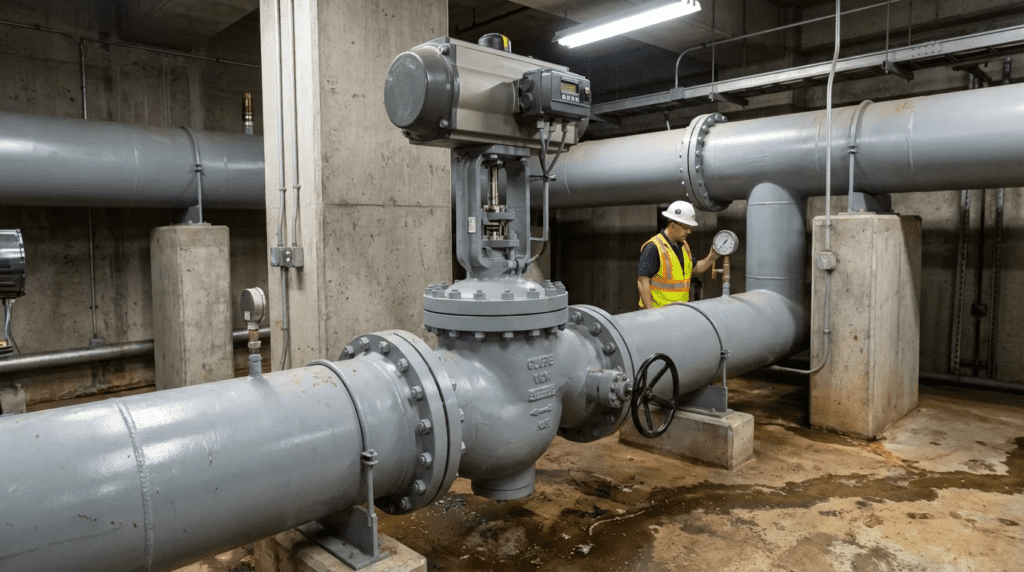
Introduction
In municipal and industrial hydraulic systems, the management of high pressure differentials presents a distinct physical challenge: cavitation. When water accelerates through a valve restriction to the point where the static pressure drops below the fluid’s vapor pressure, vapor bubbles form. As the fluid recovers pressure downstream, these bubbles collapse with violent force, generating micro-jets and shock waves. In standard control valves, this phenomenon leads to severe noise, vibration, choked flow, and rapid erosion of valve internals and downstream piping.
Anti-cavitation valves are engineered specifically to mitigate this destructive process. They are critical components in high-head gravity systems, reservoir fill lines, pressure reducing stations with high reduction ratios, and pump bypass applications. Unlike standard globe or butterfly valves, anti-cavitation valves utilize specialized trim designs—cages, slotted sleeves, or stacked plates—to stage the pressure drop or shift the frequency of the turbulence, thereby keeping the fluid pressure above the vapor pressure limit or directing the bubble collapse away from metal surfaces.
For consulting engineers, plant managers, and utility directors, the selection of an Original Equipment Manufacturer (OEM) for anti-cavitation valves is not merely a procurement decision; it is a lifecycle reliability calculation. The difference between a properly specified anti-cavitation valve and a standard valve forced into a high-pressure drop application is the difference between a 20-year service life and a catastrophic failure within months.
This article provides a comprehensive, technical analysis of the selection criteria for anti-cavitation valves and evaluates the specific engineering approaches of the four dominant OEMs in this sector: Cla-Val, Bermad, Singer Valve, and OCV Control Valves. The focus is strictly on engineering performance, material science, and operational maintainability.
How to Select This Valve Type
Selecting an anti-cavitation valve requires a more rigorous engineering approach than sizing standard isolation or check valves. The decision matrix must account for fluid dynamics, acoustic properties, and material resistance to erosion. Engineers must move beyond simple $C_v$ calculations and analyze the system’s cavitation index ($sigma$) across the entire flow range.
1. Calculating the Cavitation Index ($sigma$)
The fundamental metric for selection is the dimensionless cavitation index, Sigma ($sigma$). It is defined as the ratio of the potential for resisting cavitation (downstream pressure minus vapor pressure) to the potential for causing cavitation (pressure drop).
$$ sigma = frac{P_{downstream} – P_{vapor}}{P_{upstream} – P_{downstream}} $$
Engineers must calculate $sigma$ for minimum, average, and maximum flow conditions.
- $sigma > 2.0$: generally indicates benign conditions where standard valves may suffice.
- $1.0 < sigma < 2.0$: suggests incipient cavitation; standard valves will experience noise and minor vibration.
- $sigma < 1.0$: indicates severe cavitation potential. This is the mandatory zone for specifying anti-cavitation trim.
If the calculated Sigma falls into the critical range, the valve trim must be designed to increase the localized pressure recovery factor ($F_L$) or split the pressure drop into multiple stages.
2. Valve Function and Trim Design
The core differentiator in anti-cavitation valves is the trim architecture. OEMs employ different strategies to dissipate energy:
- Multi-Stage Trim: This design forces the fluid through a series of restrictions. By breaking a single large pressure drop ($Delta P$) into two or three smaller drops, the fluid pressure at the vena contracta of each stage remains above the vapor pressure, preventing bubble formation entirely.
- Cage/Sleeve Design: These trims direct opposing flow streams into the center of the valve or through tortuous paths (labyrinths). This increases the friction factor and dissipates energy through turbulence in the center of the fluid stream, rather than against the valve body walls.
- External Impingement: Some designs allow cavitation to occur but focus the bubble collapse in the center of the flow stream, away from the metallic components. This is often less expensive but carries higher risk if flow profiles shift.
3. Materials of Construction
Even with advanced trim designs, high-velocity water can cause erosion. Material selection is critical for the valve body and the trim.
- Body Material: Ductile iron (ASTM A536) is standard for municipal water. However, for severe service, the interior may require epoxy coating or, in extreme cases, 316 Stainless Steel cladding to prevent scour.
- Trim Material: The anti-cavitation trim (seat and cage) must be harder than the standard bronze or brass used in general service valves. Austenitic Stainless Steel (303 or 316) is the baseline requirement. For extreme pressure drops, engineers should specify precipitation-hardened stainless steels (like 17-4 PH) or Stellite overlays to resist work-hardening and pitting.
4. Sizing and Flow Rangeability
A common specification error is “line-sizing” the control valve (e.g., specifying a 12-inch valve for a 12-inch pipe). Anti-cavitation trims significantly reduce the valve’s flow coefficient ($C_v$) compared to a standard globe valve of the same size due to the restriction of the cage.
Engineers must verify the valve can pass the maximum required flow at the available pressure drop with the restrictive trim installed. Conversely, the valve must be stable at low flows. Anti-cavitation cages can sometimes exhibit “hunting” or instability at very low valve openings (below 10-15%) if the pilot system is not tuned correctly or if the valve is grossly oversized.
5. Pilot Systems and Actuation
Most municipal anti-cavitation valves are hydraulically operated, diaphragm-actuated globe valves controlled by a pilot circuit.
- Pilot Sensitivity: The pilot must be capable of sensing small pressure changes and modulating the main valve smoothly. Jerky movement in an anti-cavitation valve can induce water hammer, exacerbating system stress.
- Filtration: Because anti-cavitation trims often feature small orifices or slots, they are susceptible to clogging if large debris is present. However, the pilot circuit is the most vulnerable point. High-quality strainers on the pilot supply line are mandatory.
6. Lifecycle Cost and Maintenance
The initial capital expenditure (CapEx) for an anti-cavitation valve is typically 2 to 3 times that of a standard control valve. However, the operational expenditure (OpEx) justification is straightforward. A standard valve in a cavitating application may require body replacement or major overhaul every 12 to 24 months. A properly specified anti-cavitation valve should provide 10 to 20 years of service with only elastomeric parts replacement.
Engineers must evaluate the ease of accessing the trim. Can the cage be removed without removing the valve body from the line? Are the seats replaceable or integral?
Comparison Table
The following table contrasts the technical approaches and operational characteristics of the four primary OEMs evaluated in this article. This is not a ranking but a guide to understanding the engineering philosophy and “sweet spot” for each manufacturer. “Trim Technology” refers to the specific mechanism used to dissipate energy. “Serviceability” indicates the complexity involved in inspecting or replacing internal components.
| OEM | Primary Anti-Cavitation Technology | Typical Flow Path | Serviceability Profile | Best-Fit Application Scenarios |
|---|---|---|---|---|
| Cla-Val | KO Trim (Anti-Cavitation) / Disc Stack | Seat-mounted cage with radial slots | High. Trim is a retrofit kit for standard bodies. Easy top-entry access. | Municipal distribution, widely varying flow rates, retrofitting existing standard valves to anti-cav service. |
| Singer Valve | AC Trim (Dual Cage) | Dual sliding cages with impinging flow | Moderate/High. Requires removing the inner valve assembly. Heavy duty construction. | High pressure differential, extreme continuous cavitation, applications requiring precise low-flow stability. |
| Bermad | Double Chamber / V-Port / Cage | Plug and Cage or V-Port Throttling | High. Unitized actuator assembly allows quick removal. | Complex pressure management, fast-response requirements, systems needing independent opening/closing speed control. |
| OCV Control Valves | Series 127 Trim | Slotted or Perforated Cage | High. Simple mechanical design. Standardized parts. | Fuel/Water dual-use environments, industrial process water, standard pressure relief/reduction with moderate cavitation. |
Top OEM Manufacturers
The following analysis details the specific engineering attributes of the four locked OEMs. These manufacturers represent the standard of reliability in the waterworks industry for automatic control valves.
Cla-Val
Overview: Cla-Val is arguably the most ubiquitous name in the North American municipal water market. Their reputation is built on the standardization of the “100-01” Hytrol main valve body, which serves as the platform for nearly all their applications, including anti-cavitation.
Technical Approach:
Cla-Val utilizes the “KO” (Anti-Cavitation) trim. This is not a separate valve body design but rather a specialized seat and disc guide assembly that can often be retrofitted into existing Cla-Val bodies. The KO trim features a 316 Stainless Steel seat with radial slots. As the valve modulates, the disc guide moves within this seat.
The design focuses on directing the energy dissipation. The flow enters the slots and converges in the center of the seat cage. The collision of the flow streams dissipates energy through fluid-to-fluid friction rather than fluid-to-metal friction. This centralization of the turbulence keeps the imploding vapor bubbles away from the metal surfaces of the valve body and the seating surface.
Engineering Strengths:
The primary engineering advantage of the Cla-Val approach is modularity. A utility can convert a standard pressure reducing valve (PRV) into an anti-cavitation PRV simply by changing the internal trim, provided the body size allows for the reduced $C_v$. The use of 316SS as a standard for the KO trim ensures excellent corrosion and erosion resistance. Additionally, Cla-Val offers “KO-1” and other variations to handle different degrees of cavitation.
Operational Considerations:
Because the trim reduces the effective flow area, engineers must carefully check the valve sizing. A 6-inch valve with KO trim will have significantly less flow capacity than a standard 6-inch valve. In some cases, the valve size must be increased to accommodate the restrictive trim, which involves piping changes.
Bermad
Overview: Bermad is a global leader in hydraulic control valves, known for innovation in actuator design and efficient hydraulic flow paths. In the context of anti-cavitation, Bermad focuses heavily on their 700 and 800 series valves, offering sophisticated cage and plug designs.
Technical Approach:
Bermad employs a “Double Chamber” actuator design in many of their high-performance valves. Unlike a standard single-chamber valve where the closing force is provided by a spring and upstream pressure, the double chamber allows for positive hydraulic pressure to both open and close the valve. This provides extremely precise modulation, which is critical when managing cavitation. If a valve hunts (oscillates), it spends more time in high-wear positions; Bermad’s stable control loop minimizes this.
For the trim, Bermad utilizes stainless steel cavitation cages. These cages are designed with specific slot geometries that increase flow resistance and force energy dissipation within the cage volume.
Engineering Strengths:
The standout feature for engineers is the unitized actuator assembly. The entire internal mechanism can be removed as a single unit for maintenance, which reduces downtime. The Y-pattern body options available in the 700 series also provide higher flow capacities ($C_v$) for a given valve size compared to standard globe patterns, helping to offset the flow reduction caused by the anti-cavitation cage.
Operational Considerations:
Bermad valves often utilize composite materials in their pilot systems and actuators, which offer excellent corrosion resistance but require operators to be mindful of torque specifications during maintenance to prevent cracking.
Singer Valve
Overview: Now part of Mueller Water Products, Singer Valve has historically maintained a strong niche in high-performance pressure management. They are frequently specified for the most severe cavitation applications where multi-stage energy dissipation is required.
Technical Approach:
Singer’s flagship solution is their Anti-Cavitation (AC) Trim. It utilizes two heavy, sliding stainless steel cages. As the valve opens, the outer cage slides over the inner cage. The holes are aligned such that the flow is directed to impinge upon itself in the center of the cage capsule.
Crucially, Singer focuses on “Low Flow Stability.” Many anti-cavitation valves struggle at low flows because the small opening creates high velocities immediately. Singer’s Single Rolling Diaphragm (SRD) or older Dual Rolling Diaphragm technology ensures smooth, steady movement of the stem even at very low flow rates, preventing the chatter that destroys seats.
Engineering Strengths:
Singer is noted for custom-drilling cages. They analyze the specific hydraulic data (flow vs. head pressure) and can customize the cage perforation pattern to match the system curve. This bespoke engineering prevents “one size fits all” issues. Their trim containment is exceptionally robust, containing the recovery process fully within the stainless steel capsule, ensuring zero damage to the ductile iron body.
Operational Considerations:
The custom nature of some cages means that replacement parts must be ordered by serial number and may have longer lead times than off-the-shelf standard trims. Operators must plan maintenance inventory accordingly.
OCV Control Valves
Overview: OCV Control Valves (an Aquestia brand) is known for rugged simplicity and high reliability in both the waterworks and aviation fueling industries. Their approach to anti-cavitation is consistent with their philosophy of straightforward, maintainable mechanical design.
Technical Approach:
OCV typically utilizes the Series 127 classification for pressure reducing valves, which can be outfitted with anti-cavitation valve trim. Their design generally involves a stainless steel seat and a slotted or perforated stainless steel stem assembly (cage).
The OCV design relies on a straightforward flow-over-the-seat path where the cage restricts the flow exiting the seat ring. This creates the necessary backpressure to keep the fluid in liquid phase or dissipates the energy of bubble collapse within the cage structure.
Engineering Strengths:
Simplicity is the primary strength. The OCV valve has fewer internal moving parts than some dual-chamber competitors. For maintenance crews, this translates to easier troubleshooting and assembly. The guides and seats are designed for alignment, reducing the risk of binding. They are particularly strong in industrial water applications where durability is prioritized over complex feature sets.
Operational Considerations:
While highly effective for moderate to heavy cavitation, extreme, multi-stage pressure drops might require careful consultation with the factory to ensure the standard cage design is sufficient. OCV is excellent at providing clear documentation and support for these specific limitations.
Application Fit Guidance
While all four OEMs produce high-quality equipment, specific nuances make them better suited for certain environments.
Municipal Water Distribution
Cla-Val and Singer Valve are the dominant choices here. Cla-Val is ideal for systems where standardization is key; if a utility already has 500 Cla-Val PRVs, stocking the KO trim kit is a logical logistical decision. Singer is the preferred choice for transmission mains with extreme pressure drops (e.g., bringing water down a mountain into a valley) due to their custom-drilled cage capabilities and low-flow stability.
Municipal Wastewater
Anti-cavitation control valves are generally not recommended for raw sewage due to the small orifices in the cages which will clog instantly. However, for treated effluent or reclaimed water pumping, Bermad and Cla-Val offer robust solutions. Bermad’s obstruction-free flow path (when fully open) and strong actuator forces help manage fluids that may have minor suspended solids, provided the cage design is selected carefully (larger slots vs. small holes).
Industrial Water and High Pressure
OCV Control Valves and Singer Valve excel here. OCV’s background in fuel and industrial handling translates to robust designs that tolerate the rigors of industrial plant cycling. Singer’s ability to handle high $Delta P$ makes them a favorite for cooling tower makeup lines or high-pressure pump bypass systems in power plants.
Buried vs. Exposed Installations
Ideally, no control valve should be buried. They require maintenance. However, if a valve must be installed in a vault or pit that is prone to flooding, Cla-Val and Bermad offer excellent protection. Bermad’s double-chamber actuators are sealed units, and Cla-Val’s pilots are robust against external moisture intrusion, provided the breathers are piped remotely.
Engineer & Operator Considerations
Successful implementation of anti-cavitation valves extends beyond OEM selection. The following best practices are derived from field failures and operational lessons learned.
1. Installation Best Practices
Straight Piping Runs: Anti-cavitation trims require uniform velocity profiles to function correctly. Engineers should specify a minimum of 5 pipe diameters (5D) of straight pipe upstream and 3 to 5 diameters downstream of the valve. Turbulence entering the valve reduces the effectiveness of the cage and can induce vibration.
Air Release Valves: Cavitation, by definition, involves the formation of vapor. Even when controlled, significant pressure drops release entrained air from the water. An air release valve (ARV) must be installed immediately downstream of the anti-cavitation valve to prevent air binding or downstream hammer.
2. Common Specification Mistakes
Oversizing: This is the most common failure mode. An engineer adds a safety factor to the flow, selecting a valve that is too large. The valve then operates at 5-10% open to maintain pressure. In this position, the gap between the plug and the cage is minimal, causing high-velocity wire-drawing (erosion) of the seat. Always size for the actual flow conditions, not the line size.
Ignoring Minimum Flow: Anti-cavitation effectiveness decreases at very low flows because the separation between the cage and the plug may not be engaged. If the system requires prolonged operation at near-zero flow, a smaller bypass valve should be installed to handle the low loads.
3. Maintenance and Access
Pilot Strainer Maintenance: The pilot system controls the valve. If the pilot strainer clogs, the valve will either fail open or fail closed (depending on the circuit). A flushing schedule for pilot strainers is mandatory.
Exercise the Valve: Valves that sit in one position for months will accumulate mineral scale on the guide stems. When they are finally called to move, they may stick. Operators should exercise these valves (modulate them fully open and closed) at least twice a year to wipe the stems clean and verify diaphragm flexibility.
Spare Parts Strategy: For anti-cavitation valves, the “consumable” is not just the rubber diaphragm. The stainless steel cage and seat are wear parts. While they last much longer than standard trim, they will eventually pit. Utilities should keep a complete “internal kit” (Seat, Cage, Stem, Diaphragm) on the shelf for their critical assets.
Conclusion
The selection of an anti-cavitation valve is a critical engineering task that directly impacts the safety and longevity of water infrastructure. While standard control valves are commodities, anti-cavitation valves are engineered solutions.
Cla-Val offers the security of the industry standard with excellent retrofit capabilities. Singer Valve provides superior technical customization for the most extreme pressure drops and challenging hydraulic profiles. Bermad delivers advanced actuation and control stability for dynamic systems. OCV Control Valves offers rugged, simple reliability for industrial and municipal crossovers.
For the consulting engineer and the plant manager, the goal is to match the valve’s energy dissipation strategy to the system’s calculated Sigma. By prioritizing accurate sizing, appropriate material selection (316SS trims), and a robust maintenance plan, utilities can convert a potential point of failure into a reliable asset that protects the entire piping network for decades.