
Top OEMs for Tanks and Covers
Introduction to Tanks and Covers in Water and Wastewater Systems
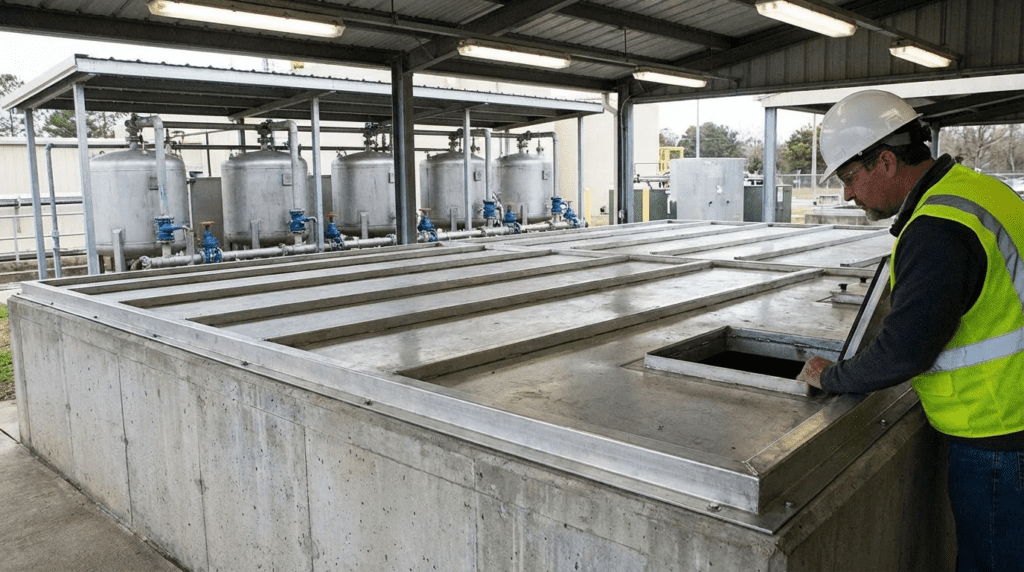
Liquid containment and headspace management are foundational elements of municipal and industrial water and wastewater infrastructure. Tanks and covers serve not merely as passive storage vessels but as critical process components that define the hydraulic profile, chemical safety, biological stability, and environmental compliance of a treatment facility. From raw water equalization and potable water distribution storage to anaerobic digestion vessels and aggressive chemical containment, the engineering specifications applied to tanks and covers directly influence facility longevity and operational flexibility.
In municipal water systems, storage tanks regulate pressure zones, provide fire flow reserves, and allow for contact time (CT) compliance in disinfection processes. In wastewater treatment, tanks serve as bioreactors, clarifiers, sludge holding vessels, and equalization basins. The selection of materials—whether prestressed concrete, glass-fused-to-steel, welded steel, or polyethylene—dictates the maintenance intervals and the asset’s resistance to corrosion, particularly in environments rich in hydrogen sulfide (H2S) or abrasive solids.
Covers have evolved from simple debris barriers to sophisticated process controls. In wastewater applications, covers are essential for odor control, collecting biogenic gases for energy recovery, and maintaining thermal consistency in biological processes. In potable applications, they prevent contamination from airborne particulates, wildlife, and sunlight-induced algae growth, which is a precursor to taste and odor issues and disinfection byproducts (DBPs).
Regulatory drivers, including the Safe Drinking Water Act (SDWA), the Ten State Standards, and various state-level environmental protection mandates, enforce strict guidelines on tank integrity, sanitary protection, and leakage prevention. Furthermore, structural codes such as AWWA D100, D103, and D110 establish the baseline for design loads, including seismic and wind considerations. For the consulting engineer and plant manager, the selection of an Original Equipment Manufacturer (OEM) is not simply a purchase of volume; it is a commitment to a specific structural methodology, a warranty structure, and a long-term maintenance philosophy. This article provides a comprehensive technical analysis of the equipment, material science, and leading OEMs in the tank and cover sector.
How to Select Tanks and Covers
The specification of tanks and covers requires a multi-disciplinary approach, integrating structural engineering, hydraulics, materials science, and process chemistry. Engineers must move beyond simple capacity calculations to evaluate the interaction between the contained fluid and the structural envelope over a projected lifecycle of 25 to 100 years.
Process Function and Performance Requirements
The primary function of the tank dictates its geometry and design standards. For flow equalization, the tank must handle rapid drawdown and filling cycles without structural fatigue. The engineer must calculate the “breathing” requirements—how air enters and exits the headspace during rapid level changes—to prevent vacuum collapse or over-pressurization, particularly in sealed cover applications.
For process tanks, such as Sequencing Batch Reactors (SBRs) or aerobic digesters, the tank wall must withstand dynamic loads from mixing equipment and aeration vibration. In potable water storage, the focus shifts to water quality preservation; the design must minimize dead zones to prevent thermal stratification and chlorine residual decay. Computational Fluid Dynamics (CFD) modeling is often required to verify mixing characteristics within the tank geometry.
Materials of Construction
Material selection is the most critical variable in tank specification. The industry relies on several primary material standards, each with distinct advantages and limitations:
- Prestressed Concrete (AWWA D110): Utilizes a concrete core wall placed in compression by high-strength steel wires or strands. This material provides exceptional durability and low maintenance, as the concrete is kept in compression to prevent cracking. It is ideal for large-volume storage (over 1 million gallons) and aggressive environments but requires significant onsite construction time and capital investment.
- Glass-Fused-to-Steel (AWWA D103): Also known as bolted steel tanks. The coating involves fusing silica glass to the steel substrate at high temperatures (approx. 1500°F). This creates a chemical and physical bond that is highly resistant to corrosion and chemical attack. These tanks are modular, allowing for rapid construction and future expansion, but rely heavily on the integrity of the panel sealants and bolt encapsulation.
- Welded Steel (AWWA D100): The traditional standard for standpipes and reservoirs. These offer flexibility in custom dimensions and penetrations. However, they rely entirely on field-applied coating systems for corrosion protection. The lifecycle cost is heavily influenced by the requirement for sandblasting and recoating every 15 to 20 years.
- Cross-Linked Polyethylene (XLPE): Used primarily for chemical storage and smaller batch tanks (typically under 15,000 gallons). XLPE offers a seamless, monolithic construction with superior chemical resistance compared to linear polyethylene. It eliminates wetted metal parts but has limitations in maximum volume and pressure capabilities.
Cover Systems and Odor Control
Cover selection is driven by the need for access versus containment. Aluminum Geodesic Domes provide clear-span coverage for large diameters, offering weather protection without internal columns. However, they are not gas-tight. For odor control or anaerobic digestion, Membrane Covers or Flat Aluminum/FRP Covers with gas-tight seals are required. Engineers must evaluate snow loads, wind uplift, and the corrosive nature of the headspace gas. In high H2S environments, 316 stainless steel or FRP (Fiberglass Reinforced Plastic) components are mandatory to prevent structural failure of the cover system.
Foundation and Geotechnical Considerations
The interaction between the tank and the soil is governed by the bearing capacity and settlement predictions. Engineers must choose between Ringwall foundations (common for steel tanks), Slab-on-Grade (common for concrete), or granular berms. Differential settlement is a critical failure mode; a steel tank can tolerate slight deformation, whereas rigid concrete structures require a more stable subgrade or deep foundations (piles). In seismic zones, the sloshing wave mass must be calculated to determine the freeboard requirement and the overturning moment at the tank base.
Operations and Maintenance Impacts
Design choices directly impact operational expenditure (OPEX). Welded steel tanks require periodic draining for coating inspection and rehabilitation, necessitating system redundancy. Glass-fused-to-steel and concrete tanks typically require less frequent intervention, usually limited to sediment removal or sealant inspection.
For chemical tanks, the ability to drain completely is vital for safety during transition or cleaning. Full drain outlets (IMFO) or conical bottoms are preferred over flat bottoms with side wall penetrations, which leave residual chemicals. Maintenance access to covers is also critical; hatches must be sized for personnel with breathing apparatus (SCBA) and extraction gear, adhering to OSHA confined space entry regulations.
Lifecycle Cost Considerations
A thorough 20-year Lifecycle Cost Analysis (LCCA) often shifts the preference from the lowest bid capital cost to the lowest total cost of ownership. The LCCA must factor in:
- Initial capital construction and foundation costs.
- Cathodic protection energy and anode replacement costs.
- Interior and exterior recoating cycles (including downtime and bypass pumping costs).
- Inspection frequency (ROV vs. draining).
- End-of-life disposal or demolition costs.
Comparison Table: Top Tank and Cover OEMs
The following table compares the leading Original Equipment Manufacturers in the tank and cover sector. Engineers should use this data to align specific project constraints—such as chemical compatibility, installation timeframe, and volume requirements—with the vendor’s core manufacturing competencies.
| OEM Name | Typical Applications | Engineering Strengths | Limitations | Best-Fit Scenarios | Maintenance Considerations |
|---|---|---|---|---|---|
| CST Industries (Aquastore) | Potable water, wastewater storage, composite elevated tanks, leachate storage. | Proprietary glass-fused-to-steel technology (Vitrium); rapid bolted assembly; modular expansion capability; low lifecycle coating costs. | Panel joints and sealants require inspection; standard panel sizes limit complete dimensional customization compared to welded steel. | Municipal water storage and wastewater clarifiers where rapid erection and minimal coating maintenance are priorities. | Periodic inspection of sealant and sacrificial anodes (if equipped). No field painting required. |
| DN Tanks | Large volume potable water reservoirs, thermal energy storage (TES), wastewater equalization, anaerobic digesters. | AWWA D110 prestressed concrete; extreme durability; maintenance-free exterior; inherent thermal insulation; seismic resilience. | Higher initial capital cost; longer construction schedule; heavy foundation requirements due to structural weight. | Large-scale municipal reservoirs (>1 MG) and projects demanding 50+ year lifecycles with near-zero maintenance. | Minimal. Occasional exterior cleaning. Interior typically requires no coating maintenance. |
| Superior Tank Co. | Potable water, fire protection, oil storage, industrial process water. | Offers both bolted steel and welded steel options; factory powder coating for bolted tanks; complies with AWWA D103 and D100. | Powder coating, while durable, may not match the chemical resistance of glass-fusing in aggressive industrial wastewater. | Mid-sized utility storage and fire protection water tanks where budget and code compliance are balanced. | Routine inspection of coatings and bolt gaskets. Welded tanks require eventual recoating. |
| Poly Processing | Chemical storage (hypochlorite, alum, fluoride), small batch treatment tanks, industrial wastewater. | Cross-linked polyethylene (XLPE) technology; seamless construction; OR-1000 antioxidant inner surface for aggressive oxidizers. | Limited volume (typically max 15,000 gallons per vessel); not suitable for high pressure or extreme temperatures (>150°F). | Chemical feed systems and small industrial wastewater holding tanks requiring high chemical resistance. | Visual inspection for crazing/cracking. No corrosion. Tanks are generally replaced rather than repaired at end of life. |
| Geomembrane Technologies Inc. (GTI) | Covers for wastewater tanks, anaerobic digesters, odor control containment. | Specializes in gas-tight covers; structurally supported covers; biogas collection systems; retractable covers for maintenance access. | Focus is on covers/containment rather than the tank vessel itself; membrane materials susceptible to physical puncture if mishandled. | Odor control retrofit projects and anaerobic digestion gas collection where hermetic sealing is required. | Inspection of tensioning systems, membrane integrity, and seal tightness. |
Top OEM Manufacturers
The following section details the technical profiles of the industry-leading manufacturers authorized for this category. These OEMs represent the standard for quality and reliability in North American water and wastewater infrastructure.
CST Industries (Aquastore)
CST Industries is arguably the most recognizable name in bolted steel tank manufacturing, largely due to their flagship brand, Aquastore. The core technology that differentiates CST is the Glass-Fused-to-Steel (GFS) process. In this manufacturing method, a silica glass coating is fired onto the steel panels at temperatures exceeding 1,500°F. The result is a single material where the glass forms a physical and chemical bond with the steel, providing a porcelain-enamel surface.
From an engineering perspective, the GFS coating offers an inert barrier against corrosion on both the interior and exterior of the tank. This is particularly advantageous in wastewater applications where headspace gases can be highly corrosive to standard epoxies. The panels are factory-manufactured under controlled conditions, eliminating the weather-dependency and quality control variables associated with field-applied coatings.
CST tanks utilize a proprietary edge-coating technology to protect the steel panel edges—the most vulnerable point in bolted tanks. Construction is achieved using a jacking system that allows the tank to be built at ground level and jacked up as rings are added. This significantly improves safety and reduces the need for high-scaffolding or heavy cranes. While Aquastore tanks are their premium line, CST also manufactures epoxy-coated tanks (HydroTec) for less aggressive applications. Engineers often specify CST when project timelines are tight, as the field assembly is significantly faster than concrete or welded steel construction.
DN Tanks
DN Tanks is the dominant entity in the prestressed concrete tank market, formed by the merger of DyK and Natgun. Their tanks are engineered in accordance with AWWA D110, specifically utilizing Type III (wire-wound with a steel diaphragm) or Type I (cast-in-place with post-tensioning) designs. The fundamental engineering principle is to place the concrete wall in permanent vertical and horizontal compression. This ensures that the concrete remains crack-free even when the tank is full and the walls are subjected to hoop stress.
A key feature of the DN Tanks design is the watertight steel diaphragm embedded within the wall or effectively acting as the barrier, which ensures liquid tightness. The prestressing wires are then covered with automated shotcrete, providing a high-pH, passivating environment that protects the steel from corrosion.
For engineers, the primary appeal of DN Tanks is the “set it and forget it” lifecycle profile. Unlike steel tanks, they do not require repainting, making them the preferred choice for massive municipal reservoirs where taking a tank offline for maintenance is operationally difficult. They also offer excellent thermal mass, which helps prevent freezing in northern climates. DN Tanks also specializes in thermal energy storage (TES) tanks for district cooling, leveraging the same structural technology. Limitations are primarily related to site access (requiring space for casting beds) and higher initial capital expenditure compared to steel options.
Superior Tank Co.
Superior Tank Co. holds a unique position by offering both bolted steel (AWWA D103) and welded steel (AWWA D100) solutions. This duality allows them to provide unbiased recommendations based on the specific hydraulic and site constraints of a project. Their bolted steel tanks feature factory-applied powder coatings. Unlike traditional wet spray applications, powder coating is electrostatically applied and cured, resulting in a durable, uniform finish with high resistance to impact and abrasion.
Superior Tank Co. focuses heavily on the potable water and fire protection markets. Their engineering team provides comprehensive seismic calculations, ensuring compliance with local codes, which is particularly relevant in their West Coast stronghold. The bolted design allows for flat-packing and shipping to remote locations where transporting large welded sections or concrete casting equipment would be logistically impossible.
While they may not offer the glass-fused technology of CST, their advanced epoxy and powder coating systems provide a cost-effective alternative for standard water storage applications. Maintenance involves standard coating inspections, and their bolted gasket design is engineered for long-term elasticity and leak prevention.
Poly Processing
Poly Processing is the industry leader in Cross-Linked Polyethylene (XLPE) chemical storage systems. Unlike linear polyethylene, XLPE is created through a chemical reaction that links the polymer chains, significantly increasing the material’s impact strength, environmental stress crack resistance (ESCR), and temperature tolerance.
Engineers specify Poly Processing primarily for the containment of aggressive water treatment chemicals such as sodium hypochlorite, sulfuric acid, ferric chloride, and hydrofluorosilicic acid. A critical innovation from Poly Processing is the “Integrally Molded Flanged Outlet” (IMFO). Traditional polyethylene tanks require a sidewall penetration for the outlet, which sits above the tank floor, preventing full drainage and complicating sludge removal. The IMFO is molded as part of the tank at the lowest point, allowing for full vessel drainage without the structural weakness of a mechanical fitting.
They also offer the OR-1000 system, an engineered inner surface designed specifically to resist oxidation, extending tank life in sodium hypochlorite applications by resisting the aggressive attack of the chemical. While limited in size compared to steel or concrete (typically capping at around 13,000–15,000 gallons), they can be manifolded together. They provide a safe, non-corrosive solution that eliminates the need for expensive high-alloy metal tanks.
Geomembrane Technologies Inc. (GTI)
GTI, an Evoqua (now Xylem) brand, focuses specifically on the cover and containment aspect of the market. They are renowned for their custom-engineered cover systems for municipal and industrial wastewater applications. Their product portfolio includes structurally supported covers, floating covers, and gas collection covers.
A key engineering strength of GTI is their ability to retrofit covers onto existing tanks of any material or shape (rectangular or circular) to solve odor control problems or capture biogas. Their gas collection covers are critical for anaerobic digestion systems, designed to withstand the corrosive nature of biogas (H2S, CO2) while maintaining a gas-tight seal at variable pressures.
GTI also manufactures retractable structural covers, which address a common operator complaint: lack of access. These covers allow plant personnel to easily expose tank sections for maintenance or mixer repair without removing the entire cover system. Their designs explicitly account for wind uplift, snow loads, and the specific corrosive environment of the headspace, often utilizing industrial-grade fabrics and stainless steel or aluminum structural elements.
Application Fit Guidance
Selecting the right OEM and technology requires mapping the facility’s specific needs against the equipment’s capabilities.
Municipal Water Distribution
For large-scale finished water storage (reservoirs >2 MG), DN Tanks is often the preferred choice due to the permanence of concrete and the lack of recoating requirements. For elevated tanks or standpipes in the 0.5 MG to 2 MG range, CST Industries (Aquastore) provides an excellent balance of speed of construction and low maintenance. Superior Tank Co. is a strong fit for smaller distribution tanks and fire protection reserves, particularly where budget constraints are a primary factor.
Municipal Wastewater Treatment
In wastewater, corrosion resistance is paramount. For clarifiers, aeration basins, and sludge holding, CST Industries (Glass-Fused-to-Steel) is highly favored because the glass coating is impervious to the microbial induced corrosion (MIC) common in these environments. DN Tanks are frequently used for SBR reactors and equalization basins where the structural mass helps dampen vibration from aeration equipment.
Anaerobic Digestion
This is a specialized application requiring gas-tight integrity. DN Tanks and CST Industries are the primary vessel suppliers. However, the cover system is often sourced from Geomembrane Technologies Inc. (GTI) or integrated by the tank manufacturer if they offer a membrane gas holder option. The integration between the tank rim and the cover is the critical engineering interface.
Chemical Feed Systems
For the “tank farm” area of a plant, Poly Processing is the standard specification. Whether storing coagulants, disinfectants, or pH adjustment chemicals, the XLPE construction offers the safest containment. Engineers should specify double-walled (“SAFE-Tank”) systems for hazardous chemicals to provide passive secondary containment without the need for a concrete bund.
Industrial Wastewater
Industrial streams can vary wildly in pH and temperature. If the effluent is highly acidic or hot, material compatibility must be verified. CST Industries offers specific glass formulations for industrial applications. For smaller industrial batch treatment, Poly Processing tanks are ideal due to their chemical inertness.
Engineer & Operator Considerations
Beyond the catalogue specifications, several practical factors influence the success of a tank or cover installation.
Installation and Commissioning
Concrete tanks (DN Tanks) require a longer lead time and significant site laydown area for construction equipment and casting. Engineers must verify site access for heavy machinery. Conversely, bolted steel tanks (CST, Superior) arrive on pallets and can be assembled in tight footprints, making them ideal for retrofits in existing plants. Leak testing (hydrostatic testing) is mandatory for all tanks; for concrete, a soak period is required to allow for hydration and minor autogenous healing before the official test.
Maintenance Access and Confined Space
Operators frequently cite poor access as a major design flaw. Tank hatches must be sized for rescue stretchers (minimum 30-36 inches). Internal ladders generally should be avoided in favor of external ladders with safety cages or fall arrest rails. For covers (GTI), checking the tensioning mechanisms and seals requires walkable access or safe perimeter pathways. Design specifications should include davit cranes bases near manways to facilitate equipment removal (mixers, pumps) without hiring external crane services.
Spare Parts and Local Support
For bolted tanks, the availability of specific panel gaskets and bolt caps is essential. While the steel panels last decades, the sealants do not. Engineers should require the delivery of a “spare parts kit” at commissioning, containing extra bolts, sealant, and gasket material. For Poly Processing tanks, spare fittings and flexible expansion joints should be kept on hand, as rigid piping connections are a common failure point due to the thermal expansion/contraction of the polyethylene.
Long-Term Reliability Risks
The most common failure mode for steel tanks is coating failure leading to localized corrosion. For glass-fused tanks, impact damage (rocks, tools) can chip the glass, exposing the steel. Cathodic protection systems must be monitored monthly; if the rectifier fails or anodes are depleted, the tank can corrode rapidly. For concrete tanks, the risk is low, but differential settlement of the foundation can cause vertical cracking. Regular elevation surveys of the tank foundation are recommended.
Conclusion
The selection of tanks and covers is a decision that echoes through the operational life of a water or wastewater facility. There is no single “best” material; rather, there is an optimal fit for specific hydraulic, chemical, and economic constraints.
DN Tanks represents the pinnacle of durability for large-volume, permanent infrastructure where capital budget permits a long-term investment. CST Industries offers a versatile, rapid-deployment solution with the chemical resistance of glass, bridging the gap between steel and concrete performance. Superior Tank Co. provides cost-effective, code-compliant storage for standard water applications. Poly Processing is the undisputed choice for chemical safety and small-batch corrosive containment. Finally, Geomembrane Technologies Inc. (GTI) is the critical partner for mastering the headspace, ensuring odor control and gas safety.
Consulting engineers must weigh the initial capital costs against the 20-year net present value, factoring in the inevitable costs of coating rehabilitation and inspection. By aligning the process requirements—be it aggressive sludge storage or pristine potable water—with the specific engineering strengths of these top OEMs, utilities can ensure resilient, compliant, and cost-effective infrastructure for decades to come.