
Crane vs Henry Pratt Check Valves Equipment: Comparison & Best Fit
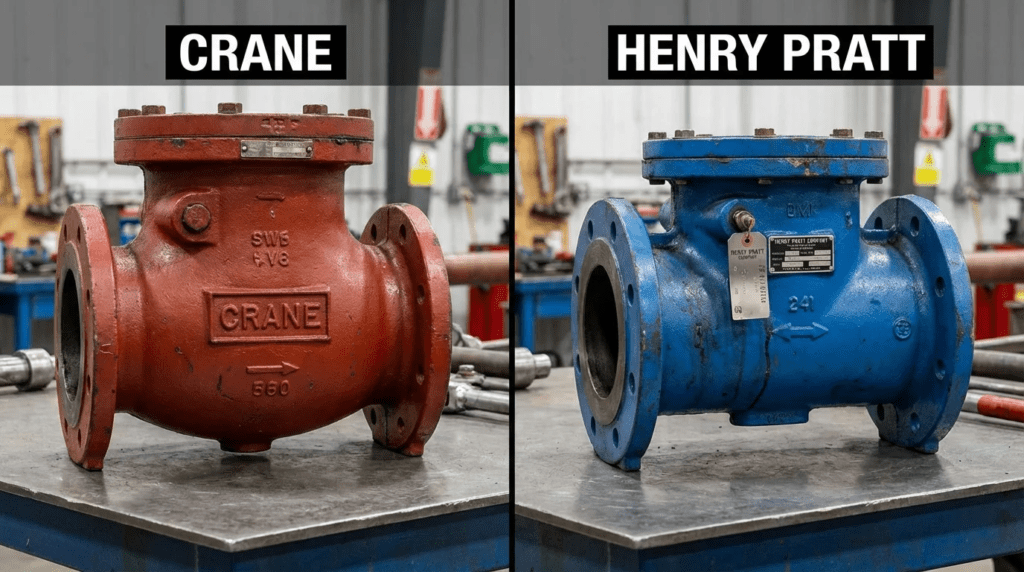
Crane vs Henry Pratt Check Valves: Comparison and Best Fit
Introduction
Check valve selection receives a fraction of the scrutiny applied to pump selection, yet the check valve is the primary defence against water hammer, reverse rotation damage and piping fatigue. A poorly chosen check valve does not merely leak — it can burst a line or shear a pump shaft.
Crane and Henry Pratt, now part of Mueller Water Products, represent different design traditions. Crane’s check valve lines include compact wafer-style dual-plate and nozzle designs oriented toward industrial and higher-pressure service. Pratt’s portfolio is built around AWWA municipal standards and full-bodied swing and specialty designs. The differences are about design philosophy rather than quality.
Manufacturer positioning across the category is covered in our overview of the top OEMs for check valves.
How to Select and Specify
Duty Conditions
- Deceleration of the liquid column: High-head systems see rapid flow reversal on pump trip. Spring-assisted dual-plate valves close faster than unassisted swing checks, reducing slam potential in high-dynamic systems.
- Minimum velocity for full open: Oversizing is the most common failure mode across all check valve types. If normal velocity is insufficient to hold the disc firmly against its stop or spring, the valve chatters, and chatter destroys hinge pins and seats.
- Pressure class: Crane’s industrial range extends well above municipal pressure classes. Pratt’s portfolio is optimised for AWWA service pressures.
Materials
- Bodies: Ductile or cast iron with epoxy coating is standard for AWWA service. Broader alloy availability matters for aggressive industrial wastewater or brine, where standard municipal materials are inadequate.
- Seats: Soft seats give tight shutoff but abrade in grit service. Metal-to-metal seating is more durable but allows slightly higher leakage rates. The choice follows the fluid, not the manufacturer.
- Springs: Where spring-assisted designs are used, specify 316 stainless springs to prevent chloride stress corrosion cracking, even in fresh water service.
Hydraulics
- Head loss: Tilted disc designs are known for low head loss owing to the streamlined disc profile, giving them a high flow coefficient. Wafer dual-plate valves have a central rib that obstructs flow somewhat more, though nozzle check designs offer excellent pressure recovery.
- Non-slam behaviour: Non-slam is not a product feature but a relationship between valve closing speed and system reversal time. Spring-loaded dual plates close before flow reverses, which is inherently non-slam. Swing checks generally need external levers and weights, or air or oil cushions, to achieve comparable behaviour.
Installation
- Laying length: Wafer valves fit between flanges and occupy a fraction of the space of a conventional flanged swing check — decisive in retrofits and crowded dry wells.
- Weight: A wafer check is dramatically lighter than a flanged swing check of the same diameter, which affects structural support and whether overhead lifting equipment is needed for installation and service.
- Orientation: Most dual-plate valves install in horizontal or vertical flow-up positions. Swing checks in vertical lines are generally discouraged unless specifically designed for it, because solids settle onto the seat.
Reliability
- Hinge pin wear: In undamped swing checks, constant flutter wears the pin oval, causing misalignment and leakage. In dual-plate designs, springs are the wear component; a broken spring leaves one plate dragging.
- Solids handling: For raw sewage the unobstructed flow path of a swing or ball check is clearly superior. The central post of a dual-plate valve catches rags and stringy material, which can prevent closure entirely.
Maintainability
- Internal access: Bolted-bonnet swing checks allow disc and seat replacement without removing the valve from the line — a significant operational advantage.
- Replace versus repair: Wafer valves generally must come out of the line for service, and in smaller sizes are usually treated as replacement items.
Comparison
| Focus | Strengths | Design types | Limitations | Maintenance |
|---|---|---|---|---|
| Crane Industrial, compact, higher pressure |
Very compact wafer bodies; spring-assisted fast closure; high pressure ratings; broad alloy availability | Dual-plate wafer, nozzle check, single-plate wafer | Poor solids handling — central post catches rags; higher head loss than tilted disc; requires removal from line for service | Low frequency; typically unit replacement or shop refurbishment. Spring fatigue is the main wear mode |
| Henry Pratt Municipal, AWWA, durability |
Full-bore flow paths; low head loss in tilted disc designs; top-entry maintenance; superior solids handling | Swing check, tilted disc, ball check for wastewater | Large and heavy; higher capital cost for tilted disc; standard swing checks need cushions or weights to avoid slam | Moderate frequency — external hinge servicing. Internals replaceable in line. Hinge pin wear is the main wear mode |
| Application | Appropriate design | Decision factor |
|---|---|---|
| Clean water distribution, high volume | Tilted disc | Energy savings from low head loss outweigh higher capital cost |
| Raw sewage and wastewater | Ball check or swing check with external lever | Clog resistance — avoid dual-plate designs entirely |
| High head, rapid reversal | Nozzle check or spring-assisted dual plate | Closure speed; tilted disc with dashpot also works |
| Retrofit in constrained space | Wafer style | Laying length and weight |
Field Notes
Commissioning
- Listen at shutdown: A properly selected check valve seats quietly. A loud metallic bang means the valve is closing after flow reversal has begun, which amplifies surge pressure rather than preventing it. This is common in uncushioned swing checks that have not been adjusted.
- Low-flow chatter: Run the pump at its minimum operating point and listen at the valve body with a stethoscope. Rhythmic clicking means the disc is unstable — a sizing problem, not a manufacturing defect.
Specification Mistakes
- Defaulting to swing check universally: Copy-pasting an AWWA C508 swing check specification into a high-head lift station is a frequent cause of severe water hammer. High-dynamic systems need a tilted disc or spring-assisted dual plate.
- Ignoring cracking pressure: In gravity or low-head service, spring strength governs. Too strong and head loss is excessive; too weak and closure is too slow.
Operations
- Swing and tilted disc: Maintenance centres on external levers, weights and dashpots. Hinge pin packing glands need inspection for leaks, and oil-cushioned units need oil level checks.
- Wafer designs: Effectively fit-and-forget until failure, with no external glands to leak. The trade-off is that operators cannot visually verify position, so diagnosis depends on downstream pressure and auditory checks.
Troubleshooting
- Severe water hammer: On a swing check, the lever weight may be misplaced or the dashpot cushion clogged or empty. On a dual plate, springs may have fatigued, or the valve is oversized and the plates were never fully open.
- Chatter: Flow velocity is insufficient to hold the disc against its stop. Verify whether the pump is running below the assumed minimum on its VFD. If the hydraulic design is fixed, the valve may need to be smaller or a different style.
Design Details
Sizing
- Determine minimum flow, including the lowest VFD speed the pump will actually run at.
- Calculate velocity at that minimum flow.
- Compare against minimum velocity thresholds. Swing checks generally require the highest velocity to hold fully open; tilted disc designs somewhat less; spring-assisted dual plates can be stable at lower velocities if correctly sprung. Obtain the actual threshold from the manufacturer for the specific model.
- Check head loss at maximum flow using ΔP = SG × (Q / Cv)², confirming the valve does not push the pump back along its curve.
Specification Checklist
- Closure characterisation: Require curves showing reverse velocity against system deceleration
- Seat testing: Specify testing to the applicable standard; industrial standards generally impose tighter leakage allowances than waterworks standards
- Spring material: 316 stainless for dual-plate designs
- Flow direction cast into the body, not painted
Standards
- AWWA C508: Swing-check valves for waterworks service
- AWWA C518: Dual-disc swing-check valves for waterworks service
- NSF/ANSI 61 and 372: Required for potable water contact
Frequently Asked Questions
What is the core difference between these designs?
Dual-plate wafer valves are compact, spring-assisted and fast-closing, suited to higher pressures and constrained spaces in clean water service. Full-bodied swing checks are heavier, often fitted with external levers and weights, built to AWWA specifications, and considerably better at handling solids while allowing in-line maintenance.
Which is right for wastewater?
Swing or ball check designs, without qualification. The unobstructed flow path prevents clogging. Dual-plate valves have a central hinge post that catches stringy material, which can prevent the valve from opening or closing. Reserve dual-plate designs for final effluent and clean water service.
Which offers better water hammer protection?
It depends on system dynamics. Where flow reverses rapidly, spring-assisted dual-plate and nozzle check valves are often superior because they close before reversal occurs, eliminating slam. Tilted disc valves perform well too but may need dashpots. Standard swing checks are the most slam-prone unless fitted with properly tuned cushions.
What lifespan should be expected?
Twenty to thirty years in clean water service with proper maintenance for either design family. The wear components differ: swing checks need periodic hinge pin and disc attention, while dual-plate valves may need spring replacement and are harder to repair in place.
Is chatter a brand problem?
No, it is a sizing problem. Chatter occurs when velocity is insufficient to hold the disc fully open, causing oscillation that destroys hinge pins and seats. Spring-assisted designs tolerate lower velocities than unweighted swing checks if the spring is correctly selected, but no valve will run stably below its minimum velocity.
Conclusion
Key Takeaways
- Fluid decides first: Swing or ball checks for raw wastewater and solids. Wafer, nozzle or tilted disc for clean water and constrained headers.
- Surge control: Spring-assisted closure is inherently better at preventing slam without accessories. Swing checks need cushions or weights to match it.
- Size on velocity, not diameter. Oversizing causes chatter, and chatter destroys valves.
- Access matters: Top-entry designs allow in-line repair. Wafer valves generally require removal.
- Energy: Tilted disc designs offer the lowest head loss and therefore the highest flow coefficient, which is where the lifecycle energy advantage comes from.
The decision is rarely about which manufacturer is better in the abstract, but which design philosophy suits the hydraulic and physical constraints of the installation. Compact wafer and nozzle designs maximise space, handle high pressures, and mitigate surge through fast spring-assisted closure. Full-bodied AWWA designs provide the solids-passing capability and in-line maintainability that municipal operations teams depend on.
The critical design step is calculating system deceleration and comparing it against the valve’s reverse velocity characteristics. Related evaluations appear in our comparisons of actuated and pilot-operated pump control valves and of Henry Pratt and Val-Matic check valves.